Quick Verdict: The Audi e-tron S at a Glance
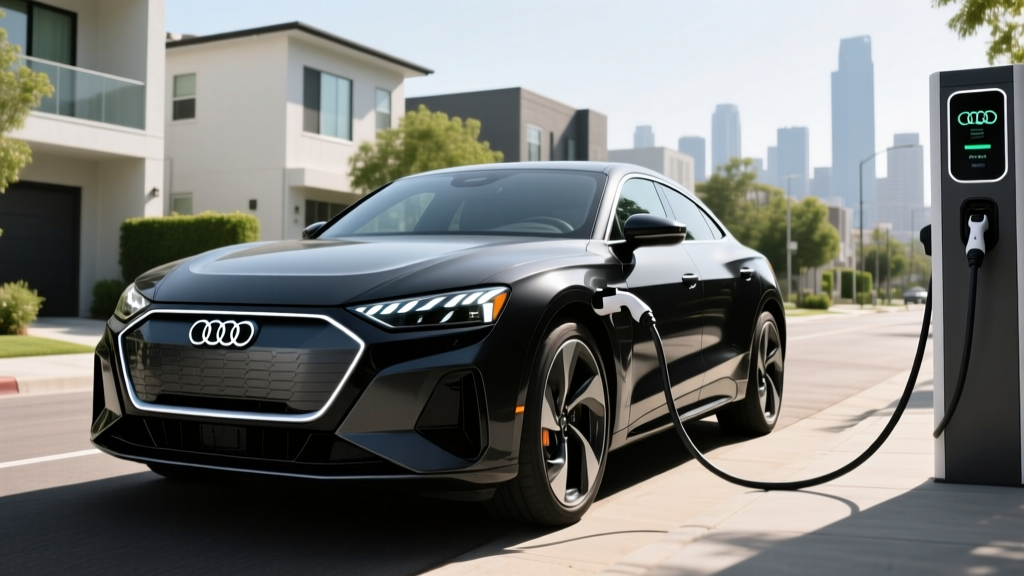
The 2026 Audi e-tron S is a luxury performance SUV that trades maximum range for genuine driving engagement. With 496 horsepower in boost mode, a tri-motor all-wheel-drive layout, and Audi's hallmark build quality, it occupies a narrow but compelling lane: the EV for enthusiasts who need daily practicality. But at a starting MSRP of $96,300 and with an EPA-estimated range around 300 miles, buyers need to understand exactly what they're getting — and what they're giving up — before signing.
This review covers the real numbers that matter: actual highway range, DC fast-charging curves, home charging speed, federal tax credit eligibility under current IRS §30D rules, and how the e-tron S stacks up against the BMW iX M60, Tesla Model X Plaid, and Mercedes EQE SUV.
| Spec | Value |
|---|---|
| EPA Range | ~300 miles (est.) |
| Battery (usable) | 106 kWh (NMC chemistry) |
| Drivetrain | Tri-motor AWD (1 front, 2 rear) |
| Horsepower (boost) | 496 hp / 718 lb-ft torque |
| 0–60 mph | 4.5 seconds |
| Max DC Fast Charge | 170 kW peak |
| 10–80% DC Charge Time | ~31 minutes |
| Level 2 Home Charge Rate | 11.5 kW (~25 mi/hr) |
| MPGe (combined) | ~78 MPGe (est.) |
| Efficiency | ~43 kWh/100 mi |
| Cargo Volume | 57.0 cu ft (rear seats folded) |
| Base MSRP | $96,300 |
| Battery Warranty | 8 years / 100,000 miles |
Range and Efficiency: EPA vs. the Real World
The 2026 Audi e-tron S carries a 106 kWh usable battery pack using NMC (nickel-manganese-cobalt) chemistry, chosen for its high energy density — critical when you're pushing nearly 500 horsepower through three electric motors. The EPA-estimated range lands at approximately 300 miles for the SUV body style.
The EPA cycle blends city and highway driving under moderate conditions. In practice:
- Highway (70–75 mph, 70°F): Expect 245–265 miles. The tri-motor AWD system and 5,600+ lb curb weight demand more energy at sustained speed.
- Cold weather (30°F, highway): Range drops to roughly 200–225 miles. The e-tron S uses a heat pump (standard), which mitigates cabin-heating losses, but battery chemistry still suffers in the cold.
- City / mixed commuting (55°F): 280–300 miles is achievable, especially with regenerative braking doing heavy lifting in stop-and-go traffic.
Bottom line: plan road trips around 220–240 miles between charges to maintain a comfort buffer.
Efficiency comes in around 78 MPGe combined, or roughly 43 kWh per 100 miles. That's thirstier than a Tesla Model X (about 100 MPGe) and slightly behind the BMW iX xDrive50, but competitive with other performance-oriented luxury EVs. The energy cost per mile, at a national average of $0.16/kWh, works out to about $0.069/mile — still dramatically cheaper than premium gasoline in a comparable performance SUV.
For official EPA figures as they're finalized, check fueleconomy.gov.
Charging Speed: DC Fast Charging and Home Level 2
Charging speed is where the e-tron S's NMC battery and 800V-capable architecture show their engineering. Audi rates the peak DC fast-charge rate at 170 kW, which is competitive but not class-leading (the Porsche Taycan and Hyundai Ioniq 5 can hit 350 kW on capable chargers).
| Charging Level | Power (kW) | Speed / Time |
|---|---|---|
| Level 1 (120V household) | ~1.4 kW | ~3 miles per hour |
| Level 2 (240V, 48A) | 11.5 kW | ~25 miles per hour; full charge in ~9.5 hours |
| DC Fast Charge (peak) | 170 kW | 10–80% in ~31 minutes |
| DC Fast Charge (sustained avg) | ~120 kW avg | 10–80% realistic session |
Understanding the charge curve: The 170 kW peak is not sustained across the entire session. The e-tron S holds strong charging speeds from 10% to about 50% state of charge (SoC), then progressively tapers. From 80% to 100%, the rate drops sharply — this is standard for NMC chemistry to protect long-term battery health. On a road trip, plan to charge from 10–80% and drive on; the last 20% takes disproportionately long.
At home on a Level 2 charger (which you'll want installed — a 106 kWh battery on Level 1 is impractical for daily use), the 11.5 kW onboard charger replenishes about 25 miles of range per hour. A full overnight charge from 20% to 100% takes roughly 7–8 hours, which is fine for commuters who plug in when they get home.
The e-tron S uses the NACS (North American Charging Standard) connector for the 2026 model year, granting native access to Tesla Supercharger stations via the North American network — a significant advantage over CCS-only vehicles now that Tesla's network dominates DC fast-charging infrastructure.
Performance and Driving Dynamics
This is where the "S" badge earns its keep. The tri-motor layout — one motor on the front axle, two on the rear — enables precise torque vectoring across the rear wheels. In boost mode (activated via the drive select system, available for short bursts), the e-tron S produces 496 hp and 718 lb-ft of torque, rocketing to 60 mph in 4.5 seconds.
In normal driving mode, output settles to around 429 hp, which is still plenty quick for merging and passing. The dual rear motors allow the car to actively shift torque between the left and right rear wheels, creating a subtle but genuine rear-biased feel through corners that most AWD EVs can't match.
The adaptive air suspension is standard, offering adjustable ride height and damping. In Dynamic mode, the e-tron S hunkers down and firms up for canyon roads; in Comfort or Off-Road, it raises for speed bumps and rough surfaces. Ride quality in Comfort mode is genuinely plush — this is a luxury car first, performance car second.
Regenerative braking is adjustable through paddles behind the steering wheel, offering three levels of regen intensity. It doesn't quite achieve true one-pedal driving (the car creeps at very low speeds rather than coming to a complete stop), but in the highest regen setting, you'll rarely need the friction brakes in normal traffic.
Interior, Technology, and Cargo
The e-tron S cabin is a showcase of Audi's dual-touchscreen MMI system: a 12.3-inch upper display handles navigation and media, while a 10.1-inch lower screen manages climate and handwriting input. The Virtual Cockpit Plus digital gauge cluster is standard, and a head-up display with augmented-reality navigation overlays is available on the Prestige trim.
Driver assistance comes via Audi's Adaptive Cruise Assist with lane guidance — this is an SAE Level 2 system, meaning you must keep your hands on the wheel and eyes on the road at all times. It is not self-driving. The system handles highway traffic competently but requires active driver supervision.
Audi Adaptive Cruise Assist is a Level 2 driver-assistance system per SAE classification. The driver remains fully responsible for vehicle control. Hands-off-wheel detection will issue warnings and eventually disengage the system if you fail to respond.
Cargo and passenger space:
- Cargo behind second row: 28.5 cu ft
- Cargo with rear seats folded: 57.0 cu ft
- Front legroom: 41.3 inches
- Rear legroom: 37.3 inches
- No front trunk (frunk) — the space is occupied by electronics and the front motor
The lack of a frunk is a notable omission at this price point. Competitors like the Tesla Model X and Rivian R1S offer meaningful front storage. The 57 cu ft maximum cargo volume is adequate for a family of four's luggage but trails the BMW iX (72 cu ft max) and Model X (88 cu ft max).
Pricing, Trims, and Federal Tax Credit Eligibility
The 2026 Audi e-tron S is offered in two trims:
- Premium Plus: $96,300 MSRP — includes air suspension, 21-inch wheels, matrix LED headlights, leather upholstery, Adaptive Cruise Assist
- Prestige: $103,300 MSRP — adds head-up display, Bang & Olusen premium audio, rear-seat entertainment prep, Night Vision Assist
Destination charges add approximately $1,195. A well-equipped Prestige with options (carbon-fiber trim, S sport package) can push past $112,000.
| Item | Premium Plus | Prestige |
|---|---|---|
| Base MSRP | $96,300 | $103,300 |
| Destination | $1,195 | $1,195 |
| Est. As-Tested | $99,500 | $110,000+ |
| Federal Tax Credit (§30D) | See eligibility below | See eligibility below |
Does the Audi e-tron S Qualify for the Federal EV Tax Credit?
This is where things get complicated, and buyers must do their homework. Under current IRS §30D rules, several requirements must all be met simultaneously:
- MSRP cap: SUVs must have an MSRP at or below $80,000. The e-tron S starts at $96,300 — it exceeds the cap and does not qualify for the new-vehicle §30D credit.
- Buyer income cap: Even if the MSRP qualified, AGI limits apply ($300K joint, $225K head of household, $150K individual).
- Battery sourcing: Critical minerals and battery component sourcing requirements must be met, with percentages increasing annually through 2029.
- Point-of-sale transfer: Eligible credits can be transferred to the dealer at purchase for an immediate price reduction, but only if all other criteria are satisfied.
Bottom line: The 2026 Audi e-tron S does not qualify for the $7,500 federal new-vehicle tax credit because its MSRP exceeds the $80,000 SUV cap. There is no workaround for this at the point of sale. Consult a tax professional for your specific situation, and check current IRS guidance as rules evolve.
Pros, Cons, and Who Should Buy
- Tri-motor torque vectoring delivers genuine performance-SUV dynamics
- Quiet, refined cabin with excellent ride quality in Comfort mode
- 170 kW DC charging with a well-managed charge curve
- NACS connector provides native Tesla Supercharger access
- Heat pump standard for better cold-weather efficiency
- 8-year/100,000-mile battery warranty
- Does not qualify for §30D federal tax credit (MSRP over $80K cap)
- No front trunk (frunk) — unusual at this price
- Cargo volume (57 cu ft max) trails key competitors
- Real-world highway range of ~245 miles requires planning on long trips
- Heavy at 5,600+ lbs — felt during braking and low-speed maneuvers
- Dual-touchscreen interface can be distracting vs. physical controls
Who Is the Audi e-tron S For?
Buy it if: You want a luxury performance SUV with genuine handling chops, you commute under 200 miles round-trip with reliable home charging, you value cabin quietness and build quality over maximum range, and the lack of a federal tax credit doesn't change your math.
Look elsewhere if: You need 350+ miles of real-world range for frequent road trips (consider the Tesla Model S or Lucid Air), you want maximum cargo space for a large family (BMW iX, Rivian R1S), or you need the $7,500 tax credit to make the purchase pencil out (look at the Audi Q8 e-tron non-S or Genesis Electrified GV70).
Competitor Comparison: e-tron S vs. the Field
| Spec | Audi e-tron S | BMW iX M60 | Tesla Model X Plaid | Mercedes EQE 580 SUV |
|---|---|---|---|---|
| EPA Range | ~300 mi | ~296 mi | ~333 mi | ~279 mi |
| Horsepower | 496 hp | 610 hp | 1,020 hp | 536 hp |
| 0–60 mph | 4.5s | 3.6s | 2.5s | 3.8s |
| Max DC Charge | 170 kW | 195 kW | 250 kW | 170 kW |
| Base MSRP | $96,300 | $111,500 | $98,490 | $98,050 |
| Cargo (max) | 57 cu ft | 72 cu ft | 88 cu ft | 55 cu ft |
| Tax Credit | No (MSRP cap) | No (MSRP cap) | No (MSRP cap) | No (MSRP cap) |
None of these luxury performance SUVs qualify for the federal credit — the $80K MSRP cap eliminates the entire segment. The e-tron S sits in the middle: slower than the Model X Plaid and iX M60 in a straight line, but offering a more balanced ride-handling compromise and a quieter cabin. If straight-line speed is paramount, the Tesla wins. If cargo space matters most, the Model X or iX are clearly superior. If you want the best blend of daily comfort with occasional back-road fun, the e-tron S has a legitimate case.
Battery Warranty and Long-Term Ownership
Audi provides an 8-year / 100,000-mile high-voltage battery warranty, covering defects and capacity loss below 70% of original capacity. This is industry-standard and matches BMW, Mercedes, and Tesla's coverage terms.
The NMC chemistry in the e-tron S is proven but does degrade slightly faster than LFP (lithium iron phosphate) over many charge cycles. Real-world data from earlier Audi e-tron models (2019–2023) suggests approximately 8–10% capacity loss over 100,000 miles with normal use — meaning you'd still have roughly 270 miles of range at that mileage, which is well within the 70% warranty threshold.
To maximize battery longevity: avoid routinely charging to 100% on Level 2 (set a daily limit of 80–90%), minimize repeated DC fast-charging sessions, and use preconditioning before fast charging (the e-tron S does this automatically when a charger is set as your navigation destination).
Audi's new-vehicle limited warranty covers 4 years / 50,000 miles, which is competitive. Scheduled maintenance is minimal — EVs don't need oil changes, spark plugs, or transmission fluid — but budget for cabin air filters, brake fluid checks, wiper blades, and tire rotation.
Frequently Asked Questions
What is the real-world range of the 2026 Audi e-tron S?
On the highway at 70–75 mph in moderate temperatures, expect 245–265 miles. In cold weather (below freezing), highway range drops to approximately 200–225 miles. City and mixed driving in mild weather can approach the EPA estimate of 300 miles.
How fast does the Audi e-tron S charge at home and on the road?
On DC fast charging, it peaks at 170 kW and charges from 10–80% in approximately 31 minutes. At home on a Level 2 (240V) charger, the 11.5 kW onboard charger adds about 25 miles per hour, fully replenishing the battery overnight in roughly 8–9 hours from near-empty.
Does the Audi e-tron S qualify for the $7,500 federal EV tax credit?
No. Under current IRS §30D rules, SUVs must have an MSRP at or below $80,000 to qualify. The e-tron S starts at $96,300, exceeding the cap. No luxury performance SUV in this price range currently qualifies for the new-vehicle credit.
Is the Audi e-tron S worth buying over a Tesla Model X or BMW iX?
It depends on your priorities. The e-tron S offers the quietest cabin and best ride comfort in the segment, with genuine handling capability from its tri-motor system. The Model X wins on range, charging speed, and cargo space. The BMW iX offers more power and cargo room but at a higher starting price. Test-drive all three — the e-tron S's appeal is tactile and hard to capture in spec sheets.
What connector does the 2026 Audi e-tron S use?
The 2026 model year uses the NACS (North American Charging Standard) connector, providing native access to Tesla Superchargers and the growing NACS public charging network without an adapter.
How much does insurance cost for the Audi e-tron S?
Insurance premiums for luxury performance EVs are higher than average. Expect $2,800–$3,800 annually depending on your location, driving record, and coverage level. Get quotes before purchasing — some insurers offer EV-specific discounts.