The Audi e-tron — now rebranded as the Q8 e-tron for the 2024 model year onward — occupies a specific niche in the luxury EV space: a refined, quiet, build-quality-forward electric SUV that prioritizes comfort and long-term ownership satisfaction over headline-grabbing range or acceleration numbers. For buyers researching Audi e-tron reliability, the story is largely positive, but it comes with nuances that only emerge once you look past the badge and into the data.
This review covers the current 2026 Audi Q8 e-tron lineup (the direct successor to the original e-tron), including real-world range expectations, charging performance, battery longevity indicators, ownership costs, and how it stacks up against competitors like the BMW iX, Mercedes EQE SUV, and Tesla Model X.
2026 Audi Q8 e-tron at a Glance: Key Specs
| Specification | Q8 e-tron Premium Plus | Q8 e-tron Prestige | SQ8 e-tron |
|---|---|---|---|
| EPA Range | 285 miles | 285 miles | 250 miles |
| Battery (usable) | 106 kWh (NMC) | 106 kWh (NMC) | 106 kWh (NMC) |
| Drivetrain | Dual-motor AWD | Dual-motor AWD | Dual-motor AWD (performance tune) |
| Horsepower | 402 hp (boost mode) | 402 hp (boost mode) | 496 hp (boost mode) |
| 0–60 mph | 5.5 seconds | 5.5 seconds | 4.5 seconds |
| Max DC Fast Charge | 170 kW | 170 kW | 170 kW |
| 10–80% DC Charge Time | ~31 minutes | ~31 minutes | ~31 minutes |
| Level 2 Home Charge Rate | 19.2 kW (AC) | 19.2 kW (AC) | 19.2 kW (AC) |
| Efficiency (combined) | 80 MPGe / 42 kWh/100mi | 80 MPGe / 42 kWh/100mi | 72 MPGe / 47 kWh/100mi |
| Cargo (rear seats up) | 28.5 cu ft | 28.5 cu ft | 28.5 cu ft |
| Cargo (rear seats folded) | 57.0 cu ft | 57.0 cu ft | 57.0 cu ft |
| Base MSRP | $75,695 | $81,895 | $90,595 |
Source: fueleconomy.gov and Audi USA official specifications for the 2026 model year.
Real-World Range: What the EPA Number Doesn't Tell You
Real-World Expectation: 240–265 miles highway driving in mild weather; 200–230 miles in cold conditions (below 32°F) with cabin heat active.
The Q8 e-tron's 285-mile EPA rating is respectable for a luxury SUV in this weight class (curb weight exceeds 5,700 lbs), but it trails competitors like the BMW iX xDrive50 (324 miles EPA) and the Rivian R1S Dual-Motor Max (352 miles EPA). The real-world picture requires context:
- Highway driving at 70–80 mph typically yields 240–265 miles before needing a charge stop. The Q8 e-tron's aerodynamics are optimized, but its mass works against it at sustained speed.
- City and mixed commuting often returns 270–290 miles thanks to regenerative braking recapturing energy in stop-and-go traffic.
- Cold weather (below freezing) reduces usable range by 15–25%. Expect 200–230 miles in January conditions, especially if using resistive cabin heating. The Q8 e-tron does include a heat pump in most trims, which mitigates some of this loss compared to older e-tron models that lacked one.
- Towing (rated at 4,000 lbs) can cut range nearly in half under load — plan for 130–160 miles between charges when pulling a trailer.
For daily commuters covering under 80 miles round-trip, the range is more than adequate with nightly home charging. Road-trippers should plan charging stops every 200–220 miles to keep state of charge (SoC) in the fast-charging sweet spot (10–80%).
Charging Performance: DC Fast and Home Level 2
| Charging Level | Power / Rate | Miles Added per Hour | Notes |
|---|---|---|---|
| Level 1 (120V household) | ~1.4 kW | ~3–4 mi/hr | Emergency/trickle only |
| Level 2 (240V home, 48A) | 11.5 kW | ~28 mi/hr | Full charge in ~10 hours |
| Level 2 (240V, 80A hardwired) | 19.2 kW | ~46 mi/hr | Requires 100A circuit; full charge ~6 hrs |
| DC Fast Charge (peak) | 170 kW | ~220 mi/hr (at peak) | 10–80% in ~31 min |
| DC Fast Charge (sustained avg) | ~120 kW | ~150 mi/hr avg | Curve tapers significantly above 70% SoC |
The Q8 e-tron's 170 kW peak DC fast-charging rate is a carryover from the previous generation. It's adequate but no longer class-leading — the Hyundai Ioniq 5 peaks at 240 kW, and the Tesla Model X at 250 kW. Here's what matters in practice:
The charge curve is the real story. The Q8 e-tron holds strong charging power (150+ kW) from roughly 10% to 55% SoC, then begins tapering. From 70% to 80%, power drops to around 70–90 kW. This is why the 10–80% time of ~31 minutes, while competitive, doesn't reflect how quickly you'll add range on a quick stop. In practice, a 15-minute stop at a 350 kW Electrify America station can add roughly 120–140 miles — enough for most highway stretches between chargers.
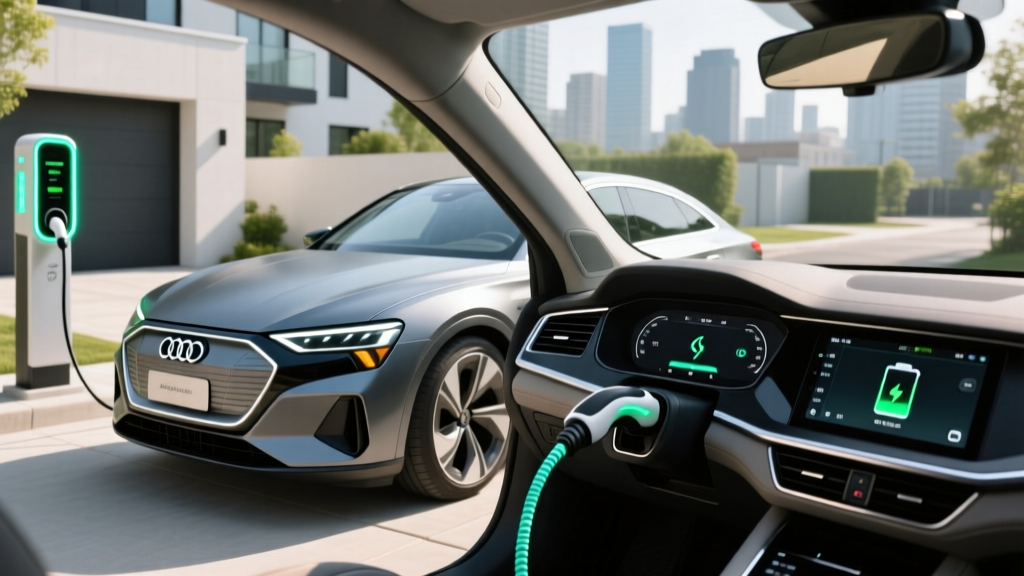
Home charging is a strong suit. The Q8 e-tron's onboard charger supports up to 19.2 kW on Level 2 AC, which is among the fastest in the segment. With an 80-amp hardwired Level 2 station (requiring a 100-amp dedicated circuit — consult a licensed electrician for panel capacity), you can fully recharge overnight in about 6 hours. Most owners on a standard 48-amp / 11.5 kW setup will see a full charge in roughly 10 hours, which works fine for overnight replenishment.
Connector note: The 2026 Q8 e-tron uses the CCS1 connector for DC fast charging. Audi has confirmed NACS (Tesla-style) adoption for future models, but the 2026 Q8 e-tron still ships with CCS1. Adapters for Tesla Supercharger access are available but add a step to the charging process.
Battery Chemistry, Degradation, and Long-Term Reliability
The Q8 e-tron uses a 114 kWh gross / 106 kWh usable NMC (nickel manganese cobalt) lithium-ion battery pack. Audi deliberately locks out approximately 8 kWh as a buffer (split between top and bottom of the charge range) to protect long-term battery health. This conservative buffer strategy is one of the key reasons Audi e-tron reliability data has trended positively.
Battery degradation data: Based on aggregated owner reports and fleet data from the original e-tron (2019–2023), NMC packs in the Audi platform typically show 5–8% capacity loss over 100,000 miles, which is better than the industry average of 8–12% for similar chemistry. The large buffer and sophisticated thermal management system (liquid cooling with active preconditioning) are the primary contributors to this longevity.
Warranty coverage:
- Battery: 8 years / 100,000 miles (whichever comes first), guaranteeing minimum 70% capacity retention
- Powertrain: 8 years / 100,000 miles
- Bumper-to-bumper: 4 years / 50,000 miles
- Complimentary scheduled maintenance: 1 year / 10,000 miles
The 70% retention threshold is standard for the industry. In practice, few Audi e-tron/Q8 e-tron owners have reported warranty claims for battery replacement — a positive signal, though the platform is still relatively young (the original e-tron launched in the U.S. for the 2019 model year, meaning the oldest examples are now approaching 7 years on the road).
Known reliability concerns to watch:
- Charging port door actuator: Some owners of 2019–2022 e-trons reported failures of the motorized charge port door. Audi addressed this with revised hardware in later model years, but it's worth checking on CPO or used examples.
- 12V auxiliary battery: Like many EVs, the Q8 e-tron has been known to throw 12V battery warnings. The 12V system powers electronics, door locks, and the computers that manage the high-voltage pack. If the 12V dies, the car won't start even with a full traction battery. Audi has issued software updates to improve 12V charging logic.
- Suspension (adaptive air): The optional adaptive air suspension delivers a superb ride but adds complexity. Air strut replacement outside of warranty can cost $1,500–$2,500 per corner. Consider extended warranty coverage if planning to keep the vehicle past 60,000 miles.
- Software/infotainment glitches: Audi's MMI touch response system is feature-rich but has drawn complaints about occasional screen freezes and slow boot times. Most issues have been addressed through OTA updates, but the dual-screen layout can be distracting to operate while driving.
Pricing, Tax Credits, and Total Cost
| Trim | Base MSRP | Federal §30D Credit Eligibility | Effective Starting Price |
|---|---|---|---|
| Q8 e-tron Premium Plus | $75,695 | Not eligible (MSRP exceeds $80,000 SUV cap when destination + options applied; battery sourcing may not meet critical minerals threshold) | $75,695 |
| Q8 e-tron Prestige | $81,895 | Not eligible (MSRP exceeds $80,000 SUV cap) | $81,895 |
| SQ8 e-tron Premium Plus | $90,595 | Not eligible (MSRP exceeds $80,000 SUV cap) | $90,595 |
Federal tax credit reality check: Under current IRS §30D rules, new clean vehicles must meet several criteria to qualify for up to $7,500 in federal tax credits: MSRP must not exceed $80,000 for SUVs, the buyer must fall under income caps ($300,000 joint / $150,000 single for new vehicles), and the battery must meet critical mineral and component sourcing thresholds that tighten annually.
The 2026 Q8 e-tron's base MSRP of $75,695 technically falls under the $80,000 SUV cap, but once destination charges ($1,195) and even minimal options are added, most configurations push above the threshold. Additionally, Audi's battery supply chain has historically not met the escalating critical minerals and foreign-entity-of-concern (FEOC) sourcing requirements for the full $7,500 credit. Most buyers should not count on federal tax credit eligibility for the Q8 e-tron. Consult a tax professional and verify current eligibility on fueleconomy.gov before purchasing.
Lease workaround: Vehicles leased (not purchased) may qualify for the commercial clean vehicle credit (§45W), which the leasing company can pass through as a capitalized cost reduction. Many Audi dealers advertise $7,500 in "lease cash" on the Q8 e-tron — this is the mechanism behind it. If you're open to leasing, this can meaningfully reduce monthly payments.
Used Q8 e-tron value: The used EV tax credit (§25E) offers up to $4,000 (or 30% of the sale price, whichever is less) on pre-owned EVs priced under $25,000. Given that 2019–2022 e-tron models have depreciated significantly — some now trading in the $22,000–$28,000 range — the used credit may apply. Income caps are lower for this credit ($150,000 joint / $75,000 single).
Driving Experience, Tech, and Interior
The Q8 e-tron's driving character is best described as effortlessly calm. The dual-motor AWD system provides confident traction, and the 402 hp (in boost mode) delivers brisk acceleration without the neck-snapping urgency of a Tesla or Porsche. The 5.5-second 0–60 time is quick by any measure, but the power delivery is linear and refined rather than aggressive.
Ride quality is where the Q8 e-tron separates itself from most competitors. With the standard steel suspension, the ride is composed and well-damped. The available adaptive air suspension (standard on Prestige, optional on Premium Plus) elevates it further — the ability to raise the ride height for rough roads or lower it for highway efficiency is genuinely useful, and the damping is among the best in the luxury EV segment.
Interior and technology:
- Dual-screen MMI touch response: 10.1-inch upper display (navigation, media) and 8.6-inch lower display (climate, shortcuts). Haptic feedback helps, but the dual-screen layout requires more attention than physical knobs.
- Virtual Cockpit Plus: 12.3-inch configurable driver display with navigation, range, and media integration. One of the best digital instrument clusters in the industry.
- Head-up display: Available on Prestige, projects speed and navigation onto the windshield with augmented-reality arrows.
- Driver assistance (Adaptive Cruise Assist with Lane Guidance): This is a SAE Level 2 system — it combines adaptive cruise control and lane centering for highway driving but requires the driver to remain engaged with hands on the wheel. It is not autonomous driving. The system is competent but not class-leading; BMW's Highway Assistant and GM's Super Cruise offer more polished hands-free experiences in their respective models.
- Parking system plus: Surround-view cameras and semi-autonomous parking assist are well-executed and useful given the Q8 e-tron's 193-inch length.
Passenger and cargo space:
- Front headroom: 38.1 in | Front legroom: 41.5 in
- Rear headroom: 37.6 in | Rear legroom: 37.3 in
- Cargo behind rear seats: 28.5 cu ft
- Cargo with rear seats folded: 57.0 cu ft
- Front trunk (frunk): 2.1 cu ft (small — fits a charging cable bag, not much else)
The rear seat is comfortable for two adults on longer trips, with decent legroom and available heated/ventilated outboard seats. The center tunnel intrusion is modest. Cargo capacity trails the BMW iX (35.5 cu ft behind rear seats) and the Tesla Model X significantly, which matters if you regularly haul gear.
Pros and Cons: The Honest Assessment
Pros
- Exceptional ride quality and cabin quietness — among the most refined EVs on the road
- Strong build quality and materials consistent with Audi's premium positioning
- Conservative battery buffer strategy supports long-term battery health and reliability
- 19.2 kW Level 2 AC charging is best-in-class for overnight home replenishment
- Air suspension with adjustable ride height is genuinely practical
- Strong depreciation on used models creates compelling CPO and pre-owned value
Cons
- 285-mile EPA range trails key competitors (BMW iX, Rivian R1S, Tesla Model X)
- 170 kW peak DC charging is adequate but no longer competitive with 250+ kW rivals
- Most trims ineligible for the $7,500 federal purchase tax credit
- Cargo space is modest for the vehicle's exterior footprint
- Small frunk limits practical cable storage
- MMI dual-screen interface can be distracting while driving
- CCS1 connector (no native NACS) requires adapter for Tesla Supercharger access
Who Should Buy the Q8 e-tron — and Who Shouldn't
The Q8 e-tron is best for:
- Luxury commuters who prioritize ride comfort, cabin silence, and build quality over maximum range. If your daily drive is under 80 miles and you charge at home nightly, the 285-mile range is a non-issue.
- Brand-loyal Audi owners transitioning from a Q5 or Q7 who want an EV that feels familiar in its design language, dealership experience, and interior ergonomics.
- Used-EV bargain hunters — the original e-tron's steep depreciation means 2020–2022 models are now available in the $25,000–$35,000 range, offering luxury EV ownership at a mainstream price. The used EV tax credit (§25E) may further reduce cost.
- Buyers who value long-term reliability signals over cutting-edge specs. The conservative battery management and proven powertrain architecture suggest strong longevity.
Look elsewhere if:
- Range is your top priority — the BMW iX xDrive50 (324 mi) or Rivian R1S Max Pack (352 mi) go significantly farther per charge.
- You road-trip frequently and want the fastest possible charging stops — the Tesla Model X and Hyundai Ioniq 5 charge substantially faster.
- You need maximum cargo space — the Tesla Model X and Rivian R1S offer considerably more room.
- Federal tax credit eligibility is essential to your purchase math — consider the Tesla Model Y, Ford Mustang Mach-E, or Hyundai Ioniq 5, which more consistently qualify.
Audi e-tron Reliability FAQ
What is the real-world range of the Audi Q8 e-tron?
The EPA rates the Q8 e-tron at 285 miles. In real-world highway driving at 70–80 mph, expect 240–265 miles. In cold weather below freezing, plan for 200–230 miles. City commuting with regenerative braking can return 270–290 miles.
How fast does the Q8 e-tron charge at home and on the road?
On DC fast charging, the Q8 e-tron peaks at 170 kW and charges from 10–80% in approximately 31 minutes. At home on a 48-amp Level 2 charger (11.5 kW), a full charge takes about 10 hours. On an 80-amp circuit (19.2 kW), a full charge takes roughly 6 hours.
Does the 2026 Audi Q8 e-tron qualify for the federal EV tax credit?
Most configurations do not qualify for the $7,500 federal purchase credit (§30D). The base MSRP of $75,695 is technically under the $80,000 SUV cap, but destination charges and options typically push it over. Additionally, the battery's critical mineral sourcing may not meet current thresholds. Lease buyers may benefit from the commercial credit (§45W) passed through as lease cash. Always verify on fueleconomy.gov and consult a tax professional.
Is the Audi e-tron reliable long-term?
Available data is encouraging. The large battery buffer (~8 kWh locked out), sophisticated thermal management, and NMC chemistry have resulted in 5–8% degradation over 100,000 miles in fleet data — better than average. Known issues include charge port door actuators (earlier models), 12V battery warnings, and adaptive air suspension cost outside warranty. The 8-year/100,000-mile battery warranty provides a strong backstop.
How does the Q8 e-tron compare to the BMW iX and Tesla Model X?
The Q8 e-tron wins on ride refinement and cabin quietness. The BMW iX offers more range (324 mi), more cargo space, and a more modern interior design. The Tesla Model X offers the longest range, fastest charging, and access to the Supercharger network natively (NACS), but its build quality and ride comfort don't match the Audi. Pricing is comparable across all three in the $75,000–$95,000 range.
What battery chemistry does the Q8 e-tron use?
The Q8 e-tron uses an NMC (nickel manganese cobalt) lithium-ion battery with 106 kWh of usable capacity from a 114 kWh gross pack. NMC offers higher energy density than LFP (lithium iron phosphate), which helps keep pack weight and size manageable. The trade-off is that NMC is generally more sensitive to sustained high-SoC storage, so Audi recommends charging to 80% for daily use and 100% only before long trips.