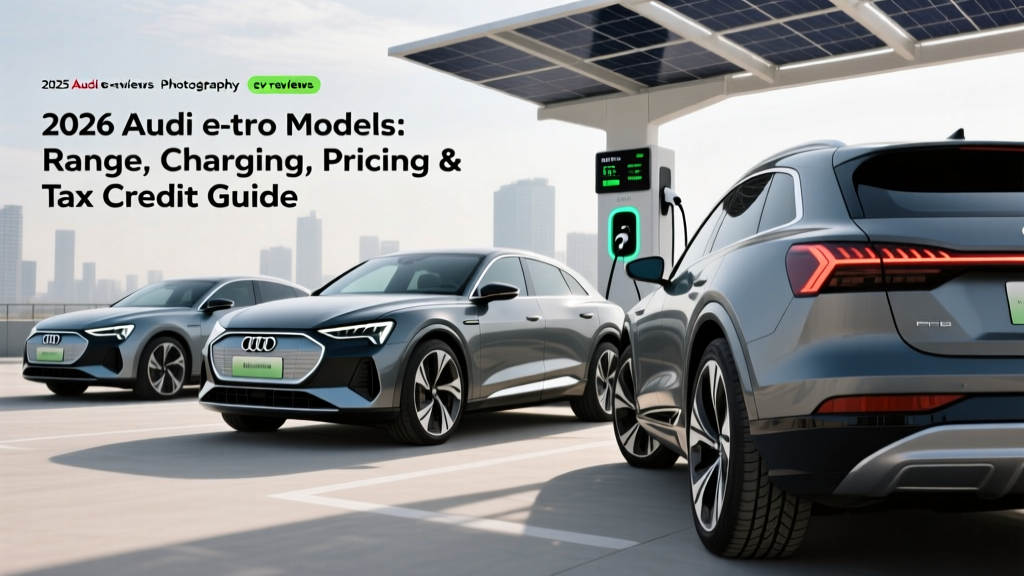
Audi's electric lineup has matured considerably since the original e-tron SUV debuted. For 2026, the brand fields three distinct battery-electric families under the e-tron umbrella: the flagship Q8 e-tron luxury SUV, the tech-forward Q6 e-tron midsize crossover built on the PPE platform, and the performance-oriented e-tron GT sedan. Each targets a different buyer, and their specs — from battery chemistry to charging architecture — diverge in ways that matter for real-world ownership.
This guide breaks down every current Audi e-tron model with the exact numbers buyers need: EPA range versus what you'll actually see on the highway, DC fast-charging curves (not just peak kW), home charging rates, and the often-confusing federal tax credit picture under IRS §30D rules.
2026 Audi e-tron Model Lineup at a Glance
| Specification | Q8 e-tron (SUV) | Q6 e-tron (Crossover) | e-tron GT (Sedan) |
|---|---|---|---|
| EPA Range | 285 mi (Premium Plus) | 321 mi (Premium) | 270 mi (Premium Plus) |
| Battery (Usable) | 106 kWh, NMC | 94.4 kWh, NMC | 83.7 kWh, NMC |
| Max DC Fast Charge | 170 kW | 270 kW | 320 kW (GT); 270 kW (RS) |
| 10–80% DCFC Time | ~31 min | ~21 min | ~18 min (GT) |
| Level 2 Home Rate | 19.2 kW (AC) | 11.5 kW (AC) | 19.2 kW (AC) |
| 0–60 mph | 5.5 sec (quattro) | 4.9 sec (quattro) | 3.9 sec (GT quattro) |
| Horsepower | 402 hp | 456 hp (Launch Edition) | 590 hp (GT); 646 hp (RS) |
| Drivetrain | Dual-motor AWD | Dual-motor AWD | Dual-motor AWD |
| MPGe (Combined) | 81 MPGe | 94 MPGe | 85 MPGe |
| Base MSRP | $75,695 | $65,095 | $108,695 |
| Battery Warranty | 8 yr / 100,000 mi | 8 yr / 100,000 mi | 8 yr / 100,000 mi |
All three models use nickel-manganese-cobalt (NMC) lithium-ion battery packs. Audi has not adopted LFP chemistry in any current e-tron, opting instead for NMC's higher energy density to maximize range in premium packaging. The trade-off: NMC cells are more sensitive to sustained 100% state-of-charge storage and extreme heat, so daily charging to 80% is recommended for longevity.
Real-World Range: What the EPA Sticker Doesn't Tell You
EPA vs. Reality — Audi e-tron Models
- Q8 e-tron: EPA 285 mi. Expect ~245–260 mi in mixed highway driving; ~210–230 mi in sustained cold weather (below 30°F) with cabin heating.
- Q6 e-tron: EPA 321 mi. Expect ~275–295 mi highway; ~240–260 mi in cold conditions. The PPE platform's heat pump (standard) helps mitigate winter losses.
- e-tron GT: EPA 270 mi. Expect ~235–250 mi highway at 75+ mph; the low-slung sedan aero helps, but performance tires and aggressive throttle cut range faster than the EPA cycle suggests.
The Q6 e-tron's advantage comes from the PPE (Premium Platform Electric) architecture, which uses an 800-volt electrical system and more efficient silicon-carbide inverters. That efficiency shows up in its 94 MPGe combined rating versus the Q8 e-tron's 81 MPGe, despite similar weight.
For highway-heavy commuters, plan on roughly 85–90% of EPA range in moderate temperatures and 70–80% in deep winter. The Q8 e-tron's large 106 kWh usable pack partially offsets its lower efficiency — you're trading watts-per-mile for a bigger fuel tank, so to speak.
Charging Speed: DC Fast, Home Level 2, and the 800V Advantage
Charging architecture is where the Q6 e-tron and e-tron GT separate from the Q8 e-tron. The newer PPE-based models run 800-volt systems, enabling dramatically faster DC fast charging. The Q8 e-tron, still on the older MLB Evo-derived platform, is limited to 400V and 170 kW peak.
| Charging Level | Q8 e-tron | Q6 e-tron | e-tron GT |
|---|---|---|---|
| Level 1 (120V, 1.4 kW) | ~4 mi/hr | ~3.5 mi/hr | ~3 mi/hr |
| Level 2 (240V, home) | ~50 mi/hr (19.2 kW) | ~30 mi/hr (11.5 kW) | ~50 mi/hr (19.2 kW) |
| DC Fast (peak kW) | 170 kW | 270 kW | 320 kW (GT) |
| DCFC 10–80% time | ~31 min | ~21 min | ~18 min (GT) |
| Sustained rate (20–60%) | ~145 kW avg | ~230 kW avg | ~275 kW avg |
Charging curve reality: Peak kW numbers only tell part of the story. The e-tron GT's 320 kW peak is available roughly between 10–45% state of charge, after which the curve tapers progressively. By 80%, you're looking at roughly 100–120 kW. Still, the 10–80% sprint in approximately 18 minutes is among the fastest in the luxury EV segment.
The Q6 e-tron's 270 kW capability means a typical road-trip stop adds 150+ miles in about 15 minutes at a 350 kW Electrify America or Tesla Supercharger (with NACS adapter). The Q8 e-tron's 170 kW cap means longer stops — plan for 30+ minutes to go from 10–80%.
For home charging, the Q8 e-tron and e-tron GT accept up to 19.2 kW on a hardwired Level 2 charger (requires an 80-amp circuit). The Q6 e-tron is limited to 11.5 kW (48-amp circuit), which still delivers a full overnight charge but means you'll want to plug in every night rather than topping off opportunistically. Most home installations run $800–$2,500 for a Level 2 charger, depending on panel proximity and whether a 200-amp service upgrade is needed.
Pricing, Trims, and Federal Tax Credit Eligibility
| Model / Trim | MSRP | §30D Credit Eligible? | Effective Price (est.) |
|---|---|---|---|
| Q8 e-tron Premium Plus | $75,695 | Yes (SUV, under $80K cap) | ~$68,195* |
| Q8 e-tron Prestige | $82,495 | Yes (SUV, under $80K cap — base trim only qualifies) | Varies |
| Q6 e-tron Premium | $65,095 | Yes (SUV, under $80K cap) | ~$57,595* |
| Q6 e-tron Premium Plus | $70,295 | Yes (SUV, under $80K cap) | ~$62,795* |
| e-tron GT Premium Plus | $108,695 | No (MSRP exceeds $55K sedan cap) | $108,695 |
*Effective price assumes full $7,500 §30D credit. Actual eligibility depends on buyer income, battery sourcing, and point-of-sale transfer rules.
The federal EV tax credit under IRS §30D has specific requirements that affect the Audi lineup unevenly:
- MSRP caps: SUVs, vans, and trucks must have an MSRP ≤ $80,000. Sedans must be ≤ $55,000. This immediately disqualifies the e-tron GT sedan.
- Income caps: Modified AGI must not exceed $150,000 (single), $225,000 (head of household), or $300,000 (joint filing).
- Battery sourcing: A percentage of critical minerals and battery components must be sourced from the U.S. or free-trade-agreement countries. These thresholds increase annually and can reduce the credit to $3,750 or eliminate it entirely for specific VINs.
- Point-of-sale transfer: As of 2024, buyers can transfer the credit to the dealer for an immediate price reduction rather than waiting to claim it on their tax return.
Because battery-sourcing requirements tighten each year, always verify credit eligibility with your dealer for the specific VIN you're purchasing. The Q8 e-tron and Q6 e-tron are the credit-eligible models in the lineup; the e-tron GT's price and sedan classification lock it out.
Performance and Driving Dynamics
All three Audi e-tron models come standard with quattro all-wheel drive via dual electric motors. The character differences are pronounced:
Q8 e-tron (402 hp, 5.5 sec 0–60): The comfort-oriented cruiser. Adaptive air suspension soaks up highway imperfections, and the steering is deliberately light. It's a 5,300-pound luxury SUV that prioritizes serenity over sportiness. Towing capacity reaches 4,000 lbs — adequate for a small trailer or pair of dirt bikes.
Q6 e-tron (456 hp, 4.9 sec 0–60): The balanced daily driver. Lighter than the Q8 by roughly 400 lbs, with a lower center of gravity from the PPE platform's flat battery. The available S sport package adds rear-axle torque vectoring for sharper cornering. This is the driver's choice among the SUVs.
e-tron GT (590 hp / 3.9 sec 0–60 in standard; 646 hp / 3.1 sec in RS): The performance flagship. Built on the same J1 platform as the Porsche Taycan, it delivers genuinely sports-car acceleration with a 2,400-lb tow rating that limits it to a bike rack at best. The RS variant's launch control is repeatable without significant power derating — a thermal management win.
Interior Space, Cargo, and Daily Practicality
Practicality varies dramatically across the lineup:
- Q8 e-tron: 28.5 cu ft cargo behind rear seats; 57.0 cu ft with seats folded. Rear legroom is a generous 39.1 inches. A small front trunk (frunk) adds 2.1 cu ft for charging cables. This is a genuine family hauler.
- Q6 e-tron: 26.1 cu ft cargo rear; 54.3 cu ft folded. Rear legroom is 36.2 inches — adequate for adults but tighter than the Q8. The frunk is 2.3 cu ft. Better suited for couples or families with younger children.
- e-tron GT: 12.9 cu ft rear trunk; 3.2 cu ft frunk. Rear headroom is tight for anyone over 6 feet due to the sloping roofline. This is a grand tourer, not a cargo hauler.
Technology, Driver Assistance, and Infotainment
The Q6 e-tron debuts Audi's latest MIB4 infotainment system with a 14.5-inch OLED touchscreen and an available 10.9-inch passenger display. The Q8 e-tron and e-tron GT use the prior-generation MIB3 with twin touchscreens (10.1-inch upper, 8.6-inch lower). All models support wireless Apple CarPlay and Android Auto.
Driver Assistance — SAE Level 2: Audi's Adaptive Cruise Assist with Lane Guidance is a Level 2 driver-assistance system. It handles steering, acceleration, and braking on highways, but the driver must remain attentive with hands on the wheel. This is not autonomous driving — it requires continuous supervision.
Standard safety tech across all models includes automatic emergency braking, lane-departure warning, and rear cross-traffic alert. The Q6 e-tron adds a more advanced surround-view camera system and available augmented-reality head-up display that overlays navigation arrows onto the road ahead.
Who Should Buy Which Audi e-tron?
Choose the Q8 e-tron if: You need maximum cargo and passenger space, tow occasionally, and prioritize ride comfort over charging speed. Best for families who mostly charge at home and take occasional road trips where 30-minute stops are acceptable.
Choose the Q6 e-tron if: You want the best combination of range, charging speed, and modern tech in a midsize package. Ideal for daily commuters who road-trip regularly and value the 800V fast-charging advantage. The strongest value proposition in the lineup.
Choose the e-tron GT if: Performance and design are your priorities, you don't need cargo space or rear-seat headroom, and tax-credit eligibility isn't a factor. Best as a second vehicle or for driving enthusiasts who want Taycan-level dynamics in a four-door.
Pros and Cons
Pros
- Q6 e-tron's 800V architecture delivers class-leading 270 kW DC fast charging
- Standard quattro AWD across the entire lineup
- Excellent build quality and cabin materials consistent with Audi's premium positioning
- Q8 e-tron offers genuine family-SUV practicality with 4,000-lb towing
- Q6 e-tron and Q8 e-tron eligible for up to $7,500 federal tax credit
- 8-year/100,000-mile battery warranty with 70% capacity retention guarantee
Cons
- Q8 e-tron limited to 170 kW DC charging — slowest in the lineup and behind rivals
- e-tron GT disqualified from federal tax credit due to MSRP and sedan classification
- Q6 e-tron Level 2 home charging capped at 11.5 kW — slower overnight fills
- All models use NMC chemistry; no LFP option for buyers who want 100% daily charging tolerance
- Infotainment in Q8 e-tron and GT uses older dual-screen MIB3 system
- Real-world highway range falls 10–15% below EPA across the board
Frequently Asked Questions
What is the real-world range of Audi e-tron models?
In mixed highway driving at 70–75 mph, expect roughly 245–260 miles from the Q8 e-tron (EPA 285), 275–295 miles from the Q6 e-tron (EPA 321), and 235–250 miles from the e-tron GT (EPA 270). Cold weather below freezing reduces these figures by an additional 15–25%, depending on cabin heating use and whether you precondition the battery.
How fast do Audi e-tron models charge at home and on the road?
At home on a Level 2 charger, the Q8 e-tron and e-tron GT add about 50 miles of range per hour at 19.2 kW; the Q6 e-tron adds about 30 mi/hr at 11.5 kW. On DC fast chargers, the Q6 e-tron (270 kW peak) and e-tron GT (320 kW peak) charge dramatically faster than the Q8 e-tron (170 kW peak), reaching 10–80% in roughly 18–21 minutes versus 31 minutes.
Does the Audi Q6 e-tron qualify for the federal EV tax credit?
The Q6 e-tron qualifies for up to $7,500 under §30D, provided the buyer's income is within limits ($300K joint / $150K single), the MSRP stays under the $80,000 SUV cap, and the specific VIN meets battery-sourcing requirements. Always confirm credit eligibility with your dealer for the exact vehicle. See IRS guidelines for current rules.
Is the Audi Q6 e-tron worth buying over the Tesla Model Y or BMW iX?
The Q6 e-tron's 800V charging speed (270 kW) gives it a road-trip advantage over the Model Y (~250 kW peak) and BMW iX (~150 kW). However, the Model Y offers more cargo space and Supercharger network access, while the iX has a more spacious rear seat. The Q6 e-tron wins on charging speed and interior material quality; it loses on rear-seat room and total cost of ownership if you can't access the full tax credit.
How long will the Audi e-tron battery last?
Audi warranties all e-tron batteries for 8 years or 100,000 miles against defects and capacity loss below 70% of original. Based on NMC degradation data from similar platforms, expect roughly 10–15% capacity loss over 100,000 miles with proper care (avoiding frequent 100% charges and extreme heat exposure). A full battery replacement out of warranty costs approximately $18,000–$25,000 depending on the model.
Which Audi e-tron model charges the fastest?
The e-tron GT charges the fastest, with a 320 kW peak rate and approximately 18 minutes from 10–80% on a 350 kW DC fast charger. The Q6 e-tron follows at 270 kW and ~21 minutes. Both benefit from 800-volt architecture, while the Q8 e-tron's 400V system limits it to 170 kW and ~31 minutes.