Quick Verdict: A Grand Tourer That Actually Tours
The Audi e-tron GT occupies a rare position in the EV landscape: a low-slung, dual-motor performance sedan that prioritizes 800-volt charging architecture and long-distance comfort over raw track numbers. With up to 270 kW DC fast-charging capability and a refined air-suspension ride, it makes a compelling case as a daily-driver exotic. But at a base price above $106,000 and with an EPA range that trails some rivals, buyers need to know exactly what they're getting before signing.
| Spec | e-tron GT Premium Plus | e-tron GT Prestige | RS e-tron GT Performance |
|---|---|---|---|
| EPA Range | 270 mi (est.) | 260 mi (est.) | 232 mi (est.) |
| Battery (usable) | ~84 kWh, NMC | ~84 kWh, NMC | ~93.4 kWh, NMC |
| Horsepower | 522 hp (boost) | 522 hp (boost) | 912 hp (boost) |
| 0–60 mph | 3.9 sec | 3.9 sec | 2.2 sec |
| Drivetrain | Dual-motor AWD | Dual-motor AWD | Dual-motor AWD |
| Max DC Charge | 270 kW | 270 kW | 320 kW |
| 10–80% DC Time | ~18 min | ~18 min | ~18 min |
| Level 2 Rate | 11 kW (AC) | 11 kW (AC) | 11 kW (AC) |
| MPGe (combined) | 85 MPGe | 82 MPGe | 78 MPGe |
| Base MSRP | $106,495 | $114,995 | $164,995 |
| Battery Warranty | 8 yr / 100,000 mi | 8 yr / 100,000 mi | 8 yr / 100,000 mi |
Note: 2026 model-year specs reflect Audi's updated Performance lineup. Verify final figures on audiusa.com before purchasing.
Range and Efficiency: EPA vs. the Real World
Real-World Expectation: 235–255 miles highway at 70 mph; 200–220 miles in sub-30°F cold weather
The e-tron GT's 800-volt architecture pairs with a net usable battery capacity of approximately 84 kWh in Premium Plus and Prestige trims, rising to roughly 93.4 kWh in the RS Performance variant. Audi uses NMC (nickel-manganese-cobalt) pouch cells supplied by LG Energy Solution — chosen for energy density over the cycle-life advantages of LFP chemistry. For a grand tourer, that's the right call: you want maximum miles in a physically compact battery pack.
On fueleconomy.gov, the e-tron GT posts a combined efficiency around 85 MPGe, which translates to roughly 39–41 kWh per 100 miles. That's respectable for a 5,100-pound AWD sedan, though it trails the lighter Tesla Model S (124 MPGe combined) and Lucid Air (131 MPGe combined). Where the e-tron GT makes up ground is in charging speed — more on that below.
In real-world mixed driving at moderate temperatures (55–75°F), expect to see 240–260 miles before needing to plug in. Sustained highway driving at 75+ mph will pull range down to the 220–240 mile window, and cold-weather operation with cabin heating can drop that further to 200–220 miles. The heat pump (standard on Prestige and RS trims) mitigates cold-weather losses by 10–15%, but physics is physics: a cold battery and resistive heating take a toll.
Charging: 800-Volt Architecture Done Right
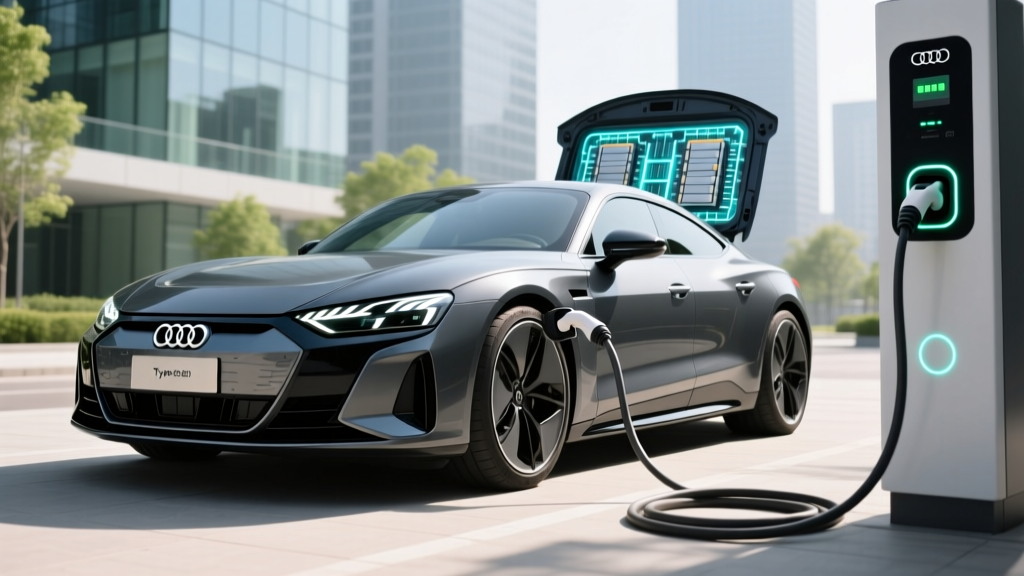
The e-tron GT's headline charging feature is its 800-volt electrical architecture — shared with the Porsche Taycan — which enables sustained high-power DC fast charging without the thermal throttling that plagues 400-volt systems. Here's what that looks like in practice:
| Charging Level | Power (kW) | Speed | Typical Use Case |
|---|---|---|---|
| Level 1 (120V outlet) | ~1.4 kW | ~4 miles/hour | Emergency / overnight trickle |
| Level 2 (240V home) | 11 kW | ~30 miles/hour | Daily home charging; 0–100% in ~8.5 hrs |
| DC Fast Charge | Up to 270 kW (GT) / 320 kW (RS) | 10–80% in ~18 min | Road trips; Electrify America, IONNA |
At a 350 kW-capable Electrify America or IONNA station, the e-tron GT Premium Plus peaks around 270 kW and sustains above 200 kW through approximately 55% state of charge before tapering. The RS Performance variant pushes to 320 kW peak. In both cases, a 10–80% session takes roughly 18 minutes under ideal thermal conditions — meaning you've preconditioned the battery via the navigation system's charge-routing feature.
Critical detail: If you arrive at a DC fast charger without preconditioning (i.e., you didn't set the charger as your navigation destination), expect peak rates closer to 150–180 kW and a 10–80% time of 25–30 minutes. Preconditioning warms the battery to its optimal charging temperature and is non-negotiable for achieving advertised speeds.
For home charging, the 11 kW onboard AC charger is adequate but not class-leading. A full charge from empty takes roughly 8.5 hours — fine for overnight, but if you deplete the battery on a weekend road trip and need a full replenishment at home, you'll want to start early. Most owners charging from a typical 30–80% daily window will see 4–5 hour sessions on a Level 2 home charger (48-amp circuit recommended).
The e-tron GT uses a CCS1 connector in North America. Audi has not announced a native NACS port for the 2026 model year, though a J3400 adapter may become available. Check with your dealer for the latest connector compatibility.
Performance and Driving Dynamics
With 522 horsepower in boost mode (launch control engaged), the standard e-tron GT hits 0–60 mph in 3.9 seconds — firmly in sports-sedan territory. The RS e-tron GT Performance, with 912 hp in boost, demolishes the run in 2.2 seconds, making it one of the quickest production sedans ever built.
But straight-line numbers only tell part of the story. The e-tron GT's three-chamber air suspension, rear-axle steering (available on Prestige and RS), and torque-vectoring rear differential create a ride-and-handling balance that few EVs can match. The car absorbs highway imperfections with the composure of an A8, yet tightens up convincingly on canyon roads. It's a genuine grand tourer: fast, comfortable, and stable at speed.
Regenerative braking is adjustable via steering-wheel paddles (three levels plus coasting), but the e-tron GT does not offer true one-pedal driving to a full stop. You'll still use the brake pedal in stop-and-go traffic — a deliberate choice by Audi to preserve a conventional brake feel. Some EV veterans find this refreshing; others miss the one-pedal convenience of a Tesla or Hyundai Ioniq 5.
Interior, Cargo, and Technology
The cabin is where the e-tron GT justifies its price. Audi's build quality is evident in every surface: available Nappa leather, open-pore wood trim, and a driver-focused cockpit with a 12.3-inch Virtual Cockpit instrument cluster and a 10.1-inch MMI touchscreen. The dual-screen layout (with an 8.6-inch climate control panel below) is functional, though some users prefer a single large display.
Passenger space:
- Front legroom: 41.3 inches
- Rear legroom: 32.1 inches (tight for tall adults on long trips)
- Front headroom: 38.0 inches
- Rear headroom: 36.5 inches (the sloping roofline compromises space for passengers over 6'0")
Cargo:
- Rear trunk: 9.2 cu ft
- Front trunk (frunk): 3.5 cu ft
- Total: 12.7 cu ft — significantly less than a Tesla Model S (28 cu ft behind rear seats) or Lucid Air (32 cu ft)
This is the e-tron GT's most significant practicality compromise. It's a four-door coupe, and it sacrifices cargo volume for that silhouette. Weekend trips for two are fine; family road-trip duty falls to an SUV.
On the technology front, the MMI infotainment system supports wireless Apple CarPlay and Android Auto, over-the-air updates, and Audi connect services. Driver assistance includes adaptive cruise control with stop-and-go, lane-keeping assist, traffic-sign recognition, and intersection assist. These are SAE Level 2 driver-assistance features — the driver must remain engaged and hands on the wheel at all times. The e-tron GT does not offer hands-free driving on par with GM's Super Cruise or Ford's BlueCruise.
Pricing, Trims, and Federal Tax Credit Eligibility
| Trim | Base MSRP | Destination | Total Before Incentives |
|---|---|---|---|
| e-tron GT Premium Plus | $106,495 | $1,295 | $107,790 |
| e-tron GT Prestige | $114,995 | $1,295 | $116,290 |
| RS e-tron GT Performance | $164,995 | $1,295 | $166,290 |
As-tested, a well-optioned Prestige trim with the Year-Round package, carbon-fiber exterior accents, and 21-inch wheels can push past $125,000. The RS Performance, fully loaded, approaches $180,000.
- MSRP cap: Sedans must be under $55,000 MSRP. The e-tron GT exceeds this cap at every trim level and does NOT qualify for the new-vehicle §30D credit.
- Income cap: Even if it did qualify, buyer AGI must be ≤ $150,000 (single) / $300,000 (joint). Most e-tron GT buyers exceed these thresholds.
- Battery sourcing: Critical-mineral and battery-component requirements apply to eligible vehicles.
- Point-of-sale transfer: Available for qualifying vehicles — but again, the e-tron GT does not meet the MSRP cap.
Verify current rules at IRS.gov §30D. Tax-credit rules are subject to legislative change.
The absence of a federal tax credit is a real financial consideration. Competitors like the Tesla Model S and Lucid Air Pure also exceed the $55,000 sedan cap, so this is a segment-wide issue rather than an Audi-specific penalty. Some states offer their own EV incentives regardless of MSRP — check your state's energy office for details.
How Does It Compare to the Competition?
| Spec | Audi e-tron GT Premium Plus | Porsche Taycan 4S | Tesla Model S Long Range | Lucid Air Pure |
|---|---|---|---|---|
| EPA Range | 270 mi | 254 mi | 402 mi | 419 mi |
| Battery | ~84 kWh NMC | ~84 kWh NMC | ~100 kWh | 88 kWh NMC |
| Max DC Charge | 270 kW | 270 kW | 250 kW | 200+ kW |
| 0–60 mph | 3.9 sec | 3.8 sec | 3.1 sec | 3.4 sec |
| Horsepower | 522 hp | 562 hp | 670 hp | 430 hp |
| Cargo (total) | 12.7 cu ft | 14.3 cu ft | 28.0 cu ft | 32.0 cu ft |
| Base MSRP | $106,495 | $108,750 | $79,990 | $69,900 |
| Tax Credit | No (MSRP cap) | No (MSRP cap) | No (MSRP cap) | No (MSRP cap) |
Choose the Audi e-tron GT if: You want the most refined ride quality in the segment, 800V charging speed, Audi build quality, and you value driving engagement over maximum range or cargo space.
Choose the Tesla Model S if: Range is your top priority (402 miles EPA), you need practical cargo space, and you want access to the Supercharger network natively.
Choose the Lucid Air Pure if: You want the best range-per-dollar in the luxury EV sedan segment and a spacious interior, with a starting price $36,000 below the e-tron GT.
Choose the Porsche Taycan if: You prioritize driving dynamics above all else and are willing to accept slightly lower range for sharper handling and Porsche brand cachet.
Ownership Costs and Warranty
Audi covers the e-tron GT's battery and electric drivetrain for 8 years or 100,000 miles (whichever comes first), with a capacity-retention threshold of 70% — meaning Audi will repair or replace the battery if it degrades below 70% of original capacity within the warranty period. The limited vehicle warranty is 4 years / 50,000 miles, with complimentary scheduled maintenance for the first year or 10,000 miles.
Insurance costs are elevated: expect annual premiums of $3,200–$4,500 depending on your state, driving record, and coverage level. That's roughly 30–50% more than insuring a comparably priced gasoline Audi A7, driven by higher repair costs and EV-specific parts pricing.
Charging costs at home (at the US average of $0.16/kWh) run approximately $13.50 to fully charge the 84 kWh battery, or about $0.05 per mile. That's roughly one-third the per-mile cost of a gasoline vehicle achieving 25 MPG at $3.50/gallon. Public DC fast-charging costs vary widely — Electrify America and IONNA typically charge $0.35–$0.55/kWh, bringing road-trip fueling costs closer to (or sometimes above) gasoline equivalents.
Pros
- 800V architecture enables class-leading DC charge speeds (270–320 kW)
- Air suspension delivers exceptional ride quality and composure
- Build quality and materials rival anything in the segment
- Rear-axle steering (available) makes it surprisingly agile
- Preconditioning integration with navigation optimizes charging
- Quiet, refined cabin at highway speeds
Cons
- EPA range (270 mi max) trails Tesla Model S and Lucid Air by 130+ miles
- Cargo space (12.7 cu ft total) is severely limited for a four-door sedan
- Rear seat headroom and legroom are tight for tall passengers
- No federal tax credit eligibility due to MSRP cap
- No true one-pedal driving mode
- CCS1 connector; NACS adapter availability uncertain
- Insurance premiums significantly above gasoline equivalents
Who Should Buy the Audi e-tron GT?
The e-tron GT is best suited for:
- Performance-oriented commuters who want a thrilling daily drive with air-suspension comfort and have home Level 2 charging access.
- Two-person households who don't need substantial cargo space and value style and driving dynamics over practicality.
- Existing Audi owners familiar with the MMI ecosystem who want to transition to electric without learning a new interface.
- Road-trippers in the Eastern and Western US where Electrify America and IONNA DC fast-charging density is strong enough to leverage the 800V charging speed.
It is not ideal for families needing rear-seat space and cargo volume, budget-conscious buyers (the Lucid Air Pure offers more range for $36,000 less), or drivers in charging-desert regions where the limited EPA range could become stressful.
Frequently Asked Questions
What is the real-world range of the Audi e-tron GT?
The EPA rates the e-tron GT Premium Plus at 270 miles. In real-world highway driving at 70 mph in moderate temperatures, expect 235–255 miles. In cold weather (below 30°F) with cabin heating, range drops to approximately 200–220 miles. The RS Performance variant, with its larger 93.4 kWh battery and more powerful motors, posts lower EPA range (around 232 miles) due to increased energy consumption.
How fast does the e-tron GT charge at home and on the road?
At home on a 240V Level 2 charger, the e-tron GT charges at up to 11 kW, adding roughly 30 miles per hour and completing a full charge in about 8.5 hours. On a 350 kW-capable DC fast charger with battery preconditioning, it peaks at 270 kW (320 kW for the RS Performance) and reaches 10–80% in approximately 18 minutes. Without preconditioning, expect 25–30 minutes for the same session.
Does the Audi e-tron GT qualify for the $7,500 federal EV tax credit?
No. Under IRS §30D rules, new electric sedans must have an MSRP below $55,000 to qualify for the federal tax credit. The e-tron GT starts at $106,495, far exceeding this cap. Additionally, buyer income caps ($150,000 single / $300,000 joint AGI) would exclude many buyers in this price range. Always verify current rules at IRS.gov and consult a tax professional.
Is the e-tron GT worth buying over the Tesla Model S or Lucid Air?
It depends on your priorities. The e-tron GT offers superior ride quality, 800V charging speed, and Audi build refinement, but gives up 130+ miles of EPA range and significant cargo space to the Model S and Air. If range, practicality, and value are paramount, the Lucid Air Pure ($69,900, 419 mi EPA) is the rational choice. If driving engagement and luxury ambiance matter most, the e-tron GT earns its premium. The Porsche Taycan is the closest rival in character, sharing the 800V platform with slightly sharper handling.
What battery chemistry does the e-tron GT use, and how long will it last?
The e-tron GT uses NMC (nickel-manganese-cobalt) lithium-ion pouch cells, chosen for their high energy density. NMC batteries typically retain 85–90% capacity after 100,000 miles under normal use. Audi warranties the battery at 8 years / 100,000 miles with a 70% capacity-retention threshold. To maximize longevity, avoid routinely charging to 100% (set a daily limit of 80%) and use preconditioning before DC fast charging.
Does the e-tron GT have one-pedal driving?
No. The e-tron GT offers adjustable regenerative braking via steering-wheel paddles (three levels plus a coasting mode), but the car will not come to a complete stop using regen alone. You must use the brake pedal for final stopping. This is a deliberate engineering choice to preserve a natural, progressive brake feel consistent with Audi's other vehicles.
What connector does the e-tron GT use?
In North America, the 2026 e-tron GT uses a CCS1 (Combined Charging System) connector for both Level 2 AC and DC fast charging. Audi has not confirmed a native NACS (Tesla-style) port for this model year. If you plan to use Tesla Superchargers (which are opening to non-Tesla EVs via the NACS standard), check with your dealer about adapter availability.