A Grand Tourer Rebuilt Around Its Battery
The 2026 Audi e-tron GT shares its 800-volt J1 platform with the Porsche Taycan, but Audi has tuned the sedan for a quieter, more luxurious driving experience. After spending time behind the wheel — and, more importantly, inside the cabin on a 400-mile highway loop — the e-tron GT's interior stands out as one of the most material-rich, driver-focused cabins in the electric luxury segment. But luxury comes at a cost, and not just the MSRP. Let's run the numbers on range, charging, space, and whether the e-tron GT's interior and driving dynamics justify the six-figure price tag.
Full Specifications at a Glance
| Spec | e-tron GT quattro | RS e-tron GT | RS e-tron GT Performance |
|---|---|---|---|
| EPA Range | 270 mi | 278 mi | 300 mi (est.) |
| Battery (usable) | 97.0 kWh (NMC) | 97.0 kWh (NMC) | 105.0 kWh (NMC, est.) |
| Horsepower | 590 hp (boost) | 670 hp (boost) | 912 hp (boost) |
| 0–60 mph | 3.9 sec | 3.2 sec | 2.5 sec |
| Drivetrain | Dual-motor AWD | Dual-motor AWD | Dual-motor AWD |
| Max DC Fast Charge | 320 kW | 320 kW | 320 kW |
| 10–80% DC Time | ~18 min | ~18 min | ~18 min |
| Level 2 Home Rate | 11 kW (AC) | 11 kW (AC) | 11 kW (AC) |
| MPGe (combined) | 85 MPGe | 82 MPGe | TBD |
| Efficiency | 40 kWh/100 mi | 41 kWh/100 mi | TBD |
| Base MSRP | $108,995 | $149,995 | $179,995 |
| Battery Warranty | 8 yr / 100,000 mi | 8 yr / 100,000 mi | 8 yr / 100,000 mi |
Source: fueleconomy.gov and Audi USA press materials. Performance model specs are manufacturer-estimated pending EPA certification.
The Audi e-tron GT Interior: Materials, Space, and Technology
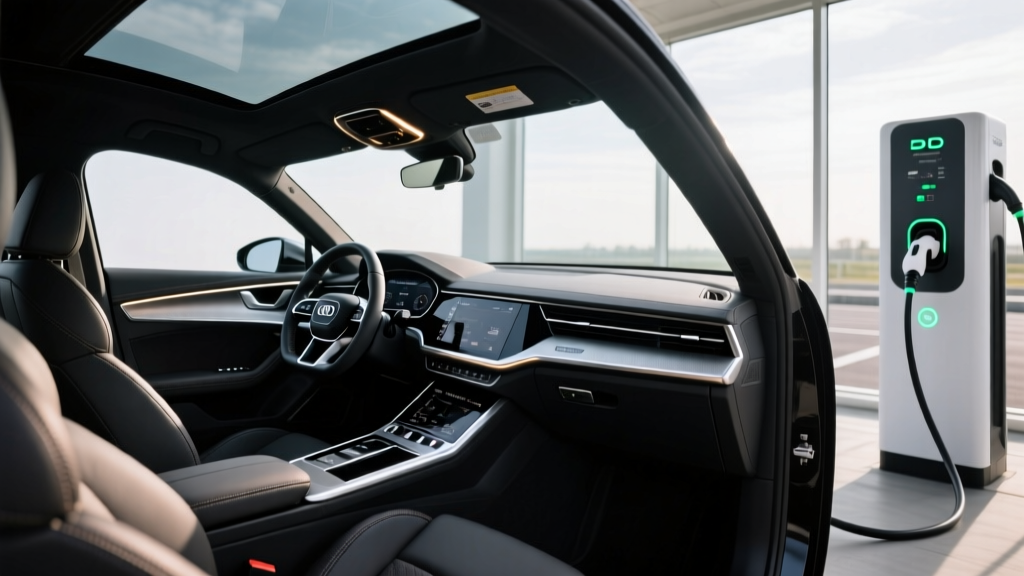
The search volume around the Audi e-tron GT interior reflects genuine buyer curiosity — this is one of the few EVs where the cabin materials rival a Mercedes EQS or a Bentley Flying Spur. Audi uses a combination of Valcona leather, Dinamica microfiber, and an available "Leather-Free Design Package" that substitutes recycled Kaskade material on the seats and dashboard. The flat-bottom steering wheel is standard on RS trims and features haptic-touch controls that, frankly, are more frustrating than physical buttons during spirited driving.
Passenger and Cargo Dimensions
The e-tron GT is a low-slung four-door coupe, which means compromises in headroom and cargo. Here's what you're working with:
| Dimension | e-tron GT | Tesla Model S (comp) |
|---|---|---|
| Front Headroom | 38.6 in | 40.0 in |
| Rear Headroom | 36.5 in | 38.1 in |
| Front Legroom | 41.2 in | 42.7 in |
| Rear Legroom | 32.4 in | 35.4 in |
| Trunk (rear) | 9.2 cu ft | 28.0 cu ft |
| Frunk | 3.2 cu ft | 3.1 cu ft |
The rear seat is best suited for children or adults on short trips. The sloping roofline cuts into headroom noticeably, and the center tunnel — a legacy of the J1 platform's battery packaging — limits the middle seat to emergency use. Cargo space is tight for a grand tourer: a weekend trip for two is manageable, but a family road trip requires packing discipline or a roof box (not recommended given the drag coefficient).
Infotainment and Driver-Assist Tech
The 10.1-inch upper touchscreen runs Audi's latest MIB 4 software, which is noticeably faster than the MIB 3 system in the outgoing model. Wireless Apple CarPlay and Android Auto are standard, and the 12.3-inch Virtual Cockit Plus driver display remains one of the best-configurable instrument clusters in the industry. The available head-up display with augmented-reality navigation overlays is genuinely useful on unfamiliar highways.
Driver-assist features fall under Audi's "Adaptive Cruise Assist" umbrella — a Level 2 SAE system that handles lane centering and adaptive cruise simultaneously. It is not a self-driving system. You must keep your hands on the wheel. Audi does not currently offer a hands-free highway driving system comparable to GM's Super Cruise or Ford's BlueCruise, which is a notable gap at this price point.
Range, Efficiency, and Real-World Expectations
The e-tron GT quattro carries an EPA-estimated 270 miles of range, while the RS e-tron GT achieves 278 miles thanks to minor aero and motor calibration differences. In real-world highway driving at 70–75 mph in moderate temperatures (55–75°F), expect approximately 230–245 miles before needing a charge stop. In cold weather (below 30°F), range can drop to 190–210 miles due to battery-resistance increase and cabin-heating demand, even with the standard heat pump. City driving with regenerative braking can push range above the EPA sticker, closer to 280–290 miles.
The 97.0 kWh usable battery pack (NMC chemistry — nickel manganese cobalt) prioritizes energy density and charge speed over the cycle-life longevity of LFP packs. Audi quotes a 70% capacity-retention threshold under the 8-year/100,000-mile battery warranty, which is industry-standard but less generous than Hyundai's 8-year/unlimited-mile policy.
Charging Speed: 800V Architecture Pays Off
The e-tron GT's 800-volt electrical architecture is its most practical advantage for road-trip charging. On a 350 kW DC fast charger (such as Electrify America's latest stalls), the e-tron GT peaks at 320 kW and sustains above 200 kW through roughly 60% state of charge.
| Charging Level | Power | Speed / Time | Notes |
|---|---|---|---|
| Level 1 (120V) | 1.4 kW | ~3 mi/hr | Emergency only; full charge in ~70 hr |
| Level 2 (240V, home) | 11 kW | ~25 mi/hr | Full 10–100% in ~9.5 hr |
| DC Fast Charge | 320 kW peak | 10–80% in ~18 min | Requires 350 kW-capable station; CCS1 connector |
Charging-curve reality check: The 320 kW peak is impressive, but it's a ceiling, not an average. The charge curve tapers significantly above 80% SoC to protect battery health. A 10–80% session averages roughly 230–250 kW — still excellent, but don't expect to sustain 320 kW for the full session. Preconditioning the battery (via the navigation-routed charging feature) is essential to hit peak speeds; arriving at a fast charger without preconditioning can add 5–8 minutes to your stop.
Home charging at 11 kW requires a 48-amp Level 2 wallbox on a 60-amp dedicated circuit. Installation typically runs $800–$2,000 depending on panel capacity and run length. The e-tron GT uses the CCS1 connector natively; Audi has not yet switched to NACS (Tesla's connector), though an adapter is expected for future model years.
Pricing, Trims, and Federal Tax-Credit Eligibility
The 2026 e-tron GT lineup has expanded to three trims, with the new RS e-tron GT Performance sitting at the top as a 912-hp flagship.
| Trim | Base MSRP | As-Tested (typical options) | §30D Credit Eligible? |
|---|---|---|---|
| e-tron GT quattro Premium Plus | $108,995 | $115,000–$120,000 | No (MSRP cap exceeded) |
| RS e-tron GT | $149,995 | $160,000–$170,000 | No (MSRP cap exceeded) |
| RS e-tron GT Performance | $179,995 | $190,000+ | No (MSRP cap exceeded) |
Federal tax-credit reality: Under current IRS §30D rules, new EVs must have an MSRP at or below $55,000 (sedans) or $80,000 (SUVs/vans/pickups) to qualify for the up-to-$7,500 credit. The e-tron GT is classified as a sedan, so the $55,000 cap applies — meaning no trim of the e-tron GT qualifies for the federal EV tax credit. Additionally, buyer income caps ($150K single / $300K joint AGI) and critical-mineral/battery-component sourcing rules further restrict eligibility even for vehicles under the MSRP threshold. Always verify current-year rules at irs.gov and consult a tax professional before purchasing.
The point-of-sale transfer provision (available since 2024) is irrelevant here since the vehicle doesn't meet the MSRP cap. Some states offer their own EV rebates or HOV-lane access that may apply — check your local DMV or energy office.
How It Compares: e-tron GT vs. Taycan, Model S, and i5 M60
The e-tron GT doesn't exist in a vacuum. Its closest rivals share platforms or price brackets:
- You prioritize interior material quality and cabin quietness
- You want 800V fast-charging without the Porsche premium
- Design and road presence matter more than cargo practicality
- You prefer physical buttons and a traditional luxury layout
- Taycan: You want sharper handling, more rear-seat space, or NACS charging (2025+)
- Tesla Model S: You need cargo space, Supercharger access, or hands-free-driving tech (FSD)
- BMW i5 M60: You want a more practical rear seat, lower price, and similar performance
The Porsche Taycan (which shares the J1 platform) offers marginally better rear-seat comfort and now supports NACS natively, giving it access to Tesla's Supercharger network without an adapter. The Tesla Model S wins on cargo (28 cu ft trunk + frunk), Supercharger reliability, and Autopilot/FSD capability — though its interior materials and ride quality are a clear step below the Audi's. The BMW i5 M60 at ~$87,000 offers 295 miles of range, a more usable rear seat, and a significantly lower price, though it lacks the e-tron GT's 800V charging speed.
Pros, Cons, and Final Verdict
- Exceptional interior materials and build quality
- 320 kW peak DC charging — among the fastest in production
- Refined, quiet ride with adaptive air suspension
- 800V architecture enables consistent fast-charge speeds
- Strong straight-line performance across all trims
- Cramped rear seat and limited cargo (9.2 cu ft trunk)
- No federal tax-credit eligibility (MSRP cap exceeded)
- No hands-free Level 2+ driving system (unlike Super Cruise/BlueCruise)
- Haptic-touch steering-wheel controls are distracting
- CCS-only; no native NACS access to Superchargers
Who this EV suits: The e-tron GT is built for a luxury buyer who commutes in style, takes occasional road trips (where 18-minute DC fast-charge stops are tolerable), and values interior craftsmanship over cargo space. It's not a family hauler — the rear seat and trunk rule that out. It's a grand tourer in the truest sense: fast, comfortable, beautifully appointed, and designed for two people who appreciate design. If you need practicality, the BMW i5 or Audi Q8 e-tron serve better. If you want the ultimate electric GT interior experience and can live with the compromises, the e-tron GT delivers.
Frequently Asked Questions
What is the real-world range of the Audi e-tron GT?
The EPA rates the e-tron GT quattro at 270 miles and the RS at 278 miles. In real-world highway driving at 70–75 mph, expect 230–245 miles. In cold weather below 30°F, range drops to roughly 190–210 miles. City driving with regenerative braking can exceed the EPA estimate.
How fast does the e-tron GT charge at home and on the road?
On a 350 kW DC fast charger, the e-tron GT peaks at 320 kW and charges from 10–80% in approximately 18 minutes. At home on a Level 2 (240V, 11 kW) charger, it adds roughly 25 miles of range per hour, with a full charge taking about 9.5 hours.
Does the 2026 Audi e-tron GT qualify for the $7,500 federal EV tax credit?
No. Under current IRS §30D rules, new sedans must have an MSRP at or below $55,000 to qualify. The e-tron GT starts at $108,995, so no trim is eligible. Always check irs.gov for the latest rules.
Is the e-tron GT worth buying over the Porsche Taycan?
If you prioritize interior luxury and cabin quietness over outright handling precision, the e-tron GT is the stronger choice. The Taycan offers a more engaging drive, slightly more rear-seat room, and NACS Supercharger access. Both share the same 800V platform and similar charging speeds.
What battery chemistry does the e-tron GT use?
The e-tron GT uses NMC (nickel manganese cobalt) chemistry, which offers higher energy density than LFP but slightly lower cycle-life longevity. The battery is warrantied for 8 years or 100,000 miles with a 70% capacity-retention threshold.
Does the e-tron GT have a hands-free driving mode?
No. Audi's Adaptive Cruise Assist is an SAE Level 2 driver-assist system that requires hands-on-wheel supervision at all times. Audi does not currently offer a hands-free highway driving system comparable to GM's Super Cruise or Ford's BlueCruise.