Quick Verdict: The Grand Tourer That Actually Tours
The 2026 Audi e-tron GT is a luxury electric grand tourer that pairs Porsche Taycan underpinnings with Audi's design language and a more comfort-oriented suspension tune. With up to 646 horsepower in the RS variant, a 93.4 kWh (gross) NMC battery, and an 800-volt architecture enabling peak 320 kW DC fast charging, the e-tron GT is engineered for long-distance cruising rather than track abuse. The base GT quattro starts at $107,995 and delivers 522 hp with an EPA-estimated 270 miles of range, while the RS e-tron GT pushes 646 hp and a slightly lower 257-mile EPA estimate. Neither trim qualifies for the federal §30D tax credit due to MSRP and sourcing constraints, which narrows its buyer pool to those prioritizing driving refinement over incentive-driven value.
| Spec | GT quattro | RS e-tron GT |
|---|---|---|
| EPA Range | 270 mi | 257 mi |
| Battery (gross / usable) | 93.4 kWh / ~85 kWh | 93.4 kWh / ~85 kWh |
| Chemistry | NMC (Nickel Manganese Cobalt) | NMC |
| Horsepower (boost) | 522 hp | 646 hp |
| 0–60 mph | 3.9 sec | 3.1 sec |
| Drivetrain | Dual-motor AWD | Dual-motor AWD |
| Peak DC Charge Rate | 320 kW | 320 kW |
| 10–80% DC Time | ~18 min | ~18 min |
| Level 2 Charge Rate | 11 kW (~37 mi/hr) | 11 kW (~37 mi/hr) |
| MPGe (combined) | 85 MPGe | 79 MPGe |
| Base MSRP | $107,995 | $149,995 |
| Battery Warranty | 8 yr / 100,000 mi | 8 yr / 100,000 mi |
Real-World Range: What the EPA Sticker Doesn't Tell You
GT quattro: EPA 270 mi — Expect ~230–245 mi on sustained highway driving at 70–75 mph. In cold weather (below 32°F / 0°C), plan for 195–220 mi due to cabin heating loads and increased battery internal resistance.
RS e-tron GT: EPA 257 mi — Highway reality is ~215–235 mi; cold weather drops this to approximately 185–205 mi.
The e-tron GT's 800-volt platform and NMC cells are optimized for sustained power delivery rather than maximum energy density. Compared to the Hyundai Ioniq 5's 77.4 kWh pack (which achieves 305 EPA miles in Long Range AWD), the Audi prioritizes discharge rate and thermal stability. This means you trade some range for consistently strong performance and faster DC charging.
In EPA testing published on fueleconomy.gov, the GT quattro posts 85 MPGe combined (roughly 35 kWh/100 mi). The RS variant's additional powertrain mass and wider 21-inch performance tires drop efficiency to 79 MPGe. If your daily commute is under 60 miles round-trip, both trims handle multi-day use without charging. For road trips exceeding 200 miles, you'll want to plan at least one DC fast-charge stop.
Charging Speed: 800-Volt Architecture Delivers
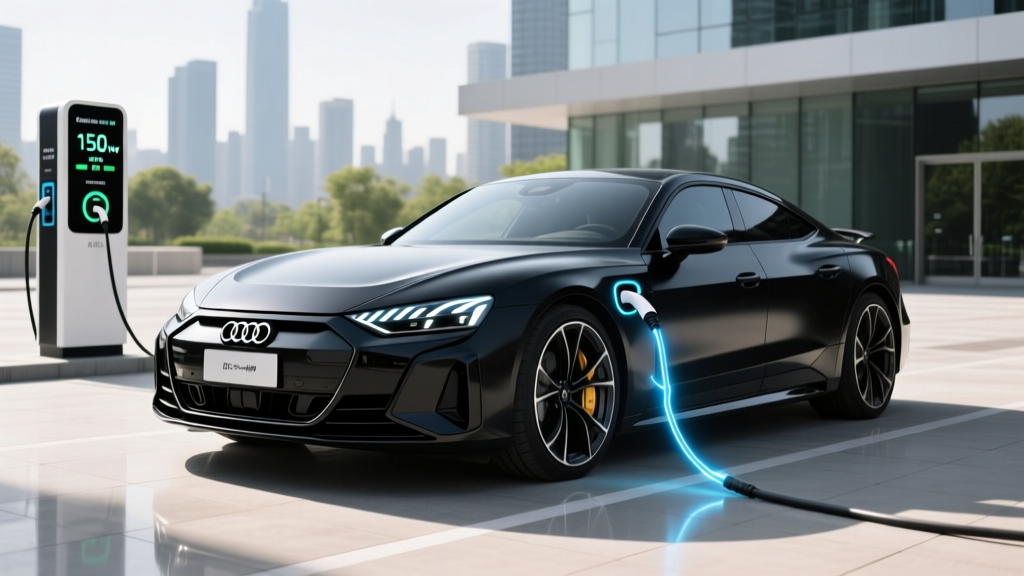
The e-tron GT's 800-volt electrical architecture is one of its strongest practical advantages. At a compatible 350 kW DC fast charger (such as Electrify America's latest stalls), the GT can accept a peak rate of 320 kW — translating to a 10–80% charge in approximately 18 minutes under ideal thermal conditions. However, real-world charging curves tell a more nuanced story.
| Charging Level | Power (kW) | Miles Added per Hour | Typical Use Case |
|---|---|---|---|
| Level 1 (120V household) | ~1.4 kW | ~4 mi/hr | Emergency / overnight trickle |
| Level 2 (240V home, 48A) | 11 kW | ~37 mi/hr | Primary daily charging |
| DC Fast (peak) | 320 kW | ~800+ mi/hr (peak) | Road-trip stops |
| DC Fast (sustained 10–80%) | ~200 kW avg | — | 18 min 10–80% |
Charging-curve reality check: The 320 kW peak is reached between roughly 10–30% State of Charge (SoC) when the battery is preconditioned. Above 50% SoC, the rate tapers significantly — by 80% SoC, you're typically seeing 50–80 kW. This is standard for NMC chemistry protecting cell longevity. Always precondition the battery via the MMI navigation-to-charger feature before arriving at a DC fast charger; skipping this step in cold weather can double your 10–80% time.
For home Level 2 charging, the e-tron GT accepts up to 11 kW via its onboard charger. On a 48-amp / 240-volt circuit, expect roughly 37 miles of range added per hour, or a full overnight charge from 20% in about 7.5 hours. A dedicated Level 2 home charger (such as a ChargePoint Home Flex or Emporia Level 2) is strongly recommended — installation costs typically range from $800 to $2,500 depending on panel capacity and run length.
Performance: 522 to 646 HP with Dual-Motor AWD
Both e-tron GT trims use a dual-motor all-wheel-drive layout with a rear-mounted two-speed transmission — a design shared with the Porsche Taycan. The front motor handles low-speed torque and regenerative braking, while the rear motor's two-speed gearbox provides aggressive launch gearing and efficient highway cruising.
GT quattro (522 hp, 472 lb-ft in boost mode): The 0–60 mph sprint completes in 3.9 seconds. Launch Control activates the full boost output for 2.5 seconds; sustained output drops to approximately 469 hp. The power delivery is linear and confident, with the dual-motor system managing torque vectoring seamlessly.
RS e-tron GT (646 hp, 612 lb-ft in boost mode): Audi quotes 3.1 seconds to 60 mph. The additional 124 hp comes from a more aggressive rear motor and revised power electronics. On real roads, the difference is most noticeable above 50 mph, where the RS pulls harder through the midrange. Both trims are electronically limited to 152 mph (GT) and 155 mph (RS).
Regenerative braking is handled through steering-wheel paddles offering three levels (0.05g, 0.1g, 0.2g) plus an auto mode that uses radar and camera data to modulate regen based on traffic ahead. Unlike some competitors, the e-tron GT does not offer true one-pedal driving to a full stop — you'll need the brake pedal at low speeds. This is a deliberate engineering choice prioritizing brake-blending feel, but it may frustrate buyers accustomed to Nissan LEAF or Tesla one-pedal behavior.
Interior, Cargo, and Technology
The e-tron GT cabin balances Audi's minimalist design ethos with luxury-grade materials. Standard features include a 10.1-inch MMI touchscreen, a 12.3-inch Virtual Cocklet digital instrument cluster, heated and ventilated 18-way sport seats (GT Prestige trim), and a 16-speaker Bang & Olufsen audio system. The center console uses a touch-sensitive climate control bar that some owners find less intuitive than physical buttons.
Cargo space is the e-tron GT's most significant practical compromise:
- Rear trunk: 9.2 cu ft (sedan-style liftback opening)
- Front trunk (frunk): 3.5 cu ft (fits a small duffel or charging cables)
- Total cargo: 12.7 cu ft — roughly half of a Tesla Model S (28 cu ft) or Lucid Air (32 cu ft)
- Rear legroom: 33.5 inches — adequate for adults under 6 feet on shorter trips, tight for taller passengers
The rear seat is best described as a 2+2 configuration. The center position is essentially unusable due to the battery tunnel hump. This is a grand tourer for two with occasional rear-seat use, not a family sedan.
Driver assistance: The e-tron GT comes with Audi's Adaptive Cruise Assist, which provides SAE Level 2 lane-centering and speed management. This is a driver-supervision system — your hands must remain on the wheel, and the system monitors attentiveness via a steering-wheel sensor. It is not autonomous driving. Standard safety features include front and rear automatic emergency braking, lane-keeping assist, and intersection assist. The Insurance Institute for Highway Safety (IIHS) has not separately crash-tested the e-tron GT as of early 2026, though the platform's aluminum-intensive structure and low center of gravity suggest strong crash performance.
Pricing, Trims, and Federal Tax Credit Eligibility
| Trim | Base MSRP | As-Tested (typical options) | Federal §30D Credit |
|---|---|---|---|
| GT quattro Premium Plus | $107,995 | $115,000–$120,000 | Not eligible |
| GT quattro Prestige | $114,995 | $122,000–$128,000 | Not eligible |
| RS e-tron GT | $149,995 | $158,000–$168,000 | Not eligible |
Federal tax credit reality: The 2026 Audi e-tron GT does not qualify for the IRS §30D New Clean Vehicle Credit of up to $7,500. The reasons are twofold:
- MSRP cap: §30D limits eligible sedans to an MSRP of $55,000 or less. The e-tron GT's base price of $107,995 far exceeds this threshold.
- Battery sourcing requirements: Even if the MSRP were within limits, the e-tron GT's battery cells and critical minerals are sourced from supply chains that do not currently satisfy §30D's domestic-content and free-trade-agreement requirements for 2026.
Buyers in states with additional incentives (such as California's CVRP rebate or Colorado's state tax credit) should consult their state's energy office — some state programs have different MSRP thresholds or no cap at all. A tax professional can advise on eligibility for any state-level credits or utility rebates.
Who Should Buy the e-tron GT — and Who Shouldn't
- 320 kW peak DC charging among the fastest in the luxury segment
- Refined ride quality with adaptive air suspension standard
- 800V architecture enables consistent high-power delivery
- Build quality and materials exceed Tesla Model S
- Strong 8-year / 100,000-mile battery warranty
- Only 12.7 cu ft total cargo — impractical for families
- No federal tax credit eligibility
- Rear seat is tight for adults on long trips
- Infotainment touch-bar climate controls are distracting
- No true one-pedal driving to a full stop
- Real-world highway range ~230 mi falls short of Lucid Air and Model S
- You want a luxury performance EV with superior build quality and ride refinement over raw range
- Your typical trips are under 200 miles, or you're comfortable planning one DC charge stop on longer drives
- Cargo and rear-seat space are secondary concerns (couple or empty-nester lifestyle)
- You value 800V fast-charging capability for road-trip convenience
- You need 300+ miles of real-world range — consider the Lucid Air Pure (380+ mi EPA) or Tesla Model S (402 mi EPA)
- Family hauling is a priority — the BMW i5, Mercedes EQS, or Tesla Model S offer significantly more cargo and rear-seat room
- Federal tax credit eligibility is a deal-breaker — no luxury sedan over $55,000 MSRP qualifies under current §30D rules
Warranty and Long-Term Ownership
Audi covers the e-tron GT's high-voltage battery for 8 years or 100,000 miles, whichever comes first, against defects and capacity loss below 70% of original capacity. The powertrain (motors, power electronics, reduction gears) is covered under the same 8-year/100,000-mile term. The basic vehicle warranty is 4 years / 50,000 miles, which is standard for German luxury brands but shorter than Hyundai/Kia's 5-year/60,000-mile coverage.
NMC battery chemistry in the e-tron GT has demonstrated strong longevity in fleet data from European markets, where the platform (shared with the Taycan) has been in service since 2020. Typical degradation is approximately 5–8% over the first 100,000 miles when owners avoid frequent 100% charges and minimize DC fast-charging in extreme heat. Audi's thermal management system — which includes active liquid cooling and heating — is among the most robust in the industry, helping preserve cell health across climate extremes.
Insurance premiums for the e-tron GT run 15–25% higher than comparable internal-combustion Audi models, driven by repair costs for aluminum body panels and high-voltage components. Expect annual premiums in the $3,200–$4,500 range depending on location and driving record. Always obtain personalized quotes before purchasing.
Frequently Asked Questions
What is the real-world range of the 2026 Audi e-tron GT?
The GT quattro's EPA estimate is 270 miles, but expect approximately 230–245 miles on sustained highway driving and 195–220 miles in freezing temperatures. The RS variant drops to roughly 215–235 miles highway and 185–205 miles in cold weather.
How fast does the e-tron GT charge at home and on the road?
At home on a Level 2 (240V, 48A) charger, the e-tron GT accepts up to 11 kW, adding roughly 37 miles of range per hour — a full charge from 20% takes about 7.5 hours. On a 350 kW DC fast charger, it peaks at 320 kW and charges from 10–80% in approximately 18 minutes when the battery is preconditioned.
Does the Audi e-tron GT qualify for the $7,500 federal EV tax credit?
No. Under current IRS §30D rules, the e-tron GT is ineligible due to its MSRP exceeding the $55,000 sedan cap and battery sourcing requirements not being met. State-level incentives may still apply — check with your state energy office and a tax professional.
How does the e-tron GT compare to the Porsche Taycan?
Both share the J1 800V platform and 93.4 kWh battery. The e-tron GT prioritizes ride comfort with a softer air-suspension tune and a more upscale interior, while the Taycan offers sharper handling and a slightly more engaging driving experience. Range and charging specs are nearly identical. The e-tron GT is typically $5,000–$10,000 less expensive at equivalent trim levels.
Is the e-tron GT suitable as a daily driver and road-trip car?
For daily commuting under 80 miles round-trip, the e-tron GT excels — it's quiet, comfortable, and charges fully overnight on Level 2. For road trips over 200 miles, plan one DC fast-charge stop every 180–220 miles depending on speed and temperature. The 18-minute 10–80% charge time makes stops brief, but cargo limitations and tight rear seating make it better suited for couples than families.
What is the biggest drawback of the e-tron GT?
Cargo space. With only 12.7 cubic feet total (9.2 cu ft trunk + 3.5 cu ft frunk), the e-tron GT carries less than half the cargo of a Tesla Model S or Lucid Air. Combined with a cramped rear seat, this limits its utility for families or anyone who regularly hauls gear.