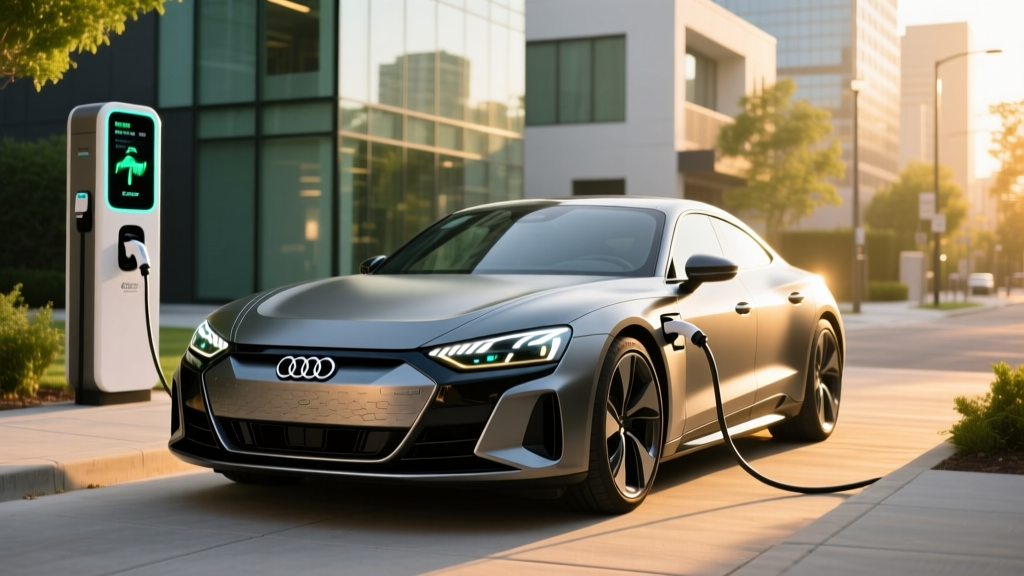
The 2022 Audi e-tron GT was Audi's first serious entry into the performance electric grand-tourer segment, sharing its J1 platform with the Porsche Taycan. Now that these cars have been on the road for several years, we have real-world data on battery degradation, charging reliability, and long-term ownership costs. This review examines the 2022 model year specifically — what you get, what it costs on the used market in 2026, and whether it still holds up against newer competition.
2022 Audi e-tron GT at a Glance: Key Specs
| Spec | e-tron GT quattro | RS e-tron GT |
|---|---|---|
| EPA Range | 238 miles | 232 miles |
| Battery (gross / usable) | 93.4 kWh / ~85 kWh | 93.4 kWh / ~85 kWh |
| Battery Chemistry | NMC (Nickel Manganese Cobalt) | NMC |
| Drivetrain | Dual-motor AWD | Dual-motor AWD |
| Horsepower (boost) | 522 hp | 637 hp |
| 0-60 mph | 3.9 seconds | 3.1 seconds |
| Max DC Fast Charge | 270 kW | 270 kW |
| 10-80% DC Time | ~22.5 minutes | ~22.5 minutes |
| Level 2 Charge Rate | 9.6 kW (~29 mi/hr) | 9.6 kW (~29 mi/hr) |
| MPGe (combined) | 82 MPGe | 79 MPGe |
| Efficiency | 41 kWh/100 mi | 43 kWh/100 mi |
| Base MSRP (2022) | $103,500 | $140,100 |
| Battery Warranty | 8 yr / 100,000 mi | 8 yr / 100,000 mi |
Real-World Range: What the EPA Sticker Doesn't Tell You
EPA Estimate: 238 miles
Real-World Highway (70-75 mph, moderate temps): ~200-215 miles
Real-World City / Mixed: ~220-235 miles
Cold Weather (below 30°F, highway): ~165-185 miles
Expectation: Plan for 200 miles of usable range on road trips.
The 2022 e-tron GT's EPA rating of 238 miles for the standard GT quattro and 232 miles for the RS variant was competitive at launch but falls short of today's benchmarks. The EPA's fueleconomy.gov listing confirms these figures, but real-world results depend heavily on driving style and conditions.
The e-tron GT's 800-volt architecture and sophisticated thermal management system mean it holds an advantage in sustained high-speed driving compared to 400V rivals. However, the low-slung grand-tourer body creates more aerodynamic drag than a crossover, and highway efficiency suffers accordingly. In mixed driving at moderate temperatures, owners consistently report achieving 90-95% of the EPA sticker. On pure highway runs at 75 mph, expect roughly 200-215 miles before needing to find a charger.
Cold weather is the bigger concern. The e-tron GT does include a heat pump (standard on all trims), which mitigates cabin-heating energy draw. But lithium-ion chemistry simply delivers less capacity at low temperatures, and battery preconditioning only partially offsets this. In sub-30°F highway driving, range drops to approximately 165-185 miles. For daily commuting in cold climates, this is manageable with home charging; for winter road trips, it requires careful route planning.
Charging Speed: The 800V Advantage in Practice
| Charging Level | Power / Voltage | Speed (miles added per hour) | Notes |
|---|---|---|---|
| Level 1 (120V household) | ~1.4 kW | ~4 mi/hr | Emergency / overnight trickle only |
| Level 2 (240V home) | 9.6 kW | ~29 mi/hr | Full charge in ~9 hours |
| DC Fast Charge (peak) | 270 kW (800V) | ~180 mi/hr (peak) | Requires 350 kW-capable station |
| DC Fast Charge (50 kW) | 50 kW | ~55 mi/hr | Older CCS stations |
The e-tron GT's 270 kW peak DC fast-charging capability was class-leading in 2022 and remains excellent in 2026. The 800-volt architecture allows the car to sustain high charge rates longer than 400V competitors, which is where the real-world benefit lies. On a 350 kW Electrify America or compatible station with the battery preconditioned, the e-tron GT will ramp quickly to its 270 kW peak and hold strong through roughly 40-50% SoC before tapering.
Audi's official 10-80% time of approximately 22.5 minutes is achievable under ideal conditions — battery preconditioned, station capable of 350 kW, ambient temperatures between 50-80°F. In practice, at typical Electrify America stalls that may be shared or operating at reduced output, expect 25-30 minutes for the 10-80% window. The charge curve is relatively flat compared to many rivals: you won't see the dramatic cliff that some 400V vehicles experience above 60% SoC.
For home charging, the onboard charger maxes out at 9.6 kW on Level 2. A full charge from empty takes roughly 9 hours — fine for overnight replenishment. If you're installing a home Level 2 charger, a 48-amp circuit on a 60-amp breaker is the recommended setup to deliver the full 9.6 kW. A licensed electrician will typically quote $800-$2,000 for a Level 2 installation, depending on panel proximity and whether a panel upgrade is needed.
Connector note: The 2022 e-tron GT uses the CCS1 (Combined Charging System) connector. Audi has since committed to the NACS (Tesla-style) connector for future models, but the 2022 model year requires a CCS-to-NACS adapter for Tesla Supercharger access. Audi offers an official adapter; verify compatibility with your specific VIN before purchasing.
Performance and Driving Dynamics
Both trims use a dual-motor all-wheel-drive layout with a two-speed transmission on the rear axle — a design shared with the Porsche Taycan. The first gear provides aggressive acceleration off the line, while the second gear optimizes efficiency at highway speeds. This engineering choice gives the e-tron GT a distinct advantage in both launch performance and high-speed efficiency compared to single-speed EVs.
The standard GT quattro produces 469 hp in normal driving, rising to 522 hp in launch-control boost mode for a 3.9-second 0-60 time. The RS e-tron GT bumps output to 590 hp (637 hp on boost) and drops the 0-60 to 3.1 seconds — firmly supercar territory. Top speed is electronically limited to 152 mph on the GT and 155 mph on the RS.
Adaptive air suspension is standard across both trims, offering adjustable ride height and damping. The GT sits low and drives like a proper grand tourer: composed on highway sweeps, capable on back roads, and surprisingly compliant in Comfort mode over rough pavement. Rear-axle steering (optional on GT, standard on RS) tightens the turning circle and adds agility at low speeds while improving stability at high speeds.
Regenerative braking is adjustable via steering-wheel paddles, offering three levels of regen plus an auto mode that uses radar and navigation data to modulate deceleration. One-pedal driving is possible but not as aggressive as a Tesla or Nissan Leaf — Audi's philosophy clearly favors blending regen with friction braking for a natural feel.
Interior, Cargo, and Daily Practicality
The e-tron GT's cabin uses Audi's dual-screen MMI layout: a 12.3-inch Virtual Cockit Plus digital instrument cluster and a 10.1-inch central touchscreen angled toward the driver. The infotainment system supports wireless Apple CarPlay and Android Auto, built-in navigation with EV route planning, and natural-language voice control. A Bang & Olufsen 3D audio system is available.
Material quality is exceptional — as expected at this price point. Standard upholstery is a leather/leatherette combination, with full Valcona leather and a Dinamica microfiber option on the RS. Recaro sport seats are available. The flat floor and low seating position create a cockpit-like feel, though rear-seat headroom is tight for anyone over 6 feet due to the sloping roofline.
Practicality is the e-tron GT's weakest point relative to SUV-shaped EVs:
- Rear trunk: 9.2 cubic feet (shallow and narrow due to the rear motor)
- Front trunk (frunk): 3.5 cubic feet (fits a charging cable bag and a small duffel)
- Total cargo: 12.7 cubic feet — enough for two carry-ons and a garment bag
- Rear legroom: 32.1 inches — adequate for adults on shorter trips, tight for long hauls
- Rear headroom: 36.5 inches — compromised by the roofline
This is a grand tourer for two people (or two-plus-children). It is not a family hauler. If you need cargo space for strollers, ski gear, or Costco runs, look at the Audi Q8 e-tron or a competing electric SUV.
Pricing, Tax Credits, and 2026 Used-Market Value
| Item | GT quattro Premium Plus | RS e-tron GT |
|---|---|---|
| Original MSRP (2022) | $103,500 | $140,100 |
| Typical Used Price (2026, 25-40k mi) | $55,000 - $68,000 | $75,000 - $92,000 |
| Federal Used EV Credit (§25E) | Up to $4,000 (if eligible) | Not eligible (MSRP cap) |
| Federal New EV Credit (§30D) | N/A — used vehicle | N/A — used vehicle |
Critical tax-credit context for 2026 buyers: The §30D new-vehicle credit no longer applies to the 2022 e-tron GT, since you'd be purchasing it used. However, the IRS §25E used clean vehicle credit may apply. This credit provides 30% of the sale price, up to $4,000, for qualifying used EVs. Key requirements:
- The vehicle must be at least two model years old (the 2022 qualifies in 2026)
- Sale price must be $25,000 or less (this is the problem — most 2022 e-tron GTs sell well above this cap)
- Buyer income caps apply: $75,000 single / $112,500 head of household / $150,000 joint
- Must purchase from a licensed dealer
In practice, the $25,000 sale-price cap effectively disqualifies the e-tron GT from the used EV credit in nearly all transactions. Even the most depreciated examples with higher mileage typically list above $50,000. This means you should budget the full purchase price without expecting federal credit assistance.
Regarding the original new-vehicle credit: the 2022 e-tron GT was eligible for up to $7,500 under the pre-IRA rules that applied through the end of 2022. Buyers who purchased new and claimed the credit effectively reduced their net cost. That benefit is now embedded in the used-market depreciation — these cars depreciated steeply, which is good news for second owners.
Ownership Costs, Warranty, and Long-Term Outlook
Audi covers the e-tron GT's battery pack for 8 years or 100,000 miles (whichever comes first) against defects and excessive capacity loss. Audi defines excessive degradation as falling below 70% of original capacity during the warranty period. The general vehicle warranty is 4 years / 50,000 miles, and complimentary scheduled maintenance is included for the first year or 10,000 miles.
For a 2022 model purchased in 2026, approximately 4 years and ~60,000 miles of battery warranty remain (assuming average mileage). This is a meaningful safety net, as NMC battery packs at this age and mileage typically show 5-10% degradation based on industry data — well within the 70% threshold.
Insurance costs are significant. Expect annual premiums in the $2,800-$4,200 range depending on your profile, location, and coverage level. This reflects the e-tron GT's high repair costs (aluminum body panels, specialized high-voltage components) and performance classification.
Maintenance is lighter than a comparable ICE sports sedan — no oil changes, no transmission fluid, no spark plugs. Budget for tire replacement every 20,000-30,000 miles (performance EVs are hard on tires due to instant torque and heavy weight), cabin air filters annually, and brake fluid checks every two years. The regenerative braking system means brake pads often last 80,000+ miles.
Pros, Cons, and the Verdict
- 270 kW DC fast charging with excellent sustained charge curve
- Supb ride quality from adaptive air suspension
- Build quality and materials rival anything in the segment
- 800V architecture still outpaces many 2026 competitors
- Strong depreciation = compelling used-market value
- Heat pump standard on all trims
- 238-mile EPA range is below 2026 averages
- 12.7 cu ft total cargo is impractical for families
- Rear headroom is tight for tall passengers
- No eligibility for federal tax credits on used purchase
- CCS1 connector requires adapter for NACS Supercharger use
- Infotainment lacks wireless charging pad in base trim
- Insurance premiums are high
Who should buy the 2022 e-tron GT in 2026? This car suits the buyer who prioritizes driving dynamics, build quality, and fast-charging capability over maximum range or cargo practicality. If you commute 30-60 miles round trip, have reliable home charging, and want a luxury performance GT that can handle occasional road trips (with planning), the used e-tron GT offers tremendous value at 2026 prices. It is not the right choice for families needing cargo space, road-trippers in charging-desert regions, or anyone whose daily drive exceeds 200 miles without charging access.
Frequently Asked Questions
What is the real-world range of the 2022 Audi e-tron GT?
The EPA rates the GT quattro at 238 miles and the RS at 232 miles. In real-world mixed driving, expect 220-235 miles. On the highway at 75 mph, plan for 200-215 miles. In cold weather below 30°F, highway range drops to approximately 165-185 miles.
How fast does the 2022 e-tron GT charge?
On a 350 kW DC fast charger, the e-tron GT peaks at 270 kW and charges from 10-80% in approximately 22.5 minutes under ideal conditions. At home on a Level 2 (240V, 9.6 kW) charger, a full charge takes about 9 hours, adding roughly 29 miles of range per hour.
Does the 2022 Audi e-tron GT qualify for a federal tax credit?
If purchased used in 2026, the §25E used EV credit theoretically applies but the $25,000 sale-price cap effectively disqualifies the e-tron GT, as nearly all examples sell for $50,000+. The §30D new-vehicle credit is no longer applicable. Consult a tax professional and review current IRS guidance for your specific situation.
Is the 2022 e-tron GT worth buying vs. a Tesla Model S or Porsche Taycan?
The e-tron GT offers better build quality and ride comfort than the Model S, but less range (238 vs. 405 miles) and no Supercharger-native access. Against the Porsche Taycan (its platform sibling), the e-tron GT is priced significantly lower on the used market while offering near-identical performance and charging speed. If brand cachet matters, the Porsche wins; if value matters, the Audi is the smarter buy.
What is the battery replacement cost?
A full battery pack replacement for the e-tron GT is estimated at $20,000-$30,000 out of warranty. However, NMC packs in the J1 platform have shown strong longevity, and significant degradation within the 8-year/100,000-mile warranty window has been rare. Module-level repairs (replacing individual cell modules rather than the full pack) may be available at lower cost through specialized EV service centers.
Can I use Tesla Superchargers with the 2022 e-tron GT?
Yes, but only with a CCS-to-NACS adapter. The 2022 e-tron GT has a native CCS1 port. Audi offers an official adapter that enables access to Tesla Superchargers equipped with CCS compatibility (most V3 and V4 stalls). Verify adapter compatibility and Supercharger station CCS support in your area through the Tesla app before relying on this for travel.