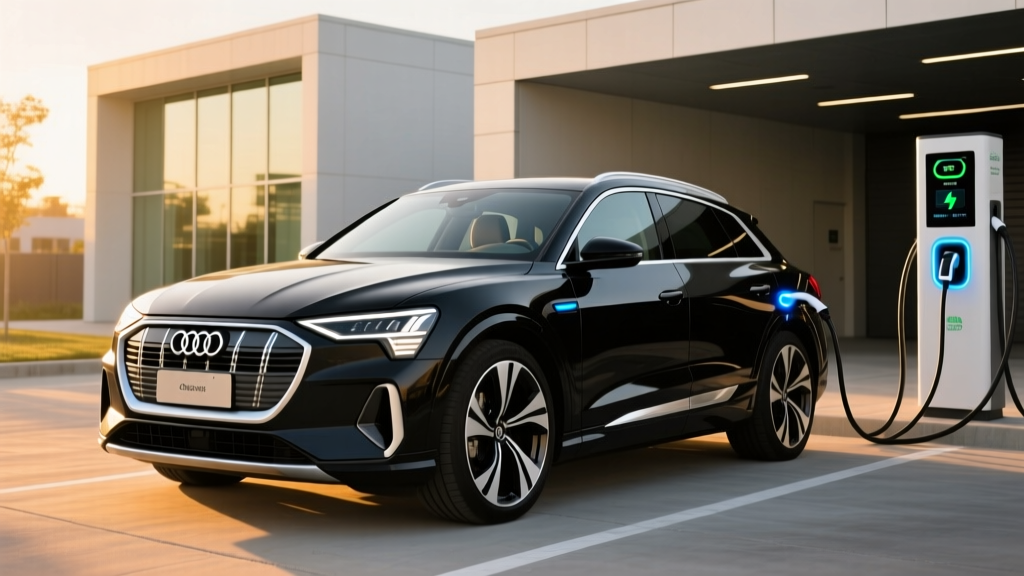
If you are shopping the premium used-EV market in 2026, the 2023 Audi e-tron occupies a compelling sweet spot: luxury build quality, a refined ride, and DC fast-charging that still holds up against newer rivals. Audi renamed its electric SUV lineup for 2024 (the e-tron became the Q8 e-tron), which means the 2023 model year represents the final iteration of the original e-tron platform — and that makes it a strong candidate for the federal used-EV tax credit.
This review breaks down everything a data-driven buyer needs: real-world range versus the EPA sticker, exact charging speeds and curve behavior, 2026 pricing with credit eligibility, and how the 2023 e-tron stacks up against the BMW iX, Mercedes EQE SUV, and Tesla Model X on the used market.
2023 Audi e-tron Quick Specs at a Glance
| Spec | e-tron Premium Plus | e-tron S |
|---|---|---|
| EPA Range | 222 miles | 208 miles |
| Battery (gross / usable) | 95.3 kWh / ~86.5 kWh (NMC) | 95.3 kWh / ~86.5 kWh (NMC) |
| Peak DC Fast Charge | 150 kW | 150 kW |
| 10–80% DC Time | ~30 minutes | ~30 minutes |
| Level 2 Home Charge | 11.5 kW (~27 mi/hr) | 11.5 kW (~27 mi/hr) |
| 0–60 mph | 5.5 seconds | 4.5 seconds |
| Horsepower | 402 hp (Boost mode) | 496 hp (Boost mode) |
| Drivetrain | Dual-motor AWD (quattro) | Tri-motor AWD |
| Combined MPGe | 78 MPGe | 73 MPGe |
| Efficiency | 43 kWh/100 mi | 46 kWh/100 mi |
| Cargo (rear seats up / folded) | 28.5 / 57.0 cu ft | 28.5 / 57.0 cu ft |
| Original MSRP (2023) | ~$70,800 | ~$96,500 |
| Battery Warranty | 8 yr / 100,000 mi | 8 yr / 100,000 mi |
Real-World Range: What to Expect Beyond the EPA Sticker
EPA estimate: 222 miles (Premium Plus), 208 miles (e-tron S)
Real-world highway (70–80 mph, moderate temps): ~185–200 miles
Real-world cold weather (below 32°F, highway): ~150–170 miles
Mixed city/highway commuting (55–65 mph, 60–80°F): ~200–215 miles
The 2023 Audi e-tron carries a 95.3 kWh gross battery pack (approximately 86.5 kWh usable) using nickel-manganese-cobalt (NMC) lithium-ion chemistry. Audi's conservative buffer strategy — keeping roughly 9% of the pack inaccessible — protects long-term battery health but directly limits range compared to competitors with smaller buffers.
The EPA rates the e-tron Premium Plus at 222 miles combined. In practice, expect to see closer to 185–200 miles on sustained highway driving at 70–80 mph. The e-tron's aerodynamic drag coefficient of 0.28 Cd is respectable for an SUV, but its 5,700-pound curb weight works against efficiency at speed. In cold weather — particularly below 32°F — range drops to roughly 150–170 miles on the highway due to battery heating demands and cabin climate load, even with the standard heat pump.
For daily commuting with mixed speeds, most owners report 200–215 miles comfortably. If your round-trip commute exceeds 180 miles or you frequently drive in sub-freezing climates, the range envelope tightens meaningfully. This is the e-tron's most honest limitation: it is a luxury cruiser, not a range champion.
Charging Speeds: DC Fast Charging and Home Setup
| Charging Level | Power / Rate | Time / Miles Added |
|---|---|---|
| Level 1 (120V household) | ~1.4 kW | ~4 miles per hour |
| Level 2 (240V home, 48A) | 11.5 kW | ~27 miles per hour; full charge ~9 hours |
| DC Fast Charge (peak) | 150 kW | 10–80% in ~30 min; adds ~140 miles in 20 min |
| DC Fast Charge (sustained avg) | ~110–120 kW avg | 10–80% real-world average |
The 2023 e-tron's 150 kW peak DC fast-charging capability was class-leading when it launched and remains competitive in 2026. What sets the e-tron apart is not peak speed but sustained charging behavior. Many EVs spike to a peak kW figure then taper aggressively. The e-tron's thermal management system holds close to 150 kW well into the 70% state of charge before tapering — a characteristic that makes real-world 10–80% times consistently close to 30 minutes at a properly rated charger.
For context, at an Electrify America or EVgo 150+ kW station, you can expect roughly 140 miles of range added in a 20-minute stop. Above 80% SoC, charging slows significantly — typical for NMC chemistry — so plan to unplug and drive rather than topping off to 100% on road trips unless you need the final miles to reach your destination.
At home on a Level 2 charger (240V, 48-amp circuit with a 60-amp breaker), the onboard 11.5 kW charger replenishes the battery at about 27 miles of range per hour. A full charge from near-empty takes roughly 9 hours — easily accomplished overnight. Installation of a home Level 2 charger typically costs $800–$2,000 depending on your electrical panel capacity and run length to the garage. Budget for a potential panel upgrade if your home still has a 100-amp service.
Performance and Driving Dynamics
The standard e-tron Premium Plus uses a dual-motor all-wheel-drive layout (Audi's electric quattro system) producing 355 hp in normal driving and 402 hp in Boost mode, which engages for short bursts during hard acceleration. The 0–60 mph time of 5.5 seconds is brisk rather than thrilling — appropriate for a luxury SUV focused on refinement over sportiness.
The e-tron S variant adds a tri-motor setup (one front, two rear) for 496 hp in Boost mode and a 4.5-second 0–60 time. The rear torque-vectoring motors give the S noticeably sharper cornering behavior, though the 5,900-pound curb weight is always present. Both variants feature adaptive air suspension with five ride-height settings, which lowers the vehicle at highway speed for improved aerodynamics and raises it for rough roads or light off-pavement use.
Towing capacity is rated at 4,000 pounds — adequate for a small boat or utility trailer but not competitive with the Rivian R1S (7,700 lb) or Tesla Model X (5,000 lb). If towing is a priority, factor in a 30–40% range reduction when pulling a loaded trailer.
Interior, Tech, and Daily Livability
The 2023 e-tron interior is where Audi's luxury positioning justifies the badge. Materials quality is excellent — standard leather upholstery, genuine aluminum trim, and tight panel gaps throughout. The cabin is notably quiet at highway speed, aided by acoustic glass and well-insulated motor mounts.
Infotainment: Audi's MMI touch response system uses dual screens (10.1-inch upper, 8.6-inch lower) with haptic feedback. Wireless Apple CarPlay and Android Auto are standard. The system is responsive, though the dual-screen layout requires more glance time than a single large display. The 12.3-inch Virtual Cockit digital instrument cluster is one of the best in the industry, with a dedicated EV range/efficiency view.
Driver Assistance: Standard features include adaptive cruise control with stop-and-go, lane centering assist, automatic emergency braking with pedestrian detection, and blind-spot monitoring. Available Audi Adaptive Cruise Assist with lane guidance is a competent Level 2 driver-assist system, though it does not match the hands-free capability of GM's Super Cruise or Ford's BlueCruise. The driver must keep hands on the wheel at all times.
Cargo and Passenger Space: The e-tron offers 28.5 cubic feet behind the second row and 57.0 cubic feet with the rear seats folded. Rear legroom is 39.1 inches — generous for adults on long trips. There is no front trunk (frunk); the space under the hood houses electronics. A small under-floor cargo area in the rear adds about 2 cubic feet of hidden storage.
Pricing, Trims, and Federal Tax Credit Eligibility in 2026
| Trim | 2023 MSRP | Est. 2026 Used Price | Used-EV Credit Eligible? |
|---|---|---|---|
| Premium Plus | $70,800 | $38,000–$45,000 | Yes, if ≤$25,000 sale price |
| Prestige | $77,400 | $42,000–$48,000 | Only if priced ≤$25,000 |
| e-tron S Premium Plus | $96,500 | $52,000–$60,000 | No (exceeds $25,000 cap) |
| e-tron S Prestige | $103,100 | $56,000–$65,000 | No (exceeds $25,000 cap) |
Since the 2023 Audi e-tron is now a used vehicle, it is no longer eligible for the new-vehicle §30D federal tax credit (up to $7,500). Instead, buyers should evaluate the Used Clean Vehicle Credit (§25E), which provides up to $4,000 or 30% of the sale price — whichever is lower — on qualifying pre-owned EVs. Key rules per the IRS Used EV Credit page:
- Sale price cap: The vehicle must sell for $25,000 or less to qualify
- Buyer income limits: AGI must not exceed $75,000 (single), $112,500 (head of household), or $150,000 (joint)
- Vehicle age: Must be at least 2 model years old (2023 models qualify in 2026)
- Dealer requirement: Must be purchased from a licensed dealer, who must report the sale to the IRS
- Once-per-vehicle limit: The credit can only be claimed once per VIN, regardless of how many times it is resold
In practice, this means the standard e-tron Premium Plus — if you can find one priced at or below $25,000 from a dealer — could net a $4,000 credit (30% of $25,000 = $7,500, but the cap is $4,000). Finding a 2023 e-tron at that price point in 2026 is challenging but not impossible for higher-mileage examples. The Prestige and S trims almost certainly exceed the $25,000 threshold and will not qualify. Always confirm eligibility with a tax professional before relying on the credit.
Competitor Comparison: e-tron vs. BMW iX, EQE SUV, Model X
| Spec | Audi e-tron | BMW iX xDrive50 | Mercedes EQE 350+ SUV | Tesla Model X LR |
|---|---|---|---|---|
| EPA Range | 222 mi | 324 mi | 279 mi | 348 mi |
| Battery | 95.3 kWh NMC | 111.5 kWh NMC | 90.6 kWh NMC | 100 kWh NMC |
| Peak DC Charge | 150 kW | 200 kW | 170 kW | 250 kW |
| 0–60 mph | 5.5 sec | 4.4 sec | 6.2 sec | 3.8 sec |
| Cargo (rear up) | 28.5 cu ft | 35.5 cu ft | 14.0 cu ft | 37.1 cu ft |
| Est. 2026 Used Price | $38K–$45K | $50K–$60K | $45K–$55K | $55K–$68K |
The e-tron's range is the weakest among these four, and that matters if road trips are frequent. The BMW iX offers 100 more miles of range and faster charging, but commands a premium on the used market. The Model X dominates on range, performance, and Supercharger access but has a less refined interior. The EQE SUV is the closest rival in luxury feel but offers surprisingly little cargo space.
The e-tron's advantage is value: it offers the most traditional luxury-car experience at the lowest entry price among German premium EVs. If your daily driving stays under 150 miles and you prioritize ride comfort and cabin quietness over range, the e-tron is a strong pick.
Pros and Cons
- Excellent build quality and cabin quietness
- Sustained 150 kW DC charging with minimal taper
- Comfortable adaptive air suspension ride
- Strong used-market value vs. German rivals
- 8-year/100,000-mile battery warranty transfers to second owner
- Heat pump standard for cold-climate efficiency
- 222-mile EPA range is below class average
- Cold-weather highway range drops to ~150 miles
- No front trunk (frunk) for additional storage
- Driver-assist system requires hands-on-wheel at all times
- Most used examples exceed $25K used-EV credit cap
- High energy consumption at 43 kWh/100 mi
Who Should Buy the 2023 Audi e-tron?
Think twice if: You regularly road-trip more than 200 miles between charging stops, live in an extreme cold climate without garage parking, or need maximum cargo space. The BMW iX or Tesla Model X serve those use cases better.
Frequently Asked Questions
What is the real-world range of the 2023 Audi e-tron?
The EPA rates it at 222 miles (Premium Plus). Expect 185–200 miles on the highway in moderate weather, 150–170 miles in cold weather below freezing, and up to 215 miles in mixed city driving. The e-tron S drops to 208 EPA miles with similar real-world reductions.
How fast does the 2023 e-tron charge?
At a 150+ kW DC fast charger, the e-tron charges from 10–80% in approximately 30 minutes, with sustained speeds close to peak well into the 70% SoC range. At home on Level 2 (240V, 48A), it charges at 11.5 kW, adding about 27 miles per hour — a full overnight charge in roughly 9 hours.
Does the 2023 Audi e-tron qualify for any federal tax credit in 2026?
As a used vehicle, it is not eligible for the new-vehicle §30D credit. It may qualify for the §25E Used Clean Vehicle Credit (up to $4,000) if the dealer sale price is $25,000 or less, the buyer meets income caps ($75K single / $150K joint), and the VIN has not previously been claimed. Most 2023 e-tron examples currently sell above the $25,000 threshold.
Is the 2023 e-tron worth buying vs. the BMW iX or Tesla Model X?
It depends on priorities. The e-tron offers the best ride comfort and cabin refinement at the lowest used-market price. The BMW iX delivers far more range (324 mi) and faster charging. The Tesla Model X wins on range, performance, and Supercharger network access. If daily range needs stay under 180 miles and luxury feel is paramount, the e-tron is a strong value.
What is the battery warranty on a used 2023 e-tron?
Audi's high-voltage battery warranty is 8 years or 100,000 miles (whichever comes first), covering defects and capacity loss below 70% of original capacity. This warranty transfers fully to subsequent owners. For a 2023 model, coverage extends through 2031 or 100,000 miles.
How much does it cost to charge the e-tron at home?
At the US average electricity rate of ~$0.16/kWh, fully charging the 86.5 kWh usable battery costs roughly $13.84 — translating to about $0.06 per mile. Compare that to a comparable gas SUV at 22 MPG and $3.40/gallon: roughly $0.15 per mile. Home charging cuts fuel costs by more than half.