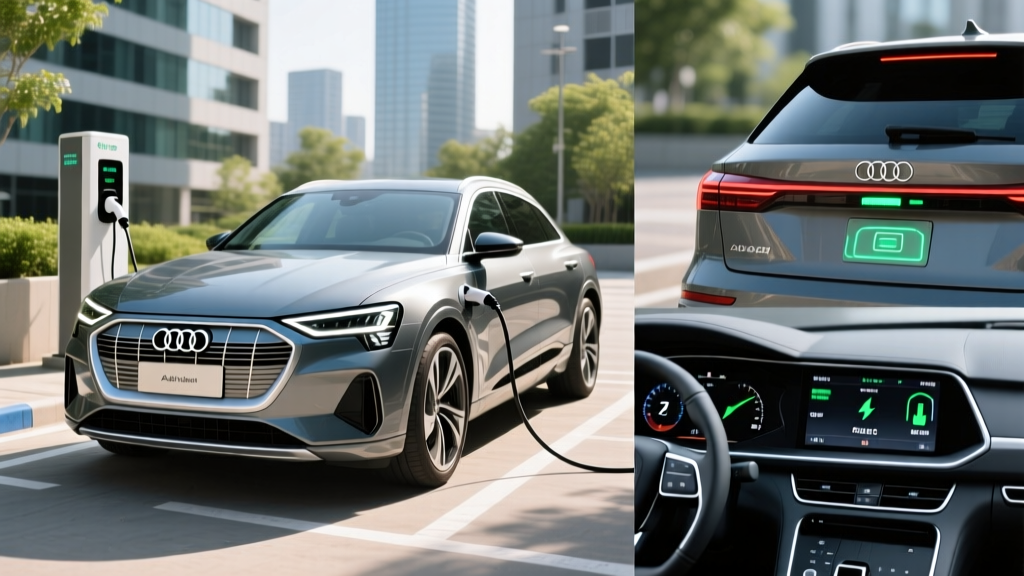
If you are shopping the used luxury electric SUV market in 2026, the 2021 Audi e-tron deserves a close look — not because it leads the pack in range or efficiency, but because it delivers a level of refinement, build quality, and charging-curve engineering that still holds up against newer rivals. Audi's first ground-up BEV was never the spec-sheet champion, but it was arguably the best-driving luxury EV of its era. Now that these vehicles are hitting the secondary market at significant discounts, the value proposition has shifted dramatically.
This review covers the 2021 Audi e-tron (the pre-rename generation — Audi rebranded the lineup to Q8 e-tron for the 2024 model year) with exact EPA figures, real-world range data, charging speeds, and a detailed look at whether this SUV qualifies for the used-EV federal tax credit under current IRS §25E rules.
2021 Audi e-tron: Core Specifications at a Glance
| Specification | e-tron SUV | e-tron Sportback |
|---|---|---|
| EPA Range | 222 miles | 218 miles |
| Battery (gross / usable) | 95 kWh / 86.5 kWh | 95 kWh / 86.5 kWh |
| Battery Chemistry | NMC (Nickel Manganese Cobalt) | NMC |
| Drivetrain | Dual-motor AWD (quattro) | Dual-motor AWD (quattro) |
| Horsepower (Boost Mode) | 402 hp | 402 hp |
| Torque (Boost Mode) | 490 lb-ft | 490 lb-ft |
| 0–60 mph | 5.5 seconds | 5.5 seconds |
| Max DC Fast Charge | 150 kW | 150 kW |
| 10–80% DC Charge Time | ~30 minutes | ~30 minutes |
| Level 2 Home Charge Rate | 9.6 kW (48A) | 9.6 kW (48A) |
| EPA Efficiency (Combined) | 78 MPGe (43 kWh/100mi) | 77 MPGe (44 kWh/100mi) |
| Cargo Volume (rear seats up/down) | 28.5 / 57.0 cu ft | 27.2 / 54.8 cu ft |
| Battery Warranty | 8 years / 100,000 miles | 8 years / 100,000 miles |
| Original Base MSRP | $65,900 | $69,900 |
Real-World Range: What the EPA Sticker Doesn't Tell You
EPA Sticker: 222 miles (SUV) / 218 miles (Sportback)
Real-World Highway (70 mph, mild weather): ~195–210 miles
Real-World Cold Weather (below 32°F, mixed driving): ~160–180 miles
Real-World City / Commuter (mild weather): ~215–230 miles
The 2021 e-tron's 222-mile EPA rating was already behind the Tesla Model X and Jaguar I-PACE at launch, and it looks even more modest against 2026 competitors pushing 300+ miles. But the EPA number is a blended cycle — the e-tron's real behavior depends heavily on how and where you drive.
On a 70-mph highway loop in 65–75°F conditions, expect roughly 195 to 210 miles before the battery hits the low-SoC buffer. The e-tron's relatively tall, heavy platform (5,765 lbs curb weight) and 0.28 drag coefficient penalize it at sustained highway speeds. However, in stop-and-go city driving, regenerative braking recovers meaningful energy, and some owners report exceeding the EPA estimate on urban commutes.
Cold weather is the great equalizer for all EVs, but the e-tron's liquid thermal management system and available heat pump (standard on 2021 models) help mitigate losses. Still, expect a 20–30% range reduction in sub-freezing temperatures, landing you around 160–180 miles of practical range. Audi's battery buffer strategy — reserving roughly 8.5 kWh of the 95 kWh gross capacity — protects long-term State of Health (SoH) but reduces the usable energy pool compared to some competitors that run a smaller buffer.
For context, fueleconomy.gov lists the 2021 e-tron at 78 MPGe combined, which translates to 43 kWh per 100 miles. That is thirstier than the 2021 Tesla Model X Long Range (101 MPGe / 33 kWh/100mi) and the 2021 Ford Mustang Mach-E Extended Range AWD (93 MPGe / 36 kWh/100mi).
Charging Performance: The e-tron's Secret Weapon
| Charging Level | Power / Voltage | Miles Added per Hour | Notes |
|---|---|---|---|
| Level 1 (120V household) | 1.2 kW | ~3 miles/hr | Emergency / overnight trickle only |
| Level 2 (240V home) | 9.6 kW (48A) | ~22 miles/hr | Full charge in ~9 hours |
| DC Fast Charge | 150 kW peak (CCS1) | ~150 miles in 30 min (10–80%) | Sustains high rate to ~70% SoC |
The 2021 e-tron's 150 kW peak DC fast-charging rate sounds unremarkable next to the 250–350 kW peaks now common on newer platforms. But peak kW tells only part of the story. The e-tron's charge curve is one of the flattest and most sustained in the industry — a characteristic that matters far more in practice than a headline number.
Most EVs hit their peak charge rate briefly (often only between 10–30% SoC) and then taper aggressively. The e-tron, by contrast, sustains close to 150 kW from roughly 10% all the way to about 70% SoC before gradually tapering. This means the 10–80% charge time of approximately 30 minutes is genuinely achievable at a 150 kW CCS station, not just a theoretical best-case. In real-world testing at Electrify America 150 kW stalls, the e-tron consistently adds 130–150 miles of range in a 30-minute session.
Above 80% SoC, the taper becomes steep — charging from 80–100% can take an additional 30–40 minutes. This is standard behavior for NMC chemistry managed conservatively, but it reinforces the practical habit of charging to 80% on road trips and moving on.
For home Level 2 charging, the onboard charger accepts up to 9.6 kW (48 amps on a 60-amp circuit). A full charge from near-empty takes about 9 hours, which is perfectly adequate for overnight replenishment. If your home electrical panel supports only a 40-amp circuit (32A / 7.7 kW), expect roughly 18 miles of range per hour and a 10–11 hour full charge. An Audi-recommended licensed electrician should evaluate your panel capacity before installation — a 200-amp panel upgrade may be necessary in older homes, adding $1,500–$3,000 to the installation cost.
Connector note: The 2021 e-tron uses the CCS1 (Combo) standard. As of 2026, the industry is migrating to NACS (Tesla's connector), and adapters are widely available. Audi has confirmed CCS-to-NACS adapters work with the e-tron for access to Tesla Supercharger V2/V3 stalls, though charge speed will be limited to the e-tron's 150 kW ceiling.
Performance and Driving Dynamics
The 2021 e-tron's dual-motor quattro all-wheel-drive system produces 355 hp in standard driving mode, with a Boost Mode (activated via the shift lever) that temporarily unlocks 402 hp and 490 lb-ft of torque for up to 60 seconds. In Boost Mode, the 0–60 mph sprint takes 5.5 seconds — brisk for a 5,765-lb SUV, though not thrilling by Tesla Model X Plaid standards (2.5 seconds).
Where the e-tron genuinely shines is ride quality. The standard adaptive air suspension delivers a compliant, near-silent ride that makes it one of the most comfortable luxury EVs on the highway. The steering is precise if not particularly communicative, and the low center of gravity (battery pack mounted under the floor) keeps body roll well-controlled through corners. This is a cruiser, not a sports SUV — and that is exactly what most luxury-EV buyers want.
The e-tron also offers a tow rating of 4,000 lbs (with the factory towing package), which is competitive for the segment and sufficient for a small boat trailer or lightweight camper.
Interior, Tech, and Driver Assistance
Audi's interior execution in the 2021 e-tron is a high point. The cabin uses premium materials — available Valcona leather, open-pore wood trim, and aluminum accents — with build quality that surpasses the Tesla Model X and rivals the Mercedes-Benz EQC. The dual-touchscreen MMI response setup (10.1-inch upper, 8.6-inch lower) handles infotainment and climate controls, though the lower screen's haptic-feedback buttons can be distracting while driving.
The 12.3-inch Virtual Cockit digital instrument cluster is one of the best in the business, offering a configurable EV-specific display with range, energy flow, and navigation mapping. Apple CarPlay and Android Auto are wired (not wireless) on the 2021 model year.
On the driver-assistance front, the 2021 e-tron comes equipped with Audi pre sense basic and pre sense city (automatic emergency braking with pedestrian detection), lane departure warning, and a rearview camera. The available Adaptive Cruise Assist with Traffic Jam Assist provides SAE Level 2 semi-automated driving — combining adaptive cruise control with lane-centering on highways. Note: this is a Level 2 system requiring continuous driver supervision, not a hands-off or "self-driving" capability.
Audi Adaptive Cruise Assist is an SAE Level 2 driver-assistance system. The driver must keep hands on the wheel and remain fully engaged at all times. It does not autonomously navigate, change lanes without confirmation, or handle all traffic scenarios. It is not comparable to Level 4 robotaxi services like Waymo.
Notable drawbacks: The e-tron lacks a front trunk (frunk) — the space under the hood houses power electronics. Rear-seat legroom (39.1 inches) is adequate but not generous for the class. And the second-row middle seat is best suited for children due to a pronounced floor hump.
Pricing, Trim Levels, and Federal Tax Credit Eligibility
| Trim | Original MSRP | Est. 2026 Used Price |
|---|---|---|
| Premium Plus (SUV) | $65,900 | $28,000–$35,000 |
| Prestige (SUV) | $72,200 | $32,000–$40,000 |
| Premium Plus (Sportback) | $69,900 | $30,000–$38,000 |
| Prestige (Sportback) | $76,200 | $35,000–$43,000 |
The 2021 e-tron's original MSRP placed it firmly in luxury-EV territory. Depreciation has been steep — a common pattern for early luxury EVs — and 2026 used-market pricing puts most examples between $28,000 and $43,000 depending on trim, mileage, and condition.
Does the 2021 Audi e-tron qualify for a federal tax credit?
The new-vehicle §30D federal tax credit of up to $7,500 no longer applies to the 2021 e-tron, since it is only available as a used vehicle. However, the §25E Used Clean Vehicle Credit may apply if you purchase from a licensed dealer. Key requirements as of 2026:
- Credit amount: 30% of the sale price, up to a maximum of $4,000
- Vehicle price cap: Sale price must be $25,000 or less
- Buyer income caps: AGI must not exceed $75,000 (single), $112,500 (head of household), or $150,000 (married filing jointly)
- Vehicle age: Must be at least 2 model years old (the 2021 qualifies)
- Dealer sale required: Private-party purchases do not qualify
- First-time transfer: The credit can only be claimed once per vehicle since August 16, 2022
- Battery requirement: Vehicle must have at least 7 kWh battery capacity (e-tron's 95 kWh easily meets this)
Practical reality: Many 2021 e-tron Prestige and Sportback examples sell above the $25,000 price cap, disqualifying them from the used credit. Premium Plus SUV models with higher mileage are more likely to fall under the threshold. Always verify eligibility with the selling dealer and consult IRS guidance on §25E before finalizing a purchase. Tax professionals can confirm your income eligibility and whether the point-of-sale transfer option is available at your dealership.
Ownership Costs and Long-Term Outlook
Charging costs for the e-tron are moderate. At the national average residential electricity rate of ~$0.16/kWh (2026 EIA data), a full 86.5 kWh usable charge costs roughly $13.84, yielding a per-mile cost of about $0.063 at EPA efficiency. DC fast charging at Electrify America or EVgo typically runs $0.35–$0.48/kWh depending on the plan and time of day, pushing road-trip fueling costs to $0.13–$0.17 per mile — still below the $0.14–$0.18 per mile a comparable 22-mpg gas SUV would burn at $3.50/gallon.
Insurance premiums for the e-tron tend to run 15–25% higher than equivalent ICE Audi Q5 models, reflecting repair-cost data for EV battery packs and aluminum body panels. Expect annual premiums in the $1,800–$2,600 range depending on your state, driving record, and coverage level.
The 8-year/100,000-mile battery and powertrain warranty (mandated by federal emissions regulations for EVs) covers defects and capacity loss below 70% of original capacity. For a 2021 model, that warranty extends through the 2029 model year or 100,000 miles — whichever comes first. Given that NMC batteries in the e-tron's thermal management system have shown degradation of roughly 8–12% over the first 5 years / 60,000 miles in owner-reported data, most examples should retain 85–90% State of Health at this point in their lifecycle.
If the battery ever requires out-of-warranty replacement, expect a quote in the $15,000–$22,000 range from Audi, though third-party EV battery specialists are beginning to offer module-level repairs for $5,000–$10,000.
2021 Audi e-tron vs. Key Competitors
| Attribute | Audi e-tron | Tesla Model X LR | Jaguar I-PACE | Mercedes EQC |
|---|---|---|---|---|
| EPA Range | 222 mi | 360 mi | 234 mi | 220 mi (est.) |
| 10–80% DC Charge | ~30 min | ~25 min | ~40 min | ~40 min |
| 0–60 mph | 5.5 sec | 3.8 sec | 4.5 sec | 4.8 sec |
| Used Price (2026) | $28K–$43K | $35K–$55K | $24K–$38K | $25K–$38K |
| Build Quality | Excellent | Good | Very Good | Very Good |
| Charging Curve | Flat / sustained | Peak-heavy | Slow taper | Slow taper |
The Model X wins on range and performance, but the e-tron surpasses it in interior fit-and-finish and ride comfort. The I-PACE offers sharper handling and a lower used price, but its 100 kW DC charge ceiling makes road trips noticeably slower. The EQC is the e-tron's closest rival in comfort but was never officially sold in the U.S., limiting parts availability.
- Exceptionally flat DC charging curve — real-world 30-min 10–80% sessions
- Class-leading ride quality with standard air suspension
- Premium interior materials and build quality
- 4,000-lb towing capacity
- Quiet cabin even at highway speeds
- Strong depreciation = compelling used value
- Below-average EPA range (222 mi) for the class
- Heavy at 5,765 lbs — hurts efficiency
- No frunk (front trunk)
- 150 kW peak DC charge rate trails newer platforms
- Many used examples exceed §25E credit price cap
- Wired-only Apple CarPlay / Android Auto
Who Should Buy the 2021 Audi e-tron?
Choose the 2021 e-tron if:
- You prioritize ride comfort and interior luxury over maximum range
- Your daily commute is under 150 miles round-trip with home charging
- You value a sustained, predictable DC fast-charging experience on road trips
- You want a premium badge at a depreciated price point ($28K–$40K)
- You need a 4,000-lb tow rating for a small trailer
- You need 300+ miles of range for frequent long-distance driving
- You want the latest ADAS technology (GM Super Cruise, Tesla FSD)
- You require three-row seating (consider the Model X or Rivian R1S)
- You want NACS native charging without an adapter
The 2021 Audi e-tron is best suited as a luxury daily commuter and weekend-trip vehicle for households with reliable home Level 2 charging. Its range is sufficient for the vast majority of daily driving, and its charging behavior makes road trips manageable if you plan stops around 150 kW CCS stations. It is not the right choice for buyers who regularly drive 300+ miles in a single day or who need the longest possible range between charges.
Frequently Asked Questions
What is the real-world range of the 2021 Audi e-tron?
The EPA rates the e-tron SUV at 222 miles and the Sportback at 218 miles. In real-world highway driving at 70 mph in mild weather, expect 195–210 miles. In cold weather (below freezing), expect 160–180 miles. City driving with regenerative braking can push slightly above the EPA estimate.
How fast does the 2021 e-tron charge at home and on the road?
At home on a 240V Level 2 charger (9.6 kW), the e-tron adds about 22 miles of range per hour, with a full charge taking approximately 9 hours. On a 150 kW DC fast charger, the 10–80% charge takes about 30 minutes, with an exceptionally flat charge curve that sustains near-peak power to ~70% SoC.
Does the 2021 Audi e-tron qualify for the federal EV tax credit in 2026?
Not the new-vehicle §30D credit. However, it may qualify for the §25E Used Clean Vehicle Credit of up to $4,000 if the sale price is $25,000 or less, you buy from a licensed dealer, and your AGI falls within IRS income caps ($75K single / $150K married filing jointly). Many e-tron examples exceed the $25,000 price cap, so eligibility varies by specific vehicle and trim.
Is the 2021 e-tron worth buying vs. a Tesla Model X or newer EV?
If you value interior quality, ride comfort, and a predictable charging experience over maximum range and acceleration, the e-tron is a strong used buy. It costs significantly less than a used Model X and offers a more refined cabin. However, if range is your top priority, the Model X (360 mi EPA) or a newer Hyundai Ioniq 5 (303+ mi) are better fits.
How long will the 2021 e-tron's battery last?
The NMC battery is covered by an 8-year/100,000-mile warranty (through 2029 for a 2021 model). Owner data suggests roughly 8–12% degradation over the first 5 years / 60,000 miles, meaning a well-maintained 2021 e-tron likely retains 85–90% of its original capacity today. With proper care (avoiding frequent 100% charges, minimizing DC fast charging in extreme heat), the pack should deliver 150,000–200,000+ miles before significant capacity loss.
Can I charge a 2021 e-tron at Tesla Superchargers?
Yes, with a CCS-to-NACS adapter. The e-tron's CCS1 port is compatible with Tesla Supercharger V2 and V3 stalls via widely available third-party adapters. Charge speed will be limited to the e-tron's 150 kW maximum, even at a 250 kW V3 stall.
Sources: U.S. EPA / fueleconomy.gov, IRS §25E Used Clean Vehicle Credit, NHTSA