Quick Answer: Which Audi Electric SUV Fits You?
Audi currently sells two fully electric SUVs in the U.S.: the Q8 e-tron (midsize, 285-mile EPA range, starting ~$75,695) and the newer Q6 e-tron (compact, up to 321 miles EPA, starting ~$65,095). If you prioritize cargo space and highway comfort, the Q8 e-tron is the stronger pick. If you want the latest 800-volt charging architecture (10–80% in ~21 minutes), sharper efficiency, and a lower entry price, the Q6 e-tron is the more compelling buy in 2026. Neither qualifies for the full $7,500 federal §30D tax credit at time of writing due to battery-sourcing rules—always verify current eligibility at IRS.gov.
Audi's 2026 Electric SUV Lineup at a Glance
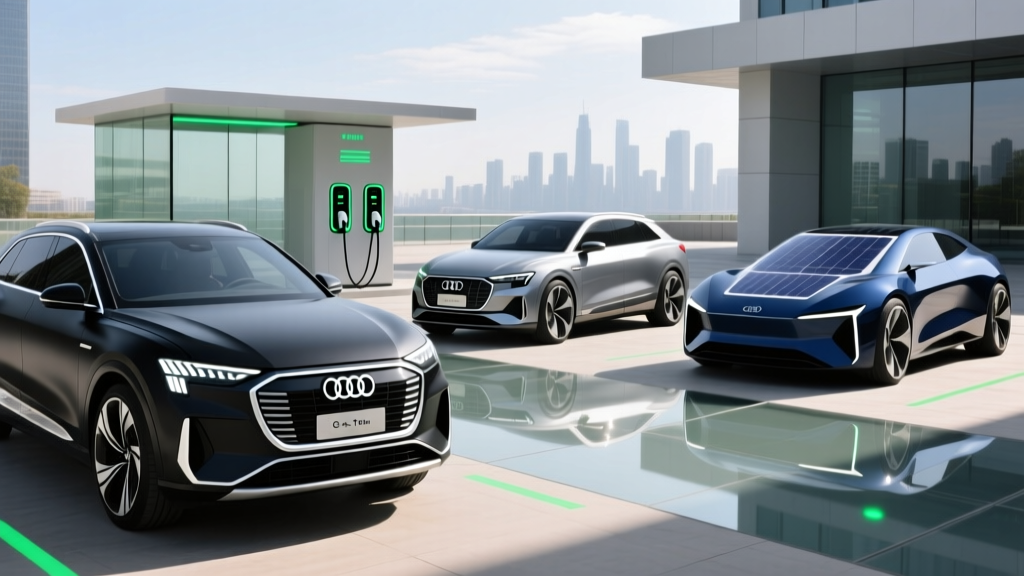
Audi has consolidated its EV naming. The original e-tron (introduced in 2019) was renamed the Q8 e-tron for the 2024 model year, receiving a larger battery and improved aerodynamics. The Q6 e-tron, built on the new PPE (Premium Platform Electric) architecture co-developed with Porsche, arrived for 2025 and carries into 2026 with minor trim adjustments.
| Spec | Q6 e-tron (Premium) | Q6 e-tron quattro | Q8 e-tron Premium | Q8 Sportback e-tron |
|---|---|---|---|---|
| EPA Range | 321 mi | 308 mi | 285 mi | 288 mi |
| Battery (usable) | 94.4 kWh (NMC) | 94.4 kWh (NMC) | 106 kWh (NMC) | 106 kWh (NMC) |
| Platform | PPE (800V) | PPE (800V) | MLB Evo (400V) | MLB Evo (400V) |
| Horsepower | 335 hp (boost: 456 hp) | 435 hp (boost: 509 hp) | 402 hp | 402 hp |
| 0–60 mph | 4.9 sec | 4.6 sec | 5.5 sec | 5.5 sec |
| Peak DC Charge | 270 kW | 270 kW | 170 kW | 170 kW |
| 10–80% DC Time | ~21 min | ~21 min | ~31 min | ~31 min |
| Level 2 (AC) | 11.5 kW | 11.5 kW | 11.5 kW | 11.5 kW |
| MPGe (combined) | 100 MPGe | 93 MPGe | 84 MPGe | 85 MPGe |
| Cargo (rear seats up) | 28.7 cu ft | 28.7 cu ft | 28.5 cu ft | 27.2 cu ft |
| Base MSRP | $65,095 | $68,895 | $75,695 | $79,195 |
| Battery Warranty | 8 yr / 100,000 mi | 8 yr / 100,000 mi | 8 yr / 100,000 mi | 8 yr / 100,000 mi |
Sources: EPA / fueleconomy.gov, Audi USA. EPA estimates; your real-world range will vary based on temperature, speed, and terrain.
Real-World Range vs. EPA Sticker
Q6 e-tron (321 mi EPA): Expect ~265–285 miles on a highway-heavy road trip at 70–75 mph. In freezing temperatures (below 32°F), plan for 220–245 miles due to cabin heating demand and reduced battery chemistry efficiency. The Q6's heat pump (standard on most trims) helps mitigate cold-weather losses by ~10–15% compared to resistive heating.
Q8 e-tron (285 mi EPA): Highway driving at sustained speeds typically yields 235–255 miles. Cold-weather range drops to roughly 200–220 miles. The Q8's larger 106 kWh battery compensates somewhat for its lower efficiency, but the 400-volt architecture means less energy density per pound than the PPE platform.
Charging Speed: Where the Q6 e-tron Pulls Ahead
The biggest practical difference between Audi's two electric SUVs is the charging architecture. The Q6 e-tron uses an 800-volt PPE platform, enabling a peak DC fast-charge rate of 270 kW. The Q8 e-tron, on the older MLB Evo 400-volt architecture, peaks at 170 kW.
Here's what that means at a DC fast charger:
| Charging Level | Q6 e-tron | Q8 e-tron |
|---|---|---|
| Level 1 (120V / 12A) | ~1.4 kW · ~4 mi/hr | ~1.4 kW · ~3 mi/hr |
| Level 2 (240V / 48A) | 11.5 kW · ~33 mi/hr | 11.5 kW · ~28 mi/hr |
| DC Fast (peak) | 270 kW · ~21 min (10–80%) | 170 kW · ~31 min (10–80%) |
Charging-curve reality: Neither SUV sustains its peak rate for the entire session. The Q6 e-tron holds above 200 kW up to roughly 50% state of charge (SoC), then tapers. Above 80%, both vehicles drop below 50 kW to protect battery longevity—this is normal and why 10–80% times are the standard metric. On a road trip, the Q6's faster charging saves roughly 10 minutes per stop, which compounds over multi-day drives.
Both models use the CCS1 connector natively. Audi includes a NACS adapter for Tesla Supercharger access (standard on 2025+ models; retrofit availability for earlier Q8 e-trons varies by dealer). Electrify America's 350 kW stalls are the best match for the Q6's peak capability.
EV vs. Gas: How Audi's Electric SUVs Compare to the Q5 and Q7
Buyers cross-shopping Audi's electric SUVs often compare them to the gas-powered Q5 (compact) and Q7 (midsize). Here's a data-driven comparison:
| Metric | Q6 e-tron quattro | Q5 45 TFSI (gas) | Q8 e-tron | Q7 45 TFSI (gas) |
|---|---|---|---|---|
| Base MSRP | $68,895 | $46,695 | $75,695 | $61,795 |
| EPA Efficiency | 93 MPGe | 25 MPG combined | 84 MPGe | 21 MPG combined |
| Energy cost / 1,000 mi* | ~$105 (home charging) | ~$132 (gasoline) | ~$127 (home charging) | ~$157 (gasoline) |
| 0–60 mph | 4.6 sec | 5.7 sec | 5.5 sec | 6.5 sec |
| Annual maintenance (est.) | ~$300 | ~$650 | ~$300 | ~$700 |
*Based on $0.15/kWh national average and $3.30/gal regular unleaded. Public DC fast charging at $0.40–$0.50/kWh raises EV costs to roughly $140–$175 per 1,000 miles.
The electric Audis cost $15,000–$20,000 more upfront but save $300–$500 annually in fuel and maintenance. The breakeven point without tax incentives is roughly 8–12 years at 12,000 miles per year. With a federal or state credit, that window shrinks to 4–7 years.
Real Ownership Costs: 5-Year Breakdown
Below is a five-year total-cost-of-ownership estimate for the Q6 e-tron quattro versus the Q5 45 TFSI, assuming 12,000 miles/year, 80% home charging at $0.15/kWh, and 20% public DC at $0.45/kWh.
| Category | Q6 e-tron quattro | Q5 45 TFSI |
|---|---|---|
| Purchase price (base) | $68,895 | $46,695 |
| Federal tax credit (§30D) | $0 (sourcing rules)* | $0 |
| Estimated state incentives | $0–$2,000 (varies) | $0 |
| Fuel / energy (5 yr) | $6,400 | $7,920 |
| Maintenance (5 yr) | $1,500 | $3,250 |
| Insurance (5 yr est.) | $12,500 | $9,500 |
| Depreciation (est. 50%) | $34,448 | $23,348 |
| Total 5-yr cost | ~$123,743 | ~$90,713 |
*Verify §30D eligibility at IRS.gov. Audi's battery supply chain currently limits credit eligibility for most trims. Insurance premiums for EVs are typically 15–25% higher due to repair costs and battery replacement values.
The gap narrows if your state offers rebates (e.g., California's CVRP, Colorado's innovative motor vehicle credit) or if you have access to free/subsidized workplace charging. But the upfront premium remains the largest barrier.
Common Misconceptions About Audi Electric SUVs
| Myth | Fact |
|---|---|
| "The battery will need replacing in 5 years." | Audi warranties the battery for 8 years / 100,000 miles against capacity loss below 70%. NMC chemistry in modern Audis typically degrades ~10–15% over 150,000 miles based on industry fleet data. |
| "Audi electric SUVs qualify for the $7,500 federal tax credit." | As of 2026, most Audi EVs do not meet §30D critical-mineral and battery-component sourcing requirements. Check the IRS qualified-vehicles list before purchasing—rules update periodically. |
| "I can charge to 100% at a DC fast charger in 20 minutes." | DC fast charging is rated 10–80% because the charge rate tapers sharply above 80% to protect battery health. A 10–100% session can take 45–55 minutes. For daily driving, charging to 80% is recommended. |
| "Electric Audis cost more to insure because they're unreliable." | Higher premiums reflect higher repair costs (specialized body shops, battery handling protocols), not reliability. Audi's EV powertrains have fewer moving parts than ICE equivalents. |
| "You can't drive an EV in winter." | Range drops 15–30% in sub-freezing temperatures. The Q6 e-tron's standard heat pump and battery preconditioning mitigate this. Preconditioning while plugged in preserves range and charges the cabin before departure. |
Home Charging Setup: What You Actually Need
Neither Audi includes a Level 2 home charger in the box. You'll need a 240-volt, 48-amp hardwired wall connector (or a NEMA 14-50 outlet with a mobile connector) for overnight charging. Both Audis accept up to 11.5 kW on Level 2, which fully replenishes the Q6 e-tron's 94.4 kWh battery in roughly 9 hours and the Q8 e-tron's 106 kWh battery in about 10.5 hours.
Typical home installation costs:
- Level 2 charger (hardware): $400–$700 (Audi-branded or third-party like ChargePoint Home Flex or Emporia Vue)
- Electrician labor (240V run, 50-amp circuit): $800–$2,500 depending on panel proximity
- Electrical panel upgrade (if needed, 200A service): $1,500–$4,000
- Permit: $50–$200 depending on municipality
If your electrical panel is near the garage and has spare capacity, expect $1,200–$2,000 total. Older homes with 100-amp service may need a panel upgrade, pushing the total to $3,500–$5,500. Always get a quote from a licensed electrician before committing to an EV purchase.
Decision Framework: Which Audi Electric SUV Should You Buy?
Choose the Q6 e-tron if:
- You want the fastest charging (270 kW peak, 10–80% in ~21 min) for frequent road trips
- You prioritize the latest infotainment (14.5" OLED touchscreen, augmented-reality HUD)
- Your budget is $65,000–$75,000 and you want a compact luxury EV
- You value efficiency (100 MPGe RWD) over sheer cargo volume
Choose the Q8 e-tron if:
- You need maximum cargo flexibility (28.5 cu ft rear seats up, 57 cu ft folded)
- You prefer a quieter, more planted highway ride (longer wheelbase, air suspension standard)
- You tow occasionally (4,000-lb capacity vs. Q6's 3,500-lb rating)
- Your budget extends to $75,000–$85,000 and you value space over charging speed
Consider a gas Q5 or Q7 instead if:
- You lack reliable home or workplace charging access
- Your budget is below $50,000
- You regularly drive 400+ miles in a single day through rural areas with sparse DC fast-charging infrastructure
Wait for the Q4 e-tron refresh or upcoming models if:
- You want a sub-$55,000 entry point (the Q4 e-tron starts ~$50,995 but is on the older MEB platform with slower charging)
- You're tracking Audi's announced SQ6 e-tron performance variant (expected late 2026, preliminary specs suggest 543 hp and a sport-tuned suspension)
Frequently Asked Questions
Do Audi electric SUVs qualify for any federal tax credit in 2026?
Most do not. The §30D credit requires vehicles to meet critical-mineral sourcing and battery-component manufacturing thresholds set by the Inflation Reduction Act. Audi's current supply chain has not met these thresholds for most trims. The IRS updates its qualified-vehicle list periodically, so always check IRS.gov before purchasing. Some state incentives (e.g., California, Colorado, Massachusetts) may still apply regardless of federal eligibility.
How long does the battery last, and what does replacement cost?
Audi warranties its high-voltage batteries for 8 years or 100,000 miles against capacity loss below 70% of original. Real-world degradation data from European fleet operators suggests NMC batteries in PPE-platform vehicles retain ~85–90% capacity after 100,000 miles under normal use. Out-of-warranty battery replacement for a 94–106 kWh pack currently runs $18,000–$28,000 including labor, though prices are expected to decline as battery manufacturing scales.
Can I use Tesla Superchargers with an Audi electric SUV?
Yes, with an adapter. Audi provides a NACS-to-CCS adapter for 2025+ Q6 e-tron and Q8 e-tron models. Retrofit adapters for earlier Q8 e-trons may be available through dealers. On Tesla's V3 and V4 Superchargers, expect peak rates limited by the vehicle's onboard charger: ~170 kW for the Q8 e-tron and ~250 kW for the Q6 e-tron (the Q6's 800V architecture can leverage higher-power stalls more effectively).
What's the difference between kW and kWh?
kW (kilowatts) measures power—the rate at which energy flows. A 270 kW charger delivers energy quickly, like a wide hose. kWh (kilowatt-hours) measures energy capacity—how much the battery holds, like the size of a tank. The Q6 e-tron has a 94.4 kWh battery and can accept up to 270 kW of charging power. You need both numbers: kWh tells you how far you can go; kW tells you how fast you can recharge.
Is Audi's driver-assist system self-driving?
No. Audi's Adaptive Cruise Assist with lane guidance is an SAE Level 2 system, meaning the driver must remain fully engaged—hands on or near the wheel, eyes on the road—at all times. It is not autonomous driving. Only Level 4 services like Waymo operate without a human driver, and those are limited to specific geofenced areas in select cities.
Should I charge to 100% every night?
For daily driving, Audi recommends setting the charge limit to 80% to prolong battery life. NMC chemistry degrades faster when held at high SoC for extended periods. Charge to 100% only before long road trips, and try to depart shortly after reaching full charge rather than letting the car sit at 100% for hours.