Quick Answer: Audi Electric SUVs in China (2026)
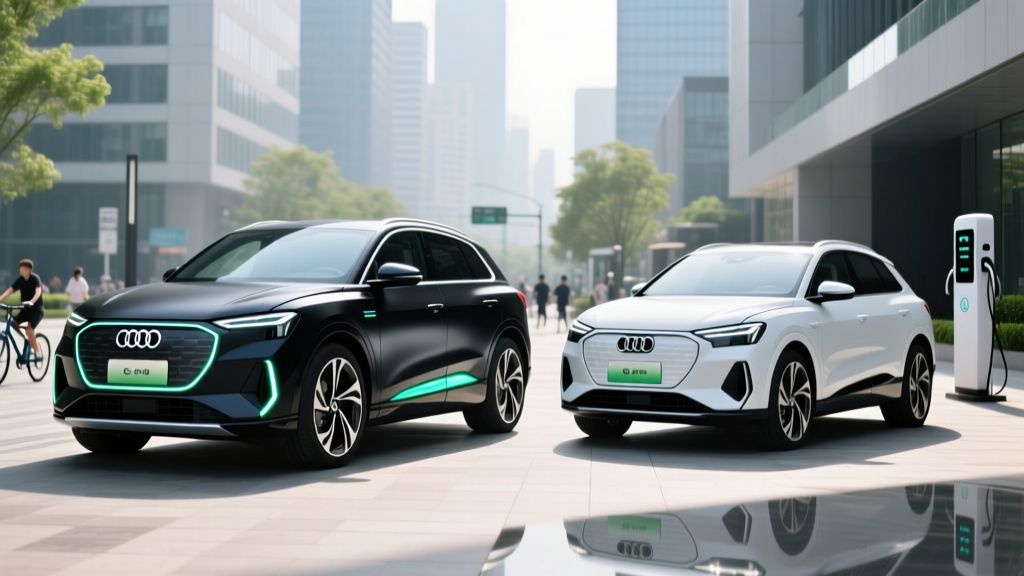
Audi's electric SUV lineup for the Chinese market centers on the Q4 e-tron (produced via the FAW-VW joint venture) and the Q6 e-tron (built on the PPE platform with SAIC Audi). The Q4 e-tron starts around ¥298,500 (~$41,000 USD) with up to 605 km CLTC range, while the Q6 e-tron starts near ¥398,000 (~$55,000 USD) with up to 700+ km CLTC range. These models are not sold in the United States and do not qualify for the U.S. §30D federal tax credit. They are purpose-built for Chinese buyers navigating license-plate restrictions, city congestion, and a rapidly maturing domestic charging network.
Why Audi Is Betting Big on Electric SUVs in China
China is the world's largest EV market, with new-energy vehicle (NEV) penetration exceeding 45% of new car sales by early 2026. For Audi, China accounts for roughly 40% of global deliveries, making localized electric SUV production not optional but existential. The brand operates through two joint ventures: FAW-Volkswagen (producing the Q4 e-tron in Foshan) and SAIC Audi (producing the Q6 e-tron in Shanghai's Anting district).
This dual-partner strategy lets Audi cover both the premium-compact segment (Q4 e-tron) and the mid-to-large luxury SUV segment (Q6 e-tron) with vehicles engineered for Chinese road conditions, digital ecosystem preferences (WeChat mini-programs, Baidu Maps integration, Alipay payment at chargers), and regulatory realities. In cities like Shanghai and Beijing, a new-energy vehicle plate can be obtained through a lottery or auction system where EVs receive preferential treatment—sometimes saving buyers ¥90,000 or more versus a combustion-car plate.
The competitive landscape is fierce. Audi's electric SUVs in China compete against the NIO ES6, Li Auto L7 (extended-range), BMW iX3 (also locally produced), Mercedes EQB, and increasingly, domestic challengers like the XPeng G9 and Avatr 11. Understanding where Audi fits requires looking at the numbers.
Audi Q4 e-tron vs Q6 e-tron: Side-by-Side Specs
| Specification | Q4 e-tron (FAW-VW) | Q6 e-tron (SAIC Audi) |
|---|---|---|
| Platform | MEB | PPE (Premium Platform Electric) |
| Battery (usable) | 84.8 kWh (NMC) | 100 kWh (NMC) |
| CLTC Range | Up to 605 km (~376 mi) | Up to 700+ km (~435 mi) |
| Real-World Highway Range | ~420–460 km (~260–285 mi) | ~500–550 km (~310–340 mi) |
| Max DC Fast Charge | 135 kW | 270 kW |
| 10–80% DC Charge Time | ~28 minutes | ~21 minutes |
| AC Level 2 Charge (0–100%) | ~9 hours (11 kW) | ~10 hours (11 kW) |
| Motor Output | 150 kW (201 hp) RWD / 220 kW (295 hp) AWD | 250 kW (335 hp) RWD / 380 kW (509 hp) AWD |
| 0–100 km/h | 8.8s (RWD) / 6.8s (AWD) | 6.2s (RWD) / 4.5s (AWD) |
| Starting Price (China) | ~¥298,500 (~$41,000) | ~¥398,000 (~$55,000) |
| Battery Warranty | 8 years / 160,000 km | 8 years / 160,000 km |
| ADAS | Audi Adaptive Cruise, Lane Assist (Level 2) | Audi Adaptive Drive Assist Plus (Level 2) |
Key distinction: The Q6 e-tron's PPE platform, co-developed with Porsche, supports 800-volt architecture. This enables the 270 kW peak DC charging rate—nearly double the Q4 e-tron's MEB-based 135 kW. On China's expanding network of 480 kW+ ultra-fast chargers (deployed by operators like XPeng, NIO Power, and State Grid), the Q6 e-tron can exploit its full charging potential, while the Q4 e-tron will bottleneck well below what newer stations offer.
Real-World Range: CLTC Sticker vs What You'll Actually Get
China uses the CLTC (China Light-Duty Vehicle Test Cycle) standard, which tends to produce more optimistic range figures than the U.S. EPA or European WLTP cycles. CLTC emphasizes low-speed urban driving with frequent stops—conditions that favor EVs through regenerative braking.
Real-World Range Expectations
Q4 e-tron (605 km CLTC): Expect approximately 420–460 km on highway trips at 100–120 km/h in moderate weather. In winter conditions (northern China, –10°C to –20°C), range can drop to 320–370 km due to battery heating demands and reduced cell efficiency. The Q4 e-tron uses a heat pump on higher trims, which mitigates cold-weather loss by roughly 10–15% compared to resistive heating.
Q6 e-tron (700+ km CLTC): Highway real-world range lands around 500–550 km in mild conditions. Winter highway driving may yield 400–450 km. The PPE platform's more advanced thermal management system and standard heat pump help preserve range in cold climates like Harbin or Shenyang.
For context, the average Chinese commuter drives roughly 30–40 km per day in urban settings, meaning either vehicle covers well over a week of commuting on a single charge. The range concern arises primarily on intercity trips—say, Shanghai to Hangzhou (~170 km) or Beijing to Tianjin (~130 km)—where a single charge suffices but leaves minimal buffer in winter.
Charging Infrastructure: Home, Public, and the 800V Advantage
China's public charging network is the world's largest, with over 3 million public charging points as of late 2025, according to the China Electric Vehicle Charging Infrastructure Promotion Alliance. However, quality varies enormously.
| Charging Level | Power | Q4 e-tron Speed | Q6 e-tron Speed | Typical Use |
|---|---|---|---|---|
| Level 1 (Portable EVSE) | ~1.8 kW | ~9 km/hr added | ~10 km/hr added | Emergency top-up |
| Level 2 (Home/Wallbox) | 7–11 kW | ~45–60 km/hr added | ~50–65 km/hr added | Overnight home charging |
| DC Fast (Public) | 50–135 kW | Up to 135 kW peak | Up to 135 kW (limited by station) | Shopping-mall / highway stops |
| DC Ultra-Fast (Public) | 180–480 kW | Capped at 135 kW | Up to 270 kW peak | Newer highway / city stations |
Home charging reality: Most Chinese apartment dwellers cannot install a personal wallbox. Audi addresses this through partnerships with charging operators (Star Charge, State Grid e-Chongdian) offering discounted public-charging packages bundled with vehicle purchase. Buyers with dedicated parking spots and access to their building's electrical panel can install an 11 kW Audi wallbox for approximately ¥4,000–8,000 ($550–$1,100), including equipment and licensed electrician labor. Older residential compounds may require a panel upgrade adding ¥2,000–5,000.
The 800V charging-curve reality for Q6 e-tron: The 270 kW peak rate is not sustained across the entire session. Expect peak power from roughly 10% to 40% SoC, after which the rate tapers progressively—dropping to ~150 kW by 60%, ~80 kW by 80%, and below 40 kW above 90%. A 10–80% session takes approximately 21 minutes at a capable 350+ kW station, but at a more common 120 kW station, that same session stretches to 35–40 minutes.
Cost Breakdown: Purchase, Charging, and Ownership
Let's compare the total cost of owning an Audi Q6 e-tron versus a comparably priced gasoline SUV—the Audi Q5L (the long-wheelbase Q5 sold in China)—over a 5-year, 100,000 km ownership period.
| Cost Category | Q6 e-tron (EV) | Q5L 45 TFSI (Gas) |
|---|---|---|
| Purchase Price (base) | ~¥398,000 | ~¥396,800 |
| Purchase Tax (China) | Exempt (NEV policy through 2025; 50% reduction in 2026–2027, capped at ¥15,000) | ~¥35,100 (10% of pre-tax price) |
| Effective Purchase Cost | ~¥398,000 + ~¥7,500 (2026 half-tax) | ~¥431,900 |
| Energy Cost (100,000 km) | ~¥9,000–12,000 (avg. ¥0.9–1.2/kWh public; lower with home) | ~¥48,000–55,000 (avg. 8.5 L/100 km at ¥8.0/L) |
| Maintenance (5 years) | ~¥6,000–8,000 (cabin filter, brake fluid, tires) | ~¥25,000–35,000 (oil, filters, spark plugs, brakes) |
| Insurance (annual avg.) | ~¥9,000–12,000/yr | ~¥7,500–10,000/yr |
| 5-Year Insurance Total | ~¥52,500 | ~¥43,750 |
| Estimated Resale Value (5yr) | ~¥180,000–210,000 (~45–53% retention) | ~¥200,000–230,000 (~50–58% retention) |
| Approx. 5-Year Total Cost of Ownership | ~¥465,000–¥483,500 | ~¥553,650–¥599,650 |
The takeaway: The Q6 e-tron saves roughly ¥70,000–120,000 ($9,600–$16,500) over five years, primarily through fuel and maintenance savings plus the purchase-tax advantage. Higher EV insurance premiums partially offset this, as do slightly lower residual values—a persistent challenge for EVs in China's used-car market where battery-health uncertainty depresses buyer confidence.
For the Q4 e-tron, savings versus a gas compact SUV like the Audi Q3 are proportionally similar but smaller in absolute terms due to the lower purchase price. Over five years, expect roughly ¥50,000–80,000 in net savings.
Audi Electric SUV China vs Gas and Hybrid Alternatives
| Factor | Audi Q6 e-tron (BEV) | Audi Q5L (Gas) | Li Auto L7 (EREV/PHEV) |
|---|---|---|---|
| Price Range | ¥398,000–¥520,000 | ¥396,800–¥488,800 | ¥319,800–¥379,800 |
| Electric-Only Range | 500–550 km (real highway) | 0 km | ~175 km (CLTC), ~130 km real |
| Total Range (incl. fuel) | 500–550 km | ~750 km (73L tank) | 1,100+ km (EREV combined) |
| Energy Cost per 100 km | ¥15–20 (home) / ¥22–30 (public DC) | ¥68–75 | ¥10–15 (electric) / ¥55–65 (gas) |
| Plate Restriction Exemption | Yes (NEV green plate) | No (subject to city lottery/auction) | Yes (NEV green plate, PHEV/EREV eligible varies by city) |
| Winter Range Loss | 20–35% in sub-zero | Minimal (~5%) | Minimal (engine supplements) |
| Maintenance Cost (5yr) | Low | High | Moderate (two powertrains) |
| Charging Infrastructure Needed | Yes (home or reliable public) | No | Optional (runs on gas if needed) |
The Li Auto L7 represents the extended-range electric vehicle (EREV) segment that dominates Chinese family-SUV sales. Its onboard 1.5T range-extender generator eliminates range anxiety entirely while still delivering an NEV green plate in most cities. For buyers in tier-2 or tier-3 cities where DC fast-charging infrastructure is sparse, an EREV offers a pragmatic bridge. The Q6 e-tron's advantage is refinement (no engine noise, no vibration), lower operating costs when charged at home, and the Audi brand cachet.
Common Misconceptions About Audi's China EVs
| Myth | Fact |
|---|---|
| "Audi's China EVs are the same as U.S./Europe models." | Partially false. The Q4 e-tron sold in China shares the MEB platform with the global model but has China-specific battery tuning, infotainment (Asterix OS with Baidu/Amap integration), and pricing. The Q6 e-tron for China is a distinct long-wheelbase variant not sold in North America. |
| "CLTC range is the same as EPA range." | False. CLTC is typically 15–25% more optimistic than EPA. A 605 km CLTC Q4 e-tron would likely rate around 480–510 km (~300–315 mi) on the EPA cycle. |
| "The battery will need replacing within 5 years." | False. Modern NMC cells with active thermal management typically retain 85–92% capacity after 160,000 km. Audi's 8-year/160,000 km warranty guarantees at least 70% capacity retention. Real-world degradation data from MEB-platform vehicles shows roughly 5–8% loss over the first 100,000 km. |
| "You can't drive an EV in Chinese winter." | Misleading. Range drops 20–35% in sub-zero temperatures, but both models include battery preconditioning and heat pumps (standard on Q6, available on Q4). A Q6 e-tron starting with 700 km CLTC still delivers 400+ km in Harbin winter—enough for most daily needs with regular charging. |
| "Public charging in China is unreliable." | Partially outdated. Tier-1 city networks (Star Charge, State Grid, Teld) have improved dramatically, with 95%+ uptime at major stations. Rural and tier-3/4 city infrastructure remains inconsistent—plan ahead using the AMAP/Gaode charging map layer. |
Decision Framework: Which Audi Electric SUV in China Is Right for You?
Choose the Audi Q4 e-tron if:
- Your budget is ¥280,000–350,000 and you want a premium compact EV
- You primarily drive in-city (under 60 km/day) with occasional intercity trips under 300 km
- You have access to home or workplace Level 2 charging
- You don't need the latest 800V ultra-fast charging capability
- You value lower insurance premiums and a smaller physical footprint for tight city parking
Choose the Audi Q6 e-tron if:
- Your budget is ¥390,000–520,000 and you want a mid-size luxury family SUV
- You regularly drive intercity routes (300–500 km) and need faster DC charging to minimize stops
- You live in a region with access to 180+ kW public chargers (major highways, tier-1 cities)
- You want the latest PPE platform technology, including 800V architecture and advanced ADAS
- Family space is a priority—the Q6 e-tron's long-wheelbase interior offers significantly more rear-seat and cargo room
Consider an EREV (Li Auto L7, AITO M7) instead if:
- You live in a tier-3 or tier-4 city with limited DC fast-charging infrastructure
- You frequently drive routes exceeding 500 km in winter conditions
- You want NEV plate benefits without any range-anxiety trade-off
- Total cost matters more than brand prestige
First-Time EV Buyer Checklist for China
- Verify your building's charging policy. Many residential compounds (xiaoqu) in China now support EV charger installation, but older buildings may lack electrical capacity. Request a load assessment from your property management (wuye) before purchasing.
- Apply for your NEV green plate early. In Shanghai, the NEV plate application process takes 2–4 weeks and requires proof of charging access (home charger installation receipt or public-charging membership). Beijing's NEV quota is more restrictive—check current allocation rules.
- Download charging apps before delivery day. Essential apps include State Grid e-Chongdian (国家电网e充电), Star Charge (星星充电), and Teld (特来电). Register, link Alipay or WeChat Pay, and verify your nearest stations.
- Understand the 2026 purchase-tax rules. China's NEV purchase-tax exemption ended December 2025. For 2026–2027, NEVs receive a 50% purchase-tax reduction, capped at ¥15,000 per vehicle. Confirm the exact calculation with your dealer, as it applies to the pre-tax vehicle price.
- Budget for higher insurance. EV insurance premiums in China run 15–30% higher than equivalent gas vehicles, driven by battery-replacement cost exposure. Get a quote from Ping An or PICC before signing the purchase contract.
- Test cold-weather range if you live north of the Yangtze. Request a winter test-drive or ask the dealer for the vehicle's real-world range data from local owners. Preconditioning the battery while plugged in (via the myAudi app) is essential for preserving range and enabling optimal DC charging speeds in cold weather.
Frequently Asked Questions
Can I buy an Audi Q6 e-tron or Q4 e-tron from China and import it to the U.S.?
Practically, no. China-spec vehicles do not meet U.S. FMVSS safety standards or EPA emissions certification requirements. Importing one for road use would require extensive—and prohibitively expensive—modifications. Additionally, these vehicles would not qualify for the U.S. §30D federal clean vehicle credit due to battery-sourcing, MSRP, and final-assembly requirements. If you're in the U.S., the Audi Q4 e-tron is available domestically starting around $49,800 MSRP for the 2026 model year.
How does the Audi Q4 e-tron in China differ from the U.S. version?
The China-spec Q4 e-tron shares the MEB platform and general architecture with the global model but features China-specific tuning: a slightly larger usable battery in some trims (up to 84.8 kWh), a localized infotainment system (Asterix OS with Baidu ecosystem integration instead of Google/MIB3), different suspension tuning for Chinese road surfaces, and significantly lower pricing (~¥298,500 vs. ~$49,800 U.S. MSRP). The U.S. version carries EPA-rated range figures (approximately 265 mi for the 2026 model), while the China version uses CLTC (605 km).
What is the real cost per kilometer to drive the Q6 e-tron in China?
With home charging at an average residential electricity rate of ¥0.55/kWh and real-world consumption of roughly 18 kWh/100 km, the cost is approximately ¥0.10/km ($0.014/km). Using public DC fast chargers at ¥1.2–1.8/kWh, the cost rises to ¥0.22–0.32/km. For comparison, the gasoline Q5L at 8.5 L/100 km and ¥8.0/L costs approximately ¥0.68/km—roughly 3–6× more per kilometer.
Is the Audi brand still competitive against Chinese EV brands in 2026?
In the premium segment, yes—but the margin is narrowing. Chinese brands like NIO, XPeng, and Li Auto now match or exceed Audi on infotainment, ADAS features, and charging speed at lower prices. Audi's advantages remain build quality, ride refinement, dealer service network depth, and brand prestige—particularly important for corporate and government fleet purchases. The Q6 e-tron's PPE platform is genuinely competitive on driving dynamics and charging speed, but Audi must continue to localize software and services to retain relevance.
What happens if the battery degrades significantly?
Audi's China warranty covers the high-voltage battery for 8 years or 160,000 km, guaranteeing at least 70% of original capacity. If capacity falls below this threshold under normal use, Audi will repair or replace the battery at no cost. Out-of-warranty replacement costs for an ~100 kWh pack currently range from ¥120,000–180,000 ($16,500–$24,700), though prices are expected to decline as cell costs continue falling. Industry data from Geotab's battery health study suggests modern NMC packs with active thermal management average roughly 2.3% annual degradation under typical use.
Sources: Audi China official specifications (audi.cn), China Electric Vehicle Charging Infrastructure Promotion Alliance, fueleconomy.gov (for U.S. EPA comparisons), Geotab battery degradation data. Pricing and tax rules reflect early 2026 information; confirm with your local Audi dealer and tax advisor before purchasing.