The Short Answer on Audi Electric Cars
Audi's 2026 EV lineup in the U.S. spans three core models: the Q4 e-tron (compact SUV, EPA 265 miles, from $49,800), the Q8 e-tron (midsize SUV, EPA 285 miles, from $74,400), and the e-tron GT / RS e-tron GT (performance sedan, EPA 238–270 miles, from $106,500). All use 800V-class or high-rate 400V architectures enabling DC fast charging from 10–80% in roughly 21–28 minutes. None currently qualify for the full $7,500 federal §30D tax credit due to battery-sourcing rules, though point-of-sale lease credits may apply. Real-world highway range typically runs 15–25% below EPA stickers, and winter driving can cut range by 20–30% depending on climate and preconditioning habits.
2026 Audi EV Lineup at a Glance
Audi has consolidated its electric portfolio around the PPE (Premium Platform Electric) architecture co-developed with Porsche for newer models, while older models retain the MLB Evo-based platforms. Here's how the current lineup stacks up on the specs that matter most.
| Model | Battery (kWh usable) | Chemistry | EPA Range | Peak DC Charge | 10–80% Time | 0–60 mph | Base MSRP |
|---|---|---|---|---|---|---|---|
| Q4 e-tron (RWD) | 77 kWh | NMC | 265 mi | 175 kW | ~28 min | 7.6 sec | $49,800 |
| Q4 e-tron (quattro AWD) | 77 kWh | NMC | 242 mi | 175 kW | ~28 min | 5.8 sec | $54,100 |
| Q8 e-tron (SUV) | 106 kWh | NMC | 285 mi | 170 kW | ~31 min | 5.5 sec | $74,400 |
| Q8 Sportback e-tron | 106 kWh | NMC | 300 mi | 170 kW | ~31 min | 5.5 sec | $78,200 |
| e-tron GT quattro | 83.7 kWh | NMC (800V) | 270 mi | 270 kW | ~22 min | 3.9 sec | $106,500 |
| RS e-tron GT | 83.7 kWh | NMC (800V) | 238 mi | 270 kW | ~22 min | 3.1 sec | $149,900 |
Sources: fueleconomy.gov, Audi USA press specifications. Real-world range will vary — see ownership section below.
Real-World Range vs. EPA Stickers
EPA range is a laboratory estimate, not a guarantee. In mixed highway testing at 70–75 mph, expect the Q4 e-tron RWD to deliver roughly 210–230 miles before needing a charge, while the Q8 e-tron SUV typically returns 235–255 miles. The e-tron GT, despite its 800V efficiency, sees highway range around 220–240 miles due to its performance-oriented tire compound and aerodynamic drag at speed.
Cold-weather impact: In sub-freezing temperatures (20–32°F), NMC batteries in all Audi EVs lose roughly 20–30% of range compared to EPA figures, primarily due to cabin heating demand and reduced battery chemistry efficiency. Using the built-in heat pump (standard on Q8 e-tron and e-tron GT, optional on Q4) and preconditioning while plugged in recovers 5–10% of that loss.
Charging-curve reality matters too: Audi's peak DC charge rates (170–270 kW) are sustained only between roughly 10–50% state of charge. Above 60%, the curve tapers significantly — you'll spend nearly as much time charging from 80–100% as from 10–80%. For road trips, plan stops around the 10–80% window and skip topping off unless overnight.
Audi EVs vs. Gas Equivalents: Cost Comparison
The most common question from Audi shoppers: does going electric actually save money versus a gas-powered Q5 or A7? Here's a five-year cost breakdown comparing the Q4 e-tron quattro to the similarly equipped Q5 45 TFSI.
| Cost Factor (5 years / 75,000 mi) | Q4 e-tron quattro | Q5 45 TFSI (Gas) | Difference |
|---|---|---|---|
| Base MSRP | $54,100 | $47,200 | +$6,900 (EV) |
| Fuel / Electricity | $4,875 (home L2, $0.13/kWh avg) | $10,500 (26 MPG, $3.64/gal) | −$5,625 (EV saves) |
| Maintenance | $1,800 (no oil, fewer brake jobs) | $4,200 (oil, filters, brakes) | −$2,400 (EV saves) |
| Insurance (avg) | $9,600 ($1,920/yr) | $7,800 ($1,560/yr) | +$1,800 (EV costs more) |
| Federal Tax Credit | $0 (sourcing rules)* | $0 | $0 |
| Estimated Depreciation | $27,050 (50%) | $18,880 (40%) | +$8,170 (EV costs more) |
| Total 5-Year Cost | $70,325 | $59,780 | +$10,545 (EV) |
*Federal §30D credit eligibility depends on battery component and critical-mineral sourcing. As of 2026, Audi EVs assembled in Europe generally do not meet sourcing thresholds for the purchase credit. However, leasing through Audi Financial Services may pass through the $7,500 commercial clean vehicle credit — consult your dealer and a tax professional. Source: IRS §30D rules.
The Q4 e-tron costs roughly $10,500 more over five years in this comparison, driven primarily by higher upfront price and steeper depreciation. Fuel and maintenance savings recover about $8,000 of that gap. The math flips if you qualify for a lease credit, have access to free or cheap workplace charging, or drive significantly more than 15,000 miles per year.
Charging at Home and on the Road
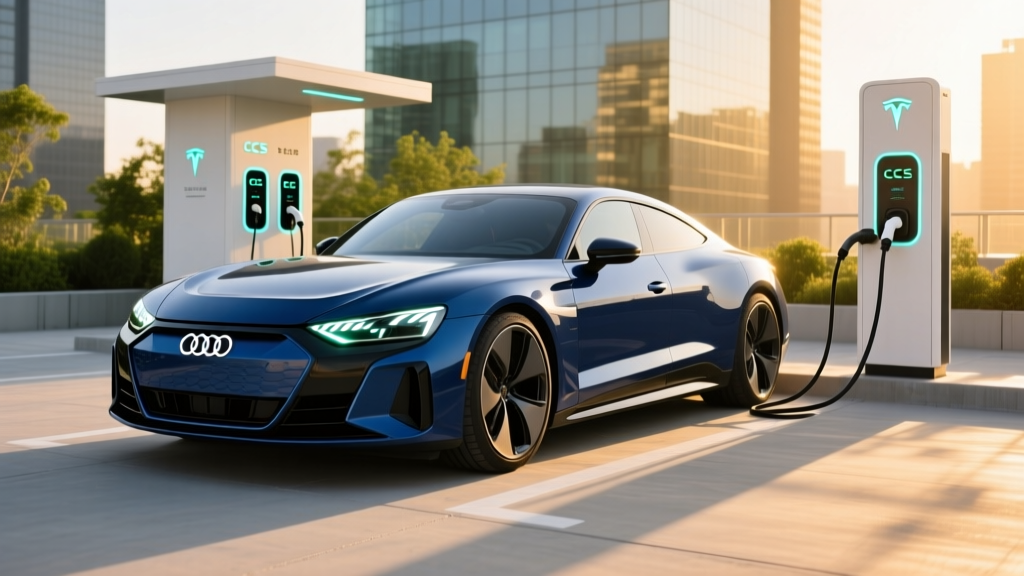
Audi EVs use the CCS1 connector for DC fast charging and the J1772 inlet for Level 2 AC charging (with a NACS adapter available through Audi for Tesla Supercharger access on newer models).
| Charging Level | Power | Connector | Miles Added per Hour | Typical Use Case |
|---|---|---|---|---|
| Level 1 | 1.4 kW (120V) | J1772 | ~3–4 mi/hr | Emergency / trickle only |
| Level 2 (Home) | 7.7–11.5 kW (240V) | J1772 | ~20–32 mi/hr | Daily / overnight charging |
| DC Fast | 170–270 kW | CCS1 / NACS adapter | ~180–280 mi in 30 min | Road trips |
Home charging setup: Most Audi EV owners install a 240V Level 2 wallbox (40–48 amps) on a dedicated 50–60 amp circuit. Expect to pay $500–$800 for the charger hardware (Audi's branded Wallbox or a third-party unit like ChargePoint Home Flex) plus $800–$2,500 for electrician labor, depending on panel proximity and whether a service upgrade to 200A is needed. A full Q8 e-tron battery charges overnight in roughly 10–11 hours on a 48A Level 2 circuit.
Public charging access: Audi includes a complimentary Electrify America charging plan (typically 250–800 kWh depending on model and model year) with new EV purchases. Electrify America's network reliability has improved but remains inconsistent in some regions. With the NACS adapter, Audi owners gain access to Tesla's Supercharger network — the most reliable DC fast-charging infrastructure in the U.S. — though charge speeds may be limited by adapter throughput on older CCS-native vehicles.
Ownership Realities: What First-Time Audi EV Buyers Should Know
Beyond the spec sheet, several practical factors determine whether an Audi EV fits your lifestyle:
Home Charging Is the Make-or-Break Factor
If you have a garage or dedicated parking spot with access to a 240V circuit, an Audi EV integrates seamlessly into daily life — plug in at night, wake up to a full battery every morning. If you rely exclusively on street parking or apartment living without charging infrastructure, the ownership experience becomes significantly more inconvenient. Public DC fast charging costs $0.35–$0.55/kWh in most markets, roughly doubling your "fuel" cost versus home charging at $0.13/kWh.
Warranty Coverage
All 2026 Audi EVs come with a 4-year/50,000-mile limited vehicle warranty and an 8-year/100,000-mile high-voltage battery warranty that guarantees at least 70% capacity retention. In practice, Audi's NMC batteries have shown modest degradation — typically 5–8% over the first 100,000 miles based on owner-reported data. Replacement costs for out-of-warranty battery packs range from $15,000–$30,000 depending on the model, though full replacements remain rare.
Insurance Premiums Run Higher
EV insurance costs 15–25% more than equivalent gas vehicles, driven by higher repair costs for battery-adjacent collision damage and specialized parts. Get quotes from your provider before purchasing — some insurers (Geico, Progressive) have narrowed the EV premium gap, while others still price aggressively.
Software and ADAS
Audi's driver-assistance suite (Adaptive Cruise Assist, Lane Guidance) operates at SAE Level 2 — the driver must remain engaged with hands on the wheel and eyes on the road at all times. This is not autonomous driving. Audi's MMI infotainment system has drawn mixed reviews for responsiveness; test the interface during your demo drive and verify wireless CarPlay/Android Auto compatibility with your devices.
Common Misconceptions About Audi EVs
| Myth | Fact |
|---|---|
| "Audi EVs get the $7,500 federal tax credit" | As of 2026, Audi's European-assembled EVs generally do not meet §30D battery-sourcing requirements for the purchase credit. Lease structures may pass through the commercial vehicle credit — verify with your dealer and tax professional. |
| "285 miles of range means 285 miles of driving" | EPA range is measured under mixed conditions. Sustained highway driving at 70+ mph, cold weather, and mountain grades reduce range by 15–30%. Plan road trips around 70–75% of the EPA number. |
| "DC fast charging to 100% is a good idea" | Charging above 80% at DC fast chargers is extremely slow due to the taper curve and generates excess heat. Charge to 80% on road trips and save 100% fills for overnight Level 2 at home. |
| "EVs need no maintenance" | EVs skip oil changes and have reduced brake wear (thanks to regenerative braking), but still require cabin air filters, brake fluid checks, coolant service, tire rotations, and wiper/12V battery replacement. |
| "The battery will need replacing in a few years" | Modern NMC batteries with active thermal management retain 90–95% capacity at 100,000 miles. Audi's 8-year/100,000-mile battery warranty at 70% retention provides substantial protection. |
Decision Framework: Which Audi EV Fits You?
Choose the Q4 e-tron if: You want the most affordable entry into Audi's EV lineup, primarily drive under 40 miles daily, have home Level 2 charging, and value compact dimensions for city driving. The RWD model at 265 miles EPA offers the best range-per-dollar in the lineup. Budget around $50,000–$58,000 depending on trim and options.
Choose the Q8 e-tron if: You need midsize SUV cargo space (57 cu ft with seats folded), regularly carry four adults, take road trips of 300+ miles, and want the most comfortable long-distance cruising experience in Audi's EV range. The Sportback variant adds 15 miles of range for a $3,800 premium. Budget $75,000–$95,000.
Choose the e-tron GT if: Performance is your priority, you appreciate 800V charging architecture (fastest in the lineup at 270 kW peak), and you're cross-shopping the Porsche Taycan or Tesla Model S. The RS variant delivers 637 HP and 3.1-second 0–60 runs. This is a grand tourer, not a practical family hauler — cargo space is limited to 9.2 cu ft. Budget $107,000–$160,000+.
Consider a gas Audi Q5 or A6 instead if: You lack reliable home charging access, regularly tow more than 4,000 lbs, live in a region with sparse public charging infrastructure, or plan to keep the vehicle 10+ years and want to avoid out-of-warranty battery replacement risk.
Frequently Asked Questions
Do any 2026 Audi electric cars qualify for the federal tax credit?
Under current IRS §30D rules, the purchase credit requires battery components and critical minerals to meet North American sourcing thresholds. Audi's EVs are assembled primarily in Germany and Belgium, and as of 2026 do not qualify for the $7,500 purchase credit. However, leasing through Audi Financial may allow the dealer to apply the $7,500 commercial clean vehicle credit (§45W) as a capitalized-cost reduction — effectively lowering your monthly payment. Always verify current eligibility at IRS.gov and with your tax professional.
How long does it take to charge an Audi EV at home?
On a 48-amp Level 2 home charger (11.5 kW), the Q4 e-tron (77 kWh) charges from 0–100% in roughly 7.5 hours. The Q8 e-tron (106 kWh) takes about 10–11 hours. Both easily replenish overnight. Level 1 (120V standard outlet) adds only 3–4 miles per hour and is impractical as a primary charging method for daily drivers covering more than 20 miles.
Can I use Tesla Superchargers with an Audi EV?
Audi has begun offering a NACS adapter for CCS-equipped models, enabling access to Tesla's Supercharger network (V3 stalls at up to 150 kW for CCS-adapted vehicles). Availability varies by model year — confirm adapter compatibility with your specific vehicle through your Audi dealer. Native NACS ports are expected on future PPE-platform models.
What happens to range in cold weather?
Expect 20–30% range reduction in sustained sub-freezing temperatures. The primary culprits are cabin heating energy draw and reduced battery efficiency at low temperatures. Preconditioning the battery and cabin while still plugged in (using the Audi app's departure timer) significantly mitigates this loss. Models equipped with a heat pump (standard on Q8 e-tron and e-tron GT) are more efficient in cold climates than those using resistive heating.
How does Audi's EV reliability compare to competitors?
Audi's EV powertrains have proven generally reliable, with fewer reported issues than early-generation models from 2019–2021. The main complaints center on software glitches in the MMI infotainment system rather than battery or drivetrain failures. Compared to Tesla, Audi offers more traditional build quality and dealer service infrastructure but lags in software polish and over-the-air update frequency. IIHS has awarded the Q4 e-tron a Top Safety Pick designation — check current ratings for your target model.