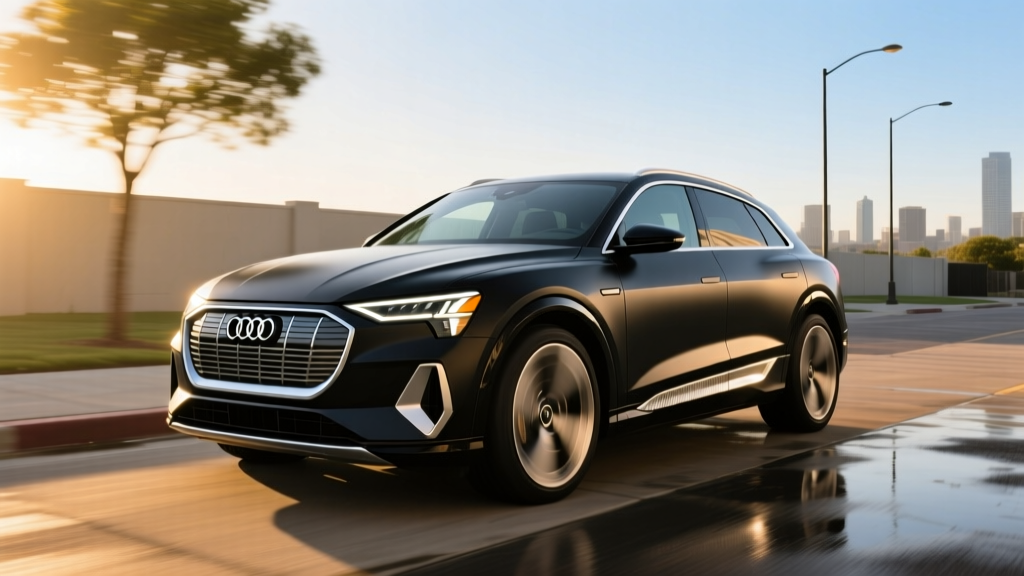
The Audi e-tron Sportback occupies a unique space in the luxury EV market: it's a premium, coupe-styled electric crossover that prioritizes build quality and driving refinement over maximum range. For buyers considering an Audi e-tron Sportback lease, the math is compelling — you get a $74,000+ vehicle with Audi's latest EV architecture, quattro all-wheel drive, and a luxury interior that rivals anything from BMW or Mercedes-Benz, while avoiding the long-term depreciation risk that plagues high-end EVs.
But leasing an EV requires understanding what you're actually getting beyond the sticker. In this guide, we break down the real-world range, charging behavior, ownership economics, and tax credit implications of the 2026 Audi e-tron Sportback — so you can decide if the lease numbers make sense for your driving life.
2026 Audi e-tron Sportback: Key Specs at a Glance
| Specification | Premium Plus | Prestige |
|---|---|---|
| Base MSRP | $74,900 | $81,400 |
| EPA Range | 218 miles | 218 miles |
| Battery (usable) | 91 kWh (NMC) | 91 kWh (NMC) |
| Peak DC Fast Charge | 170 kW | 170 kW |
| 10–80% DC Charge Time | ~30 min | ~30 min |
| Level 2 Home Charge Rate | 11.5 kW (~25 mi/hr) | 11.5 kW (~25 mi/hr) |
| 0–60 mph | 5.5 seconds | 5.5 seconds |
| Horsepower | 402 hp (Boost mode) | 402 hp (Boost mode) |
| Drivetrain | Dual-motor quattro AWD | Dual-motor quattro AWD |
| Efficiency | 79 MPGe (85 kWh/100mi) | 79 MPGe (85 kWh/100mi) |
| Cargo (rear seats up) | 27.3 cu ft | 27.3 cu ft |
| Cargo (rear seats folded) | 54.8 cu ft | 54.8 cu ft |
| Battery Warranty | 8 yr / 100,000 mi | 8 yr / 100,000 mi |
Real-World Range: What the EPA Number Doesn't Tell You
The EPA rates the 2026 Audi e-tron Sportback at 218 miles per full charge. That figure reflects a blended city-highway driving cycle under moderate temperatures. For context, the Sportback's 91 kWh usable battery pack (NMC chemistry) delivers that range at a consumption rate of roughly 85 kWh per 100 miles — on the thirsty side for a luxury EV, owing to its 5,800-pound curb weight and emphasis on cabin insulation and ride comfort over efficiency.
- City / suburban driving (moderate climate): 210–225 miles — regen braking recovers energy in stop-and-go traffic, often matching or slightly exceeding the EPA figure.
- Highway (70–75 mph sustained): 175–195 miles — aerodynamic drag dominates at speed, and the Sportback's sloped roofline offers less aero benefit than a sedan.
- Cold weather (below 32°F / 0°C): 150–175 miles — battery resistance increases and cabin heating draws significant energy. Preconditioning while plugged in recovers 10–15 miles of range.
- Mountain / hilly terrain: 160–185 miles — sustained climbs consume heavily, though regen on descents partially offsets the loss.
The honest takeaway: if your daily commute plus errands stay under 160 miles, the Sportback will serve you well year-round without range stress. If you regularly drive 200+ miles between charging opportunities, you'll need to plan carefully — especially in winter or at highway speeds. Source: fueleconomy.gov
Charging Speed and Infrastructure
Audi equips the e-tron Sportback with a 170 kW peak DC fast-charging capability via its NACS connector (native Tesla Supercharger compatibility was adopted starting with the 2025 model year). Here's what that means in practice:
| Charging Level | Power | Speed (approx.) | Notes |
|---|---|---|---|
| Level 1 (120V outlet) | 1.2 kW | ~3 miles/hour | Emergency/top-up only; 72+ hours for full charge |
| Level 2 (240V home) | 11.5 kW | ~25 miles/hour | Full charge in ~8 hours; ideal overnight solution |
| DC Fast Charge | 170 kW peak | 10–80% in ~30 min | Sustains ~150 kW to 70% SoC, then tapers |
Charging curve reality check: The 170 kW peak is available only between roughly 10% and 55% State of Charge. Above 70%, the curve tapers to protect battery longevity — you'll see 80–100 kW from 70–80%, and charging slows dramatically above 85%. For road trips, the practical strategy is to charge from 10–80% (adding ~170 miles in 30 minutes) and move on rather than wait for a full top-off.
For home charging, a Level 2 wall connector on a 48-amp circuit delivers the full 11.5 kW. Budget $800–$1,500 for a quality Level 2 unit (such as the ChargePoint Home Flex or Emporia V2) and $500–$2,000 for professional installation depending on your electrical panel's capacity and proximity to your parking spot. A 200-amp panel is typically sufficient; older homes with 100-amp service may need a panel upgrade ($1,500–$3,000).
Leasing vs. Buying: The Tax Credit Advantage
Here's where the Audi e-tron Sportback lease proposition gets interesting. The federal EV tax credit under IRS §30D has strict eligibility rules for outright purchases — including buyer income caps ($150K single / $300K joint), MSRP caps ($80,000 for SUVs), and battery critical-mineral sourcing requirements. The e-tron Sportback's Premium Plus trim at $74,900 clears the MSRP cap, but battery sourcing rules may reduce or eliminate the credit depending on your specific purchase timing.
However, leasing changes the equation entirely. Under the commercial clean vehicle credit (§45W), the leasing company (the legal owner) can claim the full $7,500 credit regardless of your personal income or the vehicle's battery sourcing. Most luxury brands, including Audi Financial Services, pass this savings through as a "lease cash" incentive — effectively reducing your capitalized cost by up to $7,500. This means:
| Scenario | Premium Plus MSRP | Effective Price After Credit | Estimated Monthly (36-mo, $5K down) |
|---|---|---|---|
| Purchase (credit qualifies) | $74,900 | $67,400 | ~$1,050/mo (6.5% APR) |
| Purchase (credit does NOT qualify) | $74,900 | $74,900 | ~$1,160/mo (6.5% APR) |
| Lease (credit passed through) | $74,900 | $67,400 cap cost | ~$870–$950/mo (varies by residual) |
For many buyers — especially those exceeding the income cap or whose vehicle's battery sourcing doesn't meet critical-mineral thresholds — leasing is the only reliable path to capturing the $7,500 federal incentive. Always confirm with your Audi dealer that the lease cash is reflected in the capitalized cost before signing. Verify current rules at IRS.gov.
Performance, Driving Dynamics, and Technology
The e-tron Sportback's dual-motor quattro powertrain delivers 355 hp in normal driving and 402 hp in Boost mode (activated via the shift lever). The 0–60 mph sprint takes 5.5 seconds — brisk but not Tesla Model X quick. What the Sportback trades in outright acceleration, it makes up for in composure: the adaptive air suspension smooths broken pavement, and the cabin remains whisper-quiet at highway speeds thanks to acoustic glass and extensive sound deadening.
Infotainment: Audi's MMI touch response system uses a 10.1-inch upper touchscreen for navigation and media, with an 8.6-inch lower screen for climate and handwriting input. The system supports wireless Apple CarPlay and Android Auto, and includes a 12.3-inch Virtual Cockit digital instrument cluster. Response times are quick, though the dual-screen layout requires more glances than a single large display.
Driver assistance (SAE Level 2): Audi's Adaptive Cruise Assist with lane guidance combines adaptive cruise control, lane centering, and traffic jam assist. It's a competent highway companion, but this is not a self-driving system — your hands must remain on the wheel and your eyes on the road at all times. The system includes a capacitive steering wheel for hands-on detection, emergency assist (brings the car to a stop if the driver is unresponsive), and intersection assist.
Notable drawbacks: The Sportback's sloping roofline cuts into rear headroom (37.9 inches vs. 38.6 in the standard e-tron SUV) and reduces cargo volume by about 3 cu ft behind the rear seats. The regenerative braking feel is progressive rather than aggressive — if you want true one-pedal driving, you'll need to adapt to the paddle-shift regen levels, which don't bring the car to a complete stop without brake application.
How It Compares: Sportback vs. Key Competitors
At this price point, the e-tron Sportback faces stiff competition. Here's how it stacks up against the three most common cross-shops:
| Attribute | Audi e-tron Sportback | BMW iX xDrive50 | Mercedes EQE SUV | Tesla Model X |
|---|---|---|---|---|
| Base MSRP | $74,900 | $87,100 | $77,900 | $79,990 |
| EPA Range | 218 mi | 324 mi | 279 mi | 335 mi |
| Battery | 91 kWh NMC | 111.5 kWh NMC | 90.6 kWh NMC | 100 kWh NMC |
| Peak DC Charge | 170 kW | 200 kW | 170 kW | 250 kW |
| 0–60 mph | 5.5 sec | 4.4 sec | 5.2 sec | 3.8 sec |
| Cargo (rear up) | 27.3 cu ft | 35.5 cu ft | 14.0 cu ft | 37.1 cu ft (+ frunk) |
| Battery Warranty | 8yr/100K mi | 8yr/100K mi | 10yr/155K mi | 8yr/150K mi |
The verdict: The BMW iX wins on range and charging speed. The Tesla Model X wins on range, performance, and Supercharger network convenience. The Mercedes EQE SUV wins on rear-seat luxury. But the Audi e-tron Sportback wins on build quality, ride refinement, and lease value — it's often the most affordable to lease in this segment once the $7,500 credit is applied, and its cabin materials and assembly quality are a cut above the Tesla. If range is your top priority, the Sportback isn't the answer. If you want a luxury experience that feels like a $100,000 car at a $67,000 effective price, it's a strong candidate.
Who the Audi e-tron Sportback Suits Best
- You want a luxury EV with exceptional build quality and ride comfort
- Your daily driving stays under 160 miles round-trip
- You lease rather than buy (to capture the $7,500 credit reliably)
- You value cabin quietness and adaptive air suspension over outright performance
- You want native NACS compatibility for Tesla Supercharger access
- You regularly drive 200+ miles between charges (consider BMW iX or Tesla Model X)
- You need maximum cargo space (the coupe roofline costs you ~3 cu ft vs. the standard e-tron)
- You want one-pedal driving that brings the car to a full stop without brake input
- You plan to tow (the Sportback is rated for 4,000 lbs, but range drops sharply under load)
Warranty, Reliability, and Long-Term Battery Health
Audi covers the e-tron Sportback's battery pack for 8 years or 100,000 miles (whichever comes first), with a capacity retention threshold of 70%. If the battery degrades below 70% of its original 91 kWh capacity within that window, Audi will repair or replace it at no cost. The general vehicle warranty covers 4 years / 50,000 miles, which is standard for the luxury segment but shorter than Hyundai/Kia's 10-year coverage.
NMC battery chemistry — which the Sportback uses — typically shows 8–12% degradation over 100,000 miles based on industry fleet data. That translates to roughly 195–200 miles of range at the 100K-mile mark, which is well within the warranty threshold. To maximize longevity, Audi's battery management system includes a top/bottom buffer (you never truly use 100% or 0% of the pack), active liquid thermal management, and charge-rate limiting above 80% SoC.
Pros and Cons at a Glance
- Exceptional cabin quietness and ride quality with standard air suspension
- Native NACS connector — full Tesla Supercharger network access
- Lease cash incentive reliably captures $7,500 federal credit
- Strong build quality with premium materials throughout
- Competent SAE Level 2 Adaptive Cruise Assist
- quattro AWD with 402 hp in Boost mode
- 218-mile EPA range trails key competitors (BMW iX: 324 mi, Model X: 335 mi)
- 170 kW peak DC charging is slower than segment leaders (200–250 kW)
- Coupe roofline reduces rear headroom and cargo vs. standard e-tron SUV
- Regen braking doesn't enable full one-pedal driving
- Efficiency at 85 kWh/100mi is below average for the class
- Base MSRP above $74K pushes Prestige trim past the $80K SUV tax-credit cap for purchases
Frequently Asked Questions
What is the real-world range of the Audi e-tron Sportback?
The EPA rates it at 218 miles. In real-world driving, expect 210–225 miles in city/suburban conditions, 175–195 miles at sustained highway speeds, and 150–175 miles in cold weather below freezing. Preconditioning the battery while plugged in can recover 10–15 miles in winter.
How fast does the e-tron Sportback charge at home and on the road?
On a Level 2 home charger (240V, 48A), the Sportback charges at 11.5 kW — adding about 25 miles per hour, or a full charge overnight in ~8 hours. On a DC fast charger, it peaks at 170 kW and charges from 10–80% in approximately 30 minutes, though the rate tapers significantly above 70% SoC.
How much does an Audi e-tron Sportback lease cost after tax credits?
With the $7,500 federal lease credit (passed through as lease cash), the effective capitalized cost on the Premium Plus trim drops from $74,900 to approximately $67,400. Typical 36-month lease payments range from $870–$950/month with $5,000 due at signing, depending on your credit tier, mileage allowance, and dealer negotiations.
Does the Audi e-tron Sportback qualify for the federal EV tax credit?
For outright purchases, the Premium Plus ($74,900) qualifies under the $80,000 SUV MSRP cap, but eligibility depends on your income (≤$150K single / ≤$300K joint), battery critical-mineral sourcing compliance, and North American assembly requirements. The Prestige trim ($81,400) exceeds the MSRP cap and does not qualify for the purchase credit. However, when leased, the $7,500 credit is available to the leasing company under §45W regardless of personal income or sourcing rules, and is typically passed through to the lessee.
Is the e-tron Sportback worth it vs. the BMW iX or Tesla Model X?
If range and charging speed are your top priorities, the BMW iX (324 mi, 200 kW) and Tesla Model X (335 mi, 250 kW) are objectively better EVs. But if you prioritize cabin refinement, build quality, ride comfort, and the most favorable lease economics, the e-tron Sportback is a compelling choice — especially at the effective post-credit price. It's a luxury car that happens to be electric, rather than an EV optimized purely for efficiency metrics.
What's the battery replacement cost if it fails out of warranty?
Full battery pack replacement for the e-tron Sportback runs approximately $18,000–$24,000 including labor, based on current Audi parts pricing. However, NMC packs in liquid-cooled systems like Audi's typically retain 85–92% capacity at 100,000 miles, making out-of-warranty failure uncommon. The 8-year/100,000-mile warranty with a 70% retention threshold provides substantial coverage.
Sources: EPA fueleconomy.gov, IRS §30D Clean Vehicle Credits, Audi USA specifications.