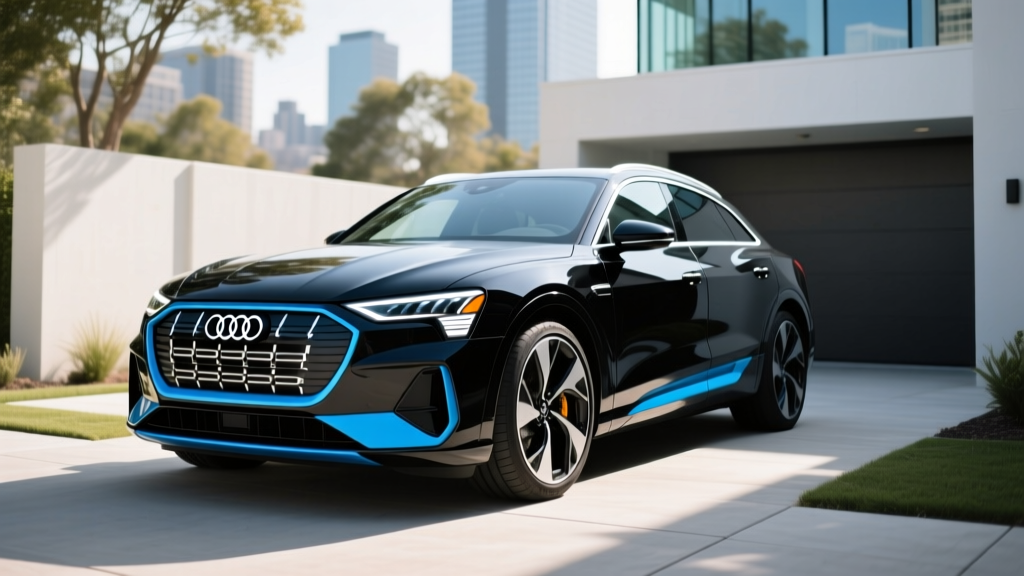
The Audi e-tron S pairs luxury SUV refinement with serious electric performance — but its range and efficiency numbers tell a more complicated story than the badge suggests. If you're cross-shopping high-end electric SUVs, this review breaks down exactly what you get, what you give up, and whether the math works in 2026.
Quick Verdict: Who the Audi e-tron S Is For
The Audi e-tron S (now sold as the Q8 e-tron S in updated form) targets buyers who prioritize driving dynamics, cabin quality, and brand prestige over maximum range per dollar. Its three-motor layout delivers genuine sports-car acceleration in a 5,700-pound SUV, and Audi's thermal management system makes DC fast charging genuinely usable on road trips. But at 206 miles EPA and efficiency figures well below rivals, this is a vehicle you buy despite its efficiency — not because of it.
EPA estimated: 208 miles (SUV body style, 21" wheels). Expect roughly 175–195 miles on highway trips at 70+ mph, and potentially 150–165 miles in freezing temperatures with cabin heat active. The e-tron S's heavy weight and performance-oriented motor tuning tax efficiency significantly at speed. Plan road-trip charging stops at 150-mile intervals to stay comfortable.
Spec Table: 2025–2026 Audi e-tron S at a Glance
| Attribute | Value |
|---|---|
| EPA Range | 208 mi (SUV, 21" wheels) |
| Battery (usable/total) | 106 kWh usable / 114 kWh gross, NMC |
| Drivetrain | Tri-motor AWD (1 front, 2 rear) |
| Horsepower | 496 hp (boost mode) |
| 0–60 mph | 4.5 seconds |
| Max DC Fast Charge | 155 kW peak |
| 10–80% DC Charge Time | ~31 minutes |
| Level 2 Home Charging | 11.5 kW (~21 mi/hr) |
| Efficiency | 73 MPGe combined / 46 kWh/100mi |
| Cargo (rear seats up/down) | 28.5 / 56.4 cu ft |
| Battery Warranty | 8 years / 100,000 miles |
| Base MSRP | $96,595 (Premium Plus) |
| Federal Tax Credit (§30D) | Not eligible (MSRP cap + sourcing) |
Range, Efficiency & the Cold-Weather Penalty
The e-tron S uses a 114 kWh gross (106 kWh usable) NMC lithium-ion battery — one of the largest packs in any production EV. That massive buffer protects long-term state-of-health, since you're rarely cycling the full chemistry envelope. But it also contributes to a 5,776-pound curb weight that crushes efficiency.
At 73 MPGe combined (fueleconomy.gov), the e-tron S consumes roughly 46 kWh per 100 miles — nearly double what a Hyundai Ioniq 5 uses for the same distance. On a practical level, this means higher electricity costs per mile and more frequent charging stops on trips.
Cold-weather impact: Like all EVs, the e-tron S loses range in freezing temperatures. Audi's standard heat pump mitigates cabin-heating energy draw, but battery chemistry itself slows in cold, reducing regen braking strength and available capacity. Expect a 20–30% range reduction below 32°F, dropping real-world highway range to roughly 150 miles on a brutal January day in the upper Midwest.
Charging: DC Fast, Level 2, and the Charge Curve
Audi engineered the e-tron platform around sustained charging performance rather than peak headline numbers. The 155 kW DC fast-charge peak isn't class-leading, but the charge curve is remarkably flat — meaning you hold close to peak rate through most of the 10–80% window.
| Charging Level | Power | Speed (approx.) |
|---|---|---|
| Level 1 (120V household) | ~1.4 kW | ~3 mi/hr |
| Level 2 (240V home, 48A) | 11.5 kW | ~21 mi/hr (full charge ~10 hrs) |
| DC Fast Charge (CCS) | 155 kW peak | 10–80% in ~31 min; 5–80% in ~36 min |
Charge curve reality: The e-tron S sustains approximately 130–150 kW from roughly 10% to 55% SoC, then tapers gradually through 80%. Above 80%, charging slows significantly — plan to unplug at 80% on road trips rather than topping off, unless you need the last 20% to reach your destination. Preconditioning activates automatically when a DC fast charger is set in navigation, warming the battery for optimal charge acceptance.
Connector note: The e-tron S uses the CCS1 connector. Audi has committed to NACS adoption for future models, but current e-tron S owners will need a CCS-to-NACS adapter (sold separately, ~$200–250) to access Tesla Supercharger V3/V4 stalls as networks open up.
Performance: Tri-Motor AWD Explained
The "S" badge is earned here. The e-tron S uses one motor on the front axle and two motors on the rear axle — a configuration borrowed from high-end sports sedans. The twin rear motors enable true torque vectoring, actively over-driving the outside rear wheel in corners to rotate the vehicle. The result is an SUV that corners with genuinely surprising agility for its mass.
In boost mode (activated via the drive selector), the powertrain produces 496 hp and 718 lb-ft of torque, launching the e-tron S to 60 mph in 4.5 seconds. That's not Tesla Model X Plaid territory, but it's firmly in Porsche Cayenne S E-Hybrid range and more than adequate for any real-world merging or passing scenario.
Regen braking is adjustable via paddles, with a mild one-pedal mode available. It doesn't offer the aggressive single-pedal feel of a Nissan LEAF or BMW iX — Audi tuned it for smoothness over aggressiveness, which suits the luxury-SUV mission.
Pricing, Trims & Federal Tax Credit Status
The e-tron S is a premium-priced EV with limited federal incentive support. Here's the breakdown:
| Trim | MSRP | §30D Federal Credit | Effective Price |
|---|---|---|---|
| Premium Plus | $96,595 | $0 (MSRP exceeds $80K SUV cap) | $96,595 |
| Prestige | $101,195 | $0 | $101,195 |
Why no tax credit? The IRS §30D new clean vehicle credit caps SUVs at an $80,000 MSRP (irs.gov). The e-tron S exceeds this by a wide margin. Additionally, battery critical-mineral and component sourcing requirements eliminate many European-assembled EVs regardless of price. State and local incentives may still apply — check your state's energy office or utility provider for rebates that operate independently of federal rules.
As-tested pricing: A Prestige trim with optional 22" wheels, towing package, and Luxury package typically lands between $108,000–$112,000 before destination. Audi's destination charge is $1,195.
Interior, Cargo & Daily Practicality
The cabin is where Audi justifies the price. Triple-screen MMI (12.3" digital cluster, 10.1" upper infotainment, 8.6" lower climate/controls), standard Valcona leather, 16-way power sport seats with massage, and available Bang & Olufsen 3D audio create a genuinely premium environment. Build quality is exemplary — panel gaps, switchgear damping, and acoustic isolation are all a step above the Tesla Model X or Rivian R1S interior.
Cargo: 28.5 cubic feet behind the second row, expanding to 56.4 cu ft with seats folded. There is no frunk — the front motor and power electronics consume that space. For comparison, the BMW iX offers 35.5 cu ft rear, and the Rivian R1S provides significantly more total volume with its three-row layout.
Passenger space: Front legroom is generous at 41.6 inches; rear legroom is 37.3 inches — adequate for adults but tighter than the long-wheelbase Mercedes EQS SUV. The panoramic glass roof creates an airy feel, though it does eat slightly into headroom.
Towing: 4,000 lbs with the optional towing package — sufficient for a small boat or light utility trailer, but well below the Rivian R1S (7,700 lbs) or Tesla Model X (5,000 lbs).
Driver Assistance & Technology
Audi's Adaptive Cruise Assist with Lane Guidance is a competent SAE Level 2 driver-assistance system. It handles highway speed, following distance, and lane centering reliably, but requires hands on the wheel (capacitive touch detection) and does not support hands-free driving like GM's Super Cruise or Ford's BlueCruise. It will not change lanes autonomously, navigate interchanges, or stop at traffic lights without driver input.
Audi Adaptive Cruise Assist is a Level 2 system per SAE J3016. The driver must remain fully engaged, monitor the road, and be prepared to take over instantly. This is not autonomous or self-driving capability. No production Audi currently offers Level 3+ autonomy in the US market.
The MMI infotainment system is responsive, supports wireless Apple CarPlay and Android Auto, and includes a Wi-Fi hotspot. Over-the-air updates are supported but have been limited in scope compared to Tesla's cadence. The virtual cockpit display remains one of the best-executed digital instrument clusters in the industry.
Pros, Cons & Competitive Verdict
- Tri-motor torque vectoring delivers genuine cornering agility
- Flat DC charge curve sustains high speed through 10–80%
- Exceptional cabin quality, isolation, and seat comfort
- Large 106 kWh usable battery buffers long-term degradation
- Heat pump standard (not an extra-cost option)
- 208-mile EPA range is poor for a $100K+ EV in 2026
- 46 kWh/100mi efficiency drives high per-mile electricity cost
- No federal §30D tax credit eligibility
- No frunk; cargo volume trails BMW iX and Rivian R1S
- CCS1 connector requires adapter for growing NACS Supercharger network
Is it worth buying vs. competitors? If you value driving engagement and cabin luxury above all else, yes — the e-tron S occupies a unique niche. But if range, efficiency, or value drive your decision, the BMW iX M60 (324 mi EPA, similar performance) or Tesla Model X (348 mi EPA, lower price) are objectively more capable daily EVs. The Rivian R1S tri-motor offers more space, more range, better towing, and a lower price — at the cost of cabin refinement.
Frequently Asked Questions
Does the Audi e-tron S qualify for the $7,500 federal EV tax credit?
No. The e-tron S exceeds the IRS §30D MSRP cap of $80,000 for SUVs and likely fails battery-sourcing requirements. Consult a tax professional for state-specific incentives or utility rebates that may offset cost.
What is the real-world highway range of the Audi e-tron S?
Expect approximately 175–195 miles at sustained highway speeds (70–80 mph) in moderate temperatures. Cold weather (below 32°F) reduces this to roughly 150–165 miles. Always plan charging stops conservatively — range estimation displays in the e-tron S are reasonably accurate when using navigation-based prediction.
How long does it take to charge the e-tron S at home?
On a 48-amp Level 2 home charger (11.5 kW), a full charge from empty takes approximately 10 hours. Most owners charging overnight from 20–80% will need roughly 6 hours. A 100-amp electrical panel is typically sufficient; a 200-amp panel is preferred if you're running other large loads simultaneously.
Is the e-tron S being discontinued?
Audi has rebranded the e-tron lineup under the Q8 e-tron name globally. The S variant continues in updated form with minor efficiency improvements. Current 2025–2026 models are fully supported with parts, service, and OTA updates.
How does the e-tron S battery hold up over time?
Audi warrants the battery for 8 years / 100,000 miles against degradation below 70% of original capacity. The large 114 kWh gross pack with a ~106 kWh usable window means moderate daily cycling (e.g., 20–80% SoC) should yield minimal noticeable degradation over 5–7 years of typical ownership. NMC chemistry in this configuration has proven durable in real-world fleet data.