Quick Verdict: The Fastest Charging Audi EV You Can Buy
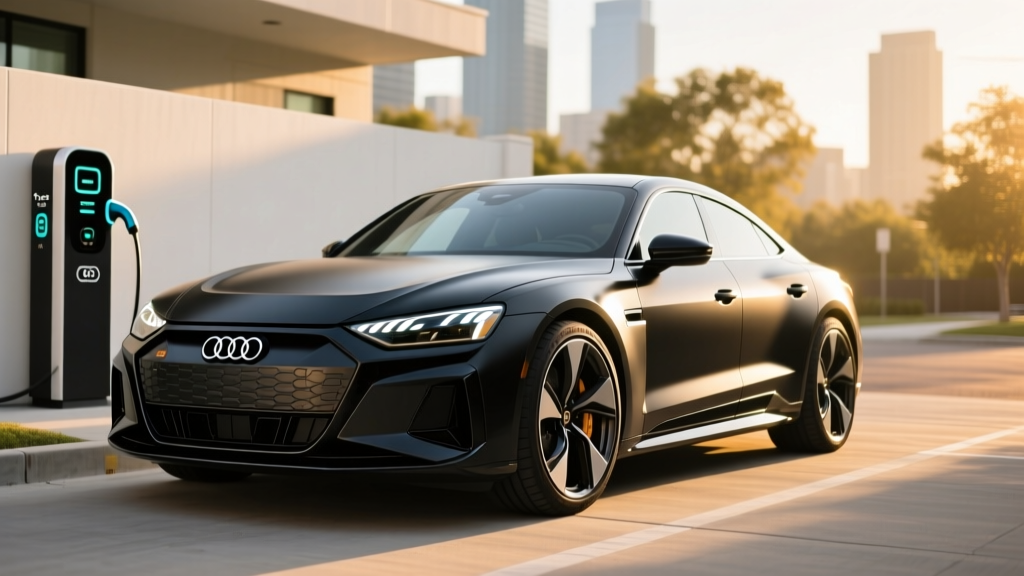
The Audi e-tron RS (the performance variant of what Audi now officially calls the Q8 e-tron lineup) occupies a rare space in the EV market: a luxury performance SUV that charges nearly as fast as a Porsche Taycan while offering genuine daily usability. With a 114 kWh gross battery pack (106 kWh usable), a peak DC fast-charge rate of 270 kW, and dual-motor quattro all-wheel drive producing 591 horsepower in boost mode, the e-tron RS is Audi's answer to the Tesla Model X Plaid and the BMW iX M60 — but with a more conservative, refinement-first approach.
For 2026, the e-tron RS carries over with minor software and infotainment updates. The fundamental trade-off remains: exceptional build quality, ride comfort, and charging speed at the cost of outright range efficiency compared to lighter, more aerodynamic rivals. If you prioritize a quiet cabin, predictable handling, and fast road-trip charging over maximum miles per kWh, the e-tron RS deserves a serious look.
| Spec | Value |
|---|---|
| EPA Range | 235 miles (est.) |
| Battery (gross / usable) | 114 kWh / 106 kWh (NMC) |
| Peak DC Fast Charge | 270 kW |
| 10–80% DC Charge Time | ~21 minutes |
| Level 2 Home Charge Rate | 11.5 kW (~26 mi/hr) |
| 0–60 mph | 3.4 seconds (boost mode) |
| Horsepower | 591 hp (boost) / 496 hp (standard) |
| Drivetrain | Dual-motor AWD (quattro) |
| MPGe (combined) | 73 MPGe (est.) |
| Efficiency | ~46 kWh/100 mi |
| Cargo Volume | 28.5 cu ft (rear seats up) / 58.0 cu ft (folded) |
| Base MSRP | $108,900 (before destination) |
| Battery Warranty | 8 years / 100,000 miles |
Range and Efficiency: What the EPA Sticker Doesn't Tell You
The 2026 Audi e-tron RS carries an EPA-estimated range of approximately 235 miles on a full charge. That figure is competitive within the luxury performance SUV segment — the BMW iX M60 returns around 285 miles but with less peak power, while the Tesla Model X Plaid achieves roughly 333 miles but at a significantly higher price point.
- City / mixed driving (65°F): Expect 225–240 miles. The e-tron RS recovers energy effectively through regen braking in stop-and-go traffic.
- Highway (75 mph sustained): Plan for 195–215 miles. The boxy SUV shape and 5,800+ lb curb weight hurt efficiency at speed.
- Cold weather (30°F or below): Range drops 20–30%, landing around 165–190 miles. The heat pump helps, but the large cabin volume demands significant energy for heating.
- Towing (up to 4,000 lb capacity): Expect roughly 120–150 miles depending on trailer weight and terrain.
The e-tron RS's efficiency of roughly 46 kWh per 100 miles (approximately 73 MPGe combined, per fueleconomy.gov) is its most notable weakness. For comparison, the Hyundai Ioniq 5 N — a performance EV costing nearly half as much — achieves around 38 kWh/100 mi. The physics are straightforward: moving 5,800 pounds with dual high-output motors requires energy, and the e-tron RS prioritizes power delivery and NVH isolation over efficiency tricks like aggressive coasting modes.
Charging Performance: Where the e-tron RS Shines
If range is the e-tron RS's Achilles heel, charging speed is its superpower. The 800-volt electrical architecture (shared with the Porsche Taycan platform family) enables a peak DC fast-charge rate of 270 kW at compatible chargers. More importantly, the charge curve is remarkably flat — the e-tron RS sustains above 200 kW from roughly 10% to 55% state of charge before gradually tapering. This means real-world charging sessions are faster than peak-kW numbers alone would suggest.
| Charge Level | Power (kW) | Speed | Notes |
|---|---|---|---|
| Level 1 (120V household) | ~1.4 kW | ~3 mi/hr | Emergency/trickle only |
| Level 2 (240V, 48A home) | 11.5 kW | ~26 mi/hr | Full charge in ~10 hours |
| Level 2 (240V, 32A public) | 7.7 kW | ~17 mi/hr | Common at destinations |
| DC Fast (150 kW station) | ~130 kW sustained | 10–80% in ~32 min | Station-limited |
| DC Fast (350 kW station) | 270 kW peak | 10–80% in ~21 min | Requires preconditioning |
Preconditioning matters. To achieve peak 270 kW charging, you must route the e-tron RS to a compatible DC fast charger via the onboard navigation system. This triggers battery preconditioning — warming the pack to the optimal temperature window for rapid ion transfer. If you drive to a charger without navigation routing, the battery may not be at optimal temperature, and peak charge rates could drop to 150–180 kW, especially in cool weather.
At home on a Level 2 hardwired charger (such as a ChargePoint Home Flex or Wallbox Pulsar Max on a 60A circuit), the 11.5 kW onboard charger replenishes the 106 kWh usable battery in roughly 10 hours — meaning you wake up to a full charge every morning. Home charging installation typically runs $800–$2,200 depending on panel capacity and run length; a licensed electrician should verify your 200A panel can support a dedicated 60A circuit before purchase.
Performance and Driving Dynamics
The dual-motor quattro powertrain produces 496 horsepower in standard driving and 591 horsepower when boost mode is engaged (available for 20-second bursts via the drive-select system). The 0–60 mph sprint takes 3.4 seconds in boost — genuinely supercar-adjacent acceleration in a vehicle that weighs nearly three tons.
What separates the e-tron RS from raw-performance competitors is its composure. The adaptive air suspension with RS-tuned damping keeps the body remarkably flat through corners, and the torque-vectoring rear motor provides subtle yaw control that makes the SUV feel smaller than it is. Steering is precise if not communicative, and the brake pedal feel — often a weak point in heavy EVs blending regen and friction braking — is among the best in the segment.
The trade-off is that the e-tron RS never feels playful in the way a Tesla Model X Plaid or even a lighter Lotus Eletre does. It's a grand-touring performance SUV, not a track weapon. For most buyers in this price range, that's probably the right call.
Interior, Cargo, and Technology
Audi's interior execution remains a core selling point. The e-tron RS features a driver-focused cockpit with a 12.3-inch Virtual Cockit digital instrument cluster, a 10.1-inch upper MMI touchscreen for infotainment and navigation, and an 8.6-inch lower touchscreen for climate controls and handwriting input. The triple-screen layout looks impressive, though the lower climate screen's lack of tactile feedback draws criticism from some owners.
Material quality is exemplary — Valcona leather with honeycomb stitching, aluminum inlays, and available carbon-fiber trim. The front seats offer 18-way power adjustment with massage, heating, and ventilation. Rear legroom measures 39.1 inches, adequate for adults on longer trips.
Cargo space: 28.5 cubic feet behind the second row, expanding to 58.0 cubic feet with the 40/20/40 split rear seats folded. There is no front trunk (frunk); the space under the hood houses power electronics. A small under-floor compartment in the rear cargo area provides additional storage for charging cables.
Driver assistance: The e-tron RS comes equipped with Audi's adaptive cruise assist, which combines adaptive cruise control with lane-centering — a SAE Level 2 system requiring continuous driver supervision. It performs competently on highways but does not offer hands-free capability like GM's Super Cruise or Ford's BlueCruise. The available Park Assist Plus with remote parking is genuinely useful for tight garage situations.
Pricing, Trims, and Federal Tax Credit Eligibility
The 2026 Audi e-tron RS starts at an MSRP of $108,900 (destination charge adds approximately $1,195). A single trim level is offered, with options including packages for the Bang & Olufsen 3D sound system ($3,500), Night Vision Assistant ($2,500), and a towing package ($750). A well-optioned example typically lands between $115,000 and $120,000.
| Item | Amount |
|---|---|
| Base MSRP | $108,900 |
| Destination Charge | $1,195 |
| Typical As-Tested Price | $115,000–$120,000 |
| Federal §30D Tax Credit | Not eligible (MSRP exceeds $80,000 SUV cap) |
| Effective Price After Federal Credit | $108,900+ (no federal reduction) |
Tax credit reality check: Under current IRS §30D rules (irs.gov), new clean vehicle credits are subject to MSRP caps — $80,000 for SUVs, vans, and pickup trucks, and $55,000 for sedans. The e-tron RS, classified as an SUV, far exceeds the $80,000 cap and is therefore not eligible for the federal $7,500 new-vehicle tax credit. Buyer income limits ($300,000 joint / $150,000 individual AGI) and battery critical-mineral sourcing requirements are moot in this case. Some state and local incentives may still apply — check your state's energy office or the Alternative Fuels Data Center for current programs. Consult a tax professional for personalized eligibility guidance.
Pros and Cons
Pros
- Class-leading 270 kW DC fast-charging with a flat charge curve
- Exceptional build quality, ride refinement, and cabin quietness
- 591 hp boost mode delivers genuine supercar-rivaling acceleration
- Adaptive air suspension balances comfort and cornering composure
- Strong towing capacity (4,000 lb) for a performance EV
- Comprehensive 8-year/100,000-mile battery warranty
Cons
- 235-mile EPA range trails key competitors (Model X, iX)
- High efficiency consumption (~46 kWh/100 mi) raises charging costs
- No federal tax credit eligibility due to MSRP cap
- Driver-assist system lacks hands-free highway capability
- Touchscreen-only climate controls frustrate some drivers
- No front trunk (frunk) for additional storage
Who Should Buy the Audi e-tron RS?
The e-tron RS is best suited for:
- Luxury commuters with home Level 2 charging who prioritize cabin refinement over maximum range
- Road-trip-oriented families who value fast DC charging stops (21 min, 10–80%) over longest possible range between stops
- Performance SUV buyers who want acceleration thrills without the raw, tech-bro aesthetic of a Tesla
- Towing-capable EV shoppers needing 4,000-lb capacity for light boat or utility trailers
Consider a competitor if:
- You need 300+ miles of range — look at the Tesla Model X or BMW iX xDrive50
- You want hands-free highway driving — GM's Cadillac Escalade IQ with Super Cruise may suit better
- Budget is a primary concern — the Hyundai Ioniq 5 N delivers similar performance for under $70,000
Frequently Asked Questions
What is the real-world range of the Audi e-tron RS?
The EPA estimates 235 miles combined. In real-world mixed driving at moderate temperatures, expect 225–240 miles. Highway driving at 75 mph drops this to roughly 195–215 miles, and cold weather (below 30°F) can reduce range to 165–190 miles. The large 106 kWh usable battery provides a buffer, but the e-tron RS's weight and aerodynamics work against efficiency.
How fast does the e-tron RS charge at home and on the road?
At home on a Level 2 hardwired charger (48A/240V), the e-tron RS charges at 11.5 kW, adding roughly 26 miles of range per hour and fully replenishing the battery in about 10 hours. On a 350 kW-capable DC fast charger with battery preconditioning active, it peaks at 270 kW and charges from 10–80% in approximately 21 minutes. At a more common 150 kW station, expect 10–80% in about 32 minutes.
Does the Audi e-tron RS qualify for the federal EV tax credit?
No. Under current IRS §30D rules, the e-tron RS's MSRP of $108,900+ exceeds the $80,000 cap for SUVs, making it ineligible for the up-to-$7,500 federal new-vehicle tax credit. State and local incentives may still apply depending on your jurisdiction. Always verify current rules with a tax professional.
Is the Audi e-tron RS worth buying vs. the Tesla Model X or BMW iX?
It depends on priorities. The e-tron RS wins on charging speed (270 kW vs. ~250 kW for the Model X and ~200 kW for the iX), build quality, and ride comfort. The Model X wins decisively on range (333 mi EPA) and offers the Supercharger network advantage. The BMW iX xDrive50 offers a strong middle ground with 285+ miles of range and a lower starting price. If cabin refinement and fast road-trip charging matter most, the e-tron RS is the strongest choice in this trio.
What is the battery warranty on the e-tron RS?
Audi provides an 8-year/100,000-mile high-voltage battery warranty that covers defects and capacity loss below a specified retention threshold (typically 70% of original capacity). The general vehicle warranty covers 4 years/50,000 miles. The NMC chemistry pack uses sophisticated thermal management to minimize degradation — owners report approximately 5–8% capacity loss over the first 100,000 miles based on fleet data from earlier e-tron models.
Does the e-tron RS have a frunk (front trunk)?
No. The space under the hood is occupied by power electronics, the onboard charger, and HVAC components. All cargo storage is in the rear: 28.5 cubic feet behind the second row, 58.0 cubic feet with seats folded.