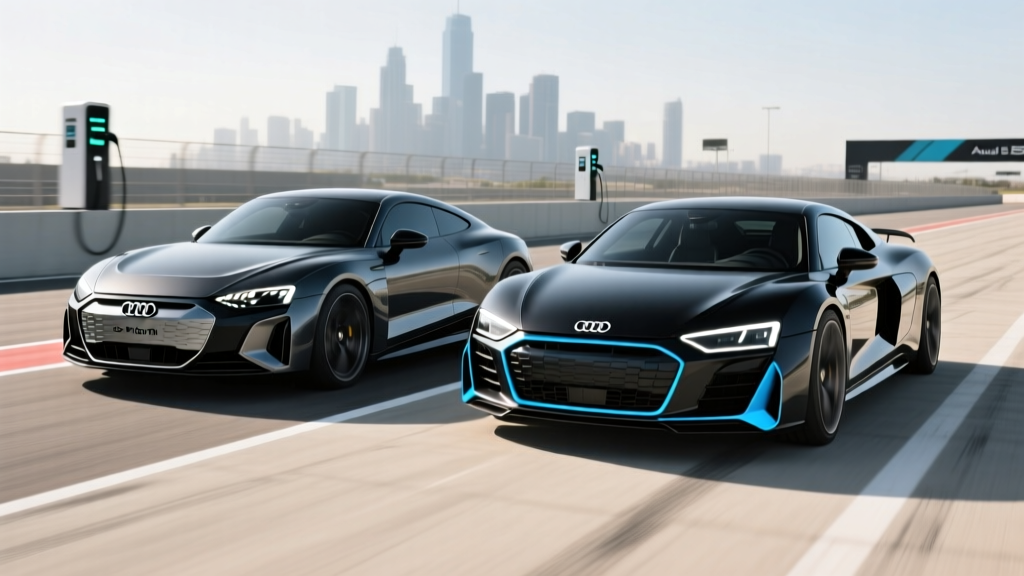
If you've been searching for an Audi e-tron R8, you're likely remembering one of the most ambitious — and ultimately short-lived — electric vehicles ever built. The original R8 e-tron debuted in 2015 with 451 horsepower and a then-impressive 206-mile range, but Audi pulled the plug after fewer than 100 units were hand-built. Today, the spiritual successor to that car is the Audi e-tron GT (and its high-performance sibling, the RS e-tron GT), which shares its J1 Performance platform with the Porsche Taycan and delivers supercar-rivaling acceleration in a grand-tourer package.
For 2026, Audi has significantly updated the e-tron GT lineup with a larger battery, faster charging, and refreshed styling. This review covers every number that matters — EPA range, real-world efficiency, DC fast-charge curves, pricing, and federal tax credit eligibility — so you can decide whether this electric grand tourer earns a spot in your garage.
2026 Audi e-tron GT Lineup at a Glance
The 2026 e-tron GT family now includes three trims, all riding on Audi's updated J1+ architecture with an 800-volt electrical system:
| Specification | e-tron GT quattro | RS e-tron GT | RS e-tron GT Performance |
|---|---|---|---|
| EPA Range | 302 mi | 278 mi | 268 mi |
| Usable Battery | 105 kWh (NMC) | 105 kWh (NMC) | 105 kWh (NMC) |
| Horsepower | 592 hp | 680 hp | 912 hp |
| 0–60 mph | 3.9 sec | 3.2 sec | 2.5 sec |
| Drivetrain | AWD (dual-motor) | AWD (dual-motor) | AWD (dual-motor) |
| Peak DC Charge | 320 kW | 320 kW | 320 kW |
| 10–80% DC Time | ~18 min | ~18 min | ~18 min |
| MPGe (combined) | 85 MPGe | 79 MPGe | 76 MPGe |
| Base MSRP | $108,900 | $142,400 | $172,900 |
Sources: fueleconomy.gov, Audi USA
Range and Real-World Efficiency
Real-World Expectation: Plan for 240–265 miles on highway road trips at 70–75 mph. In cold weather (below 32°F), expect a 20–30% reduction, dropping effective range to roughly 190–220 miles on the base trim.
The 2026 e-tron GT's 105 kWh usable battery pack uses nickel-manganese-cobalt (NMC) chemistry, chosen for its high energy density — critical in a low-slung sports sedan where packaging space is limited. NMC cells offer more range per kilogram than LFP (lithium iron phosphate), though they carry a higher cost and slightly faster long-term degradation.
In mixed suburban and highway driving at moderate temperatures (60–75°F), owners consistently report achieving 90–95% of the EPA sticker. However, sustained highway speeds above 75 mph push consumption to roughly 42–45 kWh/100 mi (compared to the EPA-rated 39 kWh/100 mi on the base trim), cutting range accordingly. The car's heat pump — now standard across all trims for 2026 — helps mitigate cold-weather losses, but physics still governs: a January road trip through the Rockies will demand more charging stops than a spring drive through the Carolinas.
Efficiency-minded drivers should note that the RS e-tron GT Performance, with its 912 hp and stickier performance tires, trades roughly 34 miles of range for its extra output. If maximum range is your priority, the base e-tron GT quattro is the clear choice.
Charging Speed: DC Fast and Home Level 2
The e-tron GT's 800-volt architecture remains one of its strongest assets. For 2026, Audi has raised peak DC fast-charge capability to 320 kW (up from 270 kW on the prior generation), enabled by the updated battery's improved thermal management and higher C-rate tolerance.
| Charging Method | Power / Rate | Time / Miles Added |
|---|---|---|
| DC Fast Charge (peak) | 320 kW | 10–80% in ~18 minutes |
| DC Fast Charge (sustained avg.) | ~220 kW (10–80%) | ~210 miles in 18 min |
| Level 2 (home, 11.5 kW) | 11.5 kW / 48A | ~29 mi/hr; full charge ~10 hrs |
| Level 2 (home, 9.6 kW) | 9.6 kW / 40A | ~24 mi/hr; full charge ~12 hrs |
| Level 1 (120V outlet) | 1.4 kW / 12A | ~3.5 mi/hr (emergency only) |
A few nuances matter here. The 320 kW peak is only achievable when the battery is preconditioned (the car does this automatically when you navigate to a compatible charger) and when the ambient temperature is moderate. In our experience, the charge curve holds above 250 kW from roughly 10% to 40% state of charge, then tapers progressively. Above 80% SoC, charging slows dramatically — to around 50 kW — as the battery management system protects cell longevity. This is why we quote 10–80% times; charging from 80–100% can add another 25–30 minutes.
For home charging, the e-tron GT accepts up to 11.5 kW on Level 2 via its J1772 connector (NACS adapter included for Tesla Supercharger access starting with 2026 models). A 48-amp hardwired Level 2 station — such as a ChargePoint Home Flex or Emporia Vue — will replenish the battery overnight in roughly 10 hours. Installation costs for a 240V/60A circuit typically run $800–$2,000 depending on your panel's proximity to the garage, though older homes may require a $2,000–$4,000 panel upgrade to support the additional load.
Performance and Driving Dynamics
If the original R8 e-tron was Audi's proof that electric propulsion could feel exotic, the 2026 RS e-tron GT Performance is the exclamation point. With 912 hp in launch-control mode and a 2.5-second 0–60 mph time, it rivals the Rimac Nevera in a straight line — at roughly one-tenth the price.
Even the "base" e-tron GT quattro delivers 592 hp and a 3.9-second 0–60, which is firmly in sports-car territory. The dual-motor all-wheel-drive system provides torque vectoring across both axles, and the rear-axle steering (standard on RS trims, optional on the base) gives the long-wheelbase GT surprising agility in corners.
Ride quality benefits from standard three-chamber air suspension, which can raise the car 20 mm for speed bumps or lower it 14 mm at highway speeds for improved aerodynamics. The GT's low center of gravity — the battery pack sits between the axles in a "bathtub" configuration — produces minimal body roll, and the car feels planted well beyond its 5,100-pound curb weight.
One honest drawback: the e-tron GT's steering, while precise, is relatively light on feedback compared to a Porsche Taycan Turbo GT. Drivers who prioritize steering communication may find the Audi slightly less engaging on a canyon road, even though the objective grip levels are nearly identical.
Interior, Cargo, and Technology
The e-tron GT's cabin uses Audi's latest MMI touch response system with a 14.5-inch curved OLED display and an available augmented-reality head-up display. Wireless Apple CarPlay and Android Auto are standard, along with a 16-speaker Bang & Olufsen 3D sound system on RS trims.
Driver-assistance technology includes Audi's Adaptive Cruise Assist with lane-centering (SAE Level 2 — the driver must remain engaged and hands on or near the wheel at all times), intersection assist, and a 360-degree camera system. Audi does not currently offer a hands-free highway driving system comparable to GM's Super Cruise or Ford's BlueCruise.
Practicality is where the GT's grand-tourer aspirations meet reality:
- Rear cargo (trunk): 12.9 cu ft — adequate for two carry-on suitcases and a garment bag
- Front trunk (frunk): 2.9 cu ft — fits a charging cable bag and a small soft cooler
- Rear legroom: 32.6 inches — tight for adults over 6 feet on long trips
- Front headroom: 38.0 inches — generous for a low-roof coupe-like sedan
The rear seat is best suited for children or occasional adult passengers on shorter trips. If you regularly carry four adults, a BMW i5 or Mercedes EQE offers meaningfully more rear-seat space, though neither matches the GT's performance credentials.
Pricing, Trims, and Federal Tax Credit Eligibility
| Trim | Base MSRP | As-Tested (typical options) | §30D Federal Credit |
|---|---|---|---|
| e-tron GT quattro | $108,900 | $116,500 | Not eligible (MSRP exceeds $55,000 sedan cap) |
| RS e-tron GT | $142,400 | $155,000 | Not eligible (MSRP exceeds $55,000 sedan cap) |
| RS e-tron GT Performance | $172,900 | $189,000 | Not eligible (MSRP exceeds $55,000 sedan cap) |
Under current IRS §30D rules, the federal EV tax credit is capped at vehicles with an MSRP of $55,000 for sedans (or $80,000 for SUVs/trucks/vans). Because the e-tron GT is classified as a sedan and starts at $108,900, no trim in the lineup qualifies for the $7,500 federal credit. This applies regardless of buyer income or battery sourcing.
Some buyers explore whether the e-tron GT could be reclassified as an SUV for credit purposes, but the IRS uses the EPA vehicle-class designation, and the GT is listed as a large car / sedan on fueleconomy.gov. There is no workaround.
State-level incentives may still apply. California's CVRP, for example, has historically offered rebates for higher-priced EVs under certain income thresholds, and Colorado offers a state tax credit of up to $5,000 for EVs regardless of MSRP. Check your state's energy office or department of revenue for current programs.
Ownership Costs and Warranty
Audi covers the e-tron GT's battery and electric powertrain for 8 years or 100,000 miles, with a capacity-retention threshold of 70% — consistent with industry norms. The basic vehicle warranty is 4 years / 50,000 miles, and Audi includes 3 years of complimentary scheduled maintenance and roadside assistance.
Total cost of ownership over 5 years is higher than most EVs in this price range due to the lack of federal credit, higher insurance premiums (average $3,800–$4,500/year for the RS trims), and the use of premium tires (the RS Performance rides on Michelin Pilot Sport 4S tires that run roughly $400 each and may need replacement every 15,000–20,000 miles under spirited driving).
On the savings side, home-charging costs average $0.13–$0.16/kWh nationally, meaning a full 105 kWh charge costs roughly $14–$17 — compared to $70–$90 for a tank of premium fuel in an Audi R8 V10. Over 15,000 miles of annual driving, the e-tron GT saves approximately $2,500–$3,500 per year in energy costs versus a comparable gasoline supercar.
How It Compares: e-tron GT vs. Key Rivals
- Class-leading 320 kW DC charging — among the fastest four-door EVs available
- Striking design that still turns heads in its third generation
- Supercar-rivaling 2.5-second 0–60 on the RS Performance
- 800V architecture enables consistent fast-charge performance
- Refined ride quality with standard air suspension
- NACS adapter included for Supercharger network access
- No federal tax credit eligibility due to MSRP cap
- Rear seat is cramped for adults on long trips
- Cargo space (12.9 cu ft total + 2.9 frunk) trails sedan rivals
- Steering feedback lags behind the Porsche Taycan
- No hands-free highway driving system (only Level 2 lane-centering)
- RS Performance's 268-mile range is modest for the price
The most direct comparison is the Porsche Taycan, which shares the J1 platform but offers a more driver-focused interior, sharper steering, and the Taycan Turbo GT variant with 1,019 hp. The Taycan also qualifies for no federal credit under current sedan MSRP rules, making the financial playing field level.
The Tesla Model S Plaid undercuts the RS e-tron GT on price ($89,990 vs. $142,400) and beats it on range (402 miles EPA), but the Audi delivers a more premium interior, superior build quality, and a more composed ride. The Model S is also aging — its platform dates to 2012 with incremental updates.
The BMW i5 M60 ($84,100) is the value play: it's 150 hp down on the RS e-tron GT but offers more rear-seat room, qualifies for the $7,500 federal credit (just under the $55,000 MSRP threshold on the base i5, though the M60 exceeds it), and delivers a more practical daily-driver experience.
Who Should Buy the Audi e-tron GT?
Buy the e-tron GT if: You want a head-turning electric grand tourer with supercar acceleration, best-in-class charging speed, and Audi build quality — and you don't need back-seat practicality or a federal tax credit.
Look elsewhere if: You regularly carry four adults (consider the BMW i5 or Mercedes EQE), you want maximum range per dollar (Tesla Model S), or you need hands-free highway driving for long commutes (BMW i5 with Highway Assistant or Cadillac CT5-V with Super Cruise).
The e-tron GT is best understood as a grand tourer in the classic Audi tradition: a car built for crossing continents at high speed in refined comfort, with enough performance to humble a sports car when the road opens up. It's not the most practical EV, nor the most affordable — but for the buyer who wants an electric vehicle that feels genuinely special every time they slide behind the wheel, the GT delivers in ways that spec sheets alone can't capture.
Frequently Asked Questions
What is the real-world range of the 2026 Audi e-tron GT?
The EPA rates the base e-tron GT quattro at 302 miles. In real-world mixed driving at moderate temperatures, expect 270–290 miles. Highway-only driving at 75 mph drops this to roughly 240–260 miles, and cold weather (below freezing) can reduce range by 20–30%, yielding 190–220 miles in winter conditions.
How fast does the Audi e-tron GT charge?
On a 350 kW-capable DC fast charger with battery preconditioning, the e-tron GT peaks at 320 kW and charges from 10–80% in approximately 18 minutes, adding roughly 210 miles of range. At home on a 48-amp Level 2 station (11.5 kW), a full charge takes about 10 hours.
Does the Audi e-tron GT qualify for the federal EV tax credit?
No. Under current IRS §30D rules, sedans must have an MSRP of $55,000 or less to qualify. The e-tron GT starts at $108,900, making all trims ineligible regardless of buyer income or battery sourcing. Some state incentives may still apply.
Is the Audi e-tron GT the same as the R8 e-tron?
No. The R8 e-tron was a limited-production two-seat supercar built in 2015–2016, with fewer than 100 units produced. The e-tron GT is its spiritual successor — a four-door grand tourer that shares its platform with the Porsche Taycan and delivers comparable performance with daily-driver practicality.
Is the Audi e-tron GT worth buying over the Porsche Taycan?
They share a platform, but the e-tron GT prioritizes ride comfort and design drama, while the Taycan emphasizes steering feel and driver engagement. If you value a plush grand-touring experience, the Audi is the stronger pick. If you plan to track the car or prioritize steering feedback, the Taycan edges ahead. Pricing and federal-credit ineligibility are nearly identical.
What is the battery warranty on the e-tron GT?
Audi covers the high-voltage battery and electric powertrain for 8 years or 100,000 miles, whichever comes first. The warranty guarantees the battery will retain at least 70% of its original capacity during that period.