The Audi e-tron R8: The Electric Supercar That Never Was
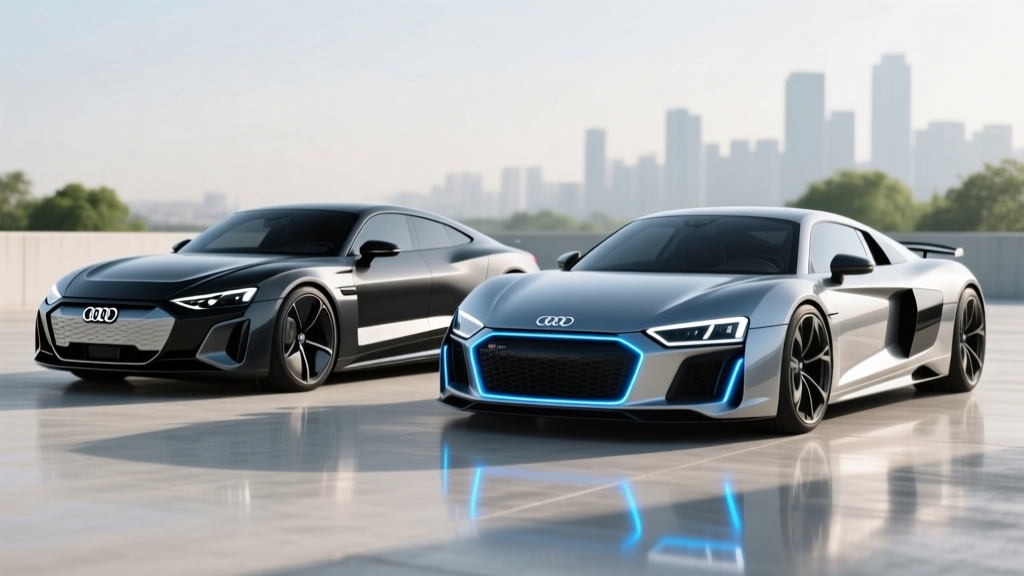
If you've been searching for an e-tron R8, you're not alone — and you're not imagining things. Audi did build an all-electric version of its legendary R8 supercar. The R8 e-tron was a real, drivable, limited-production vehicle that Audi offered briefly in 2015-2016 before quietly pulling the plug. Today, the R8 e-tron exists only in the used-car wild and in Audi's institutional memory, while its spiritual successor — the 2026 Audi e-tron GT RS — carries the electric-performance torch forward.
This article untangles the R8 e-tron's story, explains why it was discontinued, and provides a full profile of the 2026 Audi e-tron GT RS as the car Audi actually sells today if you want a four-ring electric performance machine.
What Was the Audi R8 e-tron?
The Audi R8 e-tron was a battery-electric variant of the first-generation R8 supercar, produced in extremely limited numbers (fewer than 100 units worldwide) between 2015 and 2016. It was sold exclusively in Europe, never officially imported to the United States, and was discontinued after roughly one year of availability.
Audi had been developing electric R8 prototypes since 2009, showing concepts at the Frankfurt and Detroit auto shows. The production version featured:
- Battery: ~92 kWh lithium-ion (NMC chemistry), T-shaped pack mounted in the central tunnel and behind the seats
- Range: Approximately 280 miles on the European NEDC cycle (~210-220 miles in real-world driving)
- Power: 456 hp (340 kW) from dual rear-mounted electric motors
- 0-62 mph: 3.9 seconds
- Top speed: Electronically limited to 130 mph (later raised to 155 mph)
- Price: Approximately €1,000,000 (~$1.1M at the time)
Despite impressive engineering — including a carbon-fiber body structure and advanced torque vectoring — the R8 e-tron was a commercial non-starter. The price was stratospheric, the range was modest for the cost, and buyer interest was minimal. Audi ceased production in late 2016.
Why Was the R8 e-tron Discontinued?
Several factors converged to kill the R8 e-tron after barely a year on the market:
- Prohibitive cost: At over $1 million, it was priced far beyond even wealthy enthusiasts' willingness to pay for a first-generation EV supercar with limited range.
- Low demand: Audi reportedly sold fewer than 100 units globally. Most were built to special order.
- Rapid battery obsolescence: Battery technology was advancing quickly, and the R8 e-tron's 92 kWh pack was already being outpaced by newer, cheaper, denser cells.
- Strategic pivot: Audi shifted its electrification strategy toward higher-volume models on the Volkswagen Group's new J1 and PPE platforms — leading directly to the e-tron GT.
The R8 itself (in its gasoline V8 and V10 forms) continued production through 2024 before being retired. Audi has not announced a direct R8 successor, electric or otherwise.
The 2026 Audi e-tron GT RS: The Spiritual Successor
Since the R8 e-tron is unavailable and long out of production, the car that actually answers the "electric Audi supercar" brief today is the 2026 Audi RS e-tron GT (and its higher-output RS e-tron GT Performance variant). Built on the J1 platform shared with the Porsche Taycan, it delivers supercar-rivaling acceleration in a four-door grand-tourer package.
| Specification | RS e-tron GT | RS e-tron GT Performance |
|---|---|---|
| EPA Range | 246 miles | 232 miles |
| Battery (usable) | 97.0 kWh (NMC) | 97.0 kWh (NMC) |
| Horsepower | 670 hp (launch control) | 912 hp (launch control) |
| 0-60 mph | 3.1 seconds | 2.5 seconds |
| Drivetrain | Dual-motor AWD | Dual-motor AWD |
| Max DC Fast Charge | 320 kW | 320 kW |
| 10-80% DC Time | ~18 minutes | ~18 minutes |
| Level 2 Home Charge | 11 kW (~32 mi/hr) | 11 kW (~32 mi/hr) |
| MPGe (combined) | 82 MPGe | 77 MPGe |
| Base MSRP | $151,900 | $178,200 |
| Federal Tax Credit (§30D) | Not eligible (MSRP cap $55K) | Not eligible (MSRP cap $55K) |
Sources: fueleconomy.gov, Audi USA
Charging: How Fast Does the e-tron GT RS Charge?
The e-tron GT's 800-volt architecture is one of its strongest technical assets, enabling DC fast-charge speeds that few EVs can match. Here's what charging looks like across all three levels:
| Level | Power (kW) | Miles Added per Hour | Notes |
|---|---|---|---|
| Level 1 (120V) | ~1.4 kW | ~4 mi/hr | Emergency/trickle only; full charge in ~70 hours |
| Level 2 (240V, 48A) | 11 kW | ~32 mi/hr | Full charge in ~9 hours; ideal overnight home charging |
| DC Fast (800V) | Up to 320 kW | ~190 mi in 10 min | 10-80% in ~18 min; tapers significantly above 80% SoC |
Charging curve reality: The 320 kW peak is achieved only between roughly 10-40% state of charge under optimal thermal conditions. Above 50%, the rate drops to ~180-200 kW, and above 80% it falls sharply to ~50 kW or less. This is standard behavior for NMC cells protecting longevity. If you're road-tripping, plan your stops around 10-80% charges — pushing to 100% at a DC fast charger adds 20+ minutes for minimal range gain.
The e-tron GT uses a CCS1 connector for DC fast charging in North America. Audi has confirmed that future models will adopt the NACS (Tesla) connector, but the 2026 e-tron GT retains CCS1. You can use a NACS-to-CCS adapter at Tesla Superchargers (where supported), but native Electrify America, EVgo, and ChargePoint CCS stations are the primary network options.
Performance, Interior, and Daily Usability
The RS e-tron GT's dual-motor all-wheel-drive powertrain delivers brutal acceleration — the Performance variant's 2.5-second 0-60 time places it in hypercar territory, rivaling a Bugatti Veyron's launch. But this is a grand tourer, not a track weapon, and the driving experience reflects that.
The adaptive air suspension provides a surprisingly compliant ride in Comfort mode, while Dynamic mode firms things up and sharpens throttle response. Rear-axle steering (standard on RS trims) tightens the turning radius and adds agility at low speeds. The low center of gravity — thanks to the floor-mounted battery pack — gives the e-tron GT cornering composure that belies its ~5,100-pound curb weight.
Interior Space and Cargo
This is where the GT diverges sharply from the mid-engine R8 it spiritually succeeds:
- Front headroom: 39.5 inches
- Front legroom: 41.7 inches
- Rear headroom: 36.5 inches (tight for passengers over 6 feet)
- Rear legroom: 32.1 inches (best for children or short trips)
- Trunk (rear): 9.2 cubic feet
- Frunk (front): 3.5 cubic feet (enough for a charging cable bag or small soft duffel)
Total cargo capacity is modest at ~12.7 cu ft. This is a performance GT, not a family hauler. The Porsche Taycan Cross Turismo offers more practicality if cargo matters.
Tech and Driver Assistance
The 2026 e-tron GT features Audi's latest MMI infotainment system with a 10.1-inch upper touchscreen and 8.6-inch lower climate/functions display. Wireless Apple CarPlay and Android Auto are standard. The 12.3-inch Virtual Cockit digital instrument cluster is configurable and well-executed.
Driver assistance is SAE Level 2 — meaning the driver must remain fully engaged at all times. Audi's Adaptive Cruise Assist with lane-centering is competent for highway cruising but does not offer hands-free operation like GM's Super Cruise or Ford's BlueCruise. There is no "self-driving" capability here.
Pricing, Tax Credits, and Ownership Costs
| Trim | Base MSRP | As-Tested (typical) | §30D Federal Credit |
|---|---|---|---|
| RS e-tron GT | $151,900 | ~$165,000 | $0 (exceeds $55K sedan cap) |
| RS e-tron GT Performance | $178,200 | ~$195,000 | $0 (exceeds $55K sedan cap) |
Federal tax credit status: The RS e-tron GT does not qualify for the IRS §30D New Clean Vehicle Credit. The federal credit has an MSRP cap of $55,000 for sedans (and $80,000 for SUVs/trucks/vans). At $151,900+, the e-tron GT far exceeds this threshold. There is no workaround — the buyer pays full price regardless of income level.
Ownership economics: The e-tron GT's electricity costs are reasonable (~$0.13/kWh national average = ~$5.50 per 100 miles vs. ~$14-16 for a comparable gas performance sedan at 18 MPG). However, insurance premiums are steep — expect $4,000-$6,000/year depending on your profile. Depreciation on luxury EVs remains a concern; the Taycan has historically lost 40-50% of value in three years, and the e-tron GT tracks similarly.
Warranty coverage:
- Battery: 8 years / 100,000 miles (retains ≥70% capacity)
- Powertrain: 4 years / 50,000 miles
- Bumper-to-bumper: 4 years / 50,000 miles
- Free maintenance: 1 year / 10,000 miles
Pros and Cons: The Honest Assessment
✅ Pros
- Supercar acceleration (2.5s 0-60 in Performance trim)
- 800V architecture enables 320 kW DC fast charging
- Stunning design — one of the best-looking EVs on the road
- Compliant air-suspension ride for a performance car
- High-quality interior with excellent fit and finish
- Rear-axle steering adds genuine low-speed agility
❌ Cons
- 246-mile EPA range is below rivals (Lucid Air: 516 mi)
- No federal tax credit eligibility
- Rear seats are cramped for adults
- Small frunk and trunk — limited cargo utility
- CCS1 connector (no native NACS/Tesla Supercharger access)
- Heavy depreciation typical of luxury EVs
- No hands-free driving assist (only Level 2)
Is the e-tron GT RS Worth It vs. Competitors?
The e-tron GT competes in a narrow but fierce segment. Here's how it stacks up against the key rivals:
| Metric | Audi RS e-tron GT Perf. | Porsche Taycan Turbo GT | Tesla Model S Plaid | Lucid Air Sapphire |
|---|---|---|---|---|
| 0-60 mph | 2.5s | 2.1s | 1.99s | 1.89s |
| EPA Range | 232 mi | 269 mi | 396 mi | 427 mi |
| Max DC Charge | 320 kW | 320 kW | 250 kW | 300+ kW |
| Base MSRP | $178,200 | $230,700 | $108,490 | $249,000 |
Who Should Buy the RS e-tron GT?
Choose the Audi RS e-tron GT if: You prioritize design and build quality above all else, want 800V fast charging, value the Audi/Porsche J1 platform's driving dynamics, and don't need more than ~230 miles of range.
Choose the Tesla Model S Plaid if: Range (396 mi) and value ($108K) matter more than exclusivity, and you want Supercharger network access.
Choose the Porsche Taycan Turbo GT if: Track performance and brand cachet justify a $230K+ price tag.
Choose the Lucid Air Sapphire if: You want the best combination of range, speed, and luxury, and budget is not a primary concern.
Frequently Asked Questions
Can I still buy an Audi R8 e-tron?
Not from Audi. The R8 e-tron was discontinued in 2016 after fewer than 100 units were built, all sold in Europe. A handful may appear on the collector-car market, but parts support and serviceability are significant concerns. The 2026 RS e-tron GT is Audi's current electric performance offering.
What is the real-world range of the 2026 RS e-tron GT?
The EPA rates it at 246 miles (standard RS) or 232 miles (Performance). In real-world highway driving at 75 mph, expect ~200-215 miles. In freezing temperatures, that drops to 170-185 miles. Preconditioning the battery before driving helps mitigate cold-weather losses.
Does the e-tron GT qualify for any EV tax credits?
No. The federal §30D credit has an MSRP cap of $55,000 for sedans. At $151,900+, the e-tron GT is far above this threshold. Some states may offer their own incentives for EV purchases — check your state's energy office or AFDC state incentives database — but federal credits are off the table.
How fast does the e-tron GT charge at home?
On a Level 2 home charger (240V, 48A), the e-tron GT charges at up to 11 kW, adding roughly 32 miles of range per hour. A full 0-100% charge takes approximately 9 hours. Most owners will plug in overnight and wake to a full battery. A dedicated 48A Level 2 charger costs roughly $600-$1,200 for equipment plus $500-$2,000 for professional installation depending on your electrical panel.
Is the RS e-tron GT a supercar?
By acceleration alone, yes — the Performance variant's 2.5-second 0-60 time exceeds most traditional supercars. But it's a four-door, ~5,100-pound grand tourer, not a lightweight track car. Think of it as a supercar-rivaling GT rather than a supercar in the R8/Lamborghini tradition.
Will Audi ever make an electric R8 successor?
Audi has not announced any plans for a next-generation R8, electric or otherwise. The R8 nameplate was retired after the 2024 model year. If an electric spiritual successor arrives, it would likely ride on the PPE or SSP Sport platform and wouldn't be expected before 2028-2029 at the earliest.