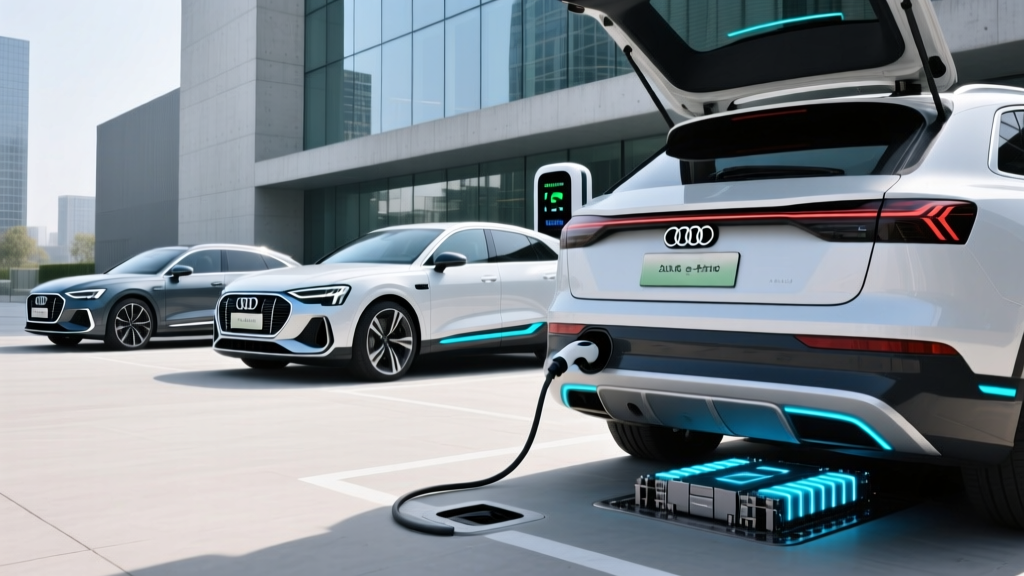
Audi's electric portfolio has expanded well beyond its original e-tron SUV. For 2026, the Audi e-tron models lineup spans three distinct vehicles built on two different platforms: the carryover Q8 e-tron on the MLB Evo architecture, and the newer Q6 e-tron and A6 e-tron sharing Volkswagen Group's dedicated PPE (Premium Platform Electric) skateboard. Each targets a different buyer, and the differences in range, charging speed, and tech are substantial.
This review covers all three current U.S.-market Audi e-tron models with exact specs, real-world ownership considerations, and the data you need to pick the right one.
2026 Audi e-tron Models at a Glance
| Spec | Q8 e-tron (SUV) | Q6 e-tron (SUV) | A6 e-tron (Sedan) |
|---|---|---|---|
| Platform | MLB Evo | PPE | PPE |
| EPA Range | 285 mi | 321 mi | 381 mi (est.) |
| Battery (usable) | 106 kWh, NMC | 94.9 kWh, NMC | 94.9 kWh, NMC |
| Max DC Charge | 170 kW | 270 kW | 270 kW |
| 10–80% DC Time | ~31 min | ~21 min | ~21 min |
| Level 2 Rate | 11.5 kW | 11.5 kW (opt. 22 kW) | 11.5 kW (opt. 22 kW) |
| 0–60 mph | 5.5s (Premium Plus) | 4.9s (quattro) | 4.3s (quattro) |
| Horsepower | 402 hp | 422 hp | 422 hp (quattro) |
| Drivetrain | Dual-motor AWD | Dual-motor AWD / RWD | Dual-motor AWD / RWD |
| MPGe (combined) | 81 MPGe | 97 MPGe | ~105 MPGe (est.) |
| Base MSRP | $75,695 | $65,095 | $67,895 (est.) |
| Cargo (behind 2nd row) | 28.5 cu ft | 27.2 cu ft | 16.1 cu ft (trunk) |
| Battery Warranty | 8 yr / 100,000 mi | 8 yr / 100,000 mi | 8 yr / 100,000 mi |
Range and Efficiency: What the EPA Numbers Miss
Q8 e-tron: EPA 285 mi. Expect 240–260 mi on the highway at 75 mph; 210–230 mi in sub-30°F weather with climate control active.
Q6 e-tron: EPA 321 mi (RWD Ultra). AWD quattro drops to ~308 mi. Highway driving yields 270–290 mi; cold weather cuts to ~250 mi.
A6 e-tron: Preliminary EPA 381 mi (RWD). Real-world highway: ~330–350 mi. Cold weather: ~290–310 mi. AWD quattro trims will rate lower.
The Q8 e-tron's older MLB platform carries a weight penalty — at roughly 5,800 lbs, it pushes electrons harder, returning just 81 MPGe combined. That translates to about 38 kWh per 100 miles. The PPE-based Q6 and A6 are leaner and more aerodynamic, with the A6 e-tron sedan's low drag coefficient (0.21 Cd) giving it a decisive efficiency edge.
The Q6 e-tron Ultra with RWD is the sweet spot for range-focused buyers. The dual-motor quattro versions sacrifice roughly 10–15 miles of range for all-weather traction. According to fueleconomy.gov, PPE's 800-volt architecture also enables more consistent energy delivery under load compared to the Q8's 400-volt system.
Charging Speed: Where PPE Leaves MLB Behind
| Charge Method | Q8 e-tron | Q6 e-tron | A6 e-tron |
|---|---|---|---|
| Level 1 (120V / 12A) | ~1.4 kW / 4 mi/hr | ~1.4 kW / 4 mi/hr | ~1.4 kW / 5 mi/hr |
| Level 2 (240V / 48A) | 11.5 kW / 33 mi/hr | 11.5 kW / 37 mi/hr | 11.5 kW / 41 mi/hr |
| Level 2 (opt. 22 kW onboard) | Not available | 22 kW / 71 mi/hr | 22 kW / 78 mi/hr |
| DC Fast (peak) | 170 kW | 270 kW | 270 kW |
| 10–80% DC Time | ~31 min | ~21 min | ~21 min |
| Charge Port | NACS (2025+) | NACS (native) | NACS (native) |
The 800-volt PPE platform in the Q6 and A6 e-tron unlocks 270 kW peak DC charging — roughly 59% faster than the Q8's 400-volt ceiling of 170 kW. On a 350 kW Electrify America or Tesla Supercharger stall (with NACS adapter or native connector), the Q6 e-tron will pull its peak rate through about 30% SoC before tapering to ~150 kW by 60%, and further to ~50 kW above 80%. This charge-curve taper is why the 10–80% metric matters more than peak kW alone.
At home on a 48-amp Level 2 circuit (requiring a 60-amp breaker), all three models replenish overnight. A full 0–100% session takes roughly 9–10 hours for the Q8 and 8–9 hours for the Q6/A6. The optional 22 kW onboard charger for PPE models cuts that to under 5 hours — useful if your home panel supports a 100-amp circuit, though installation costs rise accordingly.
Charging cost varies widely. At the national average of $0.16/kWh for home electricity, fully charging the Q6 e-tron's 94.9 kWh battery costs about $15.18. At a public DC charger averaging $0.48/kWh, that same fill runs $45.55. For comparison, fueling an equivalent Audi Q5 45 TFSI at $3.50/gallon and 25 MPG combined costs about $42 for the same distance.
Performance and Drivetrain
All three models offer Audi's quattro all-wheel drive via dual-motor setups, though the Q6 and A6 e-tron also offer single-motor RWD variants for maximum range.
The Q8 e-tron produces 402 hp and 490 lb-ft of torque in standard form, hitting 60 mph in 5.5 seconds. The SQ8 e-tron variant bumps output to 496 hp with a 4.4-second sprint, though range drops to 254 miles. Its adaptive air suspension delivers the plush, isolation-heavy ride Audi is known for, but the 5,800-lb curb weight is noticeable in tight corners.
The Q6 e-tron quattro delivers 422 hp (456 hp with launch control) and reaches 60 mph in 4.9 seconds. The lighter PPE platform — roughly 600 lbs less than the Q8 — makes this the more agile handler despite similar power. The SQ6 e-tron variant pushes 509 hp and a 4.3-second 0–60.
The A6 e-tron quattro matches the Q6's powertrain output but leverages the sedan's lower center of gravity and reduced frontal area for a 4.3-second 0–60 time. The S6 e-tron variant, with 543 hp, targets BMW i5 M60 buyers with a 3.8-second claim.
Pricing, Trims, and Federal Tax Credit Eligibility
| Model / Trim | MSRP | §30D Credit Eligibility | Effective Price (if eligible) |
|---|---|---|---|
| Q8 e-tron Premium Plus | $75,695 | Eligible — under $80K SUV cap | $68,195 |
| Q8 e-tron Prestige | $81,095 | Exceeds $80K SUV MSRP cap | $81,095 (no credit) |
| SQ8 e-tron Premium Plus | $90,595 | Exceeds $80K SUV MSRP cap | $90,595 (no credit) |
| Q6 e-tron Premium | $65,095 | Eligible — under $80K SUV cap | $57,595 |
| Q6 e-tron Premium Plus | $69,895 | Eligible — under $80K SUV cap | $62,395 |
| A6 e-tron Premium (est.) | $67,895 | Eligible — under $55K sedan cap? TBD | See note below |
The IRS §30D clean vehicle credit imposes strict limits. For SUVs, the MSRP cap is $80,000; for sedans, it's $55,000. Buyer income caps apply ($150K single / $300K joint AGI). Additionally, battery component and critical mineral sourcing requirements must be met — and these thresholds tighten annually.
For 2026, the Q8 e-tron Premium Plus and Q6 e-tron in Premium and Premium Plus trims generally qualify for the full $7,500 credit, which can now be transferred to the dealer at point of sale as a purchase-price reduction. However, the A6 e-tron sedan's eligibility is complicated: if its MSRP exceeds $55,000 (which current estimates suggest it does), it would not qualify under the sedan cap. Audi has not confirmed whether the A6 e-tron will be classified as a sedan or potentially reclassified for credit purposes — consult your dealer and a tax professional before committing.
The Q8 e-tron Prestige and SQ8 e-tron exceed the $80,000 SUV cap and receive no federal credit. Some states offer separate rebates — check your local program.
Interior, Tech, and Daily Livability
Q8 e-tron: The cabin carries over Audi's dual-touchscreen MMI layout (10.1" upper, 8.6" lower) with haptic feedback. Build quality is flagship-grade — open-pore wood, aluminum inlays, and available Valcona leather. Rear legroom measures 39.1 inches. Cargo volume is 28.5 cu ft behind the second row and 57.0 cu ft with seats folded. The frunk adds 2.1 cu ft — enough for a charging cable bag, not much more.
Q6 e-tron: The PPE platform debuts Audi's new MMI panoramic display: an 11.9" digital instrument cluster and 14.5" infotainment touchscreen in a single curved housing, plus an available 10.9" passenger display. The center console is more open thanks to the EV skateboard. Rear legroom is 37.8 inches, and cargo volume is 27.2 cu ft (58.1 cu ft folded). A 2.3 cu ft frunk provides modest bonus storage.
A6 e-tron: Shares the Q6's panoramic display architecture but in a lower, wider sedan dashboard. Rear headroom is tighter (37.2 inches vs. 38.4 in the Q6) due to the roofline. Trunk volume is 16.1 cu ft, with a pass-through for longer items. No frunk on initial U.S. trims.
All three models feature Audi's adaptive cruise assist with lane guidance — a Level 2 SAE system requiring continuous driver supervision. This is not autonomous driving; hands must remain on or near the wheel. The available parking assist plus with remote capability is genuinely useful for tight garages.
Warranty and Long-Term Ownership
Audi provides consistent coverage across all e-tron models:
- Battery: 8 years / 100,000 miles (capacity retention threshold: 70%)
- Powertrain: 8 years / 100,000 miles
- New vehicle limited: 4 years / 50,000 miles
- Roadside assistance: 4 years / unlimited miles
The 70% capacity retention threshold is standard for the industry, though some competitors (Hyundai/Kia) offer unlimited-mile battery warranties. NMC battery chemistry in all three models provides high energy density but is more susceptible to calendar degradation if routinely charged to 100% and stored in heat. Audi's battery management system includes a top and bottom buffer — roughly 5–8 kWh of the gross capacity is reserved — to slow degradation.
Real-world degradation data from earlier e-tron owners suggests roughly 5–8% capacity loss over the first 100,000 miles with mixed charging habits. DC fast charging exclusively accelerates this; home Level 2 charging at 80% daily SoC is optimal for longevity.
Pros and Cons
Pros
- Q6 and A6 e-tron offer class-leading 270 kW DC charging on 800V PPE
- Premium interior materials and build quality across the lineup
- NACS native charging on 2025+ models — Tesla Supercharger access
- A6 e-tron targets 381 mi EPA range (if finalized) — Audi's longest yet
- Adaptive air suspension standard on Q8, available on Q6
- Point-of-sale tax credit transfer available on eligible trims
Cons
- Q8 e-tron is heavy, inefficient (81 MPGe), and limited to 170 kW DC
- Prestige and SQ8 trims exceed $80K MSRP cap — no federal credit
- A6 e-tron sedan likely exceeds $55K sedan cap — credit eligibility uncertain
- 22 kW onboard charger is an option, not standard, on PPE models
- No frunk on A6 e-tron; Q8 frunk is tiny (2.1 cu ft)
- MMI dual-screen in Q8 is a generation behind the PPE panoramic display
Which Audi e-tron Model Fits Your Needs?
Choose the Q8 e-tron if: You want maximum cargo space (57 cu ft folded), air suspension comfort, and don't mind the efficiency penalty. Best for families who prioritize ride quality over charging speed and don't road-trip frequently enough for the 170 kW ceiling to matter.
Choose the Q6 e-tron if: You want the best balance of range (321 mi), charging speed (270 kW, 10–80% in 21 min), and price ($65,095 base, potentially $57,595 after credit). The default pick for most buyers in this lineup.
Choose the A6 e-tron if: You prefer a sedan, commute long distances, and want maximum range (est. 381 mi). Accept that the $55K sedan MSRP cap may disqualify it from the federal credit, and cargo space is limited to 16.1 cu ft.
Frequently Asked Questions
What is the real-world range of Audi e-tron models?
The Q8 e-tron delivers roughly 240–260 miles on the highway (EPA 285 mi). The Q6 e-tron RWD Ultra achieves 270–290 miles highway (EPA 321 mi). The A6 e-tron RWD is projected at 330–350 highway miles (EPA 381 mi est.). Cold weather reduces all figures by 15–25%.
How fast do Audi e-tron models charge?
The Q6 and A6 e-tron charge at up to 270 kW DC, reaching 10–80% in about 21 minutes at a capable station. The Q8 e-tron peaks at 170 kW and takes ~31 minutes for the same session. At home on Level 2 (11.5 kW), all three charge fully overnight in 8–10 hours.
Do Audi e-tron models qualify for the $7,500 federal tax credit?
The Q8 e-tron Premium Plus ($75,695) and Q6 e-tron Premium/Premium Plus ($65,095–$69,895) qualify, as they fall under the $80,000 SUV MSRP cap. Higher trims exceeding $80K do not. The A6 e-tron sedan's eligibility is uncertain due to the $55,000 sedan cap. Buyer income limits and battery sourcing rules also apply per IRS §30D guidelines.
Is the Q6 e-tron better than the Q8 e-tron?
For most buyers, yes. The Q6 e-tron charges faster (270 vs. 170 kW), goes farther (321 vs. 285 mi EPA), costs less ($65,095 vs. $75,695), and has newer tech. The Q8 e-tron wins only on cargo volume and available air suspension for ride comfort.
What battery chemistry do Audi e-tron models use?
All current Audi e-tron models use NMC (nickel manganese cobalt) lithium-ion cells. Audi has not announced LFP variants for the U.S. market. NMC offers higher energy density but requires more careful SoC management for long-term health compared to LFP.
How long will the Audi e-tron battery last?
Audi warranties the battery for 8 years or 100,000 miles against degradation below 70% capacity. Real-world data from earlier e-tron models suggests 5–8% capacity loss over 100,000 miles with mixed charging. With primarily Level 2 home charging and 80% daily SoC limits, many owners can expect the battery to remain above 85% capacity at 150,000 miles.