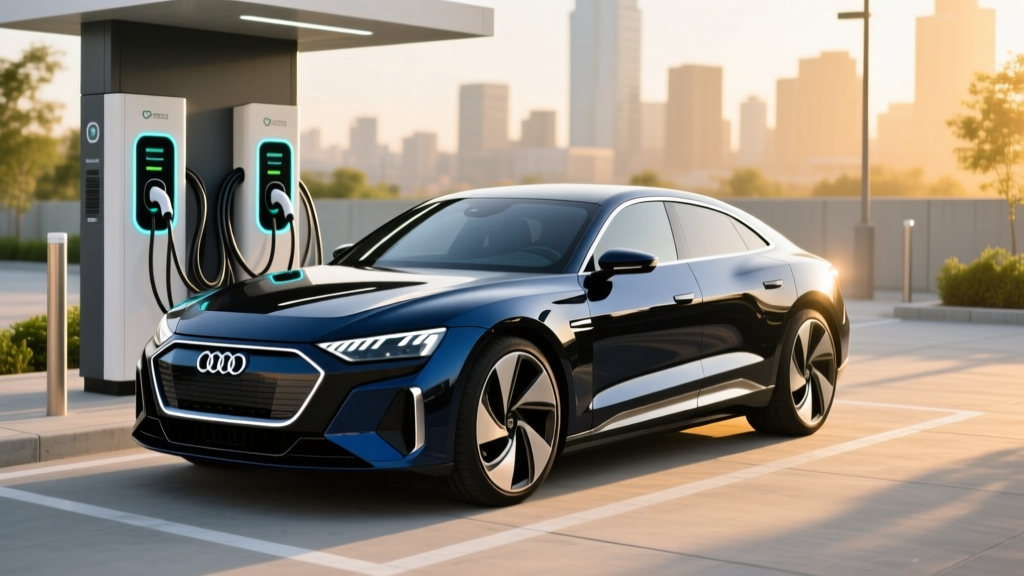
When it comes to luxury electric SUVs, the Audi E-Tron remains one of the most refined options on the market — but for many shoppers, Audi E-Tron car leasing is the smarter path to ownership. Leasing lets you sidestep the steepest part of the depreciation curve, access the latest model-year tech, and keep monthly payments predictable. In this 2026 profile, we break down exactly what you're getting: real-world range, charging performance, pricing with current federal tax credit rules, and whether leasing or buying is the better financial play for your situation.
2026 Audi E-Tron at a Glance: Key Specs
| Spec | 2026 Audi Q8 E-Tron Premium Plus | 2026 Audi Q8 E-Tron Prestige |
|---|---|---|
| EPA Range | 285 miles | 285 miles |
| Battery (Usable) | 106 kWh (NMC) | 106 kWh (NMC) |
| Max DC Fast Charge | 170 kW | 170 kW |
| 10–80% DCFC Time | ~31 minutes | ~31 minutes |
| Level 2 Charge Rate | 19.2 kW / ~45 mi/hr | 19.2 kW / ~45 mi/hr |
| 0–60 mph | 5.5 seconds | 5.5 seconds |
| Horsepower | 402 hp (boost mode) | 402 hp (boost mode) |
| Drivetrain | quattro AWD (dual-motor) | quattro AWD (dual-motor) |
| Efficiency | 77 MPGe / 44 kWh/100mi | 77 MPGe / 44 kWh/100mi |
| Base MSRP | $75,695 | $82,095 |
| Cargo Volume (rear seats up) | 28.5 cu ft | 28.5 cu ft |
| Cargo Volume (rear seats folded) | 56.4 cu ft | 56.4 cu ft |
| Battery Warranty | 8 yr / 100,000 mi | 8 yr / 100,000 mi |
Real-World Range: What the EPA Sticker Doesn't Tell You
The Q8 E-Tron's 106 kWh usable battery (114 kWh gross, NMC lithium-ion chemistry) is among the largest in its class. That massive pack is the reason the E-Tron has always prioritized charging consistency and longevity over chasing the longest EPA number. Audi manages a generous buffer — roughly 8 kWh reserved above and below the usable window — which slows long-term degradation but also means you're carrying dead weight you can't access.
Efficiency lands at 77 MPGe combined, or about 44 kWh per 100 miles, according to fueleconomy.gov. That's noticeably less efficient than a Tesla Model X (101 MPGe) or even a BMW iX xDrive50 (86 MPGe). The trade-off is a quieter, more insulated cabin and a suspension tuned for comfort over aero optimization.
For context: a daily commute of 40–50 miles round trip means you'll charge every 4–5 days at home, which is manageable for most owners. But if your routine involves frequent 200+ mile highway stretches, you'll want to map DC fast-charger locations along your routes.
Charging Speed: DC Fast, Level 2, and the Curve Reality
| Charging Level | Power (kW) | Speed | Best For |
|---|---|---|---|
| Level 1 (120V household) | ~1.4 kW | ~3 miles/hour | Emergency/top-up only |
| Level 2 (240V home) | Up to 19.2 kW | ~45 miles/hour | Daily home charging |
| DC Fast Charge (CCS) | Peak 170 kW | 10–80% in ~31 min | Road trips |
The Q8 E-Tron's 170 kW peak DC fast-charge rate is respectable, but the real story is the charge curve. Unlike many competitors that spike to peak power briefly then taper aggressively, the E-Tron sustains near-peak charging power from roughly 10% to 60% state of charge. This means your actual charging session is more predictable than the spec sheet suggests.
From 10–80%, expect about 31 minutes at a properly functioning 170+ kW station (such as an Electrify America 350 kW stall). Above 80%, charging slows dramatically — a 90% top-up can add another 15 minutes. This is standard behavior for NMC batteries to protect longevity, but it matters when you're deciding whether to charge to 80% or push for 100% on a road trip.
At home on a Level 2 charger, the 19.2 kW onboard charger is a standout. Most competitors max out at 11.5 kW, meaning the E-Tron can replenish its large battery faster overnight. A full 0–100% charge at 19.2 kW takes roughly 6 hours — so even a heavily depleted battery is ready by morning. Note: you'll need a 100-amp dedicated circuit to take full advantage of 19.2 kW; most home installations deliver 48 amps (11.5 kW), which still provides about 28 miles of range per hour of charging.
Performance, Ride, and Daily Livability
The dual-motor quattro all-wheel-drive system produces 402 horsepower and 490 lb-ft of torque in boost mode, delivering a 5.5-second 0–60 mph time. That's not sports-car quick — a Tesla Model X Plaid will embarrass it — but the E-Tron was never built for stoplight drag races. The thrust is linear, immediate, and effortless for highway merging and passing.
Where the E-Tron earns its luxury badge is ride quality. The standard adaptive air suspension soaks up broken pavement with a composure that feels more limousine than crossover. Cabin isolation is exceptional; road and wind noise are nearly absent at 80 mph. The steering is light and precise if not particularly communicative.
Interior space is generous for five passengers, with 40.2 inches of front legroom and 38.1 inches in the rear. The 28.5 cubic feet of cargo space behind the second row is competitive, expanding to 56.4 cu ft with seats folded. There's also a small front trunk (frunk) for charging cables. Build quality is classic Audi: tight panel gaps, premium materials, and a tactile satisfaction that many newer EV startups still can't match.
Pricing, Trims, and Federal Tax Credit Eligibility
| Trim | MSRP | Destination | Total Before Incentives |
|---|---|---|---|
| Premium Plus | $75,695 | $1,195 | $76,890 |
| Prestige | $82,095 | $1,195 | $83,290 |
| Sportback Premium Plus | $78,695 | $1,195 | $79,890 |
Here's where the tax credit picture requires careful attention. Under current IRS §30D rules, the Q8 E-Tron faces two hurdles:
- MSRP cap: SUVs must have an MSRP at or below $80,000. The Premium Plus trim qualifies; the Prestige trim at $82,095 does not.
- Battery sourcing requirements: To receive the full $7,500, the vehicle must meet critical-mineral and battery-component sourcing thresholds that increase each year. Audi's supply chain has been evolving, and eligibility can change mid-year. Always verify the specific VIN's credit status at fueleconomy.gov before purchasing.
- Buyer income cap: Modified adjusted gross income must not exceed $300,000 (joint), $225,000 (head of household), or $150,000 (single).
Audi E-Tron vs. Key Competitors: Is It Worth Leasing?
The Q8 E-Tron doesn't compete on range-per-dollar. It competes on refinement. Here's how it stacks up against the luxury electric SUV field:
| Model | EPA Range | Peak DC kW | 0–60 mph | Base MSRP | Efficiency |
|---|---|---|---|---|---|
| Audi Q8 E-Tron | 285 mi | 170 kW | 5.5 sec | $75,695 | 77 MPGe |
| BMW iX xDrive50 | 324 mi | 200 kW | 4.4 sec | $87,250 | 86 MPGe |
| Mercedes EQE 350 SUV | 279 mi | 170 kW | 6.4 sec | $77,900 | 80 MPGe |
| Tesla Model X Long Range | 335 mi | 250 kW | 3.8 sec | $79,990 | 101 MPGe |
| Genesis Electrified GV70 | 236 mi | 240 kW | 4.2 sec | $67,850 | 82 MPGe |
The E-Tron sits in a narrow lane: it's quieter and more traditionally luxurious than the Tesla, more affordable than the BMW iX, and offers far better range than the Genesis. If build quality, cabin serenity, and a non-polarizing design matter to you, the E-Tron is arguably the best in class. If you prioritize maximum range, fastest charging, or the lowest price, other options win those categories.
Pros and Cons: The Honest Scorecard
Pros
- Exceptional ride quality and cabin quietness
- 19.2 kW Level 2 onboard charger (best-in-class home charging)
- Flat, predictable DC charge curve — real-world charging matches specs
- Premium interior materials and build quality
- Leasing can bypass §30D purchase restrictions via §45W
- Generous 8-year/100,000-mile battery warranty
Cons
- Below-average efficiency (44 kWh/100mi) hurts range per kWh
- 285-mile EPA range trails BMW iX and Tesla Model X
- Prestige trim exceeds $80K MSRP cap for purchase tax credit
- CCS connector only — no native NACS (Tesla Supercharger) access without adapter
- Infotainment dual-screen setup is less intuitive than competitors
- Heavy vehicle weight (5,800+ lbs) increases tire wear
Tech, Driver Assistance, and Safety
The Q8 E-Tron features Audi's MMI touch response dual-screen infotainment system (10.1-inch upper, 8.6-inch lower). It supports wireless Apple CarPlay and Android Auto, includes a Wi-Fi hotspot, and offers Audi's Virtual Cockpit Plus digital instrument cluster. The system works well once learned, but the lack of physical knobs for climate control is a frequent complaint.
Driver assistance comes via Audi's Adaptive Cruise Assist with lane guidance — a SAE Level 2 system. This means it handles steering, acceleration, and braking on highways, but you must keep your hands on the wheel and eyes on the road at all times. It is not autonomous driving. The system is competent and smooth but doesn't match the hands-free convenience of GM's Super Cruise or Ford's BlueCruise on mapped highways.
The Q8 E-Tron earned a Top Safety Pick+ rating from IIHS and a 5-star overall rating from NHTSA, giving it one of the strongest safety credentials in the luxury EV segment.
Who Should Lease the Audi E-Tron — And Who Shouldn't
Lease the Q8 E-Tron if:
- You value ride comfort and cabin quietness over maximum range
- You can charge at home and want the fastest Level 2 replenishment available
- Your daily driving is under 100 miles with occasional road trips under 250 miles
- You want luxury build quality without the Tesla aesthetic
- The §45W lease credit makes the monthly payment more attractive than a purchase after §30D
Look elsewhere if:
- You regularly drive 300+ miles between charges (get a Model X or iX)
- You need NACS/Supercharger access without an adapter
- You want hands-free highway driving (Super Cruise or BlueCruise equipped vehicles)
- Efficiency and lowest cost-per-mile are your top priorities
Frequently Asked Questions
What is the real-world range of the 2026 Audi Q8 E-Tron?
The EPA rates it at 285 miles. In real-world mixed driving, expect 240–265 miles. Highway driving at 75+ mph drops that to roughly 220–240 miles. In freezing temperatures, plan for 190–220 miles per charge.
How fast does the Q8 E-Tron charge at home and on the road?
At home on Level 2 (240V), the E-Tron accepts up to 19.2 kW, adding roughly 45 miles of range per hour — the fastest onboard charger in its class. On DC fast chargers, it peaks at 170 kW and charges from 10–80% in about 31 minutes. The charge curve is notably flat, meaning it sustains high power longer than many competitors.
Does the Audi E-Tron qualify for the federal EV tax credit?
It depends on the trim and how you acquire it. The Premium Plus trim (MSRP $75,695) falls under the $80,000 SUV cap for the §30D purchase credit, but you must also meet income limits and verify battery-sourcing compliance for the specific VIN. The Prestige trim ($82,095) exceeds the MSRP cap and does not qualify for the purchase credit. However, leasing may unlock the §45W commercial credit regardless of trim, which dealers often pass through as reduced monthly payments.
How much does it cost to lease the Audi E-Tron?
Lease pricing varies by dealer, region, money factor, and term. As of early 2026, typical 36-month leases for the Premium Plus trim range from $850–$1,100/month with $3,000–$5,000 due at signing, depending on how aggressively the dealer applies the §45W lease credit. Always request the full lease disclosure (capitalized cost, residual, money factor, and any pass-through credits) before signing.
Is the Audi E-Tron better than the BMW iX or Tesla Model X?
It depends on your priorities. The E-Tron wins on ride quality, cabin quietness, and traditional luxury feel. The BMW iX wins on range (324 mi), efficiency, and charging speed. The Tesla Model X wins on performance, Supercharger network access, and efficiency. None is objectively best — they optimize for different buyers.
What is the battery warranty on the Q8 E-Tron?
Audi covers the high-voltage battery for 8 years or 100,000 miles, whichever comes first. The warranty guarantees the battery will retain at least 70% of its original capacity during that period. The general vehicle warranty is 4 years / 50,000 miles.
Can the Q8 E-Tron use Tesla Superchargers?
Not natively. The Q8 E-Tron uses a CCS1 connector. Tesla has opened some Supercharger stations to non-Tesla vehicles via the Tesla app, but you'll need a CCS-to-NACS adapter for broad access. Audi has not yet switched to the NACS connector, which is expected to become standard across the industry in coming model years.