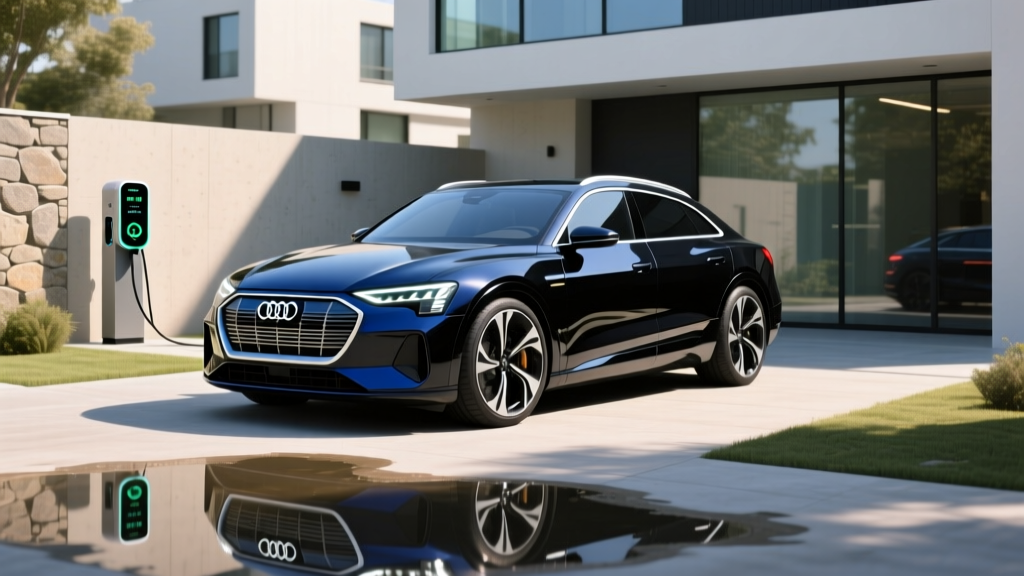
If you've been browsing Audi e-tron lease deals in 2026, you've likely noticed the nameplate has evolved. Audi rebranded its original e-tron SUV as the Q8 e-tron for the 2024 model year, and the 2026 version carries forward with meaningful refinements in battery efficiency, charging speed, and software. The Q8 e-tron occupies a specific niche in the luxury EV SUV segment: it prioritizes ride comfort, cabin quietness, and build quality over outright range or acceleration numbers. That makes it a compelling lease candidate for buyers who want a premium daily driver rather than a range-maximizing road-tripper.
This review breaks down every number that matters — EPA range, real-world efficiency, DC fast-charging curves, home charging rates, pricing by trim, and the current federal tax credit picture — so you can evaluate lease offers with full context.
2026 Audi Q8 e-tron at a Glance: Key Specs
| Specification | Q8 e-tron 55 | Q8 e-tron S |
|---|---|---|
| EPA Range | 285 miles | 264 miles |
| Battery (Usable) | 106 kWh (NMC) | 106 kWh (NMC) |
| Max DC Fast Charge | 170 kW | 170 kW |
| 10–80% DC Charge Time | ~31 minutes | ~31 minutes |
| Level 2 Home Charge Rate | 19.2 kW (AC) | 19.2 kW (AC) |
| 0–60 mph | 5.3 seconds | 4.5 seconds |
| Horsepower | 402 hp | 496 hp (boost mode) |
| Drivetrain | Dual-motor AWD (quattro) | Dual-motor AWD (quattro) |
| Efficiency (MPGe) | 81 MPGe combined | 74 MPGe combined |
| Efficiency (kWh/100 mi) | 42 kWh/100 mi | 46 kWh/100 mi |
| Cargo (rear seats up) | 28.5 cu ft | 28.5 cu ft |
| Cargo (rear seats folded) | 56.4 cu ft | 56.4 cu ft |
| Base MSRP | $75,600 | $96,800 |
| Battery Warranty | 8 yr / 100,000 mi | 8 yr / 100,000 mi |
Source: EPA / fueleconomy.gov, Audi USA official specifications.
Range Reality: EPA Sticker vs. Real-World Miles
Real-World Expectation: ~240–260 miles on mixed highway driving at 70+ mph; ~210–230 miles in sub-freezing winter conditions with cabin heat active.
The Q8 e-tron's 106 kWh usable battery (NMC chemistry) is one of the largest in its class, but the SUV's 5,800+ lb curb weight and relatively conservative aerodynamics mean it converts that energy into fewer miles than lighter competitors. The EPA's 285-mile figure for the Q8 e-tron 55 is achievable in moderate-temperature city and suburban driving where regenerative braking recaptures energy frequently.
On sustained highway trips at 75 mph — the scenario that matters most for road-trip planning — expect roughly 240–260 miles before you'll want to stop. In cold weather (below 32°F), battery internal resistance increases and cabin heating draws significant energy from the pack; plan for 210–230 miles of usable range. The Q8 e-tron does include a heat pump as standard equipment, which mitigates some cold-weather loss compared to resistive heating, but the physics of a heavy SUV in winter remain unavoidable.
For context, the EPA's fueleconomy.gov lists the Q8 e-tron 55 at 81 MPGe combined (42 kWh per 100 miles). That efficiency figure trails rivals like the BMW iX xDrive50 (87 MPGe combined) but aligns with the Audi's comfort-over-efficiency tuning philosophy.
Charging Speeds: DC Fast, Level 2, and the Curve
| Charging Level | Power / Rate | Miles Added per Hour | Notes |
|---|---|---|---|
| Level 1 (120V outlet) | ~1.4 kW | ~3–4 mi/hr | Emergency/trickle only |
| Level 2 (240V, 48A) | 11.5 kW | ~25–28 mi/hr | Standard home wallbox |
| Level 2 (240V, 80A) | 19.2 kW | ~42–46 mi/hr | Requires hardwired 100A circuit |
| DC Fast Charge (peak) | 170 kW | ~200+ mi in 30 min | 10–80% in ~31 minutes |
The Q8 e-tron's 170 kW peak DC fast-charging rate is respectable but not class-leading. Competitors like the Hyundai Ioniq 5 and Kia EV9 accept 235–350 kW on capable chargers. However, Audi's charge curve is notably flat — the SUV sustains close to 150 kW well past 50% state of charge (SoC), only tapering significantly above 80%. This means a 10–80% session takes approximately 31 minutes at a 350 kW Electrify America or Ionity station, which is competitive for the segment even though the peak number looks modest.
At home, the Q8 e-tron's onboard charger supports up to 19.2 kW on Level 2 AC — but that requires a hardwired 100-amp dedicated circuit and a compatible wallbox (such as the ChargePoint Home Flex or FLO Home X8). Most residential installations use a 60-amp circuit with a 48-amp charger, delivering 11.5 kW and adding roughly 25–28 miles of range per hour. A full overnight charge from 20% to 100% takes about 9–10 hours on a standard Level 2 setup, which is adequate for daily replenishment.
Preconditioning matters: The Q8 e-tron will precondition its battery for optimal DC charging speed when you navigate to a fast charger via the built-in MMI navigation. If you drive to a charger without preconditioning (especially in cold weather), expect significantly slower initial charge rates until the pack reaches operating temperature.
Performance, Ride, and Daily-Driving Character
The Q8 e-tron 55's dual-motor quattro all-wheel-drive system produces 402 hp and 490 lb-ft of torque, delivering a 5.3-second 0–60 mph time. The S variant unlocks 496 hp in boost mode and cuts that to 4.5 seconds. Neither figure is thrilling by EV standards — the Tesla Model X Plaid does 0–60 in 2.5 seconds — but the Audi's acceleration is smooth, progressive, and more than adequate for highway merging and passing.
Where the Q8 e-tron genuinely excels is ride quality. The standard adaptive air suspension absorbs road imperfections with a composure that rivals the best luxury SUVs, gas or electric. Cabin noise levels at 70 mph are remarkably low, aided by acoustic glass and careful aerodynamic sealing. The steering is light and precise rather than sporty, reinforcing the GT-cruiser character.
Inside, the dual-screen MMI touch response system (10.1-inch upper, 8.6-inch lower) handles infotainment and climate controls. The 12.3-inch Virtual Cockit digital instrument cluster is standard. Wireless Apple CarPlay and Android Auto are included. Driver assistance features include Audi adaptive cruise assist with lane guidance (a Level 2 SAE system — you must keep hands on the wheel and remain attentive), intersection assist, and surround-view cameras.
Pricing, Trim Levels, and Lease Economics
| Trim | Base MSRP | Typical As-Tested | Federal §30D Credit Eligible? |
|---|---|---|---|
| Q8 e-tron Premium 55 | $75,600 | $79,000–$83,000 | No — exceeds $80,000 SUV MSRP cap when optioned |
| Q8 e-tron Premium Plus 55 | $79,900 | $84,000–$88,000 | No — exceeds cap |
| Q8 e-tron Prestige 55 | $84,300 | $88,000–$93,000 | No — exceeds cap |
| Q8 e-tron S Premium Plus | $96,800 | $101,000+ | No — exceeds cap |
The 2026 Q8 e-tron's base MSRP starts at $75,600 for the Premium 55 trim. However, once destination charges and popular options (cold-weather package, towing package, premium paint) are added, most examples land between $80,000 and $90,000. The S variant starts at $96,800 and routinely exceeds $100,000 when equipped.
Federal tax credit reality: Under current IRS §30D rules, new EV SUVs must have an MSRP at or below $80,000 to qualify for the up-to-$7,500 federal tax credit. The base Q8 e-tron Premium 55 at $75,600 technically falls under the cap, but the credit also requires the buyer's modified adjusted gross income to be within limits ($300,000 joint / $150,000 single), and the vehicle's battery must meet critical-mineral and battery-component sourcing requirements that shift annually. In practice, most Q8 e-tron configurations — especially with dealer-installed options pushing the MSRP above $80,000 — will not qualify. Always verify eligibility with a tax professional before assuming credit availability.
Leasing loophole: Here's where lease deals become interesting. Under the commercial clean vehicle credit (§45W), leasing companies can claim the $7,500 credit on eligible vehicles and pass the savings through as a "lease cash" reduction. Audi Financial Services has periodically offered lease cash incentives on the Q8 e-tron that effectively reduce monthly payments. When shopping lease deals, ask the dealer specifically whether Audi is currently passing through any federal lease credit — this can shave $100–$150/month off a 36-month lease.
Who Should Lease the Q8 e-tron (And Who Shouldn't)
- You prioritize ride comfort, cabin quietness, and premium build over maximum range
- Your daily commute is under 80 miles round-trip and you have home Level 2 charging
- You want a luxury badge with strong dealer service infrastructure
- You value Audi's virtual mirrors, air suspension, and interior material quality
- You plan to keep the vehicle 36–48 months (lease term) and avoid long-term battery degradation risk
Look elsewhere if:
- You regularly drive 300+ miles between charging stops (consider the BMW iX or Lucid Gravity)
- You need maximum cargo space for large families (the Rivian R1S offers more)
- You want cutting-edge one-pedal driving (Audi's regen is mild by design; it won't bring you to a full stop)
- Federal purchase tax credit eligibility is a deal-breaker for your budget
Competitor Comparison: Q8 e-tron vs. Key Rivals
| Spec | Audi Q8 e-tron 55 | BMW iX xDrive50 | Mercedes EQE 350+ SUV |
|---|---|---|---|
| EPA Range | 285 mi | 324 mi | 305 mi |
| Battery (Usable) | 106 kWh (NMC) | 105.2 kWh (NMC) | 90.6 kWh (NMC) |
| DC Fast Charge Peak | 170 kW | 195 kW | 170 kW |
| 0–60 mph | 5.3 sec | 4.4 sec | 6.4 sec |
| Base MSRP | $75,600 | $87,250 | $78,050 |
| MPGe Combined | 81 | 87 | 82 |
| Cargo (seats up) | 28.5 cu ft | 35.5 cu ft | 14.0 cu ft |
The BMW iX xDrive50 offers superior range, faster acceleration, and more cargo space, but starts $11,650 higher and has a polarizing exterior design. The Mercedes EQE SUV prioritizes rear-seat luxury but sacrifices cargo volume. The Q8 e-tron's advantage is its combination of a lower entry price, traditional SUV proportions, and Audi's understated design language that ages gracefully.
Warranty Coverage and Long-Term Ownership
Audi covers the Q8 e-tron's high-voltage battery for 8 years or 100,000 miles, whichever comes first. The warranty guarantees the battery will retain at least 70% of its original capacity during that period. If capacity drops below that threshold, Audi will repair or replace the battery at no cost. The general vehicle limited warranty is 4 years / 50,000 miles, and the powertrain warranty matches the battery at 8 years / 100,000 miles.
For lessees on a 36-month / 36,000-mile term, battery degradation is essentially a non-issue. NMC batteries of this generation typically lose 5–8% capacity over three years of normal use — well within the warranty threshold. If you plan to purchase at lease-end, the remaining battery warranty provides substantial protection.
Pros and Cons: The Honest Scorecard
Pros
- Exceptional ride comfort with standard air suspension
- Quiet, well-insulated cabin at highway speeds
- Flat DC charge curve sustains useful speeds past 50% SoC
- 19.2 kW AC onboard charger (fast for home Level 2)
- Premium interior materials and fit-and-finish
- quattro AWD standard across all trims
- Lease cash incentives can offset high MSRP
Cons
- EPA range trails key competitors by 20–40 miles
- Heavy curb weight (5,843 lbs) hurts efficiency
- Most trims exceed the $80K federal tax credit MSRP cap
- Mild regenerative braking — no true one-pedal driving
- Touchscreen-heavy climate controls require eyes-off-road
- Cargo space (28.5 cu ft) is below segment average
Frequently Asked Questions
What is the real-world range of the Audi Q8 e-tron?
The EPA rates the Q8 e-tron 55 at 285 miles. In real-world mixed highway driving at 70–75 mph, expect 240–260 miles. In freezing winter conditions with heat running, plan for 210–230 miles. City driving with frequent regenerative braking can approach or match the EPA figure in mild weather.
How fast does the Q8 e-tron charge at home and on DC fast chargers?
On a DC fast charger, it peaks at 170 kW and charges from 10–80% in approximately 31 minutes. At home on a standard 48-amp Level 2 charger (11.5 kW), it adds about 25–28 miles per hour, fully replenishing overnight in 9–10 hours. With a hardwired 80-amp Level 2 station, the 19.2 kW onboard charger cuts that to about 6 hours.
Does the Audi Q8 e-tron qualify for the $7,500 federal EV tax credit?
It's unlikely for most buyers. The IRS §30D credit requires SUVs to have an MSRP at or below $80,000, buyer income within caps, and battery sourcing compliance. The base Premium 55 at $75,600 technically qualifies on MSRP, but options typically push it over. Leasing may unlock savings through the §45W commercial credit passed through by Audi Financial Services. Consult a tax professional and confirm with your dealer.
Is it better to buy or lease the Q8 e-tron?
Leasing is generally the stronger financial move for the Q8 e-tron. You avoid the sales tax on the full purchase price (taxed only on monthly payments in most states), you can capture any lease-cash incentives, and you sidestep long-term depreciation risk on a luxury EV. If you drive under 15,000 miles/year and want to upgrade in 3 years, a lease is the pragmatic choice.
How does the Q8 e-tron compare to the Tesla Model X?
The Model X offers significantly more range (335 mi EPA), faster DC charging (250 kW), and access to the Supercharger network. However, the Q8 e-tron delivers superior build quality, a quieter cabin, a more comfortable air-suspension ride, and a more conventional luxury SUV interior. They serve different buyer priorities: Tesla for tech and efficiency, Audi for comfort and craftsmanship.
What's the biggest drawback of the Q8 e-tron for road trips?
The 285-mile EPA range means you'll charge more frequently than in a BMW iX or Tesla Model X on long highway drives. On a 600-mile trip, expect two charging stops of ~30 minutes each rather than one. If you road-trip frequently and prioritize fewer stops, the range deficit is a legitimate trade-off.