Quick Verdict: A Luxury EV Cabin That Punches Above Its Range
The Audi e-tron (sold as the Q8 e-tron since the 2024 refresh) occupies a specific niche in the luxury EV space: it trades headline-grabbing range for a cabin that rivals the best internal-combustion Audi sedans. If your search for Audi e-tron interior details brought you here, the short answer is that this remains one of the most refined, quiet, and material-rich electric SUV cabins on the market. But the 218-mile EPA range and steep starting price mean buyers need to weigh comfort against daily practicality.
EPA Estimated: 218 miles (Q8 e-tron Premium Plus, 20" wheels)
Real-World Highway (70 mph, mild weather): ~185–200 miles
Cold Weather (below 30°F, highway): ~155–175 miles
City/Stop-and-Go (regen-heavy): ~220–235 miles
Interior Materials, Space, and Technology
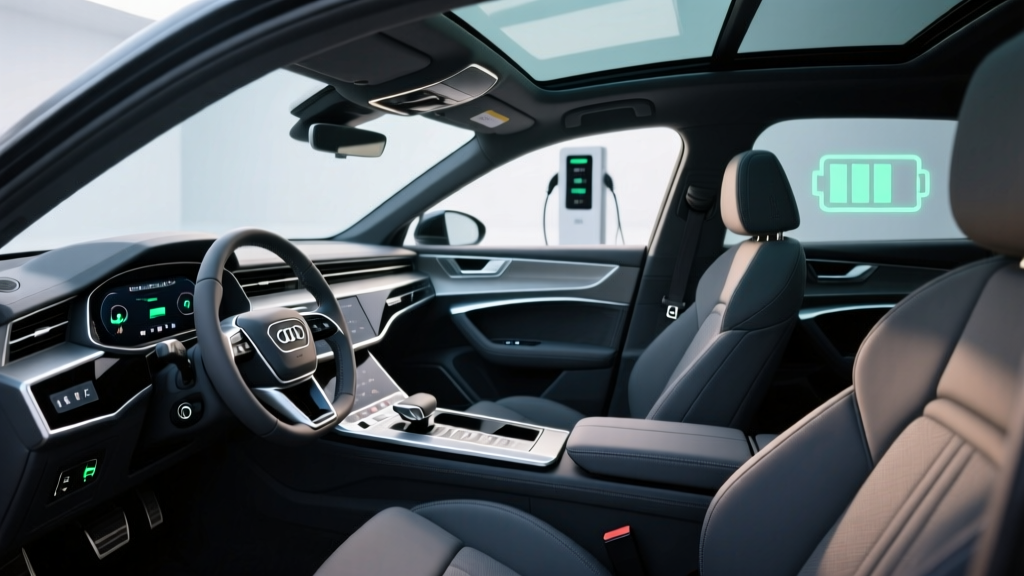
The Audi e-tron interior stands apart from competitors like the Tesla Model X and Rivian R1S by prioritizing traditional luxury over minimalist futurism. Audi uses open-pore wood, available Valcona leather, and soft-touch surfaces across the dash, door panels, and center console. The fit and finish meet the standard set by the A6 and Q7 — tight panel gaps, damped switchgear, and triple-sealed doors that keep road noise nearly absent at highway speed.
Dual-Screen MMI and Digital Cockpit
The center stack features Audi's MMI touch response system: a 10.1-inch upper display for navigation, media, and vehicle settings, and an 8.6-inch lower display for climate controls, handwriting input, and shortcut tiles. Haptic feedback confirms each press, which helps usability while driving. The 12.3-inch Virtual Cockpit Plus behind the wheel is configurable with navigation maps, range data, and driver-assist visualizations.
Wireless Apple CarPlay and Android Auto are standard. A head-up display with augmented-reality navigation arrows is available on Prestige trims. The Bang & Olussen 3D sound system (16 channels, 705 watts) is among the best in the segment.
Passenger and Cargo Dimensions
| Measurement | Specification |
|---|---|
| Front Headroom | 38.6 in |
| Rear Headroom | 38.1 in |
| Front Legroom | 41.6 in |
| Rear Legroom | 39.1 in |
| Cargo (behind 2nd row) | 28.5 cu ft |
| Cargo (2nd row folded) | 56.4 cu ft |
| Frunk | Not available (under-hood electronics) |
The flat floor (a benefit of the dedicated EV platform) gives the middle rear passenger genuine foot space, something the BMW iX also handles well. However, the 28.5 cu ft cargo area trails the iX (31.6 cu ft) and the Tesla Model X (behind-row-2 space is substantially larger). No frunk exists — the space under the hood houses power electronics and the heat pump.
Battery, Range, and Efficiency
The 2026 Q8 e-tron carries a 114 kWh gross battery pack (approximately 106 kWh usable), using NMC (nickel manganese cobalt) chemistry. This is a large pack by segment standards — larger than the BMW iX xDrive50's 111.5 kWh gross — but the e-tron's heavier curb weight (~5,800 lbs) and less aerodynamic profile keep range modest.
| Spec | Value |
|---|---|
| Battery (gross / usable) | 114 kWh / ~106 kWh |
| Chemistry | NMC (nickel manganese cobalt) |
| EPA Range (Premium Plus, 20" wheels) | 218 miles |
| EPA Range (Prestige, 21" wheels) | 204 miles |
| Combined MPGe | 81 MPGe |
| Efficiency | 41 kWh/100 mi |
| Heat Pump | Standard (improves cold-weather efficiency) |
Efficiency of 41 kWh/100 mi is the weak point. For context, the BMW iX xDrive50 achieves roughly 87 MPGe combined (~35 kWh/100 mi), and the Tesla Model X Long Range hits ~102 MPGe. Over 15,000 annual miles, the e-tron will consume roughly 1,500 more kWh than the iX — translating to $180–$300 more per year in electricity depending on your rate. (Source: EPA fueleconomy.gov)
Charging Speed: DC Fast Charge and Home Level 2
Audi equipped the Q8 e-tron with a 170 kW peak DC fast-charge rate on CCS1 connectors. The charge curve is relatively flat — a strength — sustaining roughly 150 kW through 50% SoC before tapering. A 10–80% session takes approximately 28 minutes on a 175+ kW station.
| Charging Level | Power | Speed | Notes |
|---|---|---|---|
| Level 1 (120V) | ~1.4 kW | ~3 mi/hr | Emergency/trickle only |
| Level 2 (240V, 48A) | 11.5 kW | ~25 mi/hr | Full charge in ~9.5 hrs |
| DC Fast Charge (CCS1) | 170 kW peak | 10–80% in ~28 min | Flat curve to ~50% SoC |
| DC Fast Charge (NACS adapter) | 170 kW peak | 10–80% in ~28 min | Tesla Supercharger access via adapter |
For home charging, the onboard charger accepts up to 11.5 kW on a Level 2 hardwired station (48 amps). That means a full 0–100% charge takes about 9.5 hours — feasible for overnight replenishment on a typical daily commute. A 200-amp home electrical panel is usually sufficient; older 100-amp panels may require a $1,500–$3,000 upgrade.
The Q8 e-tron ships with a CCS1 port but Audi offers a NACS adapter for Tesla Supercharger access, which matters as the Supercharger network remains the most reliable DC fast-charge infrastructure in the U.S.
Performance and Drivetrain
The standard Q8 e-tron uses a dual-motor quattro all-wheel-drive system producing 402 horsepower and 490 lb-ft of torque in Boost mode. The 0–60 mph time is 5.1 seconds — adequate for merging and passing but noticeably behind the BMW iX xDrive50 (4.4 seconds) and Tesla Model X Long Range (3.8 seconds).
The SQ8 e-tron variant bumps output to 496 hp and drops 0–60 to 4.3 seconds, but at the cost of roughly 15 miles of EPA range. Both versions feature adaptive air suspension with five ride-height settings, and the ride quality in Comfort mode absorbs broken pavement with genuine composure.
| Spec | Q8 e-tron | SQ8 e-tron |
|---|---|---|
| Horsepower (Boost) | 402 hp | 496 hp |
| Torque | 490 lb-ft | 718 lb-ft |
| 0–60 mph | 5.1 sec | 4.3 sec |
| Drivetrain | Dual-motor AWD | Dual-motor AWD |
| Towing Capacity | 4,000 lbs | 4,000 lbs |
Driver Assistance (SAE Level 2)
Audi's Adaptive Cruise Assist with Lane Guidance is a SAE Level 2 system — it handles steering, acceleration, and braking on highways, but the driver must keep hands on the wheel and eyes on the road at all times. This is not a hands-free system like GM's Super Cruise or Ford's BlueCruise. The system is competent but unremarkable; lane centering can feel tentative on faded markings, and the driver-monitoring system is camera-based and occasionally overly sensitive.
Pricing, Trims, and Federal Tax Credit Eligibility
The 2026 Audi Q8 e-tron lineup starts at $71,995 (Premium Plus) and climbs to $79,195 for the Prestige trim. The SQ8 e-tron starts at $96,495. All prices include destination but exclude options. A Prestige-trim Q8 e-tron with the Luxury package, 21-inch wheels, and Bang & Olussen audio can reach $87,000+.
| Trim | MSRP | Est. Federal Credit | Effective Price |
|---|---|---|---|
| Q8 e-tron Premium Plus | $71,995 | Up to $7,500* | ~$64,495 |
| Q8 e-tron Prestige | $79,195 | Up to $7,500* | ~$71,695 |
| SQ8 e-tron Premium Plus | $96,495 | $0 (MSRP cap) | $96,495 |
*Federal tax credit (IRS §30D) caveats: The $7,500 credit requires meeting battery component and critical mineral sourcing thresholds, which shift annually. The Q8 e-tron's MSRP is under the $80,000 SUV cap for the Premium Plus and base Prestige, but the SQ8 e-tron exceeds the cap and is ineligible. Buyer income limits also apply ($300,000 joint / $150,000 single for new vehicles). The credit can be transferred to the dealer at point of sale for an upfront price reduction. Always verify current-year eligibility on IRS.gov and confirm with a tax professional.
Pros, Cons, and Who Should Buy
- Interior materials and build quality rival the best in the segment
- Quiet cabin with excellent NVH isolation
- Flat DC fast-charge curve sustains high power to 50% SoC
- Standard heat pump for cold-weather efficiency
- Air suspension delivers compliant, adjustable ride
- 4,000-lb towing capacity
- 218-mile EPA range trails key competitors by 50–100+ miles
- 41 kWh/100 mi efficiency is below segment average
- No frunk; cargo space is modest for the class
- Driver-assist system is competent but not class-leading
- SQ8 e-tron exceeds $80K MSRP cap for federal tax credit
- Dual-screen center stack requires more glances than physical buttons
Best For
Commuters and luxury-oriented buyers who prioritize cabin refinement, ride quality, and brand prestige over maximum range. If your daily drive is under 60 miles round-trip and you have reliable home Level 2 charging, the range limitation becomes a non-issue. The Q8 e-tron also suits buyers who tow light trailers (up to 4,000 lbs) and want a traditional luxury SUV experience without learning a new interface paradigm.
Not ideal for: High-mileage road trippers, buyers in charging-desert regions, or anyone cross-shopping the Tesla Model X Long Range (348-mile EPA range) or BMW iX xDrive50 (307-mile EPA range) on efficiency grounds.
How It Compares to Key Rivals
| Spec | Audi Q8 e-tron | BMW iX xDrive50 | Tesla Model X LR |
|---|---|---|---|
| EPA Range | 218 mi | 307 mi | 348 mi |
| Battery (usable) | ~106 kWh | ~105 kWh | ~100 kWh |
| 0–60 mph | 5.1 sec | 4.4 sec | 3.8 sec |
| Peak DC Charge | 170 kW | 200 kW | 250 kW |
| Base MSRP | $71,995 | $87,250 | $79,990 |
| Cargo (behind 2nd) | 28.5 cu ft | 31.6 cu ft | 37.1 cu ft |
| Interior Quality | Excellent | Very Good | Good (minimalist) |
The Q8 e-tron wins on cabin refinement and ride comfort. The iX and Model X win decisively on range, efficiency, charging speed, and cargo space. The iX is more expensive at base but delivers meaningfully more range per dollar once you factor in charging time on road trips.
Warranty Coverage
Audi provides a 4-year/50,000-mile limited vehicle warranty and an 8-year/100,000-mile high-voltage battery warranty. The battery warranty guarantees at least 70% capacity retention over the coverage period — consistent with industry norms. (NHTSA lists no major battery-related recalls for the Q8 e-tron platform as of early 2026.)
Frequently Asked Questions
What is the real-world range of the Audi e-tron?
The EPA rates the Q8 e-tron at 218 miles (Premium Plus, 20-inch wheels). In real-world highway driving at 70 mph in mild temperatures, expect 185–200 miles. Cold weather below 30°F reduces that to roughly 155–175 miles despite the standard heat pump. City driving with regenerative braking can push range slightly above the EPA figure.
How fast does the Audi e-tron charge?
On a DC fast charger rated 175+ kW, the Q8 e-tron charges from 10–80% in approximately 28 minutes, peaking at 170 kW with a flat charge curve through about 50% state of charge. On a 48-amp Level 2 home station (11.5 kW), a full charge takes roughly 9.5 hours, adding about 25 miles of range per hour.
Does the Audi e-tron qualify for the federal EV tax credit?
The Q8 e-tron Premium Plus ($71,995) and base Prestige ($79,195) fall under the $80,000 SUV MSRP cap and may qualify for up to $7,500 under IRS §30D, subject to battery-sourcing requirements, buyer income limits ($300K joint / $150K single), and point-of-sale transfer availability. The SQ8 e-tron ($96,495) exceeds the MSRP cap and is ineligible. Verify current eligibility at fueleconomy.gov and with a tax professional.
Is the Audi e-tron worth buying over the BMW iX or Tesla Model X?
If interior luxury, ride comfort, and brand tradition are your top priorities and your daily mileage stays under 80 miles with home charging access, the Q8 e-tron is a compelling choice. If range, efficiency, and road-trip practicality matter more, the BMW iX xDrive50 (307-mile range) or Tesla Model X Long Range (348-mile range) are more rational picks despite less opulent cabins.
What is the biggest drawback of the Audi e-tron interior?
The dual-screen center stack requires more visual attention than physical climate buttons, and the lack of a frunk reduces total cargo utility. Rear cargo space at 28.5 cu ft also trails competitors. However, material quality, noise isolation, and overall fit-and-finish are genuine strengths.