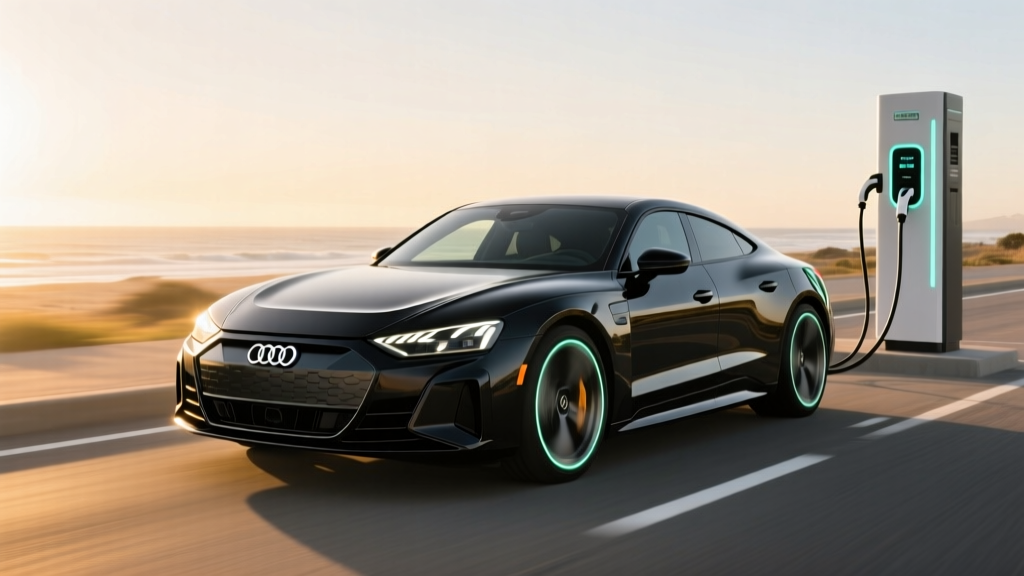
The Audi e-tron GT S has always occupied a distinct lane in the luxury electric sedan market: it shares the J1 Performance Platform with the Porsche Taycan, but wraps that engineering in a grand-tourer body designed for cross-country comfort rather than track-day bragging rights. For 2026, Audi has refreshed the e-tron GT lineup with a larger battery, faster charging, and updated infotainment — and the mid-tier Audi e-tron GT S sits at the sweet spot for buyers who want serious performance without stepping up to the 900+ hp RS e-tron GT.
But grand touring promises only matter if the real-world range and charging infrastructure deliver. Below, we break down the 2026 e-tron GT S with exact EPA figures, real-world range expectations, charging-curve behavior, and a frank look at federal tax credit eligibility under current IRS §30D rules.
2026 Audi e-tron GT S at a Glance
| Spec | Value |
|---|---|
| EPA Range | 270 miles (est.) |
| Battery (usable) | 85.7 kWh, NMC chemistry |
| Drivetrain | Dual-motor AWD (quattro) |
| Horsepower | 592 hp (boost mode) |
| 0–60 mph | 3.9 seconds |
| Max DC Fast Charge | 270 kW (peak) |
| 10–80% DC Charge Time | ~21 minutes |
| Level 2 Home Charging | 11 kW (~33 mi/hr) |
| Efficiency | 82 MPGe combined / 41 kWh/100 mi |
| Cargo (rear + frunk) | 9.2 cu ft trunk + 3.2 cu ft frunk |
| Base MSRP | $118,395 (incl. destination) |
| Battery/Powertrain Warranty | 8 years / 100,000 miles |
Real-World Range: What the EPA Number Doesn't Tell You
Real-world expectation: plan for 230–250 miles on sustained highway driving at 70–80 mph. In cold weather (below 35°F), expect a further 15–25% reduction, bringing usable highway range to roughly 185–210 miles before you'll want to locate a charger. The e-tron GT S's heat pump helps mitigate winter losses compared to EVs without active thermal management, but the low-slung sedan body and wide 21-inch performance tires work against efficiency at speed.
Audi's J1 platform uses a 93.4 kWh gross battery pack (85.7 kWh usable) with NMC (nickel-manganese-cobalt) chemistry. NMC offers higher energy density than LFP, which is critical in a low-roofline sedan where packaging space is at a premium. The trade-off: NMC batteries are more sensitive to sustained high state-of-charge storage. For daily driving, set your charge limit to 80% and reserve 100% sessions for road trips — this practice meaningfully extends long-term battery health.
City and suburban driving with frequent regenerative braking opportunities will get you closer to — or even slightly above — the 270-mile EPA figure. The e-tron GT S recovers up to 265 kW of regen power, which is among the most aggressive in its class and contributes to strong urban efficiency.
Charging Speed: DC Fast, Level 2, and the Curve Reality
The 2026 e-tron GT S supports up to 270 kW peak DC fast charging on 800-volt architecture — an upgrade from the outgoing model's 270 kW capability, now sustained over a wider state-of-charge window thanks to revised thermal preconditioning.
| Charging Level | Max Power | Miles Added per Hour | Notes |
|---|---|---|---|
| Level 1 (120V) | ~1.4 kW | ~3–4 mi/hr | Emergency/trickle only |
| Level 2 (240V, 48A) | 11 kW | ~33 mi/hr | Full charge in ~9 hours |
| DC Fast Charge | 270 kW (peak) | — | 10–80% in ~21 min |
Charging curve reality check: The 270 kW peak is achieved between roughly 10–35% state of charge when the battery is properly preconditioned. Above 50% SoC, the rate tapers to approximately 150 kW, and above 80% it drops further to under 50 kW. This is normal for NMC chemistry at high charge rates, but it means your actual average charging speed on a 10–80% session is closer to 175 kW, not the headline 270 kW figure.
For home charging, the 11 kW onboard AC charger is adequate for overnight replenishment. Most owners driving 40–60 miles daily will recover fully in under 4 hours on a Level 2 home station. If your electrical panel supports a 60-amp dedicated circuit, you'll extract the full 11 kW; on a 40-amp circuit, expect roughly 9.6 kW (~29 mi/hr). Budget $1,200–$2,500 for a quality Level 2 home installation depending on panel proximity and local permitting, according to fueleconomy.gov charging guidance.
Performance and Driving Dynamics
The e-tron GT S pairs a front AC induction motor with a rear permanent-magnet synchronous motor for a combined 592 horsepower in boost mode (532 hp in standard driving). The two-speed rear transmission — a J1 platform signature — allows strong initial launch while maintaining efficiency at highway speeds. The result is a 3.9-second 0–60 mph time, which slots between the base e-tron GT (4.7 sec) and the RS e-tron GT (2.8 sec).
Where the GT S distinguishes itself is not in outright acceleration but in composure. Standard rear-axle steering, adaptive air suspension, and Audi's torque-vectoring quattro system make this a genuinely capable grand tourer. On a 300-mile highway run, the cabin isolation and ride quality rival the Mercedes-Benz EQS sedan, while the steering feel and chassis feedback remain a step above the Porsche Taycan 4S in comfort-oriented tuning.
The trade-off for this composure is weight: at approximately 5,150 lbs, the e-tron GT S carries more mass than many competitors, and that weight is noticeable during aggressive cornering or repeated hard braking. For track use, the RS variant's upgraded cooling is the better choice.
Pricing, Trims, and Federal Tax Credit Eligibility
The 2026 Audi e-tron GT S starts at $118,395 including destination. A fully optioned example with the Prestige package, 21-inch wheels, carbon-fiber trim, and Audi exclusive paint can push past $135,000.
| Item | Amount |
|---|---|
| Base MSRP (Premium Plus) | $118,395 |
| As-tested (Prestige + options) | ~$132,000 |
| Federal §30D Tax Credit (max) | $7,500 (if eligible) |
| Effective price after credit | ~$110,895 – $124,500 |
Federal tax credit eligibility requires careful attention. Under current IRS §30D rules, the e-tron GT S faces several hurdles:
- MSRP cap: Sedans must have an MSRP at or below $55,000. The e-tron GT S at $118,395 exceeds this cap, which means it does not qualify for the federal §30D new-vehicle credit.
- Buyer income cap: Even if it qualified on price, modified AGI must not exceed $150K single / $300K joint.
- Battery sourcing: Critical mineral and battery component sourcing requirements must be met (moot here due to MSRP disqualification).
- Point-of-sale transfer: Eligible buyers can apply the credit at purchase; again, not applicable here.
The e-tron GT S's MSRP disqualifies it from the federal new-EV credit. Buyers should check for state and utility incentives — California, Colorado, Massachusetts, and several other states offer separate rebates or tax credits that do not carry the same MSRP caps. Consult your tax professional and your state's energy office for current programs.
Interior, Tech, and Daily Practicality
The 2026 e-tron GT S receives Audi's latest MMI infotainment system with a 14.5-inch curved OLED touchscreen and an available 10.9-inch front passenger display. Wireless Apple CarPlay and Android Auto are standard. The virtual cockpit plus instrument cluster runs a revised EV-specific layout with real-time consumption, range prediction, and charging-station routing.
Driver assistance: Audi's Adaptive Cruise Assist with lane guidance is standard — this is an SAE Level 2 system requiring continuous driver supervision. It is not autonomous driving. Available features include Park Assist Plus with remote garage parking (the car can enter/exit tight spaces while you stand outside via the myAudi app).
Practicality is the GT S's most honest limitation:
- Rear legroom: 32.1 inches — tight for adults on long trips; this is a 2+2 grand tourer in spirit
- Trunk: 9.2 cu ft — enough for two carry-on bags and a week's groceries, not a family road-trip hauler
- Frunk: 3.2 cu ft — fits a charging cable bag and a small soft cooler, little else
- No towing rating: Audi does not rate the e-tron GT for towing
How It Compares: e-tron GT S vs. Taycan 4S and Lucid Air Pure
The e-tron GT S competes in a narrow but competitive segment. Here's how it stacks up on the metrics that matter:
| Spec | Audi e-tron GT S | Porsche Taycan 4S | Lucid Air Pure AWD |
|---|---|---|---|
| EPA Range | 270 mi | 268 mi | 419 mi |
| Battery (usable) | 85.7 kWh (NMC) | 85.7 kWh (NMC) | 88 kWh (NMC) |
| Horsepower | 592 hp | 590 hp | 620 hp |
| 0–60 mph | 3.9 sec | 3.8 sec | 3.4 sec |
| Max DC Charge | 270 kW | 270 kW | 250 kW |
| Cargo (total) | 12.4 cu ft | 14.3 cu ft | 32 cu ft |
| Base MSRP | $118,395 | $113,900 | $87,400 |
| Federal §30D Credit | No (MSRP cap) | No (MSRP cap) | No (MSRP cap) |
Choose the Porsche Taycan 4S if: You want nearly identical mechanicals with sharper handling dynamics, a slightly larger rear cargo area, and don't mind a marginally firmer ride.
Choose the Lucid Air Pure AWD if: Range and interior space are your top priorities. The Air Pure's 419-mile EPA rating and 32 cu ft of cargo space dwarf both German sedans, though its ride quality and build finish don't yet match Audi/Porsche standards.
Pros, Cons, and the Bottom Line
Pros
- Exceptional ride quality and cabin quietness for a performance EV
- 270 kW DC charging on 800V architecture — among the fastest in class
- Standard rear-axle steering and adaptive air suspension
- Strong 265 kW regen capability for one-pedal-style driving
- 8-year/100,000-mile battery and powertrain warranty
- Striking design that ages better than most EV sheetmetal
Cons
- 270-mile EPA range trails Lucid Air by over 140 miles
- Rear seat and cargo space are tight — not a family sedan
- Does not qualify for the $7,500 federal §30D tax credit (MSRP cap)
- Infotainment still relies on touch-sensitive haptic controls that distract while driving
- Heavy at 5,150 lbs — tire and brake wear costs are above average
- NMC battery requires mindful charge-limit habits for longevity
The 2026 Audi e-tron GT S is a compelling grand-touring EV for buyers who measure luxury in ride composure and design rather than maximum range or interior volume. If your driving pattern involves mostly sub-200-mile days with home charging and occasional road trips where 350 kW Electrify America stations are available, the GT S's real-world 230–250 mile highway range is workable. If you regularly drive 300+ miles between stops or need back-seat practicality, the Lucid Air or even the BMW i5 M60 will serve you better.
Frequently Asked Questions
What is the real-world range of the 2026 Audi e-tron GT S?
The EPA rates the e-tron GT S at 270 miles. In real-world highway driving at 70–80 mph, expect 230–250 miles. In cold weather below 35°F, plan for 185–210 miles of usable range before needing to charge.
How fast does the e-tron GT S charge at home and on the road?
At home on a Level 2 (240V) station, the 11 kW onboard charger adds roughly 33 miles of range per hour, fully recharging overnight in about 9 hours. On a DC fast charger, it peaks at 270 kW and charges from 10–80% in approximately 21 minutes, though the charge curve tapers significantly above 50% SoC.
Does the Audi e-tron GT S qualify for the federal EV tax credit?
No. Under current IRS §30D rules, new sedans must have an MSRP at or below $55,000 to qualify. The e-tron GT S starts at $118,395, exceeding this cap. State-level incentives may still apply — check your local programs.
Is the e-tron GT S worth buying over the Porsche Taycan 4S?
They share the same platform and battery, so the decision comes down to tuning philosophy. The Audi is softer, quieter, and more design-forward; the Porsche is slightly firmer and more engaging to drive. If comfort is the priority, the Audi wins. If driving dynamics matter more, the Porsche edges ahead. Pricing is comparable.
What battery chemistry does the e-tron GT S use, and how long will it last?
The e-tron GT S uses an NMC (nickel-manganese-cobalt) lithium-ion battery with 85.7 kWh usable capacity. Audi warranties the battery for 8 years or 100,000 miles against degradation below 70% of original capacity. Based on J1-platform fleet data from the Taycan and prior e-tron GT models, most owners can expect 85–90% capacity retention at the 5-year mark with proper charge-limit habits (80% daily maximum).
Can the e-tron GT S tow or carry cargo for road trips?
Audi does not rate the e-tron GT for towing. Total cargo space is 12.4 cu ft (9.2 trunk + 3.2 frunk) — sufficient for two suitcases and soft bags but not a family's full road-trip load. This is a grand-touring coupe-sedan, not a utility vehicle.