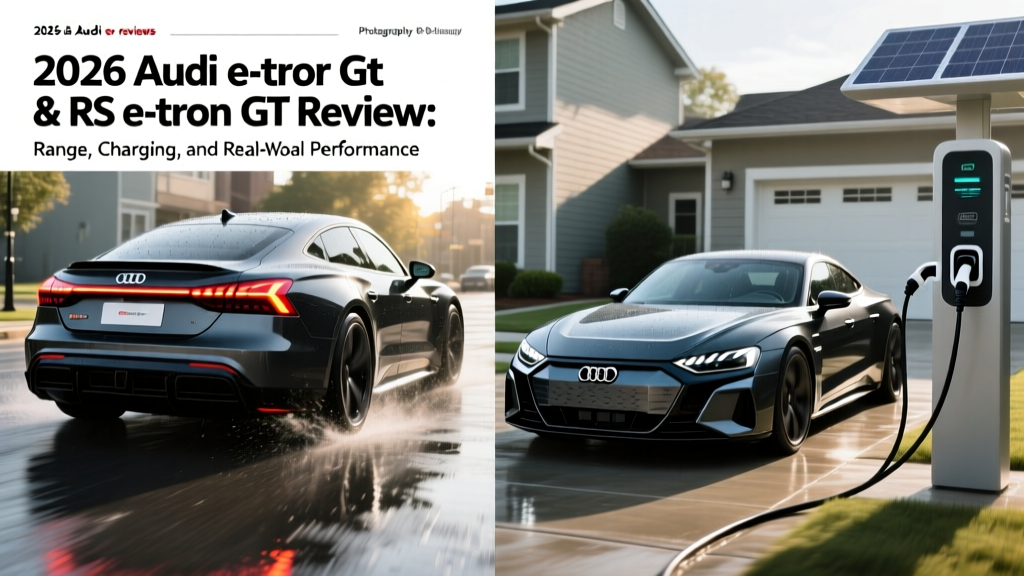
Quick Verdict: The Audi e-tron GT in 2026
The Audi e-tron GT lineup occupies a specific niche: a luxury electric grand tourer that prioritizes build quality, ride refinement, and 800-volt charging architecture over maximum range or cargo practicality. For 2026, Audi continues the e-tron GT Premium, e-tron GT Prestige, and the high-performance RS e-tron GT, all riding on the J1 platform shared with the Porsche Taycan. If you're searching for an Audi e-tron GT review that goes beyond the brochure, this is it — we'll break down real-world range, charging behavior, tax credit reality, and whether this EV justifies its six-figure price tag against formidable competitors.
The short version: the e-tron GT delivers exceptional driving dynamics and some of the fastest DC charging available, but its EPA range (238–272 miles depending on trim) and modest cargo space make it a purpose-built GT car, not a family hauler.
Full Specifications at a Glance
| Spec | e-tron GT Premium | e-tron GT Prestige | RS e-tron GT |
|---|---|---|---|
| EPA Range | 270 mi | 270 mi | 238 mi |
| Battery (usable / gross) | 83.7 kWh / 93.4 kWh | 83.7 kWh / 93.4 kWh | 83.7 kWh / 93.4 kWh |
| Battery Chemistry | NMC (Nickel Manganese Cobalt) | NMC | NMC |
| Drivetrain | Dual-motor AWD (quattro) | Dual-motor AWD (quattro) | Dual-motor AWD (quattro) |
| Horsepower (Boost) | 522 hp | 522 hp | 637 hp |
| 0–60 mph | 3.9 sec | 3.9 sec | 3.1 sec |
| Top Speed | 152 mph | 152 mph | 155 mph |
| Max DC Fast Charge | 270 kW | 270 kW | 270 kW |
| 10–80% DC Charge Time | ~22.5 min | ~22.5 min | ~22.5 min |
| Level 2 Charge Rate | 9.6 kW (AC) | 9.6 kW (AC) | 9.6 kW (AC) |
| Efficiency (MPGe) | 85 MPGe combined | 85 MPGe combined | 79 MPGe combined |
| Base MSRP | $107,995 | $113,995 | $147,895 |
| Battery Warranty | 8 yr / 100,000 mi | 8 yr / 100,000 mi | 8 yr / 100,000 mi |
Sources: EPA fueleconomy.gov, Audi USA specifications.
Range and Efficiency: EPA Numbers vs. Real-World Reality
Real-World Expectation: ~220–245 miles highway (GT), ~190–215 miles highway (RS). In freezing temperatures (below 32°F), expect a 20–30% reduction — potentially 165–195 miles for the GT and 150–175 miles for the RS.
The e-tron GT's 93.4 kWh gross battery (83.7 kWh usable) uses NMC chemistry, which offers high energy density but is more sensitive to extreme temperatures than LFP. Audi's sophisticated thermal management system — including a heat pump standard on all trims — helps mitigate cold-weather losses, but physics still applies.
In mixed suburban/highway driving at moderate temperatures (55–75°F), owners consistently report achieving within 5–10% of the EPA sticker. Sustained highway speeds above 75 mph, however, will push consumption to roughly 38–42 kWh/100mi for the GT trims, yielding closer to 200–220 real miles before you'll want to find a charger. The RS e-tron GT, with its stickier performance tires and more aggressive powertrain calibration, consumes more energy per mile — expect roughly 42–46 kWh/100mi on the highway.
For context, the EPA's official figures rate the e-tron GT at 85 MPGe combined (38 kWh/100mi) and the RS at 79 MPGe combined (42 kWh/100mi). These are respectable for a 5,100+ lb luxury performance sedan, but they trail efficiency leaders like the Lucid Air Grand Touring (131 MPGe) and even the BMW i7 xDrive60 (82 MPGe).
Charging Speed: The 800-Volt Advantage
| Charging Level | Power / Voltage | Rate | Time / Notes |
|---|---|---|---|
| Level 1 (120V household) | 1.2 kW / 120V | ~3–4 mi/hr | Not practical for daily use; 25+ hours for full charge |
| Level 2 (240V home/public) | 9.6 kW / 240V | ~28–32 mi/hr | 0–100% in ~9.5 hours; ideal overnight charging |
| DC Fast Charge (peak) | 270 kW / 800V | Up to 270 kW peak | 10–80% in ~22.5 min at compatible station |
| DC Fast Charge (CCS 350 kW station) | ~270 kW sustained to ~50% SoC | Varies by SoC | Charge curve tapers significantly above 80% |
The e-tron GT's 800-volt architecture is its strongest practical feature for road-trippers. On a 350 kW Electrify America or Ionity charger (with CCS1 connector), the GT can accept up to 270 kW peak. In practice, this means you'll see sustained rates of 200–270 kW from roughly 10% to 50% state of charge, with the curve tapering progressively from 50–80% and dropping sharply above 80%.
That 10–80% time of approximately 22.5 minutes is genuinely competitive — only the Hyundai Ioniq 5 / Kia EV6 (also 800V) and the Lucid Air match or beat it in this price segment. However, you must precondition the battery to get these speeds. Navigate to a DC fast charger using the built-in MMI navigation, and the car will automatically warm or cool the battery to the optimal temperature window. Skip preconditioning (for example, by driving to a charger without using the nav system) and your peak charge rate may drop to 150 kW or less, especially in cold weather.
For home charging, the 9.6 kW onboard charger means a full Level 2 session (0–100%) takes roughly 9.5 hours. Most owners will charge from 20–80% overnight, which takes about 5.5 hours — easily accomplished with a standard 48-amp Level 2 wallbox on a 60-amp circuit. A qualified electrician should confirm your panel capacity before installation; a 200-amp service panel is typically sufficient, but older homes may require an upgrade.
Performance and Driving Dynamics
Every e-tron GT variant uses a dual-motor all-wheel-drive system (Audi's electric quattro) with a two-speed rear transmission — a rarity in EVs. The rear two-speed gearbox provides a short first gear for explosive launches and a tall second gear for efficient highway cruising.
The standard e-tron GT (Premium and Prestige) produces 469 hp in normal driving, rising to 522 hp with launch control engaged. The 0–60 mph time of 3.9 seconds is genuinely quick for a luxury sedan weighing over 5,100 lbs. Power delivery is linear and relentless, with the instant torque characteristic of electric drivetrains.
The RS e-tron GT steps up to 637 hp (with boost) and drops the 0–60 time to 3.1 seconds. It also adds rear-axle steering, an electronically controlled limited-slip differential, and standard carbon-ceramic brakes (on the RS Performance variant). The RS is a legitimate supercar-slayer in a straight line, though its 5,139-lb curb weight is noticeable during aggressive cornering — this is a grand tourer, not a track car.
Ride quality across the lineup is excellent, thanks to standard three-chamber adaptive air suspension. The GT absorbs highway imperfections with the composure expected of a six-figure Audi, and road noise isolation is among the best in the EV segment.
Interior, Cargo, and Technology
The e-tron GT's interior reflects Audi's design language: clean, driver-focused, and material-rich. Standard features include a 10.1-inch MMI touchscreen, a 12.3-inch Virtual Cockit digital instrument cluster, wireless Apple CarPlay/Android Auto, and a 16-speaker Bang & Olufsen sound system (Prestige and RS). The flat floor (thanks to the skateboard battery platform) creates generous rear legroom — 32.1 inches — though the sloping roofline cuts into rear headroom for passengers over 6 feet tall.
Cargo capacity is the e-tron GT's most practical limitation:
- Rear trunk: 9.2 cubic feet (shallow and narrow due to the rear diffuser design)
- Front trunk (frunk): 2.9 cubic feet (enough for a charging cable bag and a small duffel)
- Total: 12.1 cubic feet — significantly less than the Tesla Model S (28 cu ft rear + 3.1 cu ft frunk) or even the BMW i7 (17.7 cu ft)
This is a car designed for two people and weekend bags, not Costco runs or family road trips with strollers.
On the technology front, the e-tron GT comes with Audi's Adaptive Cruise Assist (a Level 2 SAE driver-assistance system combining adaptive cruise control and lane-centering). It is not a hands-free system like GM's Super Cruise or Ford's BlueCruise — the driver must maintain steering-wheel contact. Other driver assists include a 360-degree camera, intersection assist, and available night vision with pedestrian detection.
Pricing, Trims, and Federal Tax Credit Eligibility
| Trim | Base MSRP | As-Tested (Typical) | §30D Federal Credit Eligibility |
|---|---|---|---|
| e-tron GT Premium | $107,995 | $112,000–$118,000 | Not eligible (exceeds $55,000 sedan MSRP cap) |
| e-tron GT Prestige | $113,995 | $120,000–$130,000 | Not eligible (exceeds $55,000 sedan MSRP cap) |
| RS e-tron GT | $147,895 | $155,000–$168,000 | Not eligible (exceeds $55,000 sedan MSRP cap) |
Let's address the tax credit question directly: no trim of the 2026 Audi e-tron GT qualifies for the $7,500 federal EV tax credit under IRS §30D. The reason is straightforward — the IRS classifies the e-tron GT as a sedan, and the federal credit imposes a $55,000 MSRP cap on sedans (the cap is $80,000 for SUVs, trucks, and vans). At nearly $108,000 for the base model, the e-tron GT exceeds this threshold by a wide margin.
Additionally, §30D imposes buyer income limits ($150,000 single / $300,000 joint modified AGI) and battery critical-mineral sourcing requirements that change annually. Even if the e-tron GT met the MSRP cap, buyers would need to satisfy all criteria. Consult a tax professional and the IRS clean vehicle credit page for your specific situation.
Some buyers may find relief through state-level incentives (California's CVRP, for example, has its own income and price caps), but these vary by jurisdiction and should be verified through official state sources.
Pros, Cons, and Who Should Buy
Pros
- Exceptional 270 kW DC fast charging via 800V architecture
- Outstanding build quality and interior materials
- Smooth, adaptive air suspension ride
- RS variant delivers supercar-level 3.1s 0–60 acceleration
- Strong standard safety tech and available night vision
- 8-year/100,000-mile battery warranty
Cons
- Limited cargo space (12.1 cu ft total)
- EPA range trails competitors (238–270 mi vs. Lucid Air's 516 mi)
- No federal tax credit eligibility (MSRP cap)
- Level 2 ADAS requires hands-on-wheel (no hands-free driving)
- High starting price with expensive options packages
- Rear seat headroom tight for tall passengers
Look elsewhere if: You need family-hauler cargo space, you want 400+ miles of range (consider the Lucid Air), you need hands-free highway driving (BMW i7 with Highway Assistant), or you're counting on the federal tax credit to offset the purchase price.
How It Compares: Key Competitors
The e-tron GT competes in a crowded luxury EV sedan segment. Here's how it stacks up against its three most relevant rivals:
- Porsche Taycan: The platform sibling. Similar 800V charging, comparable range (225–283 mi EPA), sharper handling, but a slightly firmer ride. Pricing overlaps heavily. Choose the Taycan if driving precision matters more than comfort.
- Tesla Model S: Longer range (402 mi EPA for Long Range), larger cargo area (28 cu ft), available Autosteer (Level 2), but interior quality and ride refinement don't match the Audi. Starts lower at ~$74,990.
- Lucid Air Pure: Dominates on efficiency (131 MPGe) and range (419 mi EPA), with a surprisingly competitive starting price (~$69,900). Less established service network and a less polished infotainment system. The efficiency king of this segment.
- BMW i7 xDrive60: Larger, more spacious (17.7 cu ft cargo), available hands-free Level 2 driving (Highway Assistant), and a more luxurious rear seat. Range is similar (318 mi EPA). The better choice for chauffeur-driven buyers.
Frequently Asked Questions
What is the real-world range of the Audi e-tron GT?
The EPA rates the e-tron GT Premium/Prestige at 270 miles and the RS e-tron GT at 238 miles. In real-world mixed driving at moderate temperatures, expect 245–260 miles (GT) and 210–230 miles (RS). Highway-only driving at 75+ mph reduces this to roughly 200–220 miles (GT) and 175–200 miles (RS). Cold weather (below 32°F) can reduce range by 20–30%.
How fast does the e-tron GT charge at home and on the road?
At home on a Level 2 (240V, 48-amp) charger, the e-tron GT adds approximately 28–32 miles of range per hour, with a full 0–100% charge taking about 9.5 hours. On a 350 kW DC fast charger with battery preconditioning, it peaks at 270 kW and charges from 10–80% in approximately 22.5 minutes. Always precondition via the navigation system for maximum charge speed.
Does the Audi e-tron GT qualify for the $7,500 federal EV tax credit?
No. Under IRS §30D rules, the e-tron GT exceeds the $55,000 MSRP cap for sedans. All trims start well above $100,000, making them ineligible regardless of buyer income or battery sourcing. State-level incentives may apply — check your state's official energy or DMV website.
Is the e-tron GT worth buying over the Porsche Taycan?
They share the J1 platform and 800V architecture, so charging speed and battery specs are nearly identical. The e-tron GT trades slightly softer ride tuning and more traditional Audi interior design against the Taycan's sharper handling and sportier cockpit. If comfort and understated luxury are priorities, the Audi wins. If you want a driver's car, the Porsche edges ahead. Test-drive both.
What is the battery warranty on the e-tron GT?
Audi covers the high-voltage battery for 8 years or 100,000 miles (whichever comes first), with a capacity retention threshold of 70%. If the battery degrades below 70% of its original capacity within the warranty period, Audi will repair or replace it. The general vehicle warranty is 4 years/50,000 miles.
Can I tow with the Audi e-tron GT?
No. The e-tron GT is not rated for towing. If you need an electric vehicle with towing capability, look at the Audi Q8 e-tron (4,000 lbs), Rivian R1S (7,700 lbs), or Tesla Model X (5,000 lbs).
Does the e-tron GT support NACS (Tesla Supercharger) charging?
As of the 2026 model year, the e-tron GT uses the CCS1 connector natively. Audi has announced that future models will adopt the NACS standard, but current e-tron GT owners will need a CCS-to-NACS adapter (available from Audi or third parties) to access Tesla Superchargers that have opened to non-Tesla vehicles. Always verify adapter compatibility and station availability before relying on this for road trips.