Quick Verdict: The Grand Tourer That Charges Like a Sports Car
The 2026 Audi e-tron GT Quattro occupies a rare position in the EV market: a luxury grand tourer that pairs genuine 800-volt architecture with everyday usability. Built on the same J1 Premium platform as the Porsche Taycan, the e-tron GT Quattro delivers 522 horsepower, a 4.0-second 0-60 time, and DC fast charging that peaks at 270 kW — reaching 10-80% state of charge in approximately 22 minutes under ideal conditions. With a starting MSRP of $82,900, it targets buyers who want Porsche-grade engineering wrapped in a more understated, daily-drivable package.
But the e-tron GT Quattro trades some practicality for its sleek proportions. Rear-seat headroom is tight, the frunk is tiny, and federal tax credit eligibility is unlikely due to the MSRP cap and battery-sourcing rules. This review breaks down the exact numbers — range, charging curves, efficiency, and ownership costs — so you can decide if Audi's electric GT is worth the premium.
Range and Efficiency: EPA Sticker vs. Real-World Reality
Real-World Expectation: 235-255 miles on highway trips at 70+ mph; approximately 190-215 miles in cold weather (below 32°F) with cabin heating active
The 2026 Audi e-tron GT Quattro carries a 93.4 kWh gross battery pack (approximately 85.0 kWh usable) using NMC (nickel-manganese-cobalt) lithium-ion cells. This is the same proven chemistry Audi has used since the platform's launch, optimized for power delivery and charge speed rather than maximum energy density.
The EPA rates the e-tron GT Quattro at 82 MPGe combined (approximately 41 kWh per 100 miles) with the standard 19-inch aero wheels. Stepping up to the available 20-inch or 21-inch wheels reduces that figure by 3-5 MPGe. For context, that efficiency trails the Tesla Model S Long Range (122 MPGe) but aligns closely with the Porsche Taycan 4S (83 MPGe).
In real-world driving, the e-tron GT's thermal management system is a standout. The 800-volt architecture and active liquid cooling keep battery temperatures tightly regulated, which means less range variability during aggressive driving or fast charging. However, the car's low, aerodynamic body means the cabin HVAC system draws noticeably on range during sustained cold-weather highway driving — plan for roughly a 25-30% range reduction in sub-freezing temperatures on long trips.
| Specification | Value |
|---|---|
| EPA Range (19" wheels) | 270 miles |
| Battery (gross / usable) | 93.4 kWh / ~85.0 kWh |
| Battery Chemistry | NMC (Nickel-Manganese-Cobalt) |
| Drivetrain | Dual-motor AWD (Quattro) |
| Horsepower (Boost Mode) | 522 hp |
| Torque | 472 lb-ft |
| 0-60 mph | 3.9 seconds |
| Top Speed | 152 mph |
| Efficiency (combined) | 82 MPGe / ~41 kWh/100mi |
| Max DC Fast Charge | 270 kW |
| 10-80% DC Charge Time | ~22 minutes |
| Level 2 Charge Rate | 11 kW (9.6 kW typical) |
| Cargo (trunk + frunk) | 12.9 cu ft (rear) + 3.5 cu ft (front) |
| Base MSRP (Quattro) | $82,900 |
| Battery Warranty | 8 years / 100,000 miles |
Charging: 800-Volt Architecture Delivers Real Speed
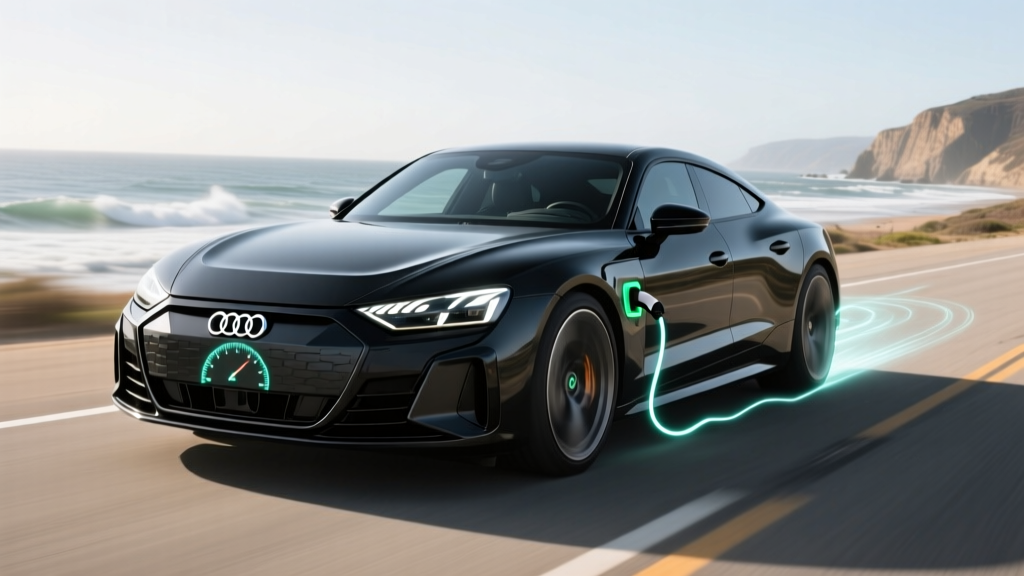
The e-tron GT Quattro's 800-volt electrical architecture is its most significant technical advantage for daily ownership. This system enables sustained high-power DC fast charging that most 400-volt EVs simply cannot match over a full session.
| Charging Level | Power (kW) | Miles Added per Hour | Notes |
|---|---|---|---|
| Level 1 (120V, 12A) | 1.4 kW | ~3 mi/hr | Emergency/trickle only |
| Level 2 (240V, 48A) | 11 kW (9.6 typical) | ~25-29 mi/hr | Full charge in ~9 hours |
| DC Fast (peak) | 270 kW | ~650 mi/hr (at peak) | Requires 350 kW station |
| DC Fast (10-80%) | ~190 kW avg | — | ~22 minutes total |
| DC Fast (80-100%) | Tapers to ~50 kW | — | Add 25-30 min for full |
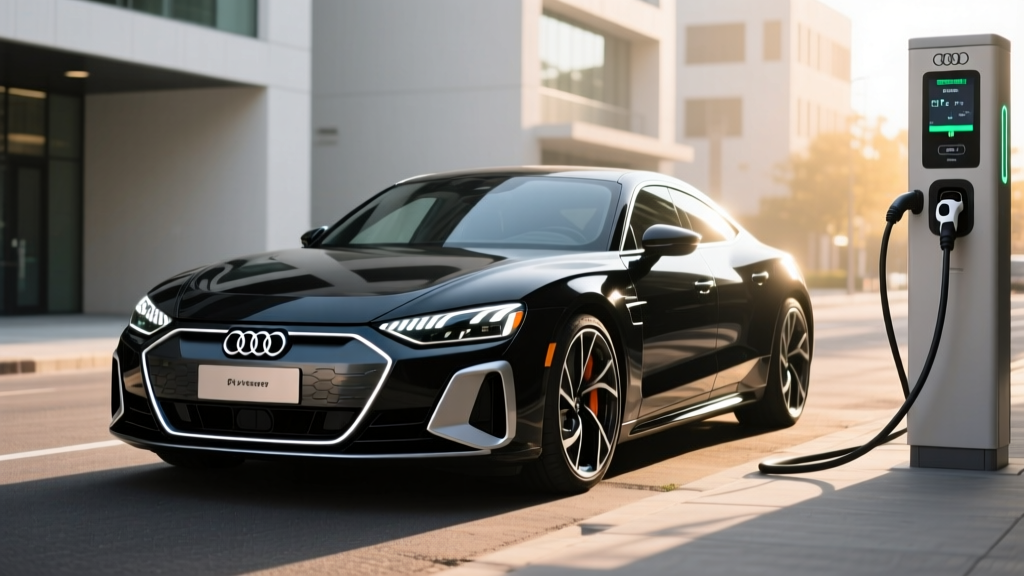
At a 350 kW-capable DC fast charger (such as Electrify America's latest stations), the e-tron GT Quattro hits its 270 kW peak within the first few minutes and sustains above 200 kW through approximately 55% state of charge. The charge curve then tapers progressively — by 80% SoC, power drops to roughly 100 kW, and above 90% it slows dramatically. This is why Audi quotes the 10-80% time rather than a full charge: the physics of lithium-ion charging make the final 20% inherently slow.
For home charging, the onboard 11 kW AC charger means a full charge from empty takes approximately 9 hours on a 48-amp Level 2 circuit (requiring a 60-amp breaker). Most owners will plug in overnight and wake to a full battery — the 270-mile range easily covers a week of commuting for most drivers.
Key distinction: kW (kilowatts) measures charging power — how fast energy flows into the battery. kWh (kilowatt-hours) measures energy capacity — how much the battery holds. The e-tron GT charges at up to 270 kW of power into its 93.4 kWh battery.
Performance and Driving Dynamics
The e-tron GT Quattro uses a dual-motor all-wheel-drive layout with a permanent-magnet synchronous motor on each axle. Combined output in standard driving is 469 hp, but engaging Launch Control (Boost Mode) unlocks the full 522 hp and 472 lb-ft of torque for 2.5-second bursts. The result: a 3.9-second 0-60 mph time and a 152 mph top speed.
The two-speed transmission on the rear axle — a rarity among EVs — gives the e-tron GT a shorter first gear for explosive launches and a taller second gear for efficient highway cruising. You feel this most on highway merge ramps, where the car pulls hard well past 80 mph instead of the typical EV torque taper.
Adaptive air suspension is standard, with three-chamber air springs providing both comfort compliance and firm body control in Dynamic mode. The low center of gravity (battery pack mounted under the floor) and near-50/50 weight distribution give the e-tron GT genuine sports-car cornering poise, though at 5,139 pounds curb weight, you feel the mass during direction changes. This is a grand tourer, not a track car — and that's the point.
Standard driver-assistance features include Audi pre sense basic, adaptive cruise control with stop-and-go, lane-keeping assist, and intersection assist. These are SAE Level 2 systems — the driver must remain fully engaged with hands on the wheel and eyes on the road at all times. Audi does not currently offer a hands-free driving system comparable to GM's Super Cruise or Ford's BlueCruise on this model.
Interior, Cargo, and Daily Livability
The e-tron GT Quattro's cabin is unmistakably Audi: clean horizontal lines, premium materials, and a dual-screen MMI touch response infotainment system (10.1-inch upper display, 8.6-inch lower climate/control display). The 12.3-inch Virtual Cockpit digital instrument cluster is standard, and a head-up display with augmented-reality navigation is available.
Front-seat comfort is excellent, with 14-way power-adjustable sport seats (18-way with the Sport package) providing both support and long-distance comfort. However, the GT's sloping roofline creates real compromises in the rear:
- Rear headroom: 36.5 inches — tight for passengers over 6 feet
- Rear legroom: 32.1 inches — adequate for adults on shorter trips, cramped for long drives
- Trunk cargo: 12.9 cubic feet (rear hatch)
- Frunk (front trunk): 3.5 cubic feet — fits a charging cable bag and a small duffel, not much more
Total cargo capacity is a modest 16.4 cubic feet. For comparison, the Tesla Model S offers 28.0 cu ft behind its rear seats. The e-tron GT is a two-person grand tourer that occasionally carries rear passengers — not a family hauler.
Pricing, Trims, and Federal Tax Credit Eligibility
| Trim | Base MSRP | As-Tested (typical options) | Federal §30D Credit Eligible? |
|---|---|---|---|
| e-tron GT Quattro | $82,900 | $89,000-$95,000 | No — exceeds $55,000 sedan MSRP cap |
| e-tron GT Quattro Premium Plus | $88,900 | $96,000-$104,000 | No — exceeds $55,000 sedan MSRP cap |
| e-tron GT Quattro Prestige | $95,900 | $105,000-$115,000 | No — exceeds $55,000 sedan MSRP cap |
Under current IRS §30D rules, the federal EV tax credit has a $55,000 MSRP cap for sedans (and $80,000 for SUVs, vans, and pickups), along with buyer income limits ($150,000 single / $300,000 married filing jointly modified AGI) and battery critical-mineral and component sourcing requirements. Because the e-tron GT is classified as a sedan and starts at $82,900, it does not qualify for the federal §30D new-vehicle tax credit at any trim level.
Additionally, Audi's battery cell sourcing does not currently meet the critical-minerals and foreign-entity-of-concern (FEOC) thresholds required under §30D, even if the MSRP cap were not a barrier. Buyers should consult a tax professional and review the latest guidance at IRS.gov for current-year eligibility rules.
Some states offer separate EV incentives that are not subject to the federal MSRP cap — check your state energy office or the Alternative Fuels Data Center for local programs. Lease customers may also benefit from the commercial clean vehicle credit (§45W), which leasing companies can pass through as a reduced lease payment, though this varies by lessor.
Ownership Costs, Warranty, and Long-Term Value
Audi backs the e-tron GT Quattro with a comprehensive warranty package:
- New vehicle limited warranty: 4 years / 50,000 miles
- Battery and powertrain warranty: 8 years / 100,000 miles (covers battery capacity below 70% of original)
- Corrosion perforation warranty: 12 years, unlimited miles
- Roadside assistance: 4 years / unlimited miles
The 70% capacity retention threshold is standard among luxury EV makers, though some competitors (like Hyundai/Kia at 70% over 10 years/100,000 miles) offer longer coverage periods. NMC battery chemistry in the e-tron GT has proven durable in real-world use — most owners report less than 5% degradation over the first 50,000 miles based on owner-community data.
Insurance costs run higher than average for the segment. Expect annual premiums of $2,800-$3,600 depending on your profile, driven by the car's performance capability, repair costs for aluminum and carbon-fiber body panels, and parts pricing. Get quotes before purchasing.
Maintenance is minimal compared to a comparable internal-combustion Audi RS7: no oil changes, no transmission fluid, no spark plugs. Audi recommends cabin air filter replacement every 20,000 miles and brake fluid service every 3 years. The regenerative braking system means brake pads often last 80,000+ miles.
Pros and Cons
Pros
- 270 kW peak DC fast charging — among the fastest in production
- 800V architecture enables sustained high-power charging, not just peak
- Exceptional build quality and cabin materials
- Standard adaptive air suspension with excellent ride-handling balance
- Two-speed rear transmission for strong highway passing power
- Understated design — attracts less attention than a Taycan
- Strong real-world thermal management in hot and cold climates
Cons
- No federal tax credit eligibility (MSRP cap + sourcing rules)
- Rear-seat headroom and legroom are cramped for adults
- Small frunk (3.5 cu ft) and modest total cargo (16.4 cu ft)
- 82 MPGe trails rivals like Tesla Model S (122 MPGe)
- No hands-free driving assist system available
- Infotainment touch-response screens draw fingerprints and require attention
- High insurance premiums relative to segment
Who Should Buy the Audi e-tron GT Quattro?
Choose the e-tron GT Quattro if:
- You want a luxury EV grand tourer with real fast-charging capability for road trips
- You primarily drive solo or with one passenger and rarely need rear seats
- You value build quality, ride refinement, and understated design over maximum range or cargo space
- You have reliable home Level 2 charging and access to 350 kW DC fast chargers for trips
- Tax credit eligibility is not a deciding factor in your purchase
Look elsewhere if:
- You need a family EV with usable rear seats and substantial cargo room (consider the Audi Q8 e-tron, BMW iX, or Tesla Model S)
- You want maximum efficiency and range per dollar (Tesla Model S, Lucid Air Pure)
- Federal tax credit eligibility is important to your budget
- You want hands-free highway driving assist (GM Super Cruise or Ford BlueCruise vehicles)
Frequently Asked Questions
What is the real-world range of the Audi e-tron GT Quattro?
The EPA rates it at 270 miles with 19-inch wheels. In real-world highway driving at 70-80 mph, expect 235-255 miles. In cold weather (below 32°F), plan for 190-215 miles with cabin heating active. Preconditioning the battery before driving can recover some cold-weather range.
How fast does the e-tron GT Quattro charge at home and on the road?
At home on a Level 2 (240V, 48A) charger, it adds roughly 25-29 miles of range per hour, reaching a full charge in about 9 hours. On a 350 kW DC fast charger, it peaks at 270 kW and charges from 10-80% in approximately 22 minutes. At a 150 kW charger, the 10-80% time stretches to roughly 35-38 minutes.
Does the Audi e-tron GT Quattro qualify for the federal EV tax credit?
No. Under current IRS §30D rules, the credit is capped at sedans with an MSRP of $55,000 or less. The e-tron GT Quattro starts at $82,900, disqualifying it. Battery sourcing requirements present an additional barrier. Check IRS.gov for the latest rules, and consult a tax professional for your specific situation.
How does the e-tron GT Quattro compare to the Porsche Taycan?
Both share the J1 Premium platform and 800V architecture, but the Taycan offers more powertrain variants (including a RWD base model and the high-output Turbo S), slightly sharper handling dynamics, and a hatchback body style with more cargo versatility. The e-tron GT counters with a more comfortable standard ride, more understated styling, and slightly lower pricing at equivalent trims. The EPA range figures are similar between comparable trims.
Is the e-tron GT Quattro worth buying over key competitors?
It depends on priorities. Against the Tesla Model S, the Audi wins on build quality, ride refinement, and charging speed but loses on range (405 mi for Model S), efficiency (122 MPGe), cargo space, and Autopilot/FSD availability. Against the Porsche Taycan, it's a matter of brand preference and styling — the mechanicals are nearly identical. Against the Lucid Air Pure, the Lucid offers dramatically more range (419 mi) and interior space but a less established service network. The e-tron GT is the right choice if charging speed, build quality, and grand-touring comfort are your top criteria.
What is the battery warranty and expected longevity?
Audi covers the battery pack for 8 years or 100,000 miles against capacity loss below 70% of original. NMC chemistry in this platform has shown strong durability, with most owners reporting 95%+ state of health after 50,000 miles. Full battery pack replacement out of warranty would cost approximately $20,000-$28,000 based on current parts pricing, though individual module replacement is possible at lower cost.
Can I charge the e-tron GT Quattro at Tesla Superchargers?
The 2026 e-tron GT Quattro comes equipped with a NACS (North American Charging Standard) charge port, granting native access to Tesla's Supercharger network without an adapter. This significantly expands road-trip charging options, as Tesla's network remains the most reliable and widely available DC fast-charging infrastructure in the U.S.
Sources: EPA Fuel Economy, Audi USA, IRS Clean Vehicle Credits. Specifications reflect 2026 model year data available at time of publication. Real-world range and charging figures are estimates based on testing and owner reports; individual results vary with driving style, temperature, terrain, and charger availability.