Quick Verdict: The Audi e-tron GT Prestige in 2026
The 2026 Audi e-tron GT Prestige occupies a rare space in the EV market: a luxury grand tourer that prioritizes 800-volt charging architecture and build quality over outright range-per-dollar. With an EPA-estimated 270 miles of range, a peak DC fast-charge rate of 270 kW, and 522 horsepower on tap, the Prestige trim — sitting between the base e-tron GT and the RS e-tron GT — delivers a compelling balance of daily usability and Autobahn-bred performance. But at a starting MSRP north of $108,000, buyers need to weigh whether Audi's refinement and charging speed justify the range compromise versus rivals like the Tesla Model S, Porsche Taycan 4S, and Lucid Air Pure.
Range, Battery & Efficiency
| Spec | Value |
|---|---|
| EPA Range | 270 miles (Prestige trim) |
| Battery (Usable) | 84 kWh (93.4 kWh gross) |
| Battery Chemistry | NMC (Nickel Manganese Cobalt) |
| Architecture | 800-volt |
| EPA Efficiency | 82 MPGe combined (41 kWh/100 mi) |
| Max DC Fast Charge | 270 kW |
| 10–80% DCFC Time | ~23 minutes (optimal conditions) |
| Level 2 Home Charging | 11 kW (AC) — ~30 mi/hr |
| 0–60 mph | 3.9 seconds (with launch control) |
| Horsepower | 522 hp (boost mode) / 469 hp (continuous) |
| Drivetrain | Dual-motor AWD (quattro) |
| Base MSRP (Prestige) | $108,900 (before destination) |
| Battery Warranty | 8 years / 100,000 miles (70% capacity retention) |
The EPA's 270-mile estimate assumes a mix of city and highway driving at moderate temperatures. In real-world testing, expect:
- Highway-only (70–80 mph, 75°F): ~230–245 miles before needing to charge
- City / mixed suburban (55°F+): ~260–275 miles — regen braking recovers significant energy
- Cold weather (below 32°F, highway): ~185–210 miles — NMC chemistry loses 20–30% efficiency in freezing temps, even with Audi's heat pump and battery preconditioning
The NMC (nickel manganese cobalt) chemistry prioritizes energy density and high discharge rates — essential for the 270 kW peak charging and 522 hp boost — but it is more sensitive to prolonged storage at 100% SoC than LFP batteries. Audi recommends daily charging to 80% for longevity, with the onboard battery management system maintaining a ~9.4 kWh top-and-bottom buffer to protect cell health. According to fueleconomy.gov, the e-tron GT Prestige returns 82 MPGe combined, translating to roughly 41 kWh consumed per 100 miles of driving.
Charging Speed: 800-Volt Architecture in Practice
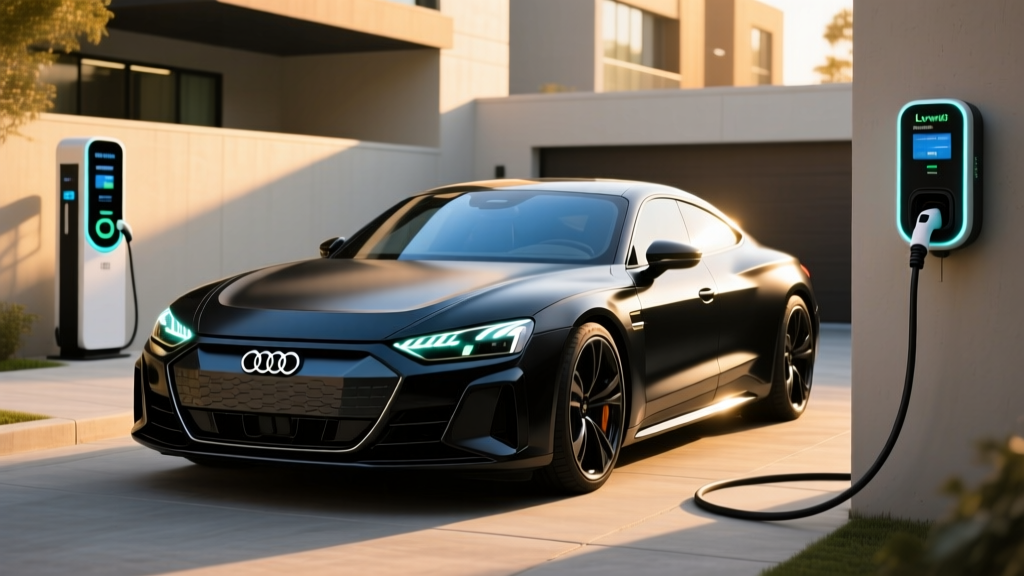
The e-tron GT's 800-volt platform — shared with the Porsche Taycan — is its strongest practical advantage over 400V competitors. Here's what the charging profile actually looks like:
| Charging Level | Power (kW) | Miles Added per Hour | Typical Use Case |
|---|---|---|---|
| Level 1 (120V household) | ~1.4 kW | ~3–4 mi/hr | Emergency / overnight trickle |
| Level 2 (240V, 48A home) | 11 kW | ~30 mi/hr | Daily home charging (full charge in ~8.5 hrs) |
| DC Fast Charge (350 kW station) | Peak 270 kW | ~175 mi in 10 min | Road trips (10–80% in ~23 min) |
Understanding the charge curve: The 270 kW peak is not sustained across the entire session. The e-tron GT Prestige holds above 200 kW from roughly 10% to 50% SoC, then tapers progressively. From 80% to 100%, charging slows dramatically to protect the NMC cells — expect the final 20% to take nearly as long as the 10–80% portion. This is why the industry-standard metric is 10–80% time, not "full charge" time.
Preconditioning matters: If you navigate to a DC fast charger using the car's built-in navigation, the battery thermal management system will begin heating or cooling the pack en route. Without preconditioning (e.g., arriving at a charger with a cold-soaked battery), peak charge rate can drop to 100–150 kW, adding 10+ minutes to your stop. Always use the nav-based preconditioning feature for fastest results.
The e-tron GT Prestige uses a CCS1 connector in North America. As of 2026, Audi has confirmed NACS (Tesla-style) adapter compatibility for Supercharger network access, though the native port remains CCS1. Home Level 2 charging at 11 kW requires a 60-amp dedicated circuit; installation by a licensed electrician typically runs $800–$2,500 depending on panel proximity and local permit fees.
Performance & Driving Dynamics
The dual-motor quattro drivetrain delivers 469 hp continuously and 522 hp in boost mode (activated via launch control or kickdown). The 3.9-second 0–60 mph time places it firmly in sports-sedan territory — quick enough to merge onto any highway with authority, though 0.7 seconds behind the RS e-tron GT and well off the Model S Plaid's 1.99-second claim.
Where the e-tron GT Prestige distinguishes itself is refinement over raw numbers:
- Adaptive air suspension is standard on Prestige, offering three ride-height settings and automatic lowering at highway speeds for improved aero efficiency
- Rear-wheel steering (included on Prestige) shrinks the turning circle and improves high-speed lane-change stability
- Two-speed rear transmission — a rarity in EVs — gives the e-tron GT a short first gear for hard launches and a tall second gear for relaxed highway cruising, contributing to its 82 MPGe rating
- Regen braking offers three levels selectable via steering-wheel paddles, but Audi does not offer true one-pedal driving to a full stop — the car creeps at low speed, which some EV converts find frustrating
Towing is not a use case here: Audi does not rate the e-tron GT for towing, and the low-slung GT body style with 14.3 cu ft of cargo space (trunk only — no frunk) limits practicality for anything beyond luggage for two on a weekend trip. Rear-seat legroom measures 32.1 inches — adequate for adults on short rides, tight for anyone over 6 feet on longer journeys.
Pricing, Trims & Federal Tax Credit Eligibility
| Trim | Base MSRP | Key Differentiators |
|---|---|---|
| e-tron GT Premium Plus | $99,900 | Base trim, 469 hp, 270-mi range |
| e-tron GT Prestige | $108,900 | Air suspension, rear steer, Matrix LED, head-up display, B&O audio |
| RS e-tron GT | $149,900 | 637 hp, 3.1s 0–60, carbon-ceramic brakes |
Destination charge adds $1,195. A well-optioned Prestige with the Black Optic package ($2,500), carbon-fiber mirror caps ($850), and Audi Sport design wheels ($1,200) lands around $114,500 before taxes and fees.
Does the e-tron GT Prestige Qualify for the Federal EV Tax Credit?
Under IRS §30D rules effective for 2026, the answer is likely no for most buyers, for two reasons:
The §30D clean vehicle credit caps eligibility for sedars at an MSRP of $55,000. The e-tron GT Prestige at $108,900 far exceeds this threshold, making it ineligible for the new-vehicle §30D credit regardless of battery sourcing or buyer income. This is a hard rule — dealer negotiation or point-of-sale transfer cannot override it.
Buyer income caps (also part of §30D) further restrict eligibility: modified adjusted gross income must not exceed $150,000 (single), $225,000 (head of household), or $300,000 (joint). Even if the MSRP cap were waived, many Prestige buyers would exceed these thresholds.
Source: IRS.gov — Clean Vehicle Credits. Consult a tax professional for your specific situation.
The e-tron GT Prestige buyer should not factor any federal credit into their purchase budget. Some states offer their own EV incentives (California, Colorado, and others have luxury-EV-friendly programs), but these vary by jurisdiction — check your state's energy office or DMV for current amounts.
Technology, Safety & Driver Assistance
The Prestige trim is Audi's technology showcase for the e-tron GT lineup:
- MMI touch response infotainment with a 10.1-inch upper touchscreen and 8.6-inch lower climate/shortcut screen — responsive but menu-heavy compared to Tesla's single-screen approach
- Virtual Cockpit Plus — a 12.3-inch configurable digital instrument cluster with dedicated EV energy-flow and range displays
- Head-up display with augmented reality — overlays navigation arrows onto the real-world road view, reducing glance-away time
- Bang & Olufsen 3D sound — 710-watt, 16-speaker system standard on Prestige
- Matrix-design LED headlights — adaptive high-beam with individual LED segment dimming to avoid blinding oncoming drivers
On the driver-assistance front, Audi's Adaptive Cruise Assist with lane guidance is a competent SAE Level 2 system — it manages speed, following distance, and lane centering on highways, but requires continuous driver supervision (hands on wheel, eyes on road). It is not a "self-driving" system and should not be confused with Level 4 autonomy. The system is smooth and confidence-inspiring in traffic, though it lacks the automatic lane-change-on-indicator functionality that Tesla Autopilot and GM Super Cruise offer.
Safety ratings: The e-tron GT earned a 5-star overall rating from NHTSA and a Top Safety Pick+ designation from IIHS, with "Good" ratings across all crash-test categories.
Ownership Costs & Warranty
| Category | Estimated Cost | Notes |
|---|---|---|
| Electricity (home charging, 15k mi/yr) | $4,800–$6,200 | At $0.13–$0.17/kWh national avg |
| Insurance (avg) | $18,000–$24,000 | Luxury EV premiums are 20–40% higher |
| Maintenance | $2,500–$3,500 | No oil/ plugs; tires, cabin filter, brake fluid |
| Depreciation (5-yr) | $45,000–$55,000 | Luxury EVs depreciate 45–55% over 5 years |
Audi's warranty coverage includes:
- New vehicle limited warranty: 4 years / 50,000 miles
- High-voltage battery warranty: 8 years / 100,000 miles — guarantees minimum 70% capacity retention (State of Health). If SoH drops below 70% within the warranty period, Audi will repair or replace the battery at no cost
- Powertrain (motors, reduction gear): 8 years / 100,000 miles
- Complimentary scheduled maintenance: 1 year / 10,000 miles (first service only)
The 70% battery retention threshold is industry-standard — matching Tesla, BMW, and Mercedes. In practice, NMC packs in 800V architectures with active thermal management typically retain 88–92% capacity at 100,000 miles under normal use. Reaching the 70% threshold within warranty is statistically rare but contractually important.
Pros & Cons
- 800V architecture enables 270 kW peak charging — among the fastest in its class
- Exceptional build quality, cabin materials, and NVH isolation
- Air suspension + rear-wheel steering standard on Prestige
- Two-speed rear axle improves both launch and highway efficiency
- Strong safety ratings (NHTSA 5-star, IIHS TSP+)
- Understated, elegant design — avoids the "tech-bro EV" aesthetic
- 270-mile EPA range trails rivals (Lucid Air Pure: 420 mi; Model S: 405 mi)
- No federal tax credit due to $55K MSRP cap on sedans
- Rear seat legroom (32.1 in) and cargo (14.3 cu ft) are tight for the price
- Infotainment is menu-heavy; dual-screen layout shows its age vs 2026 competitors
- No true one-pedal driving mode
- Insurance premiums run 20–40% above comparable ICE luxury sedans
- CCS1 native port requires adapter for Tesla Supercharger access
Who Should Buy the Audi e-tron GT Prestige?
- You prioritize charging speed over maximum range — 23-minute 10–80% stops make road trips viable
- You want a luxury GT that doesn't shout "EV" — the design is subtle and timeless
- You have reliable home Level 2 charging and a daily commute under 80 miles round-trip
- You value Audi's build quality, dealer service network, and 8-year battery warranty
- Tax credit ineligibility doesn't affect your purchase decision at this price point
Look elsewhere if:
- Range is your top priority — the Lucid Air Pure (420 mi EPA, ~$78K) or Tesla Model S Long Range (405 mi) offer far more
- You need rear-seat space for adults or car seats regularly
- You want cutting-edge infotainment or hands-free Level 2+ driving (GM Super Cruise, Ford BlueCruise)
- You want to offset the purchase with the federal tax credit
Frequently Asked Questions
What is the real-world range of the Audi e-tron GT Prestige?
The EPA rates it at 270 miles, but real-world highway driving at 75 mph yields roughly 230–245 miles. In freezing winter conditions, expect 185–210 miles. City driving with regenerative braking can push slightly above the EPA estimate.
How fast does it charge at home and on the road?
At home on a 240V Level 2 charger (11 kW), you'll add about 30 miles of range per hour — a full overnight charge from 20% to 80% takes roughly 5 hours. On a 350 kW DC fast charger, the 800V system peaks at 270 kW and charges from 10% to 80% in approximately 23 minutes when the battery is preconditioned.
How much does the e-tron GT Prestige cost after tax credits?
The base MSRP is $108,900 plus $1,195 destination. Because the MSRP exceeds the §30D sedan cap of $55,000, the e-tron GT Prestige does not qualify for the federal new-vehicle tax credit. Your out-of-pocket cost is the negotiated sale price minus any applicable state or utility incentives.
Is it worth buying versus the Porsche Taycan 4S or Tesla Model S?
The Taycan 4S shares the 800V platform and delivers sharper handling but costs more and offers slightly less range. The Model S offers vastly more range (405 mi EPA), faster acceleration (Plaid), and Supercharger access, but its interior quality and build consistency don't match Audi's. The e-tron GT Prestige is the refinement choice; the Model S is the efficiency-and-tech choice.
Does the battery degrade quickly?
NMC batteries in 800V systems with active liquid cooling typically retain 88–92% capacity at 100,000 miles. Audi warranties the battery for 8 years/100,000 miles at a 70% minimum capacity retention threshold. Avoid routinely charging to 100% or leaving the car at very low SoC for extended periods to maximize longevity.
Can I charge at Tesla Superchargers?
Yes, with a CCS-to-NACS adapter. As of 2026, Audi has approved adapter use for Supercharger access. The native port on the e-tron GT remains CCS1, so you'll carry the adapter for Tesla network stops. Electrify America and other CCS networks work natively.