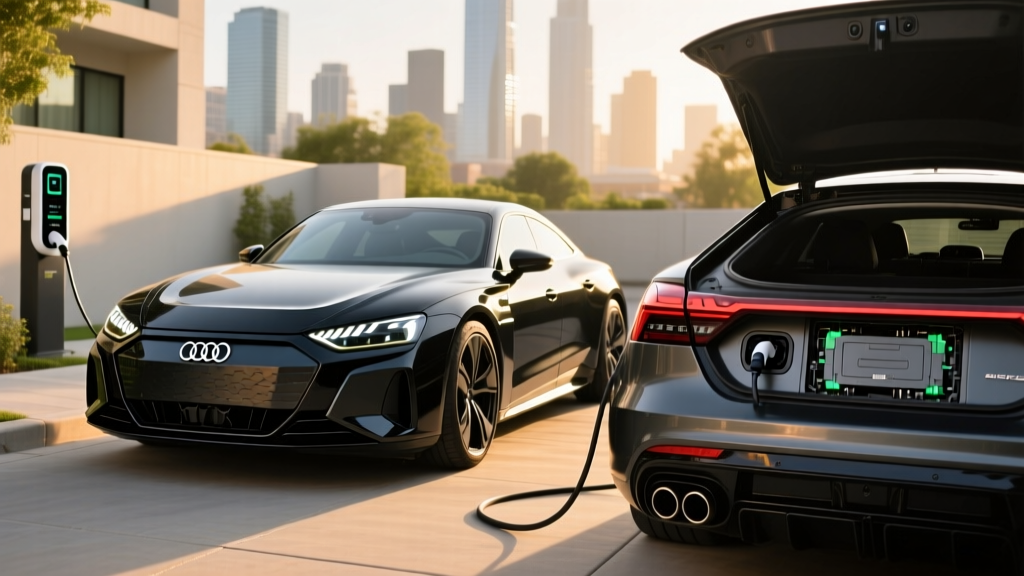
The Audi e-tron GT Premium Plus occupies a rare space in the electric luxury market: a grand tourer that pairs Porsche Taycan underpinnings with Audi's design restraint and daily-driver usability. For 2026, Audi has refreshed the e-tron GT lineup with a larger battery pack, faster charging architecture, and updated infotainment — but the question for buyers remains whether its $100,000-plus price tag delivers enough real-world range and practicality to justify the premium.
We've spent time with the 2026 Audi e-tron GT Premium Plus to bring you exact numbers on range, charging curves, efficiency, and ownership costs — not just the sticker specs. Here's what you need to know before signing the lease or purchase agreement.
Quick Verdict: Who Should Buy the e-tron GT Premium Plus?
The 2026 Audi e-tron GT Premium Plus is best suited for luxury EV buyers who prioritize design, build quality, and 800-volt fast-charging capability over maximum cargo space or class-leading range. It's a compelling commuter and weekend grand tourer for couples or small families who don't need SUV-level utility. If you regularly drive 250+ miles between charging stops or need to haul more than two suitcases, look at the Audi Q8 e-tron or a luxury SUV instead.
Choose the e-tron GT Premium Plus if: You want Porsche Taycan performance in a more understated package, value 800V DC fast charging for road trips, and primarily drive solo or with one passenger.
Look elsewhere if: You need rear-seat space for adults on long trips, require more than 14.3 cu ft of cargo volume, or want the maximum possible EPA range per dollar.
Range, Battery & Efficiency
| Specification | 2026 Audi e-tron GT Premium Plus |
|---|---|
| EPA Estimated Range | 270 miles |
| Battery Capacity (Usable) | 97.0 kWh (NMC chemistry) |
| Battery Architecture | 800-volt |
| EPA Efficiency | 82 MPGe combined (41 kWh/100 mi) |
| Drivetrain | Dual-motor AWD (quattro) |
| Horsepower (Boost Mode) | 522 hp |
| 0–60 mph | 3.9 seconds |
| Top Speed | 152 mph |
The 2026 e-tron GT Premium Plus uses an updated 97.0 kWh usable lithium-ion battery pack with NMC (nickel manganese cobalt) chemistry — a significant upgrade from the previous generation's 85.0 kWh pack. The 800-volt architecture remains a standout feature, enabling faster DC charging and more consistent power delivery under hard acceleration compared to 400-volt competitors.
EPA Range vs. Real-World Expectations: The EPA rates the 2026 e-tron GT Premium Plus at 270 miles. In real-world mixed driving at 70°F, expect approximately 245–260 miles. On sustained highway driving at 75 mph, plan for 220–235 miles before needing to charge. In cold weather (below 32°F), range can drop to 190–210 miles due to battery heating demands and cabin climate load. The heat pump (standard on Premium Plus) mitigates some of this loss, but physics is physics — plan road trips around 200-mile segments in winter conditions.
Efficiency of 41 kWh per 100 miles is competitive with the Porsche Taycan 4S but trails the Lucid Air Pure (which achieves roughly 28 kWh/100 mi). The e-tron GT prioritizes performance and all-weather traction over hypermiling efficiency, which is the expected trade-off for a dual-motor quattro system producing over 500 hp.
Charging Speed: DC Fast, Level 2 & Home Setup
| Charging Level | Power / Rate | Speed / Time |
|---|---|---|
| DC Fast Charge (Peak) | 320 kW (800V) | 10–80% in ~18 minutes |
| DC Fast Charge (Sustained Avg) | ~220 kW average to 80% | ~210 miles added in 18 min |
| Level 2 (Home / Public AC) | 11 kW (48A) | ~32 miles per hour of charging |
| Level 1 (120V Household) | 1.4 kW (12A) | ~3.5 miles per hour |
The 800-volt architecture is where the e-tron GT Premium Plus earns its keep on road trips. At a compatible 350 kW DC fast charger (such as Electrify America's latest stalls or Tesla Superchargers with a NACS adapter), the e-tron GT can peak at 320 kW. However, as with all EVs, peak rate is not sustained rate. The charge curve tapers progressively above 50% State of Charge (SoC), and by 80% you're seeing roughly 100–120 kW. The 10–80% session averages around 220 kW, which still translates to a very usable 18-minute stop.
Charging curve reality check: If you regularly charge to 100% at DC fast stations, expect the 80–100% top-off to add another 15–20 minutes due to aggressive tapering. For road trips, plan 10–80% hops and you'll minimize time at the charger.
For home charging, the onboard 11 kW AC charger means a full charge from empty takes roughly 9.5 hours on a Level 2 wallbox — ideal for overnight replenishment. We recommend a 48-amp Level 2 home charger (such as the ChargePoint Home Flex or Tesla Wall Connector with J1772 adapter) installed on a 60-amp circuit. Expect home installation costs of $800–$2,000 depending on your electrical panel's capacity and the run distance from panel to garage. According to data compiled by fueleconomy.gov, home Level 2 charging costs roughly $0.04–$0.06 per mile depending on your local electricity rate, compared to $0.12–$0.18 per mile for premium gasoline in a comparable luxury sedan.
Performance & Driving Dynamics
The dual-motor quattro all-wheel-drive system delivers 469 hp in normal driving and 522 hp in Launch Control / boost mode. The 3.9-second 0–60 mph time puts it firmly in sports-sedan territory — quick enough to merge aggressively and overtake with confidence, though the higher-output e-tron GT Performance variant (720 hp, 2.5-second 0–60) exists for those who want supercar acceleration.
What separates the e-tron GT from raw-acceleration EVs is its chassis tuning. The Premium Plus trim includes adaptive air suspension with controlled damping, rear-axle steering (up to 2.8 degrees), and a mechanical limited-slip differential on the rear axle. The result is a car that communicates through corners with more feedback than most EVs, while still filtering out highway imperfections. At 5,139 lbs curb weight, it's not a lightweight, but the low center of gravity and rear-biased torque distribution keep body roll well-controlled.
Regenerative braking offers two modes: a coasting mode (lift-off regeneration near zero, mimicking a gas car's freewheel) and a moderate regen mode activated via steering-wheel paddles. Unlike some competitors, the e-tron GT does not offer true one-pedal driving with full stop-hold capability — you'll still use the brake pedal in stop-and-go traffic. This is a deliberate engineering choice favoring natural deceleration feel, but buyers coming from a Tesla or Nissan LEAF should test-drive and adjust expectations.
Interior, Cargo & Technology
The cabin follows Audi's driver-focused design language with high-quality materials throughout — Nappa leather upholstery, open-pore wood or carbon-fiber trim, and a flat-bottom steering wheel are standard on Premium Plus. The 10.1-inch upper touchscreen handles infotainment (wireless Apple CarPlay and Android Auto, navigation, vehicle settings) while an 8.6-inch lower screen manages climate controls and handwriting input.
The 12.3-inch Virtual Cockit Plus digital instrument cluster remains one of the best in the industry for configurable driving data, including real-time kW consumption, range estimation, and navigation mapping.
Cargo and passenger space:
- Rear trunk: 14.3 cu ft (usable for two carry-on bags and a garment bag)
- Front trunk (frunk): 3.5 cu ft (fits a charging cable bag and small items)
- Rear legroom: 32.6 inches (tight for adults over 6 feet on long trips)
- Front headroom: 38.5 inches
- Seating: 4-passenger configuration (2+2 layout, no rear bench)
The 2+2 seating layout and low roofline make this a car for couples or solo drivers, not families with older children who need legroom. The frunk is small compared to competitors like the Porsche Taycan (which offers 4.1 cu ft up front) and far smaller than a Tesla Model S.
Driver assistance technology: The Premium Plus trim comes equipped with Audi's Adaptive Cruise Assist with lane guidance (SAE Level 2), intersection assist, parking system plus with surround-view cameras, and Audi Pre Sense front/rear collision mitigation. This is a hands-on-wheel, eyes-on-road system — it does not offer hands-free driving on mapped highways like GM's Super Cruise or Ford's BlueCruise. The adaptive cruise and lane-centering work well on interstates, but the driver must remain fully engaged at all times.
Pricing, Trims & Federal Tax Credit Eligibility
| Trim Level | Base MSRP | Est. As-Tested |
|---|---|---|
| e-tron GT Premium Plus | $108,900 | $114,000–$120,000 |
| e-tron GT Prestige (upgrade) | $116,400 | $125,000+ |
| e-tron GT Performance | $149,900 | $160,000+ |
The 2026 Audi e-tron GT Premium Plus starts at a base MSRP of $108,900 (including destination). Common option packages — such as the Black Optic package, carbon-fiber exterior mirror housings, and the Audi Sport design package — can push the as-tested price to $114,000–$120,000.
Does the e-tron GT Premium Plus Qualify for the Federal EV Tax Credit?
IRS §30D Federal Tax Credit — Key Requirements (2026):
- MSRP Cap: Sedans must have an MSRP at or below $55,000 to qualify. The e-tron GT Premium Plus at $108,900 exceeds this cap.
- Buyer Income Cap: Modified AGI must not exceed $150,000 (single) / $300,000 (married filing jointly).
- Battery Sourcing: Critical minerals and battery components must meet phased-in domestic/free-trade sourcing thresholds.
- Point-of-Sale Transfer: Eligible credits can be applied at purchase to reduce the transaction price.
Verdict: The 2026 Audi e-tron GT Premium Plus does not qualify for the $7,500 federal new-EV tax credit under IRS §30D rules because its MSRP exceeds the $55,000 sedan cap. Buyers should check for state-level incentives (such as California's CVRP or utility rebates), which may still apply. Consult a tax professional for your specific situation.
Warranty & Ownership Costs
Audi backs the 2026 e-tron GT with the following coverage:
- New Vehicle Limited Warranty: 4 years / 50,000 miles
- Battery & Powertrain Warranty: 8 years / 100,000 miles (covers battery capacity below 70% of original)
- Corrosion Perforation Warranty: 12 years, unlimited miles
- Roadside Assistance: 4 years / unlimited miles
The 70% battery capacity retention threshold over 8 years is industry-standard and matches Porsche, BMW, and Mercedes-Benz EV warranties. Tesla's Model S warranty is slightly more generous at 8 years / 150,000 miles. Real-world degradation data from earlier-generation e-tron GT models (2022–2024) suggests approximately 5–8% capacity loss over the first 60,000 miles with typical charging habits (avoiding frequent 100% charges and DC fast-charging exclusively). The larger 97.0 kWh battery in the 2026 model provides a bigger buffer, meaning even with 10% degradation you'd still have roughly 243 miles of original 270-mile range.
Estimated 5-year ownership costs: Insurance for the e-tron GT Premium Plus averages $3,200–$4,500 annually depending on your profile and state, according to industry data. Electricity costs for 15,000 miles/year at $0.14/kWh average roughly $860 annually — about $1,800 less per year than premium fuel in a comparable Audi RS7. Scheduled maintenance is minimal (cabin air filter, brake fluid, tire rotation), typically $300–$500 per year.
Pros & Cons
Pros
- 800V architecture enables 320 kW peak DC fast charging — 10–80% in ~18 minutes
- Exceptional build quality and cabin materials befitting the price
- Adaptive air suspension with rear-axle steering delivers engaging handling
- 522 hp in boost mode with composed, confidence-inspiring AWD traction
- Understated, elegant design that ages better than polarizing competitors
- Strong real-world charging curve (sustained ~220 kW average to 80%)
Cons
- 270-mile EPA range trails Lucid Air (400+ mi) and Tesla Model S (402 mi)
- Tight rear seats (32.6" legroom) and limited cargo (14.3 cu ft trunk + 3.5 cu ft frunk)
- Does not qualify for $7,500 federal tax credit (MSRP exceeds $55K sedan cap)
- No true one-pedal driving mode — requires brake pedal use in traffic
- Driver-assist is competent but not hands-free like Super Cruise or BlueCruise
- Infotainment dual-touchscreen layout draws eyes away from the road
Competitor Comparison
| Spec | 2026 Audi e-tron GT Premium Plus | 2026 Porsche Taycan 4S | 2026 Tesla Model S Long Range |
|---|---|---|---|
| EPA Range | 270 mi | 283 mi | 402 mi |
| Battery (Usable) | 97.0 kWh (NMC) | 97.0 kWh (NMC) | 100 kWh (NMC) |
| Peak DC Charge | 320 kW | 320 kW | 250 kW |
| 10–80% DC Time | ~18 min | ~18 min | ~27 min |
| 0–60 mph | 3.9 sec | 3.8 sec | 3.1 sec |
| Horsepower | 522 hp | 536 hp | 670 hp |
| Cargo (Total) | 17.8 cu ft | 18.3 cu ft | 28.0 cu ft |
| Base MSRP | $108,900 | $107,400 | $79,990 |
| Federal Tax Credit | No (MSRP cap) | No (MSRP cap) | No (MSRP cap) |
The Taycan 4S is the e-tron GT's closest sibling — they share the J1 platform and powertrain architecture, but the Audi offers a more comfort-oriented tune and a distinctly different interior aesthetic. The Tesla Model S wins decisively on range, cargo, and price, but cannot match the Audi's build quality, charging speed, or chassis refinement. Your choice depends on whether you value grand-touring comfort and 800V charging (Audi/Porsche) or maximum range and value (Tesla).
Frequently Asked Questions
What is the real-world range of the 2026 Audi e-tron GT Premium Plus?
The EPA rates it at 270 miles. In real-world mixed driving at moderate temperatures, expect 245–260 miles. Highway-only driving at 75 mph yields approximately 220–235 miles. In freezing temperatures, plan for 190–210 miles. Always plan road-trip charging stops with a 20% buffer.
How fast does the e-tron GT Premium Plus charge at home and on the road?
On DC fast chargers, it peaks at 320 kW and completes a 10–80% session in approximately 18 minutes at a compatible 350 kW station. At home on a Level 2 wallbox (11 kW / 48A), it adds roughly 32 miles of range per hour, fully recharging overnight in about 9.5 hours. Level 1 (120V) is emergency-only at roughly 3.5 miles per hour.
Does the 2026 Audi e-tron GT qualify for the $7,500 federal EV tax credit?
No. Under current IRS §30D rules, new electric sedans must have an MSRP at or below $55,000 to qualify. The e-tron GT Premium Plus starts at $108,900 and is ineligible regardless of buyer income. State and utility incentives may still apply — check your local programs.
Is the Audi e-tron GT worth buying over the Porsche Taycan or Tesla Model S?
If you want Taycan-level engineering with more understated styling and a slightly more comfort-biased ride, the e-tron GT is worth the premium. If range is your top priority, the Tesla Model S offers 402 EPA miles at $30,000 less. If you want the sportiest driving experience and don't mind similar pricing, the Taycan 4S is the driver's pick. None of these three qualify for the federal tax credit.
What are the biggest drawbacks of the e-tron GT Premium Plus?
The main trade-offs are modest range (270 mi EPA vs. 400+ for competitors), tight rear seating, limited cargo space, no eligibility for the federal tax credit, and the lack of a one-pedal driving mode. The dual-screen infotainment layout also requires more eyes-off-road time than physical-button alternatives.
What battery chemistry does the e-tron GT use, and how long will it last?
The 2026 e-tron GT uses NMC (nickel manganese cobalt) lithium-ion cells, chosen for their high energy density and performance characteristics. NMC batteries generally show 5–10% capacity loss over the first 100,000 miles with proper care (avoiding frequent 100% charges and extreme heat exposure). Audi warranties the battery for 8 years / 100,000 miles against capacity dropping below 70% of original.
Can I charge the e-tron GT at Tesla Superchargers?
Audi has been progressively adopting the NACS (North American Charging Standard) connector. For 2026, check whether your specific vehicle ships with a native NACS port or a CCS-to-NACS adapter. Audi and Electrify America have a partnership providing complimentary charging credits, and the broader Supercharger network is accessible via adapter or native NACS on newer models. Confirm connector specifics with your dealer at purchase.
Sources: EPA fueleconomy.gov, IRS §30D Clean Vehicle Credits, Audi USA official specifications. Pricing and tax credit rules reflect 2026 model year and are subject to change. Consult a tax professional for credit eligibility.