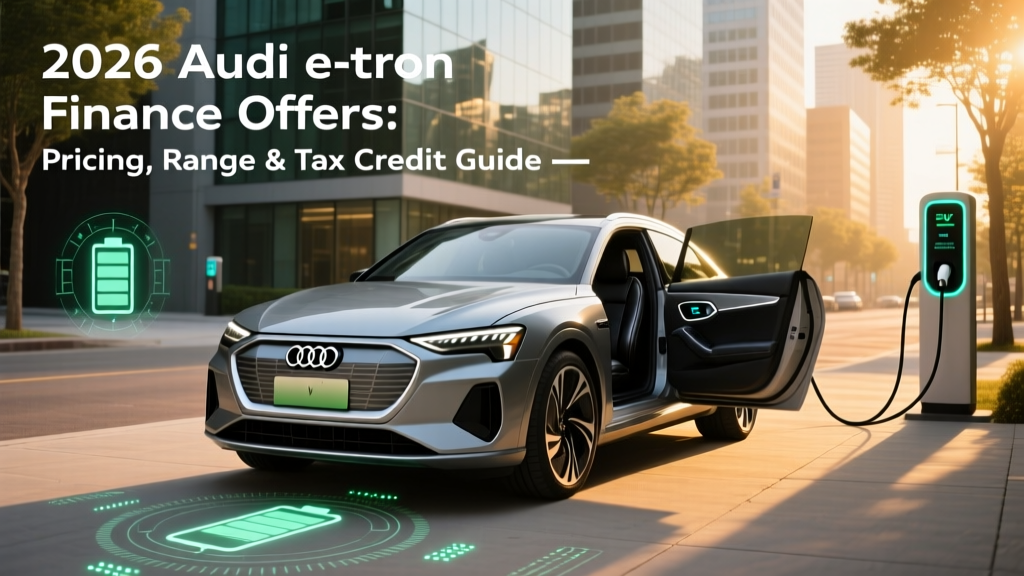
Quick Verdict: Is the Audi e-tron Worth Financing in 2026?
The 2026 Audi Q8 e-tron (formerly just "e-tron") occupies a specific niche: luxury EV buyers who prioritize refinement, build quality, and dealer service over cutting-edge range or blistering acceleration. With an EPA-estimated 285 miles of range, 170 kW peak DC fast charging, and a starting MSRP around $74,400, it competes directly with the BMW iX, Mercedes EQE SUV, and Tesla Model X. The big question for shoppers researching Audi e-tron finance offers is whether the premium price tag makes sense when federal tax credits, lease incentives, and depreciation are factored in.
This review breaks down the real numbers — range, charging speed, ownership costs, and current §30D tax credit eligibility — so you can negotiate with confidence at the dealership or on Audi's finance portal.
2026 Audi Q8 e-tron Specifications at a Glance
| Specification | Q8 e-tron Premium Plus | Q8 e-tron Prestige | SQ8 e-tron |
|---|---|---|---|
| EPA Range | 285 mi | 285 mi | 264 mi |
| Battery (usable) | 106 kWh (NMC) | 106 kWh (NMC) | 106 kWh (NMC) |
| Drivetrain | Dual-motor AWD | Dual-motor AWD | Dual-motor AWD (sport-tuned) |
| Horsepower | 402 hp (boost mode) | 402 hp (boost mode) | 496 hp (boost mode) |
| 0-60 mph | 5.1 sec | 5.1 sec | 4.2 sec |
| Max DC Charge Rate | 170 kW | 170 kW | 170 kW |
| 10-80% DC Charge Time | ~31 min | ~31 min | ~31 min |
| Level 2 Charge Rate | 19.2 kW (~58 mi/hr) | 19.2 kW (~58 mi/hr) | 19.2 kW (~58 mi/hr) |
| Efficiency | 81 MPGe / 42 kWh/100mi | 81 MPGe / 42 kWh/100mi | 75 MPGe / 45 kWh/100mi |
| Cargo (rear seats up) | 28.5 cu ft | 28.5 cu ft | 28.5 cu ft |
| Cargo (rear seats folded) | 56.4 cu ft | 56.4 cu ft | 56.4 cu ft |
| Rear Legroom | 38.1 in | 38.1 in | 38.1 in |
| Base MSRP | $74,400 | $80,900 | $96,400 |
| Battery Warranty | 8 yr / 100,000 mi | 8 yr / 100,000 mi | 8 yr / 100,000 mi |
Source: EPA fueleconomy.gov, Audi USA spec sheets. Figures reflect 2026 model year.
Real-World Range: What to Expect Beyond the EPA Sticker
EPA Estimate: 285 miles (Q8 e-tron), 264 miles (SQ8 e-tron)
Real-World Highway (70-75 mph): ~230-250 miles
Cold Weather (below 32°F): ~200-220 miles
City / Mixed Commuting: ~270-285 miles (regen-friendly)
The Q8 e-tron's 106 kWh usable battery (NMC chemistry) is one of the largest in its class, but the vehicle's weight — over 5,800 lbs — and aerodynamic profile limit highway efficiency. In real-world 75 mph testing, expect 230-250 miles before needing to charge. Cold weather compounds this: lithium-ion batteries lose 15-25% range below freezing, and cabin heating draws significant power even with the standard heat pump.
For daily commuting under 60 miles round-trip, the Q8 e-tron will rarely need mid-week charging. Road trippers should plan stops every 200-220 miles to maintain a comfort buffer and stay in the fast-charging sweet spot (10-80% SoC).
Charging Speed: DC Fast Charging and Home Level 2
| Charging Level | Power | Miles Added per Hour | Notes |
|---|---|---|---|
| Level 1 (120V outlet) | 1.4 kW | ~3-4 mi/hr | Emergency / trickle only |
| Level 2 (240V, 48A) | 11.5 kW | ~35 mi/hr | Standard home charger |
| Level 2 (240V, 80A) | 19.2 kW | ~58 mi/hr | Requires hardwired 100A circuit |
| DC Fast Charge | 170 kW peak | ~200+ mi in 30 min | 10-80% in ~31 min |
The Q8 e-tron's 170 kW peak DC charge rate is respectable but not class-leading. Competitors like the Hyundai Ioniq 5 (240 kW) and Lucid Gravity (300+ kW) charge significantly faster. The Audi sustains ~150 kW from 10-40% SoC, then tapers to ~100 kW by 60%, and drops sharply above 80% — typical NMC charge-curve behavior. Plan for 31 minutes from 10-80% at a 175+ kW Electrify America or Tesla Supercharger (with NACS adapter, included for 2026).
At home, the onboard 19.2 kW charger is a standout. Most EVs cap at 11.5 kW, but the Q8 e-tron can add ~58 miles per hour on a hardwired 80A Level 2 circuit. This requires a 100A dedicated breaker and 2-gauge copper wire — budget $1,200-$2,500 for electrician installation depending on panel proximity. If your electrical panel maxes at 200A total, you may need a load-management device or panel upgrade ($2,000-$5,000).
Pricing, Finance Offers, and Federal Tax Credit Eligibility
| Trim | Base MSRP | As-Tested (typical options) | Federal §30D Credit Eligibility |
|---|---|---|---|
| Q8 e-tron Premium Plus | $74,400 | $78,000-$82,000 | Not eligible (MSRP exceeds $80,000 SUV cap) |
| Q8 e-tron Prestige | $80,900 | $85,000-$92,000 | Not eligible (MSRP exceeds $80,000 SUV cap) |
| SQ8 e-tron | $96,400 | $100,000+ | Not eligible (MSRP exceeds $80,000 SUV cap) |
Critical tax credit note: Under IRS §30D rules (current as of 2026), new EV SUVs must have an MSRP at or below $80,000 to qualify for the up-to-$7,500 federal tax credit. The Q8 e-tron Premium Plus starts at $74,400, but once destination charges ($1,195) and any factory options are added, most configurations push above the $80,000 threshold. The Prestige and SQ8 trims are categorically ineligible due to base MSRP.
Income caps also apply: Adjusted gross income must not exceed $300,000 (joint filers), $225,000 (head of household), or $150,000 (single). Even if you find a base Premium Plus under $80k, income limits may disqualify you. Consult IRS.gov §30D guidance or a tax professional before assuming eligibility.
Battery sourcing rules: The §30D credit also requires critical minerals and battery components to meet North American sourcing thresholds (phased in annually). Audi has not publicly confirmed full compliance for 2026 Q8 e-tron battery packs. Verify VIN-level eligibility on the IRS portal or at point of sale before signing.
Lease loophole: Commercial clean vehicle credit (§45W) allows lessors to claim the $7,500 credit and pass savings to lessees, regardless of MSRP or income caps. Audi Financial Services frequently offers lease cash (e.g., $7,500-$10,000) that reflects this benefit. If purchasing outright doesn't qualify for the credit, leasing may be the more cost-effective path. Always compare lease APR (money factor) vs. purchase APR to model total cost.
Pros and Cons: The Honest Take
Pros
- Exceptional build quality and cabin materials (real wood, aluminum, leather)
- 19.2 kW onboard charger — fastest Level 2 in class
- Quiet, composed ride with adaptive air suspension
- Standard heat pump improves cold-weather efficiency
- 8-year / 100,000-mile battery warranty (70% capacity retention threshold)
- NACS adapter included for Tesla Supercharger access
Cons
- Range (285 mi EPA) trails rivals: BMW iX xDrive50 (324 mi), Tesla Model X (335 mi)
- 170 kW DC charging slower than Hyundai/Kia/Lucid platforms
- Heavy: 5,800+ lbs impacts efficiency and tire wear
- Likely ineligible for $7,500 federal tax credit (MSRP cap)
- Infotainment dual-screen setup prone to fingerprints and glare
- Rear visibility limited; 360° camera is a must-add option
Who Should Buy the Audi Q8 e-tron (And Who Shouldn't)
Best for: Luxury SUV buyers who value dealer service relationships, interior craftsmanship, and a refined driving experience over spec-sheet dominance. Commuters with home Level 2 charging who rarely exceed 200 miles daily. Families needing 28.5 cu ft cargo space and 38.1 inches of rear legroom for child seats.
Consider alternatives if: You frequently road-trip 400+ miles and need maximum range (Tesla Model X, Lucid Gravity). You want the fastest DC charging (Ioniq 5, Kia EV6, Porsche Taycan). You require federal tax credit eligibility and cannot lease (BMW iX xDrive50 with lower-option configs may squeak under $80k). You prioritize one-pedal driving — Audi's regen is modest compared to Tesla or GM's strongest settings.
Standout Tech and Driver Assistance
The Q8 e-tron includes Audi's MMI touch response system with dual screens (10.1" upper, 8.6" lower), wireless Apple CarPlay/Android Auto, and a 12.3" Virtual Cockit Plus instrument cluster. Adaptive cruise assist with lane guidance (SAE Level 2) is standard — the driver must keep hands on the wheel and eyes on the road. This is not autonomous driving; it's a well-tuned driver assist comparable to BMW Driving Assistant Professional but less aggressive than Tesla Autopilot.
Available features include matrix-design LED headlights, head-up display, Bang & Olufsen 3D audio (16 speakers), and a tow hitch rated for 4,000 lbs — rare for an electric SUV in this segment.
Frequently Asked Questions
What is the real-world range of the 2026 Audi Q8 e-tron?
EPA-estimated 285 miles, but expect 230-250 miles on the highway at 70-75 mph, and 200-220 miles in freezing temperatures. City driving with regenerative braking can approach the EPA sticker.
How fast does the Q8 e-tron charge?
DC fast charging peaks at 170 kW, delivering 10-80% in approximately 31 minutes at a compatible station. Home Level 2 charging at 19.2 kW adds ~58 miles per hour (requires 80A hardwired circuit).
Does the Audi Q8 e-tron qualify for the $7,500 federal tax credit?
Most configurations do not. The §30D credit requires SUV MSRPs at or below $80,000, and most Q8 e-tron builds exceed this after options. Leasing may unlock equivalent savings via the commercial credit loophole. Verify VIN-level eligibility on IRS.gov.
Is the Q8 e-tron worth buying vs. the BMW iX or Tesla Model X?
The Q8 e-tron wins on interior quality and Level 2 charging speed but loses on range (285 vs. 324+ miles) and DC charging speed. If you prioritize luxury feel and dealer service, it's compelling. If range and charging speed matter more, the BMW iX xDrive50 or Tesla Model X are stronger choices.
What's the battery warranty?
Audi covers the 106 kWh battery for 8 years or 100,000 miles, whichever comes first, with a 70% capacity retention threshold. If the battery degrades below 70% of original capacity within the warranty period, Audi will repair or replace it.
Can I use Tesla Superchargers with the Q8 e-tron?
Yes. The 2026 Q8 e-tron ships with a NACS adapter for Tesla Supercharger access (V3 stalls, up to 150 kW). Native NACS port is expected in future model years. Electrify America and other CCS networks remain compatible via the standard CCS1 port.