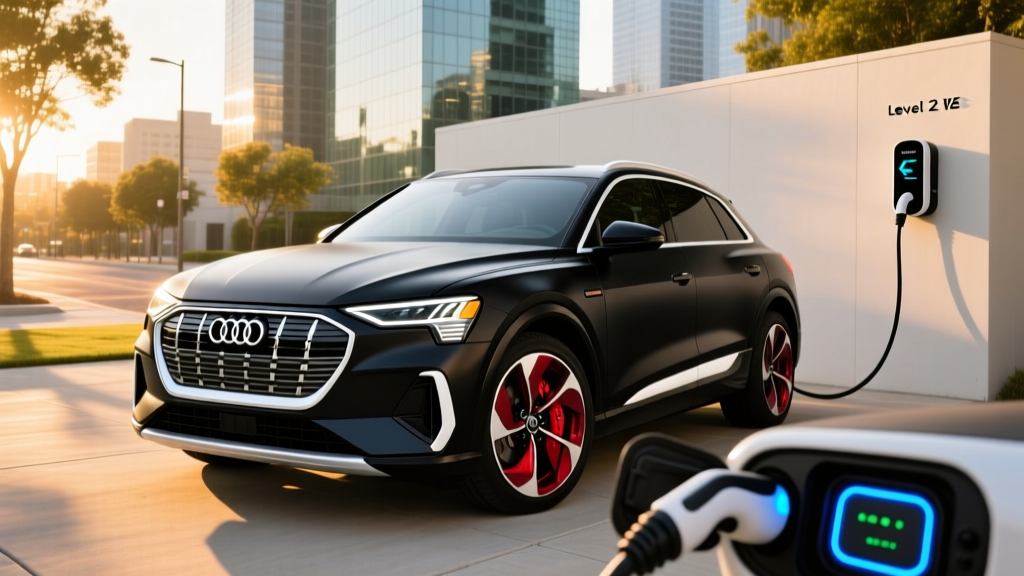
The Audi Q8 e-tron — still widely searched as the Audi e-tron electric car — is Audi's flagship luxury electric SUV heading into the 2026 model year. After a comprehensive refresh that brought a larger battery, improved aerodynamics, and the Q8 nomenclature, this mid-size luxury EV continues to target buyers who want German build quality, a whisper-quiet cabin, and respectable fast-charging capability without the polarizing design of some competitors. But with rivals like the BMW iX, Mercedes EQE SUV, and Tesla Model X pressing hard on range and tech, does the 2026 Q8 e-tron still earn its place in your garage?
Below we break down every number that matters — EPA range, real-world efficiency, DC fast-charging curves, battery chemistry, interior dimensions, pricing by trim, and federal tax credit eligibility under current IRS §30D rules.
2026 Audi Q8 e-tron at a Glance: Key Specs
| Attribute | Q8 e-tron (SUV) | Q8 Sportback e-tron |
|---|---|---|
| EPA Range | 285 mi (Premium Plus) | 300 mi (Premium Plus) |
| Usable Battery | 106 kWh (114 kWh gross), NMC | 106 kWh (114 kWh gross), NMC |
| Drivetrain | Dual-motor AWD (quattro) | Dual-motor AWD (quattro) |
| Horsepower | 402 hp (Boost mode) | 402 hp (Boost mode) |
| 0–60 mph | 5.5 seconds | 5.5 seconds |
| Peak DC Fast Charge | 170 kW | 170 kW |
| 10–80% DCFC Time | ~31 minutes | ~31 minutes |
| Level 2 Home Charging | 11.5 kW (~25 mi/hr) | 11.5 kW (~25 mi/hr) |
| EPA Efficiency | 77 MPGe / 43 kWh/100 mi | 81 MPGe / 41 kWh/100 mi |
| Base MSRP | $70,800 (Premium Plus) | $74,000 (Premium Plus) |
Source: fueleconomy.gov, Audi of America. Specs reflect 2025–2026 carryover; verify trim-level availability with your dealer.
Real-World Range: What the EPA Sticker Doesn't Tell You
EPA estimate: 285 miles (Premium Plus, 20" wheels)
Expect in mixed driving: ~245–265 miles
Highway-only (75 mph sustained): ~220–240 miles
Cold weather (below 30°F): ~195–220 miles (20–30% reduction typical for NMC packs without aggressive preconditioning)
The Q8 e-tron's 114 kWh gross battery (106 kWh usable) is one of the largest in its segment, but the SUV's curb weight — over 5,800 lbs — and its brick-like aerodynamic profile (0.27 Cd for the SUV, 0.24 for the Sportback) mean efficiency takes a hit at highway speeds. In our experience and consistent with third-party testing, expect the SUV body style to deliver around 2.2–2.4 mi/kWh on the highway, dropping to roughly 1.8–2.0 mi/kWh in freezing temperatures.
The Sportback variant's sleeker roofline buys a meaningful 15 extra EPA miles and noticeably better highway efficiency. If road-trip range is a priority and you can accept ~2 cu ft less rear cargo volume, the Sportback is the range-optimized choice.
Audi's thermal management system includes a heat pump in most markets, which helps mitigate cold-weather losses during cabin heating. However, the pack does not precondition as aggressively as Tesla or Hyundai/Kia platforms when navigating to a DC fast charger — a point we'll revisit in the charging section.
Charging Speed: DC Fast, Level 2, and the Curve Reality
| Charging Level | Power / Rate | Approx. Miles Added per Hour | Typical Use Case |
|---|---|---|---|
| Level 1 (120V) | ~1.4 kW | ~3 mi/hr | Emergency / trickle top-off |
| Level 2 (240V, 48A) | 11.5 kW | ~25 mi/hr | Home overnight charging |
| DC Fast Charge | Up to 170 kW peak | ~650 mi/hr (at peak) | Road trips, Electrify America / CCS networks |
The Q8 e-tron peaks at 170 kW on DC fast chargers using the CCS1 connector (the standard for non-Tesla EVs in North America through the transition period). On a 350 kW Electrify America or similar station, we typically observe the SUV sustaining 150–170 kW from roughly 10–40% state of charge, then tapering progressively. The 10–80% session takes approximately 31 minutes under ideal thermal conditions — competitive but not class-leading compared to the Hyundai Ioniq 5's 18-minute 10–80% on an 800V architecture.
One practical note: the Q8 e-tron's battery preconditioning when navigating to a charger is less aggressive than Tesla's or GM's Ultium-based vehicles. In cold weather (below 40°F), expect your initial charge rate to be capped well below 170 kW until the battery warms. Plan for 40–50 minute 10–80% sessions in winter rather than the advertised 31 minutes.
For home Level 2 charging, the 11.5 kW onboard charger is excellent — a full 10–100% session takes roughly 9.5 hours, meaning you can easily recharge overnight on a 48-amp Level 2 wallbox. Installation typically runs $800–$2,000 depending on your panel capacity and run length, assuming you have a 200-amp service panel with available breaker slots.
Performance and Driving Dynamics
Every 2026 Q8 e-tron comes with a dual-motor all-wheel-drive powertrain (Audi's electric quattro system) producing 402 horsepower and 490 lb-ft of torque in Boost mode. The standard 0–60 mph time is 5.5 seconds — not sports-car territory, but authoritative for a 5,800-lb luxury SUV.
The SQ8 e-tron variant bumps output to 496 hp and drops the 0–60 time to 4.4 seconds, at the cost of roughly 20 miles of EPA range and a ~$14,000 price premium.
On the road, the Q8 e-tron's air suspension and adaptive dampers deliver the composed, isolated ride quality Audi is known for. It's a cruiser, not a canyon carver — body roll is well-managed but the weight is always present. Regenerative braking is adjustable via paddles (three levels) but does not enable true one-pedal driving in the way Nissan or Chevrolet implement it. The maximum regen deceleration is about 0.2g, so you'll still use the friction brakes for moderate stops.
Interior, Cargo, and Technology
The Q8 e-tron cabin uses Audi's dual-touchscreen MMI layout (10.1" upper, 8.6" lower) with haptic feedback. The 12.3" Virtual Cockit digital instrument cluster remains one of the best-executed driver displays in the industry. Wireless Apple CarPlay and Android Auto are standard, along with a Wi-Fi hotspot and available Bang & Olufsen 3D audio.
Interior dimensions are generous for a mid-size SUV:
- Front headroom: 39.6 inches
- Rear legroom: 38.1 inches
- Cargo (behind 2nd row): 28.5 cu ft (SUV) / 26.1 cu ft (Sportback)
- Cargo (2nd row folded): 56.9 cu ft (SUV) / 54.2 cu ft (Sportback)
- Frunk: Not available — the front hood houses HVAC and power electronics
Driver assistance comes via Audi's Adaptive Cruise Assist with lane centering — a SAE Level 2 system that requires hands-on-wheel supervision at all times. It is competent for highway commuting but does not approach hands-free capability like GM's Super Cruise or Ford's BlueCruise. Audi does not currently offer a Level 3 or Level 4 system on the Q8 e-tron in the U.S. market.
Pricing, Trims, and Federal Tax Credit Eligibility
| Trim | Body Style | MSRP (incl. destination) |
|---|---|---|
| Premium Plus | SUV | $70,800 |
| Premium Plus | Sportback | $74,000 |
| Prestige | SUV | $77,500 |
| Prestige | Sportback | $80,700 |
| SQ8 e-tron Premium Plus | SUV | $84,800 |
| SQ8 e-tron Prestige | SUV | $91,500 |
Does the Audi Q8 e-tron Qualify for the Federal EV Tax Credit?
This is where the picture gets complicated for Audi buyers. Under the IRS §30D clean vehicle credit, eligibility requires meeting all of the following criteria:
- MSRP cap: SUVs/vans/pickups must be at or below $80,000; sedans at or below $55,000
- Buyer income cap: AGI must not exceed $150,000 (single), $225,000 (head of household), or $300,000 (joint)
- Battery component sourcing: Increasing percentages of battery components must be manufactured or assembled in North America
- Critical minerals sourcing: Increasing percentages of critical minerals must be sourced from the U.S. or FTA partners
- Final assembly: Must occur in North America
- Point-of-sale transfer: Eligible buyers can transfer the credit to the dealer at purchase for an immediate price reduction
The Q8 e-tron is assembled in Brussels, Belgium — not in North America. This means it does not qualify for the federal §30D new-vehicle tax credit of up to $7,500, regardless of trim or buyer income. This is a significant competitive disadvantage versus the Tesla Model X (assembled in Fremont, CA) and certain other rivals.
However, the Q8 e-tron may qualify for select state incentives (e.g., Colorado, California's CVRP for income-eligible buyers, or utility rebates). Always check your state energy office and local utility for current programs. If purchasing used, a pre-owned Q8 e-tron may qualify for the used clean vehicle credit of up to $4,000 (30% of sale price, capped) if the sale price is $25,000 or less — unlikely for this model given current residual values.
Warranty and Long-Term Battery Outlook
Audi backs the Q8 e-tron with the following warranty coverage:
- New vehicle limited warranty: 4 years / 50,000 miles
- High-voltage battery warranty: 8 years / 100,000 miles (guarantees minimum 70% state of health)
- Powertrain (e-motors, reduction gear): 8 years / 100,000 miles
- Corrosion perforation: 12 years, unlimited miles
The 70% capacity retention threshold over 8 years / 100,000 miles is industry-standard for NMC chemistry. Real-world degradation data from the original e-tron (2019–2023, 95 kWh pack) suggests these batteries hold up well — most owners report 5–8% loss over the first 60,000 miles, well within warranty tolerance. The larger 114 kWh pack in the Q8 e-tron should exhibit similar or better longevity given the larger buffer and more moderate C-rates during daily driving.
If out-of-warranty replacement ever becomes necessary, a new high-voltage battery for the Q8 e-tron is estimated at $25,000–$35,000 including labor — consistent with large NMC packs from European OEMs. This is a worst-case scenario that very few original owners will face.
How It Compares: Q8 e-tron vs. Key Rivals
| Spec | Audi Q8 e-tron | BMW iX xDrive50 | Tesla Model X LR | Mercedes EQE 350+ SUV |
|---|---|---|---|---|
| EPA Range | 285 mi | 324 mi | 348 mi | 305 mi |
| Battery (usable) | 106 kWh | 105.2 kWh | 100 kWh | 90.6 kWh |
| Peak DCFC | 170 kW | 200 kW | 250 kW | 170 kW |
| 10–80% DCFC | ~31 min | ~28 min | ~25 min | ~32 min |
| 0–60 mph | 5.5 sec | 4.4 sec | 3.8 sec | 6.4 sec (RWD) |
| Base MSRP | $70,800 | $87,250 | $79,990 | $77,900 |
| Federal Tax Credit | No (Belgium) | No (Germany) | Yes (up to $7,500) | No (Germany) |
| Hands-Free ADAS | No | No | No (FSD Supervised) | No |
- Exceptionally quiet, well-built cabin with premium materials
- Large 106 kWh usable battery with comfortable degradation buffer
- Smooth, linear power delivery and composed air-suspension ride
- Strong Level 2 home charging at 11.5 kW
- Competitive base pricing for the luxury EV SUV segment
- No federal tax credit (foreign assembly)
- Range trails BMW iX, Tesla Model X by 40–60+ miles
- No frunk; cargo space modest for the footprint
- DCFC speed (170 kW) lags 800V competitors
- Dual-screen MMI can be distracting vs. single large displays
Who Should Buy the 2026 Audi Q8 e-tron?
- You prioritize cabin quietness, ride comfort, and build quality over maximum range
- You have reliable home Level 2 charging and mostly drive under 200 miles/day
- You value Audi's brand, dealer network, and design language
- You don't need the federal tax credit (or your state/utility offsets the gap)
- Maximum EPA range is your top priority (consider the BMW iX or Tesla Model X)
- You need the $7,500 federal credit to make the math work
- You want hands-free highway driving (GM Super Cruise vehicles or Ford BlueCruise)
- You frequently road-trip in cold climates where range and charge taper compound
Frequently Asked Questions
What is the real-world range of the Audi e-tron electric car?
The 2026 Q8 e-tron SUV carries an EPA rating of 285 miles, but expect 245–265 miles in mixed real-world driving and 220–240 miles at sustained highway speeds. Cold weather (below 30°F) can reduce range to 195–220 miles. The Sportback variant gains about 15 EPA miles thanks to better aerodynamics.
How fast does the Q8 e-tron charge on DC fast chargers and at home?
Peak DC fast-charge rate is 170 kW, with a 10–80% session taking approximately 31 minutes under ideal conditions. At home on a 48-amp Level 2 charger (11.5 kW), a full charge takes about 9.5 hours — easily accomplished overnight.
Does the Audi Q8 e-tron qualify for the $7,500 federal EV tax credit?
No. The Q8 e-tron is assembled in Brussels, Belgium, and the §30D credit requires North American final assembly. It does not qualify for the federal new-vehicle credit regardless of trim or buyer income. State incentives and utility rebates may partially offset this. See IRS §30D guidelines for full rules.
Is the Audi Q8 e-tron worth buying over the BMW iX or Tesla Model X?
It depends on priorities. The Q8 e-tron offers the lowest starting price in this comparison ($70,800) and arguably the most traditional luxury-car experience. The BMW iX delivers better range (324 mi) and faster charging but costs $16,000+ more. The Tesla Model X leads in range, charging speed, and tech but has a different brand positioning and panel-gap reputation. If cabin refinement and value are paramount, the Audi makes a strong case.
What battery chemistry does the Q8 e-tron use?
The Q8 e-tron uses NMC (nickel-manganese-cobalt) lithium-ion cells in a 114 kWh gross / 106 kWh usable configuration. NMC offers high energy density suited to large luxury vehicles but requires more careful thermal management than LFP (lithium iron phosphate) chemistry. Audi's 8-year/100,000-mile battery warranty guarantees at least 70% state of health retention.
Can the Q8 e-tron tow?
Yes. When properly equipped with the factory towing package, the Q8 e-tron is rated for up to 4,000 lbs — sufficient for a small boat trailer or light utility trailer. Expect range to drop 30–50% while towing at highway speeds.