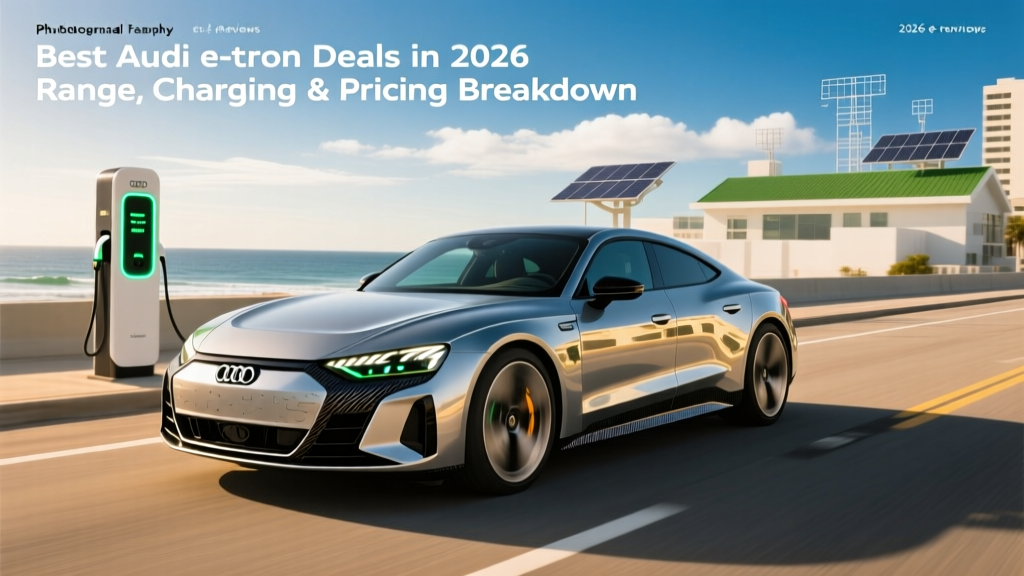
If you've been searching for Audi e-tron deals, you've likely noticed the nameplate has evolved. What launched as the Audi e-tron in 2019 was rebranded the Audi Q8 e-tron for the 2024 model year, bringing a larger battery, improved aerodynamics, and a modest range bump. Now in the 2026 model year, the Q8 e-tron occupies a specific niche in the luxury EV SUV segment: it prioritizes cabin refinement, ride quality, and build precision over chasing the longest range or quickest 0-60 time. That trade-off makes understanding the real numbers — range, charging curves, pricing, and tax-credit eligibility — essential before you sign any deal sheet.
This review covers the 2026 Audi Q8 e-tron (the standard SUV body style; the Sportback variant shares the powertrain but sacrifices a small amount of cargo space and range for its coupe-like roofline). We'll give you exact specs, real-world ownership data, and a framework for evaluating whether current Audi e-tron deals actually represent value against rivals like the BMW iX, Mercedes EQE SUV, and Tesla Model X.
Range, Efficiency, and the Real-World Reality Check
The 2026 Audi Q8 e-tron carries a 114 kWh gross / 106 kWh usable lithium-ion battery pack using NMC (nickel-manganese-cobalt) chemistry. Audi pairs this with a dual-motor quattro all-wheel-drive system producing 402 horsepower and 494 lb-ft of torque in Boost mode.
EPA Estimated: 285 miles (Q8 e-tron Premium Plus, 20" wheels)
Real-World Highway (70-75 mph): ~230–250 miles
Real-World City/Mixed: ~260–275 miles
Cold Weather (below 32°F): ~200–220 miles (expect 15–25% range reduction)
The Q8 e-tron's boxy SUV shape and ~5,800-lb curb weight hurt highway efficiency. If your commute is mostly stop-and-go city driving, you'll see numbers closer to the EPA sticker. Sustained 80 mph freeway travel or winter conditions will compress range noticeably.
On the efficiency side, the EPA rates the Q8 e-tron at 83 MPGe combined, which translates to roughly 41 kWh per 100 miles. That's thirstier than the BMW iX xDrive50 (~87 MPGe) and significantly behind the Tesla Model X (~102 MPGe). The Q8 e-tron trades efficiency for mass — and that mass buys you a remarkably quiet, planted ride.
Charging Speed: DC Fast Charging and Home Setup
Charging is where the Q8 e-tron's larger 106 kWh usable battery cuts both ways: you get more range, but you're also replenishing a bigger tank. Here's what the charging profile actually looks like across all three levels:
| Charging Level | Power / Rate | Time / Miles Added |
|---|---|---|
| Level 1 (120V household) | ~1.4 kW | ~3–4 miles per hour of charging |
| Level 2 (240V home/public) | 11.5 kW (48A onboard charger) | ~25–28 miles per hour; full 0–100% in ~9.5 hours |
| DC Fast Charge (CCS) | Peak 170 kW | 10–80% in ~31 minutes; 80–100% adds another ~25 min due to taper |
Charging curve reality: The Q8 e-tron peaks near 170 kW only between roughly 10–30% state of charge (SoC). By 50% SoC, the rate drops to approximately 120–130 kW, and above 80% it falls below 50 kW as the battery management system protects cell longevity. On a road trip, plan your stops around the 10–80% window — charging beyond 80% at a DC fast charger is painfully slow and rarely worth the wait.
The Q8 e-tron uses a CCS1 connector for DC fast charging and a J1772 inlet for Level 2. Audi provides access to the Electrify America network (typically with a complimentary charging credit for new buyers), and CCS adapters are available if you need access to Tesla Supercharger stations that have opened to non-Tesla vehicles via the Magic Dock.
Home charging setup: To get the full 11.5 kW Level 2 rate, you'll need a hardwired Level 2 charger on a 60-amp circuit (the charger itself draws 48 amps). Budget $500–$800 for a quality Level 2 unit (ChargePoint Home Flex, Emporia Level 2, or Wallbox Pulsar Plus) and $800–$2,500 for professional installation depending on your electrical panel's capacity and the run distance. If your home has a 100-amp main panel, you may need a $1,500–$3,000 panel upgrade to 200 amps — factor this into your total purchase cost.
Performance and Driving Dynamics
| Specification | 2026 Audi Q8 e-tron |
|---|---|
| Powertrain | Dual-motor AWD (quattro) |
| Horsepower | 402 hp (Boost mode) |
| Torque | 494 lb-ft |
| 0–60 mph | 5.5 seconds |
| Top Speed | 124 mph (electronically limited) |
| Curb Weight | ~5,775 lbs |
| Towing Capacity | 4,000 lbs (with factory tow package) |
| Battery (Usable) | 106 kWh, NMC chemistry |
| EPA Range | 285 miles (20" wheels) |
| Efficiency | 83 MPGe / 41 kWh/100mi |
| Max DC Charge Rate | 170 kW (CCS1) |
| Level 2 Charge Rate | 11.5 kW (48A) |
| Base MSRP | $75,695 (Premium Plus) |
The Q8 e-tron is not trying to be a performance SUV. Its 5.5-second 0–60 time is adequate but trails the BMW iX xDrive50 (4.4 seconds) and the Tesla Model X (3.8 seconds in dual-motor form). What the Audi delivers instead is composure: adaptive air suspension smooths out broken pavement, the cabin is whisper-quiet at highway speeds, and the steering is precise without being twitchy. This is a grand-touring electric SUV, not a track weapon.
Regenerative braking is adjustable via steering-wheel paddles, offering three levels of regen plus an auto mode that uses radar and navigation data to modulate deceleration. It does not offer true one-pedal driving to a complete stop in the way a Nissan LEAF or Chevrolet Bolt does — you'll still use the brake pedal in stop-and-go traffic.
Interior Space, Cargo, and Technology
The Q8 e-tron's cabin is where Audi's premium positioning justifies its price. Materials are excellent: standard leather upholstery, real aluminum or wood trim, and tight panel gaps throughout. The dual-touchscreen MMI infotainment system (10.1" upper, 8.6" lower) handles climate, navigation, and media, though the lower screen's haptic-feedback buttons can distract while driving.
Passenger and cargo dimensions:
- Front legroom: 41.0 inches
- Rear legroom: 37.3 inches
- Cargo (behind 2nd row): 28.5 cu ft
- Cargo (2nd row folded): 56.4 cu ft
- Frunk (front trunk): Not available — the space under the hood houses power electronics
That cargo volume trails the BMW iX (35.5 / 77.9 cu ft) and Tesla Model X (44.1 / 88.1 cu ft with seats folded). If you regularly haul bulky gear or a family of four with luggage for a week, this is a meaningful difference.
Driver assistance: The Q8 e-tron comes with Audi's Adaptive Cruise Assist with Lane Guidance — a SAE Level 2 system that handles steering, acceleration, and braking on highways. It is not self-driving. You must keep your hands on the wheel and your eyes on the road. The system is competent for long highway stretches but less aggressive and predictive than GM's Super Cruise or Ford's BlueCruise on compatible roads.
Pricing, Trims, and Federal Tax Credit Eligibility
The 2026 Audi Q8 e-tron is offered in three trims for the standard SUV body:
| Trim | Base MSRP | Est. As-Tested | §30D Credit Eligibility |
|---|---|---|---|
| Premium Plus | $75,695 | $78,000–$82,000 | See below |
| Prestige | $81,095 | $85,000–$92,000 | See below |
| S line (appearance package) | +$3,000 add | Varies | See below |
Federal tax credit (§30D) — the critical details: Under current IRS rules, the Q8 e-tron's eligibility for the up-to-$7,500 federal tax credit depends on several factors that change periodically:
- MSRP cap: SUVs must have an MSRP at or below $80,000. The Q8 e-tron Premium Plus qualifies; the Prestige trim may exceed this cap depending on options.
- Buyer income cap: Modified adjusted gross income must not exceed $300,000 (joint filers), $225,000 (head of household), or $150,000 (individual).
- Battery sourcing: Critical minerals and battery components must meet phased-in domestic-sourcing thresholds. Audi's supply chain compliance has shifted year to year — verify current-year status on fueleconomy.gov before purchasing.
- Point-of-sale transfer: As of 2024, eligible buyers can transfer the credit to the dealer at purchase, reducing the upfront price rather than waiting to claim it on their tax return.
Bottom line on deals: The best Audi e-tron deals will come from combining a Premium Plus trim (stays under the MSRP cap), confirming current-year battery-sourcing compliance, and stacking any available dealer incentives or lease cash. Audi frequently offers lease bonuses ($2,000–$5,000) that can make leasing significantly cheaper than buying, even if you forfeit the tax credit (the leasing company claims it and may pass savings through as a capitalized-cost reduction).
How the Q8 e-tron Stacks Up Against Competitors
| Spec | 2026 Audi Q8 e-tron | 2026 BMW iX xDrive50 | 2026 Tesla Model X LR |
|---|---|---|---|
| EPA Range | 285 mi | 324 mi | 335 mi |
| Battery (Usable) | 106 kWh | 105.2 kWh | 100 kWh |
| 0–60 mph | 5.5 sec | 4.4 sec | 3.8 sec |
| Peak DC Charge | 170 kW | 200 kW | 250 kW |
| 10–80% DC Time | ~31 min | ~28 min | ~22 min |
| Cargo (rear seats up) | 28.5 cu ft | 35.5 cu ft | 44.1 cu ft |
| Base MSRP | $75,695 | $87,250 | $79,990 |
| Efficiency | 83 MPGe | 87 MPGe | 102 MPGe |
- You prioritize ride comfort and cabin quietness over maximum range
- You want traditional luxury build quality and dealer service experience
- Your daily driving is under 200 miles and you charge at home nightly
- You value Audi's design language and interior materials
- You want 40+ more miles of EPA range and faster charging
- You need more cargo space for family use
- You're willing to pay ~$12,000 more at base for a sportier drive
- Range and charging speed are your top priorities
- You need a third row (available on Model X)
- You're comfortable with Tesla's minimalist interior and service model
Warranty and Long-Term Ownership
Audi backs the Q8 e-tron with:
- New-vehicle limited warranty: 4 years / 50,000 miles
- Battery and powertrain warranty: 8 years / 100,000 miles (covers defects and capacity loss below 70% of original capacity)
- Corrosion perforation warranty: 12 years, unlimited miles
- Roadside assistance: 4 years / unlimited miles
The 70% capacity-retention threshold over 8 years is industry-standard (matching BMW, Mercedes, and Hyundai). NMC batteries in liquid-cooled packs like the Q8 e-tron's typically degrade 8–12% over the first 100,000 miles based on fleet data from earlier e-tron models. To maximize longevity, avoid routinely charging to 100% on DC fast chargers and try to keep daily charging between 20–80% SoC on your home Level 2 unit.
Insurance costs: Expect premiums 15–25% higher than a comparable gas-powered Audi Q5, driven by repair costs for aluminum body panels and battery-pack replacement pricing. Get quotes before purchasing — the difference can be $400–$800 per year depending on your profile.
Pros, Cons, and Verdict
- Exceptionally quiet, well-damped ride quality
- Premium interior materials and fit-and-finish
- Strong 4,000-lb towing capacity for the segment
- Air suspension provides adjustable ride height
- Refined, predictable power delivery
- EPA range (285 mi) trails rivals by 40–50 miles
- Efficiency (83 MPGe) means higher charging costs
- 170 kW peak DC charging is slower than BMW/Tesla
- Cargo volume (28.5 cu ft) is tight for the class
- No frunk for additional storage
- Weight (~5,775 lbs) is felt in corners and braking
Frequently Asked Questions
What is the real-world range of the Audi Q8 e-tron?
The EPA rates it at 285 miles, but expect 230–250 miles on sustained highway trips at 70–75 mph and 200–220 miles in freezing temperatures. City and mixed driving will get you closer to 260–275 miles thanks to regenerative braking.
Does the Audi Q8 e-tron qualify for the $7,500 federal tax credit?
It can, but eligibility depends on your income, the specific trim's MSRP (must be ≤$80,000 for SUVs), and current-year battery-sourcing compliance. The Premium Plus trim typically qualifies; verify on fueleconomy.gov and consult a tax professional before relying on the credit.
How much does the Q8 e-tron cost after incentives?
A Premium Plus at ~$75,695 MSRP with full $7,500 credit eligibility comes to roughly $68,195 before state incentives, dealer discounts, or destination charges. Lease deals can push effective monthly costs lower through Audi's lease cash programs.
How fast does the Q8 e-tron charge at home and on the road?
At home on a 240V Level 2 charger (11.5 kW), you'll add about 25–28 miles per hour, fully recharging overnight in ~9.5 hours. On a DC fast charger, it peaks at 170 kW and goes from 10–80% in approximately 31 minutes.
Is the Audi Q8 e-tron worth buying over the BMW iX or Tesla Model X?
If your priority is cabin serenity, build quality, and a comfortable daily commute under 200 miles, yes. If you need maximum range, faster road-trip charging, or more cargo space, the BMW iX or Tesla Model X are stronger choices — but both cost more at base.
What is the battery replacement cost for the Q8 e-tron?
Out of warranty, a full battery pack replacement runs an estimated $25,000–$35,000 based on current parts pricing. However, module-level repairs are often possible for isolated cell failures at significantly lower cost, and most packs retain 88–92% capacity at 100,000 miles.
Sources: EPA Fuel Economy, Audi USA, IRS §30D Clean Vehicle Credits