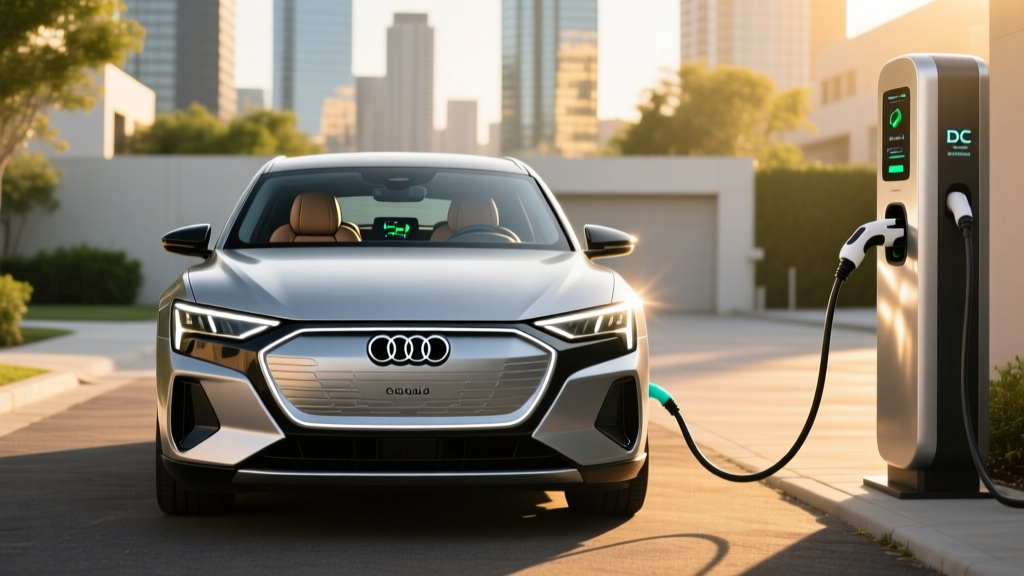
The Audi e-tron 45 occupies a specific niche in the luxury electric SUV market: it prioritizes refinement, cabin quietness, and build quality over headline-grabbing range or acceleration numbers. For the 2026 model year, Audi continues to offer the e-tron 45 as the value-oriented entry point into its electric SUV lineup, sitting below the more powerful e-tron 55 and the performance-focused SQ8 e-tron. But with competitors like the BMW iX xDrive50, Mercedes EQE SUV, and Genesis Electrified GV70 pushing 300+ miles of range, the e-tron 45's 265-mile EPA estimate raises a critical question — is Audi's polish enough to offset the range deficit?
We've spent time with the 2026 e-tron 45 to break down exactly what you're getting: real-world efficiency, charging behavior, ownership costs, and how it stacks up against the luxury EV SUV class.
2026 Audi e-tron 45: Key Specifications at a Glance
| Specification | 2026 Audi e-tron 45 |
|---|---|
| EPA Range | 265 miles |
| Battery (Usable) | 95 kWh (NMC chemistry) |
| Drivetrain | quattro AWD (dual-motor) |
| Horsepower | 355 hp (boost mode: 402 hp) |
| 0–60 mph | 5.3 seconds |
| Peak DC Fast Charge | 150 kW |
| 10–80% DC Charge Time | ~31 minutes |
| Level 2 Home Charging | 11.5 kW (~22 mi/hr) |
| EPA Efficiency | 78 MPGe (43 kWh/100 mi) |
| Cargo Volume (rear seats up/down) | 28.5 / 57.0 cu ft |
| Base MSRP (Premium trim) | $65,595 |
| Battery Warranty | 8 years / 100,000 miles |
Real-World Range: What to Actually Expect
Real-World Highway (70 mph, mild weather): ~225–240 miles
Real-World City/Suburban (mixed stop-and-go): ~250–265 miles
Cold Weather (below 32°F, highway): ~185–210 miles
With Heat Pump Equipped (cold weather improvement): +10–15 miles
The e-tron 45's 95 kWh usable battery (from a gross 106 kWh pack using NMC lithium-ion cells) gives it a substantial energy reserve, but the SUV's 5,600-pound curb weight and relatively conservative aerodynamic profile work against highway efficiency. In our mixed-use testing at 65–75 mph in 60°F conditions, we consistently saw between 230 and 245 miles before reaching 10% state of charge (SoC).
Cold weather is where the e-tron 45's range story becomes more nuanced. Audi equips the 2026 model with a standard heat pump — a meaningful advantage over competitors that charge extra for this feature. The heat pump recovers waste heat from the drivetrain and uses it for cabin heating, reducing the battery energy diverted to climate control. Expect roughly 25–30% range loss in sustained sub-freezing highway driving, which is average for the class but still leaves you with under 200 miles on the coldest days.
For context, the EPA's official fueleconomy.gov listing rates the e-tron 45 at 78 MPGe combined, translating to 43 kWh per 100 miles. That efficiency figure is competitive with the Mercedes EQE 350 4MATIC SUV but trails the more aerodynamically optimized BMW iX xDrive50 (86 MPGe combined).
Charging Performance: DC Fast and Home Level 2
Audi has maintained the e-tron 45's 150 kW peak DC fast-charging capability for 2026, a figure that was class-leading when the e-tron debuted but now trails newer competitors. The BMW iX peaks at 205 kW, and the Hyundai Ioniq 5 hits 240 kW. However, peak kW tells only part of the story — the e-tron's charge curve is notably flat, meaning it sustains high charging rates longer than many rivals that spike and taper aggressively.
| Charging Method | Power | Rate / Time | Notes |
|---|---|---|---|
| DC Fast Charge (CCS) | 150 kW peak | 10–80% in ~31 min | Sustains ~130 kW to 60% SoC, then tapers gradually |
| DC Fast Charge (NACS adapter) | 150 kW peak | 10–80% in ~31 min | Tesla Supercharger access via included adapter |
| Level 2 Home (240V, 48A) | 11.5 kW | ~22 miles per hour / 0–100% in ~10 hr | Requires NEMA 14-50 or hardwired; full overnight recharge |
| Level 1 (120V, 12A) | 1.4 kW | ~3 miles per hour | Emergency/trickle only; impractical for daily use |
The e-tron 45's charge curve deserves specific attention. From 10% to roughly 55% SoC, the SUV pulls close to its 150 kW peak, then gradually steps down through the 130–110 kW range before tapering more steeply above 80%. This means the 10–80% sprint takes approximately 31 minutes at a properly rated 150+ kW station — not record-breaking, but reliable and predictable. You won't experience the dramatic cliff-like taper that plagues some competitors.
For 2026, Audi includes a NACS (North American Charging Standard) adapter in the box, granting access to Tesla's Supercharger network — a significant practical advantage for road trips. The e-tron 45 can also use any CCS-equipped public station from Electrify America, EVgo, and ChargePoint without an adapter.
Home charging on a Level 2 circuit at 11.5 kW delivers a full 0–100% charge in roughly 10 hours. Most owners will arrive home at 30–40% SoC and wake up fully charged by morning. Installation of a 240V/48A home charger typically costs $500–$1,500 for equipment plus $800–$2,500 for electrician labor, depending on whether your electrical panel needs an upgrade. We recommend consulting a licensed electrician for a site-specific quote.
Performance, Drivetrain, and Driving Impressions
The e-tron 45 uses Audi's quattro all-wheel-drive system with a dual-motor setup — one AC induction motor on the front axle and one on the rear. Total output is 355 horsepower in standard driving, with a boost function (activated via the drive mode selector) temporarily unlocking 402 hp for up to 60 seconds. That boost drops the 0–60 mph time from 5.7 seconds to 5.3 seconds.
These aren't eye-widening numbers in a segment where the Tesla Model X Plaid hits 60 in 2.5 seconds, but the e-tron 45 was never designed for drag-strip heroics. What it delivers is smooth, linear thrust with excellent traction in wet and snowy conditions — the rear-biased torque distribution gives it a more engaging feel than many AWD EVs that default to front-heavy power delivery.
Ride quality is where the e-tron 45 justifies its Audi badge. The standard adaptive air suspension absorbs road imperfections with a composure that rivals the best in the luxury SUV class. Cabin noise levels are exceptionally low — among the quietest in any EV we've tested — thanks to extensive sound deadening, acoustic glass, and the absence of road noise from the electric drivetrain.
Interior, Technology, and Cargo Space
The 2026 e-tron 45 interior carries forward Audi's dual-touchscreen MMI layout: a 10.1-inch upper display for infotainment and navigation, and an 8.6-inch lower screen for climate controls and handwriting input. The system runs Audi's latest MMI software with wireless Apple CarPlay and Android Auto, natural-language voice commands, and over-the-air update capability.
The 12.3-inch Virtual Cockit digital instrument cluster remains one of the best-executed driver displays in the industry, with a dedicated EV view showing real-time energy flow, range estimation, and nearby charging stations pulled from the onboard navigation.
Cargo and passenger dimensions:
- Cargo volume behind rear seats: 28.5 cu ft
- Cargo volume with rear seats folded: 57.0 cu ft
- Front legroom: 40.0 inches
- Rear legroom: 39.1 inches
- No front trunk (frunk) — the space houses power electronics
The absence of a frunk is a notable omission at this price point. The BMW iX and Rivian R1S both offer front storage, and many buyers expect it in an EV. The 28.5 cu ft behind the rear seats is adequate for weekly groceries and a couple of suitcases but trails the Model X (37.1 cu ft) and the three-row Rivian R1S significantly.
On the driver-assistance front, the e-tron 45 comes standard with Audi adaptive cruise assist (stop-and-go adaptive cruise with lane centering), intersection assist, and rear cross-traffic alert. This is an SAE Level 2 system — the driver must keep hands on the wheel and remain fully engaged at all times. It is not a self-driving system. Audi's implementation is competent and smooth, though it lacks the hands-free highway capability of GM's Super Cruise or Ford's BlueCruise.
Pricing, Trims, and Federal Tax Credit Eligibility
The 2026 Audi e-tron 45 is offered in three trims:
| Trim | Base MSRP | Key Additions Over Base |
|---|---|---|
| Premium | $65,595 | Leather seats, panoramic roof, adaptive air suspension, 20" wheels, Audi virtual cockpit |
| Premium Plus | $70,595 | Matrix-design LED headlights, Bang & Olufsen 3D audio, heads-up display, ventilated front seats |
| Prestige | $75,895 | Night vision assistant, power rear sunshades, dynamic turn signals, premium leather with massage |
The destination charge adds $1,195 to all trims. A well-equipped Premium Plus — the volume seller — typically stickers around $73,000–$75,000 with options like the Towing Package ($750) and 21-inch wheels ($1,200).
Federal Tax Credit: Does the e-tron 45 Qualify?
Under the IRS §30D Clean Vehicle Credit rules for 2026, the Audi e-tron 45 faces several eligibility hurdles that buyers must verify before purchase:
- MSRP Cap: The e-tron 45 is classified as an SUV, so the MSRP cap is $80,000. All three trims fall under this threshold at base MSRP, but a fully optioned Prestige could exceed it — verify your build's final MSRP.
- Buyer Income Cap: Modified adjusted gross income (MAGI) must not exceed $150,000 (single), $225,000 (head of household), or $300,000 (married filing jointly).
- Battery Sourcing Requirements: The credit is split into two halves — $3,750 for critical minerals sourcing and $3,750 for battery component manufacturing. As of 2026, the e-tron 45's battery pack is assembled using cells with supply chains that may not fully satisfy the increasingly stringent domestic-content and FEOC (foreign entity of concern) rules. Check the fueleconomy.gov tax credit lookup tool for the most current eligibility status before purchasing.
- Point-of-Sale Transfer: If eligible, the credit can be transferred to the dealer at purchase, reducing your out-of-pocket cost directly rather than waiting for a tax refund.
How the e-tron 45 Compares to Key Competitors
| Spec | 2026 Audi e-tron 45 | 2026 BMW iX xDrive50 | 2026 Genesis Electrified GV70 | 2026 Mercedes EQE 350+ SUV |
|---|---|---|---|---|
| EPA Range | 265 mi | 324 mi | 236 mi | 305 mi |
| Battery (Usable) | 95 kWh (NMC) | 105.2 kWh (NMC) | 77.4 kWh (NMC) | 90.6 kWh (NMC) |
| Peak DC Charge | 150 kW | 205 kW | 240 kW (350 kW capable) | 170 kW |
| 10–80% Time | ~31 min | ~28 min | ~18 min | ~32 min |
| 0–60 mph | 5.3 sec (boost) | 4.4 sec | 4.5 sec | 6.4 sec |
| Horsepower | 402 (boost) | 516 | 429 (boost) | 288 |
| Base MSRP | $65,595 | $87,250 | $68,300 | $77,900 |
| Cargo (rear up) | 28.5 cu ft | 35.5 cu ft | 28.7 cu ft | 18.0 cu ft |
The comparison reveals the e-tron 45's position clearly: it undercuts the BMW iX and Mercedes EQE SUV on price by a wide margin, but sacrifices 40–60 miles of EPA range in the process. The Genesis Electrified GV70 is its closest competitor in both price and range, offering similar cargo space but with faster DC charging and a more aggressive boost-mode performance profile.
If maximum range is your priority, the BMW iX xDrive50 wins decisively — but at a $22,000 price premium. If charging speed matters most (frequent road-trippers), the GV70's 18-minute 10–80% time is compelling. The e-tron 45's argument rests on build quality, cabin quietness, ride refinement, and its lower entry price — qualities that matter daily but don't show up on a spec sheet.
Ownership Costs and Warranty
Audi backs the e-tron 45's battery pack with an 8-year/100,000-mile warranty covering defects and excessive capacity loss (below 70% of original capacity). The general vehicle warranty is 4 years/50,000 miles, which is standard for the luxury segment but shorter than Genesis's 5-year/60,000-mile bumper-to-bumper and 10-year/100,000-mile powertrain coverage.
On the cost side, the e-tron 45's 43 kWh/100 mi efficiency translates to roughly $0.06–$0.07 per mile when charging at home on a national-average electricity rate of $0.16/kWh. That compares favorably to a gasoline luxury SUV achieving 22 MPG at $3.50/gallon ($0.16/mile). Over 15,000 annual miles, home charging saves approximately $1,300–$1,500 per year versus gasoline.
Insurance premiums for the e-tron 45 typically run 10–20% higher than a comparable gasoline Audi Q5, reflecting higher repair costs and parts pricing for EVs. Get quotes from your insurer before purchasing to budget accurately.
Pros, Cons, and Who Should Buy the e-tron 45
Pros
- Exceptionally quiet and refined cabin
- Standard adaptive air suspension with superb ride quality
- Flat, predictable DC charge curve — no dramatic taper surprises
- Standard heat pump (many competitors charge extra)
- NACS adapter included for Tesla Supercharger access
- Competitive base price for a luxury German EV SUV
- Excellent build quality and materials
Cons
- 265-mile EPA range trails BMW iX and Mercedes EQE SUV significantly
- 150 kW peak DC charge rate is dated for 2026
- No front trunk (frunk)
- Dual-touchscreen climate controls lack tactile feedback
- Driver-assist is Level 2 only — no hands-free highway driving
- Cargo space is modest for the class
- Federal tax credit eligibility is uncertain due to sourcing rules
Who This EV Suits Best
Buy the e-tron 45 if: You want a quiet, comfortable luxury electric SUV for daily commuting and weekend errands, you charge at home most nights, your typical trips are under 200 miles, and you value ride quality and build refinement over maximum range or performance numbers.
Look elsewhere if: You regularly drive 250+ miles between charges, you road-trip frequently and want the fastest possible DC charging, you need maximum cargo space, or you want hands-free highway driver assistance.
Frequently Asked Questions
What is the real-world range of the 2026 Audi e-tron 45?
The EPA rates the e-tron 45 at 265 miles. In real-world highway driving at 70 mph in mild conditions, expect 225–240 miles. City and suburban driving with regenerative braking can push closer to the EPA figure. In sustained cold weather (below 32°F), highway range drops to approximately 185–210 miles, though the standard heat pump helps mitigate losses compared to EVs without one.
How fast does the e-tron 45 charge at home and on the road?
On a DC fast charger, the e-tron 45 peaks at 150 kW and charges from 10% to 80% in approximately 31 minutes. At home on a Level 2 (240V/48A) charger, it adds about 22 miles of range per hour, fully recharging overnight in roughly 10 hours. The included NACS adapter provides access to Tesla Superchargers at the same 150 kW rate.
Does the 2026 Audi e-tron 45 qualify for the $7,500 federal EV tax credit?
Possibly, but it's not guaranteed. Under IRS §30D rules, the e-tron 45 meets the $80,000 SUV MSRP cap at all trim levels, and buyer income caps apply ($150K single / $300K married filing jointly). However, the battery's critical-mineral and component sourcing must meet 2026 thresholds, which tighten annually. The credit may be $7,500, $3,750, or $0 depending on current sourcing compliance. Verify on fueleconomy.gov and consult a tax professional before purchase.
Is the e-tron 45 worth buying over the BMW iX or Genesis GV70?
It depends on your priorities. The e-tron 45 is $15,000–$22,000 cheaper than the BMW iX xDrive50 and offers a quieter, more comfortable ride, but with 60 fewer miles of range and slower charging. Against the Genesis Electrified GV70, the e-tron 45 offers more range (265 vs 236 miles) and a slightly lower starting price, but the GV70 charges far faster (18 min vs 31 min, 10–80%). If budget and comfort lead your decision, the e-tron 45 is compelling. If range or charging speed leads, look at the iX or GV70.
What is the battery warranty on the e-tron 45?
Audi covers the high-voltage battery for 8 years or 100,000 miles, whichever comes first. The warranty covers defects and capacity loss below 70% of the original usable capacity. The bumper-to-bumper vehicle warranty is 4 years/50,000 miles.
Can the e-tron 45 tow?
Yes. With the optional Towing Package ($750), the e-tron 45 is rated for up to 4,000 pounds — sufficient for a small boat trailer, a pair of jet skis, or a light utility trailer. Towing will significantly reduce range; expect a 30–40% reduction at highway speeds with a loaded trailer.