The Short Answer
There is no Audi A8 electric car currently in production or announced for sale as of 2026. Audi discontinued the gas-powered A8 sedan after the 2024 model year in the U.S. market without releasing a direct battery-electric successor wearing the A8 nameplate. Buyers seeking a full-size, flagship luxury electric sedan from Audi should look at the Audi e-tron GT (and its higher-output variants) or wait for the upcoming Audi A6 e-tron sedan, which is the closest electrified spiritual successor in Audi's lineup. If you specifically need a large luxury electric sedan with comparable rear-seat space to the old A8, cross-shopping the Mercedes-Benz EQS Sedan, BMW i7, and Lucid Air is essential.
What Happened to the Audi A8?
The Audi A8 served as the brand's flagship luxury sedan for over two decades, competing directly with the Mercedes-Benz S-Class and BMW 7 Series. For its final U.S. model years, the A8 was offered exclusively as the A8 L 60 TFSI with a 4.0-liter twin-turbo V8 mild-hybrid powertrain producing 453 horsepower, as well as the plug-in hybrid A8 L 60 TFSI e variant. The PHEV version paired a 3.0L V6 with an electric motor for a combined 455 hp and an EPA-estimated 17 miles of electric-only range from its 17.9 kWh battery pack — a figure that fell far short of modern PHEV standards.
Audi confirmed the A8's discontinuation in the U.S. market, and as of early 2026, no electric vehicle carrying the A8 badge has been formally announced or entered production. Audi's electrified sedan strategy has instead focused on the e-tron GT family and the forthcoming A6 e-tron, built on the PPE (Premium Platform Electric) architecture co-developed with Porsche.
Your Best Alternatives: Flagship Electric Sedans Compared
Since the "Audi A8 electric car" doesn't exist, here's how the closest alternatives stack up against each other on the metrics that matter for a luxury EV sedan buyer:
| Spec | Audi e-tron GT quattro | BMW i7 xDrive60 | Mercedes EQS 450+ | Lucid Air Pure |
|---|---|---|---|---|
| EPA Range | 238 mi | 318 mi | 390 mi | 419 mi |
| Battery (usable) | 83.7 kWh (NMC) | 101.7 kWh (NMC) | 108.4 kWh (NMC) | 88 kWh (NMC) |
| Peak DC Fast Charge | 270 kW | 195 kW | 200 kW | 220 kW |
| 10–80% DCFC Time | ~22 min | ~34 min | ~31 min | ~25 min |
| 0–60 mph | 3.9 sec | 4.5 sec | 5.9 sec | 5.2 sec |
| Horsepower | 522 hp | 536 hp | 355 hp | 430 hp |
| Base MSRP | $106,495 | $106,695 | $105,550 | $69,900 |
| Federal §30D Credit | Not eligible (MSRP cap) | Not eligible (MSRP cap) | Not eligible (MSRP cap) | Not eligible (MSRP cap) |
| Battery Warranty | 8 yr / 100,000 mi | 8 yr / 100,000 mi | 8 yr / 100,000 mi | 8 yr / 100,000 mi |
Real-World Range Reality Check
EPA estimates are measured under controlled conditions. In real-world highway driving at 70–75 mph, expect to lose roughly 10–15% from the sticker range. In cold weather (below 32°F / 0°C), range can drop 20–35% depending on whether the vehicle uses a heat pump (the e-tron GT, i7, EQS, and Lucid Air all include one). For the EQS 450+, that means roughly 330–350 miles on a warm highway day, and as low as 260–290 miles in freezing conditions.
Why None of These Qualify for the Federal EV Tax Credit
Under current IRS §30D rules, the federal clean vehicle credit of up to $7,500 has a hard MSRP cap of $55,000 for sedans (and $80,000 for SUVs/pickups/vans). Every flagship luxury sedan listed above starts well above $55,000, making them categorically ineligible for the new-vehicle credit regardless of battery sourcing or buyer income.
There is one potential workaround: the used clean vehicle credit (§25E), which provides up to $4,000 (or 30% of the sale price, whichever is lower) on a qualifying pre-owned EV priced at or below $25,000. However, finding a used e-tron GT, i7, or EQS at that price point is currently unrealistic given depreciation curves on these models.
Total Cost of Ownership: EV Sedan vs. the Old A8 Gas V8
To understand whether going electric saves money at this price tier, let's compare a 5-year ownership scenario for the Audi e-tron GT against the last gas-powered A8 L 60 TFSI (purchased used at a comparable price point):
| Cost Category | Audi e-tron GT (new, $106,495) | Audi A8 L 60 TFSI (used, ~$55,000) |
|---|---|---|
| Purchase / Depreciation (5 yr) | ~$53,000 (est. 50% depreciation) | ~$27,500 (est. 50% from used price) |
| Fuel / Electricity | ~$5,400 (home charging at $0.16/kWh avg) | ~$16,875 (premium gas at $4.50/gal, 19 MPG combined) |
| Maintenance | ~$2,500 (no oil changes, less brake wear w/ regen) | ~$6,500 (oil, filters, more brake replacements) |
| Insurance (avg) | ~$18,000 ($3,600/yr avg for luxury EV) | ~$12,500 ($2,500/yr avg) |
| 5-Year Total | ~$78,900 | ~$63,375 |
The e-tron GT saves roughly $15,475 in fuel and maintenance over five years, but that's offset by significantly higher depreciation (buying new vs. used) and insurance premiums. At this price tier, the financial case for going electric isn't about total savings — it's about the driving experience, instant torque, quietness, and lower day-to-day operating costs. If pure economics drive your decision, a used gas A8 is cheaper to own over five years.
Real-World Ownership Considerations Before You Buy
Flagship EV sedans demand specific infrastructure and lifestyle alignment. Here's what to honestly evaluate:
Home Charging Access Is Non-Negotiable
All four sedans above have batteries between 83 and 108 kWh. On a standard 120V household outlet (Level 1), you'd add roughly 3–5 miles of range per hour — meaning a full charge from empty could take 20 to 30+ hours. A Level 2 home charger (240V, 48A / 11.5 kW) is essential, adding roughly 30–40 miles per hour and enabling overnight replenishment. Budget $800–$2,500 for a quality Level 2 unit (such as the ChargePoint Home Flex or Wallbox Pulsar Max) plus $500–$2,000 for professional installation by a licensed electrician, depending on whether your electrical panel needs an upgrade to 200A service.
Public Charging for Road Trips
The e-tron GT uses the CCS1 connector natively, giving access to Electrify America, EVgo, and other CCS networks. The BMW i7, Mercedes EQS, and Lucid Air also use CCS1 (though BMW and Mercedes now offer NACS adapters for Tesla Supercharger access). Audi has confirmed future models will adopt the NACS (Tesla) connector, but the current e-tron GT still requires an adapter for Supercharger use. On road trips, plan for 20–30 minute charging stops every 180–250 miles depending on the vehicle and driving conditions.
Cold-Weather Performance
All four vehicles include heat pumps, which significantly reduce the range penalty of cabin heating in winter. However, DC fast charging speeds also decrease in cold weather unless the battery is preconditioned. The e-tron GT and Lucid Air both offer route-based battery preconditioning when you navigate to a charger — use it every time to avoid sluggish charge rates below 40°F.
Common Misconceptions About Luxury EV Sedans
| Myth | Fact |
|---|---|
| "The Audi A8 has an electric version you can buy." | The A8 was discontinued after 2024 in the U.S. No EV variant was produced. The A8 L 60 TFSI e was a plug-in hybrid, not a battery-electric vehicle. |
| "These cars qualify for the $7,500 federal tax credit." | The §30D credit caps sedan eligibility at $55,000 MSRP. Every flagship luxury EV sedan exceeds this threshold. |
| "EV maintenance is basically zero." | EVs eliminate oil changes and reduce brake wear, but still require tire rotations, cabin air filter replacement, coolant service, windshield washer fluid, and eventual 12V battery replacement. Budget $400–$600/year. |
| "DC fast charging always hits the peak kW rate." | Peak charge rates (e.g., 270 kW on the e-tron GT) are only sustained briefly at low state-of-charge. The charge curve tapers significantly above 50–60% SoC, and drops further above 80%. Average charge rate over a 10–80% session is typically 60–70% of peak. |
| "The battery will need replacing in 5–8 years." | Modern NMC batteries with active thermal management typically retain 85–92% capacity after 100,000 miles. All four vehicles carry an 8-year/100,000-mile battery warranty guaranteeing at least 70% capacity retention. Full replacements, while rare, cost $15,000–$25,000 out of warranty. |
Decision Framework: Which Flagship EV Sedan Fits You?
If / Then Buyer Guide
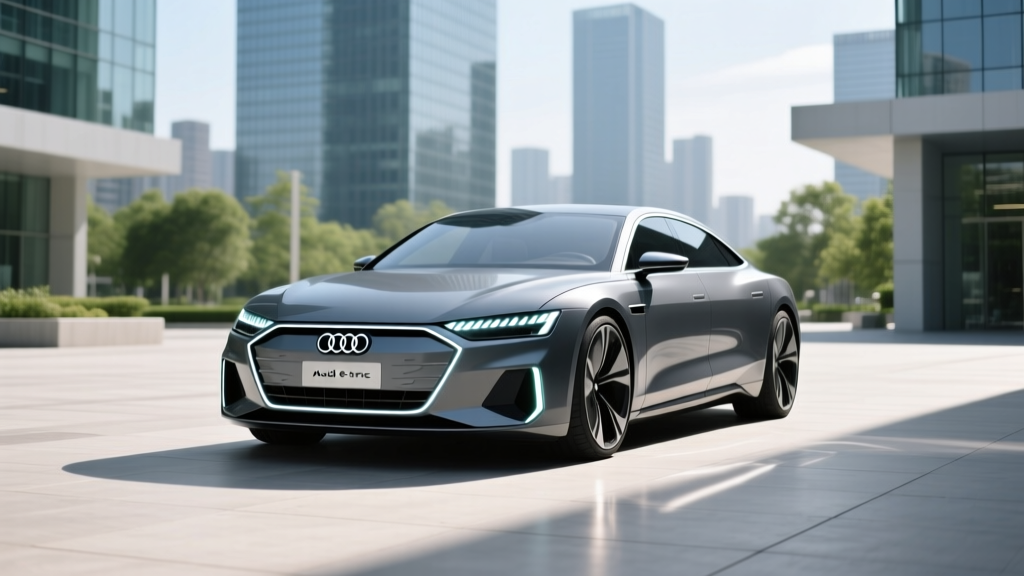
- If you want the closest thing to an "electric Audi A8" in spirit: Test-drive the Audi e-tron GT. It shares Audi's design language, quattro all-wheel drive, and build quality, but sacrifices rear-seat headroom and trunk space compared to the old long-wheelbase A8 L. It's a grand tourer, not a chauffeur sedan.
- If maximum range is your top priority: The Lucid Air Pure delivers 419 miles EPA at the lowest base price in this comparison ($69,900). Its efficiency (kWh/mile) is class-leading, though the service center network is still growing.
- If rear-seat comfort and tech are paramount: The BMW i7 and Mercedes EQS are the true A8/S-Class/7 Series successors — large, quiet, loaded with rear-seat amenities. The i7 offers more traditional styling; the EQS has the longer range but a more polarizing one-bow design.
- If you need the fastest DC charging: The Audi e-tron GT peaks at 270 kW on an 800V architecture, making it the quickest to replenish on compatible Electrify America stalls. Verify that chargers near your routes support 800V / 350 kW hardware.
- If you don't have home charging access: Reconsider a flagship EV sedan. Public-only charging at DC fast-charger rates ($0.35–$0.55/kWh) eliminates most fuel-cost savings and adds significant time. A plug-in hybrid or conventional luxury sedan may be more practical until your charging situation changes.
- If you want to wait: Audi's A6 e-tron (PPE platform, expected ~370+ miles EPA range, 800V charging) may slot in as a more practical electric sedan, though it will likely be positioned below the old A8 in size and luxury. Watch for U.S. pricing and availability announcements.
Frequently Asked Questions
Will Audi ever make an electric A8?
Audi has not announced an electric A8 as of early 2026. The brand's electric sedan roadmap currently centers on the e-tron GT and the upcoming A6 e-tron. Audi's naming convention suggests that even-numbered model lines (A4, A6, A8) may transition to EVs, but a dedicated "A8 e-tron" has not been confirmed. If a flagship electric Audi sedan arrives, it will likely debut in the 2027–2028 timeframe.
How does the Audi e-tron GT compare to the old A8 in terms of space?
They serve different purposes. The e-tron GT is a low-slung performance sedan with tighter rear-seat headroom (36.6 inches) and 8.1 cubic feet of trunk space. The old A8 L offered limousine-like rear legroom and a 12.9-cubic-foot trunk. If rear passenger comfort is your priority, the BMW i7 or Mercedes EQS are much closer to the A8 L experience.
What does it cost to charge a flagship EV sedan at home?
With a national average residential electricity rate of roughly $0.16/kWh (per EIA data), fully charging the e-tron GT's 83.7 kWh battery costs about $13.40. For the EQS with its 108.4 kWh pack, a full charge runs roughly $17.35. If you drive 15,000 miles per year at an average efficiency of 2.5–3.0 miles/kWh, annual home charging costs land between $800 and $1,100 — compared to $2,500–$3,500 in premium gasoline for a comparable gas sedan.
Is insurance really more expensive for these EVs?
Yes. Luxury EV sedans typically carry insurance premiums 15–30% higher than their gas counterparts due to higher repair costs (specialized high-voltage components, aluminum/carbon-fiber body panels, and recalibration of ADAS sensors after collision repair). Expect annual premiums of $3,200–$4,200 depending on your state, driving record, and coverage level. Always get quotes before purchasing.
Do these EVs hold their value?
Luxury EVs have experienced steeper depreciation than luxury gas sedans over the past few years, driven by rapid technology improvements, price cuts from competitors (especially Tesla), and buyer uncertainty about long-term battery health. Expect 45–55% depreciation over 5 years for a flagship EV sedan, compared to 35–45% for a comparable gas luxury sedan. Leasing can mitigate this risk by transferring residual-value exposure to the lessor.
What's the difference between kW and kWh?
This is the most common source of EV confusion. kW (kilowatts) measures power — the rate at which energy flows, like water pressure from a hose. A 270 kW DC fast charger delivers energy very quickly. kWh (kilowatt-hours) measures energy capacity — the total amount stored, like the size of a water tank. The e-tron GT's 83.7 kWh battery holds enough energy to drive approximately 238 miles. Charging at 11.5 kW (Level 2) for 8 hours adds roughly 92 kWh of energy to the battery.