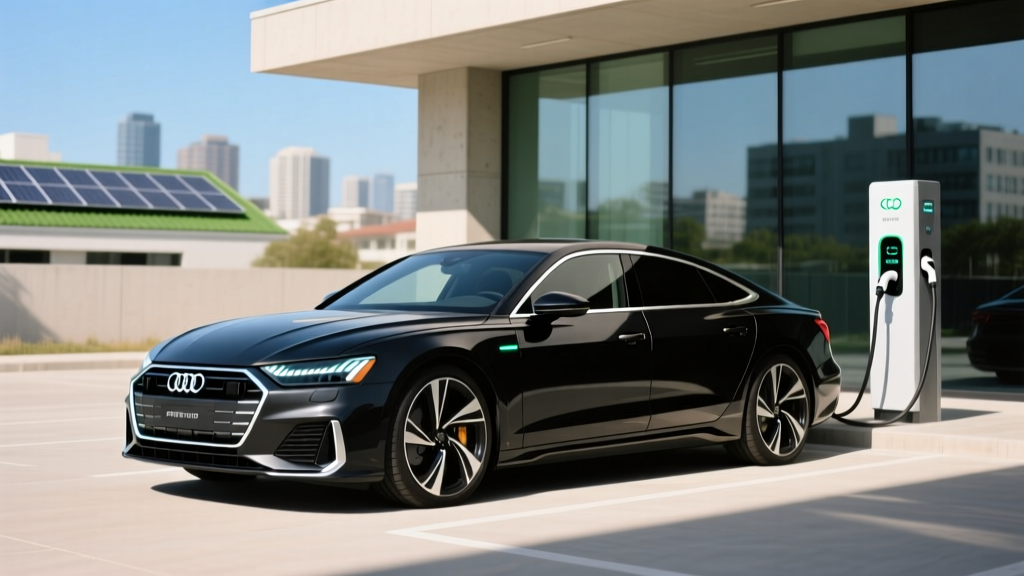
The 2026 Audi A6 e-tron arrives in the U.S. as the brand's first all-electric executive sedan built on the PPE (Premium Platform Electric) architecture co-developed with Porsche. It enters a segment where the Tesla Model S, BMW i5, and Mercedes-Benz EQE have already staked their ground. With an EPA-estimated range topping 400 miles and DC fast-charging capability that outpaces nearly every rival, the A6 e-tron makes a compelling technical case. But does the ownership experience match the spec sheet?
After spending time with the launch-edition A6 e-tron quattro, here's everything you need to know — from real-world range and charging-curve behavior to federal tax-credit eligibility under current IRS §30D rules.
Audi A6 e-tron: Quick Specs at a Glance
| Specification | A6 e-tron (RWD) | A6 e-tron quattro (AWD) |
|---|---|---|
| EPA Range | 403 mi | 378 mi |
| Battery (usable / gross) | 94.5 kWh / 100 kWh | 94.5 kWh / 100 kWh |
| Battery Chemistry | NMC (Nickel Manganese Cobalt) | NMC |
| Max DC Fast Charge | 270 kW | 270 kW |
| 10–80% DC Charge Time | ~21 min | ~21 min |
| Level 2 Home Charging | 11 kW (~36 mi/hr) | 11 kW (~36 mi/hr) |
| 0–60 mph | 5.8 sec | 4.4 sec |
| Horsepower | 362 hp | 456 hp (launch control) |
| Drivetrain | RWD, single motor | AWD, dual motor |
| MPGe (combined) | 118 MPGe | 106 MPGe |
| Base MSRP | $68,495 | $73,995 |
| Battery Warranty | 8 yr / 100,000 mi | 8 yr / 100,000 mi |
Real-World Range: What the EPA Number Doesn't Tell You
The rear-wheel-drive A6 e-tron carries an EPA-estimated 403 miles of range — one of the highest figures of any luxury electric sedan sold in the U.S. The dual-motor quattro variant drops to 378 miles. Both figures are enabled by the 100 kWh gross battery pack (94.5 kWh usable) and an aerodynamic drag coefficient of just 0.21 Cd, which Audi achieved with flush door handles, an active grille shutter, and a nearly flat underbody.
EPA estimate: 403 mi (RWD) / 378 mi (quattro)
Expect on a 75-mph highway run (65°F, dry): ~340–360 mi (RWD), ~320–340 mi (quattro)
Cold weather (below 32°F, highway): ~280–310 mi (RWD), ~260–290 mi (quattro)
Mixed city/suburban driving: Close to or slightly above EPA — regenerative braking recovers more energy at lower speeds.
The A6 e-tron's 800-volt architecture helps mitigate cold-weather losses through efficient battery preconditioning, but NMC chemistry still loses 15–25% range in sustained sub-freezing temperatures. Plan charging stops accordingly on winter road trips.
Efficiency is rated at 118 MPGe combined for the RWD model, which translates to roughly 28 kWh per 100 miles. The quattro version returns 106 MPGe (~31 kWh/100 mi). These numbers are competitive with the BMW i5 eDrive40 (113 MPGe) and meaningfully better than the Mercedes EQE 350+ (101 MPGe), thanks largely to the PPE platform's weight optimization and the A6's slippery aero profile. For the most current efficiency data, check fueleconomy.gov.
Charging: 270 kW Peak, but Mind the Curve
The A6 e-tron's 800-volt electrical architecture enables a peak DC fast-charging rate of 270 kW — a standout figure that places it ahead of the BMW i5 (205 kW) and Mercedes EQE (170 kW). On a compatible 350 kW charger (such as Electrify America's latest stalls), Audi claims a 10–80% charge in approximately 21 minutes.
| Charging Method | Power / Voltage | Rate (mi/hr added) | Time to Full / 80% |
|---|---|---|---|
| Level 1 (120V household) | 1.4 kW / 120V | ~5 mi/hr | ~70+ hours (full) |
| Level 2 (240V home/public) | 11 kW / 240V | ~36 mi/hr | ~9.5 hours (full) |
| DC Fast Charge (peak) | 270 kW / 800V | ~800+ mi/hr (peak) | ~21 min (10–80%) |
| DC Fast Charge (50 kW station) | 50 kW / 400V | ~140 mi/hr | ~65 min (10–80%) |
The charging-curve reality: Peak 270 kW is sustained from roughly 10% to about 30% State of Charge. After that, the rate tapers progressively — dropping to around 180 kW near 50% and further to about 100 kW approaching 80%. This is normal behavior for thermal management, but it means the average charge rate during a 10–80% session is closer to 170–180 kW, not the 270 kW headline number. Still, 21 minutes for a 10–80% fill is among the fastest in the luxury EV sedan class.
For home Level 2 charging, the onboard charger accepts up to 11 kW (48 amps at 240V). That translates to roughly 36 miles of range per hour of charging, meaning a depleted battery can be fully replenished overnight in about 9.5 hours. A 270V/48A hardwired Level 2 station like the ChargePoint Home Flex or Wallbox Pulsar Plus will serve this car well. Budget $800–$2,000 for the equipment and professional installation, depending on whether your electrical panel needs an upgrade.
The A6 e-tron ships with a NACS (North American Charging Standard) connector, giving it native access to Tesla Supercharger stations — a significant practical advantage over CCS-only competitors as the Supercharger network now exceeds 6,000 U.S. locations.
Performance and Driving Dynamics
The quattro variant's dual-motor setup delivers 456 horsepower and 479 lb-ft of torque with launch control engaged, hitting 0–60 mph in 4.4 seconds. The RWD model makes 362 hp and reaches 60 mph in 5.8 seconds. Both variants are electronically limited to 130 mph.
Acceleration is brisk but not brutal — this is a grand touring sedan, not a track weapon. Where the A6 e-tron distinguishes itself is ride quality. The standard adaptive air suspension smooths out highway expansion joints with composure, and the low center of gravity (battery pack mounted under the floor) keeps body roll minimal through corners. Steering is precise if slightly numb, a common trade-off in electric power steering systems.
Regenerative braking offers three levels selectable via steering-wheel paddles, including a near-one-pedal-driving mode at the strongest setting. However, unlike some competitors, full one-pedal driving (coming to a complete stop without touching the brake) is not supported — the car will creep at low speed, requiring brake-pedal use for final stops.
Interior, Tech, and Cargo Space
Inside, the A6 e-tron features Audi's latest MMI infotainment system spread across an 11.9-inch digital instrument cluster and a 14.5-inch central touchscreen angled toward the driver. A 10.9-inch front-passenger display is available as an option. Wireless Apple CarPlay and Android Auto are standard. The system is responsive, though Audi's reliance on touch-sensitive climate controls below the main screen will frustrate drivers who prefer physical knobs.
Driver assistance comes via Audi's Adaptive Cruise Assist with Lane Guidance — a Level 2 SAE system that handles longitudinal and lateral control on highways. It's competent but requires continuous driver supervision and does not support hands-free driving like GM's Super Cruise or Ford's BlueCruise.
Audi Adaptive Cruise Assist is a Level 2 driver-assistance system. The driver must remain fully engaged, keep hands on or near the wheel, and monitor the road at all times. This is not autonomous or "self-driving" capability.
Passenger and cargo dimensions:
- Front legroom: 41.3 inches
- Rear legroom: 38.0 inches
- Trunk volume: 17.8 cu ft (rear seats up)
- Frunk (front trunk): 2.1 cu ft — enough for a charging cable bag, not much more
- Wheelbase: 116.1 inches — contributing to generous rear-seat space
Rear-seat comfort is a strong point, with ample legroom rivaling the long-wheelbase gas A6. The trunk is competitive for the segment, though the BMW i5 offers slightly more at 19.4 cu ft. The frunk is disappointingly small — a common limitation of the PPE platform's front-end packaging.
Pricing, Trims, and Federal Tax Credit Eligibility
The 2026 A6 e-tron is offered in three configurations:
| Trim | Base MSRP | Est. Federal Credit* | Effective Price |
|---|---|---|---|
| A6 e-tron Premium (RWD) | $68,495 | Up to $7,500 | ~$60,995 |
| A6 e-tron Premium Plus (quattro) | $73,995 | Up to $7,500 | ~$66,495 |
| A6 e-tron Prestige (quattro) | $81,495 | Up to $7,500 | ~$73,995 |
*Federal tax credit eligibility under IRS §30D is not guaranteed and depends on multiple factors that change frequently. Consult a tax professional and verify current rules at irs.gov.
- MSRP cap: Sedars must have an MSRP at or below $55,000. The A6 e-tron's base price of $68,495 exceeds this cap — meaning it does NOT qualify for the new-vehicle §30D credit as currently structured.
- Buyer income cap: Modified AGI must not exceed $150,000 (single) / $300,000 (joint).
- Battery sourcing: Critical minerals and battery components must meet phased-in domestic/F TA-sourcing thresholds.
- Point-of-sale transfer: Eligible credits can be applied at purchase to reduce out-of-pocket cost.
Bottom line: The A6 e-tron's MSRP places it above the §30D sedan cap of $55,000. Buyers should explore state-level incentives, employer programs, and the commercial clean vehicle credit (§45W) if purchasing through a business entity. Always verify current rules before committing.
A fully loaded Prestige model with options (metallic paint, panoramic sunroof, Bang & Olufsen 3D audio, adaptive air suspension with sport tuning) can push the as-tested price to approximately $88,000–$92,000.
How It Compares: A6 e-tron vs. Key Rivals
| Attribute | Audi A6 e-tron quattro | BMW i5 xDrive40 | Mercedes EQE 350+ | Tesla Model S LR |
|---|---|---|---|---|
| EPA Range | 378 mi | 295 mi | 308 mi | 402 mi |
| Peak DC Charge | 270 kW | 205 kW | 170 kW | 250 kW |
| 0–60 mph | 4.4 sec | 4.4 sec | 6.2 sec | 3.1 sec |
| Base MSRP | $73,995 | $70,895 | $74,900 | $79,990 |
| Connector | NACS | CCS/NACS adapter | CCS/NACS adapter | NACS (native) |
| Battery Warranty | 8 yr/100k mi | 8 yr/100k mi | 10 yr/155k mi | 8 yr/150k mi |
The A6 e-tron's range and charging speed are clear advantages. The BMW i5 is a strong all-rounder but trails significantly on range and charging rate. The EQE offers a more luxurious cabin but falls short on efficiency and charging speed. The Model S Long Range matches range and crushes on acceleration, but its interior quality and service experience don't compete with Audi's at this price point.
Pros, Cons, and Who Should Buy
- 403-mi EPA range (RWD) — best in class
- 270 kW peak DC charging, 10–80% in ~21 min
- Native NACS connector — Supercharger access
- Exceptional aerodynamics (0.21 Cd) boost real-world efficiency
- Spacious rear seat with 38.0 in. legroom
- Quiet, composed highway ride with air suspension
- 800V architecture future-proofs charging performance
- Exceeds §30D MSRP cap — no federal tax credit
- Tiny 2.1 cu ft frunk
- No true one-pedal driving (creep at stop)
- Touch-sensitive climate controls lack tactile feedback
- No hands-free Level 2+ driving (unlike Super Cruise/BlueCruise)
- Quattro model gives up 25 mi of range vs RWD
- Base price higher than BMW i5
- Choose the A6 e-tron if: You want a luxury executive sedan with the longest range and fastest charging in its class, you road-trip frequently and value 21-minute DC fills, and you prefer Audi's understated design and build quality over Tesla's minimalism.
- Consider the BMW i5 if: You want a lower entry price (~$3,000 less), prefer BMW's driving dynamics, and your daily commute doesn't require 350+ miles of range.
- Consider the Tesla Model S if: Straight-line performance is a priority (3.1 sec 0–60), you want the most mature Supercharger integration, and interior material quality is less important to you.
- Consider the Mercedes EQE if: Cabin luxury and ride isolation matter most, and you can accept slower charging and shorter range.
Battery Warranty and Long-Term Ownership
Audi backs the A6 e-tron's battery pack with an 8-year/100,000-mile warranty that guarantees a minimum of 70% capacity retention. This is standard for the German luxury brands, though Mercedes offers a more generous 10-year/155,000-mile battery warranty on the EQE.
The NMC chemistry in the A6 e-tron is proven in high-energy-density applications but is more sensitive to sustained high-State-of-Charge storage than LFP (lithium iron phosphate) packs. For maximum longevity, Audi recommends setting a daily charge limit of 80% and only charging to 100% before long trips. The vehicle's thermal management system actively conditions the battery during driving and charging, which mitigates degradation.
Based on PPE-platform data from European-market vehicles and comparable 800V architectures, expect approximately 8–12% total capacity loss over the first 100,000 miles under normal use. Battery replacement cost, if needed out of warranty, is estimated at $18,000–$24,000 for the full pack — a figure to keep in mind for long-term ownership planning.
Frequently Asked Questions
What is the real-world range of the 2026 Audi A6 e-tron?
The EPA rates the RWD model at 403 miles and the quattro at 378 miles. In real-world highway driving at 75 mph in moderate temperatures, expect 340–360 miles (RWD) or 320–340 miles (quattro). Cold weather below freezing reduces range by an additional 15–25%.
How fast does the A6 e-tron charge at home and on the road?
At home on a 240V Level 2 charger, the A6 e-tron accepts up to 11 kW, adding roughly 36 miles per hour and fully recharging in about 9.5 hours. On a DC fast charger, it peaks at 270 kW and charges from 10–80% in approximately 21 minutes, though the charge rate tapers significantly above 50% SoC.
Does the Audi A6 e-tron qualify for the federal EV tax credit?
No — under current IRS §30D rules, new electric sedans must have an MSRP at or below $55,000 to qualify. The A6 e-tron starts at $68,495, exceeding this cap. Buyers may be eligible for state incentives, utility rebates, or the commercial vehicle credit (§45W) if purchasing through a business. Always check irs.gov for current rules.
Is the A6 e-tron worth buying over the BMW i5 or Tesla Model S?
The A6 e-tron wins on range (378–403 mi vs. 295 mi for the i5) and DC charging speed (270 kW vs. 205 kW for the i5). The Model S offers more performance and similar range but at a higher price and with a less premium interior. If long-distance efficiency and fast charging are your priorities, the A6 e-tron is the strongest choice in this segment.
Does it have a NACS or CCS connector?
The U.S.-market A6 e-tron comes with a native NACS connector, providing direct access to Tesla Supercharger stations without an adapter. This is a significant practical advantage as the industry transitions to NACS as the standard.
What is the battery warranty?
Audi provides an 8-year/100,000-mile battery warranty guaranteeing at least 70% capacity retention. The general vehicle warranty covers 4 years/50,000 miles.