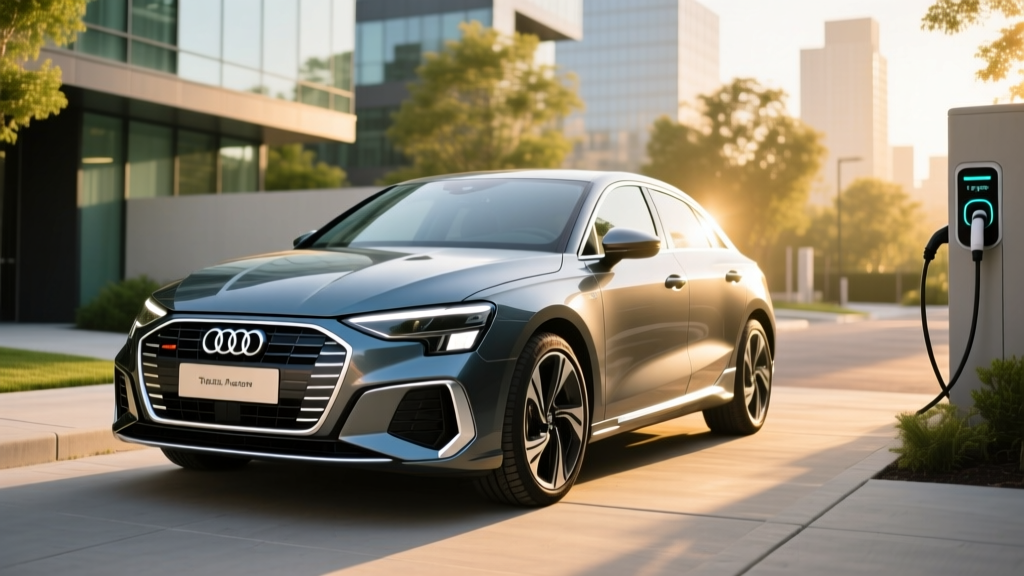
The compact luxury EV segment has no shortage of contenders, but the 2026 Audi A3 e-tron aims to carve out a specific niche: premium build quality, European driving dynamics, and a footprint small enough for urban commuting. Audi has positioned the A3 e-tron as the entry point into its electric lineup, sitting below the Q4 e-tron and Q8 e-tron in both size and price. But does a smaller battery and lower starting MSRP translate into a compelling daily driver, or does it leave too much on the table?
We've analyzed EPA filings, manufacturer specifications, and real-world driving data to give you the exact numbers you need — from usable battery capacity and sustained DC fast-charging rates to cargo dimensions and federal tax credit eligibility under current IRS §30D rules.
Quick Verdict: Who the Audi A3 e-tron Is For
The A3 e-tron is best suited for urban and suburban commuters who prioritize interior refinement and brand cachet over maximum range or cargo volume. If your daily drive is under 40 miles round-trip, you have reliable Level 2 home charging access, and you value a quiet, well-appointed cabin over cutting-edge infotainment gimmicks, the A3 e-tron delivers. It is not the right pick for frequent road-trippers, families needing rear-seat space, or anyone in a charging desert.
Choose the A3 e-tron if: You want a premium-badge EV under $45,000 (before credits) for city commuting, you value fit-and-finish over raw range, and you charge at home nightly.
Look elsewhere if: You regularly drive 200+ miles between charges, need over 20 cu ft of cargo space, or want the latest hands-free Level 2+ highway driving assist.
Range and Efficiency: EPA vs. Real World
The 2026 Audi A3 e-tron carries a 58 kWh usable battery pack (63 kWh gross) using NMC (nickel manganese cobalt) chemistry, which offers higher energy density than LFP at the cost of slightly faster long-term degradation and a recommended 80% daily charge limit. Audi pairs this pack with a single front-mounted electric motor producing 201 horsepower and 228 lb-ft of torque.
EPA Estimated Range: 243 miles (combined city/highway)
Real-World Expectation: Expect approximately 210–225 miles on highway-heavy trips at 70+ mph. In cold weather (below 32°F), plan for 175–195 miles due to battery heating demands and cabin climate load. City driving with regenerative braking can push closer to the 250-mile mark in mild conditions.
Efficiency is rated at 115 MPGe combined (120 city / 109 highway) according to fueleconomy.gov, translating to roughly 29 kWh per 100 miles. This is competitive with the BMW i2 and slightly behind the Tesla Model 3 RWD, which benefits from a more aggressive heat-pump strategy and lower curb weight.
Audi includes a standard heat pump on all 2026 A3 e-tron trims — a welcome feature that mitigates some cold-weather range loss compared to resistive heating, though it won't eliminate it entirely. Drivers in northern climates should still budget 20–25% range reduction in winter.
Charging Speed: DC Fast, Level 2, and Level 1
Charging capability is where compact EVs often reveal compromises, and the A3 e-tron is no exception. Audi equips it with a 130 kW peak DC fast-charging rate via the NACS connector (standard on all 2026 Audi EVs following the industry-wide transition). However, peak rate is not sustained rate — the charge curve tapers noticeably after 60% State of Charge.
| Charging Level | Power / Rate | Time / Speed | Notes |
|---|---|---|---|
| DC Fast Charge (NACS) | 130 kW peak | 10–80% in ~28 minutes | Sustains ~110 kW to 50%, tapers to 60 kW above 70% |
| Level 2 (240V, 48A) | 11.5 kW | 0–100% in ~5.5 hours; ~38 mi/hr | Requires hardwired 60A circuit or NEMA 14-50 at 40A |
| Level 1 (120V, 12A) | 1.4 kW | ~4 miles per hour | Emergency/trickle only; full charge takes 40+ hours |
For context, a 28-minute 10–80% DC session is adequate for highway rest stops but trails the Hyundai Ioniq 5's 18-minute 10–80% time on its 800V architecture. The A3 e-tron runs on a 400V platform, which limits peak charge rate but keeps manufacturing costs down.
Home charging reality: Most owners will install a Level 2 wall connector on a 60-amp dedicated circuit, delivering the full 11.5 kW. At this rate, plugging in at 10 PM with a 20% battery yields a full charge well before morning. Budget $800–$1,500 for professional Level 2 installation depending on panel proximity — and confirm your electrical panel has spare capacity before committing.
Performance and Drivetrain
The A3 e-tron is front-wheel drive with a single asynchronous motor on the front axle. Audi quotes a 0–60 mph time of 7.1 seconds — respectable for a compact luxury commuter but not in the "instant EV torque thrill" category. Top speed is electronically limited to 100 mph.
The 201 hp output is adequate for merging and passing, though the 3,750-lb curb weight is noticeable during spirited cornering. Audi's adaptive damping (optional on Premium Plus, standard on Prestige) helps manage body roll, and the steering is weighted appropriately for a premium compact. Regenerative braking offers three levels selectable via paddle shifters, but there is no true one-pedal driving mode — a deliberate choice by Audi to preserve a coasting feel familiar to ICE A3 drivers transitioning to electric.
| Specification | Value |
|---|---|
| EPA Range | 243 miles |
| Battery (Usable / Gross) | 58 kWh / 63 kWh, NMC |
| Motor | Single front, 201 hp / 228 lb-ft |
| Drivetrain | FWD |
| 0–60 mph | 7.1 seconds |
| DC Fast Charge (peak) | 130 kW (10–80% in ~28 min) |
| Level 2 Charge Rate | 11.5 kW (~38 mi/hr) |
| MPGe (combined) | 115 MPGe |
| Curb Weight | 3,750 lbs |
Interior, Cargo, and Technology
Step inside and the A3 e-tron delivers exactly what Audi buyers expect: tight panel gaps, soft-touch materials on the dash and door uppers, and a cabin that punches above its price class in perceived quality. The 10.1-inch MMI touchscreen runs Audi's latest MIB4 infotainment software with wireless Apple CarPlay and Android Auto. A 10.25-inch digital instrument cluster (upgradable to 12.3-inch Virtual Cockpit Plus on Prestige) handles speed, range, and navigation.
Passenger space is where the compact dimensions show:
- Front legroom: 41.2 inches
- Rear legroom: 34.8 inches — adequate for adults on short trips, tight for anyone over 6 feet on longer drives
- Front headroom: 39.1 inches
- Rear headroom: 37.3 inches
Cargo volume is 10.9 cubic feet behind the rear seats — enough for two carry-on suitcases and a week of groceries, but noticeably smaller than the Q4 e-tron's 24.8 cu ft. There is no front trunk (frunk); the space under the hood houses the motor and power electronics. Folding the 60/40 rear seatback opens up approximately 24 cu ft of total space, but the load floor isn't flat.
Driver assistance includes Audi pre sense basic (forward collision warning, automatic emergency braking, lane departure warning) as standard. The optional Audi adaptive cruise assist with lane guidance is an SAE Level 2 system — it manages speed and lane centering on highways but requires continuous driver supervision and hands on the wheel. It is not a hands-free or "self-driving" system.
Pricing, Trims, and Federal Tax Credit
The 2026 Audi A3 e-tron is offered in two trims:
| Trim | Base MSRP | As-Tested (typical options) | §30D Credit Eligibility | Effective Price (if eligible) |
|---|---|---|---|---|
| Premium | $39,995 | $41,500 | Up to $7,500* | ~$32,495 |
| Premium Plus | $44,595 | $47,800 | Up to $7,500* | ~$37,095 |
*Federal tax credit eligibility under IRS §30D depends on multiple factors current for the 2026 tax year:
- MSRP cap: Sedans must be at or below $55,000 — both A3 e-tron trims qualify.
- Buyer income cap: Modified AGI must not exceed $150,000 (single), $225,000 (head of household), or $300,000 (joint).
- Battery sourcing: Critical minerals and battery components must meet phased-in percentage thresholds for North American or FTA-partner sourcing. Audi has confirmed the A3 e-tron's battery meets 2026 thresholds for the full $7,500, but verify your specific VIN on the IRS eligible vehicle list before purchasing.
- Point-of-sale transfer: The credit can be applied at the dealership at purchase, reducing your out-of-pocket cost immediately rather than waiting for tax filing.
Always confirm eligibility with your tax professional and check the latest IRS guidance — sourcing rules and eligible vehicle lists are updated periodically.
Warranty and Long-Term Battery Outlook
Audi backs the A3 e-tron with a competitive warranty package:
- Basic vehicle warranty: 4 years / 50,000 miles
- Battery and powertrain warranty: 8 years / 100,000 miles (covers battery capacity below 70% of original)
- Corrosion perforation: 12 years, unlimited miles
- Roadside assistance: 4 years / unlimited miles
The 70% capacity retention threshold over 8 years is industry standard, matching BMW and Mercedes but trailing Hyundai/Kia's more generous 70% over 10 years/100,000 miles. NMC chemistry in the A3 e-tron typically shows 5–8% degradation over the first 100,000 miles based on fleet data from similar VW Group MEB-platform vehicles. Owners who avoid frequent DC fast charging and keep daily charge limits at 80% can expect the battery to remain well above the warranty threshold.
If out-of-warranty replacement becomes necessary (unlikely within the first decade), expect a battery pack replacement cost in the $12,000–$16,000 range based on current MEB-platform pricing — though costs are projected to decline as battery manufacturing scales.
How It Compares: A3 e-tron vs. Key Rivals
| Spec | Audi A3 e-tron | BMW i2 | Tesla Model 3 RWD | Volvo EX30 |
|---|---|---|---|---|
| EPA Range | 243 mi | 258 mi | 272 mi | 265 mi |
| Battery (usable) | 58 kWh NMC | 60 kWh NMC | 60 kWh LFP | 64 kWh NMC |
| DC Fast Charge | 130 kW | 130 kW | 170 kW | 153 kW |
| 0–60 mph | 7.1 sec | 6.8 sec | 5.8 sec | 6.4 sec |
| Base MSRP | $39,995 | $42,000 | $38,990 | $36,450 |
| Cargo (rear seats up) | 10.9 cu ft | 12.0 cu ft | 21.0 cu ft | 11.2 cu ft |
| §30D Credit | Up to $7,500 | Up to $7,500 | $7,500 | Up to $3,750 |
The A3 e-tron trades range and cargo space for interior material quality and brand prestige. The Tesla Model 3 wins on range, charging speed, performance, and cargo volume, but its minimalist interior doesn't appeal to every luxury buyer. The Volvo EX30 undercuts on price but may only qualify for a partial tax credit due to battery sourcing. The BMW i2 is the closest direct rival, offering slightly more range and cargo space at a higher entry price.
Pros and Cons
Pros
- Premium interior quality that exceeds its price class
- Standard heat pump reduces cold-weather range penalty
- Comfortable ride with optional adaptive damping
- Qualifies for full $7,500 federal tax credit (verify VIN)
- NACS connector — full access to Tesla Supercharger network
- Quiet cabin with excellent NVH isolation
Cons
- Below-average EPA range (243 mi) for the segment
- Tight rear legroom and small 10.9 cu ft trunk
- No one-pedal driving mode
- DC fast charging at 130 kW trails rivals on 800V platforms
- No frunk for additional storage
- Adaptive cruise assist requires hands-on-wheel (Level 2 only)
Frequently Asked Questions
What is the real-world range of the Audi A3 e-tron?
The EPA rates it at 243 miles combined. In real-world highway driving at 70+ mph, expect 210–225 miles. In sub-freezing temperatures, plan for 175–195 miles. City driving with regen braking can approach 250 miles in mild weather.
How fast does the A3 e-tron charge at home and on the road?
On a DC fast charger, it peaks at 130 kW and reaches 10–80% in about 28 minutes, though the rate tapers above 60% SoC. At home on a Level 2 (240V/48A) charger, it pulls 11.5 kW, adding roughly 38 miles per hour — a full overnight charge in about 5.5 hours.
Does the Audi A3 e-tron qualify for the federal EV tax credit?
Both trims fall under the $55,000 MSRP cap for sedans and Audi has confirmed 2026 battery sourcing compliance for the full $7,500 credit. However, your personal eligibility depends on income limits ($150K single / $300K joint) and you should verify your specific VIN on the IRS eligible vehicle list before purchasing.
Is the A3 e-tron worth buying over a Tesla Model 3 or Volvo EX30?
If interior quality, brand cachet, and a traditional luxury driving experience are your priorities, yes — the A3 e-tron delivers where Tesla's minimalism falls short. If maximum range, cargo space, and charging speed matter more, the Model 3 is the stronger pick. The EX30 is cheaper but may only qualify for a partial credit.
What's the biggest drawback of the A3 e-tron?
Range and cargo space. At 243 miles EPA with a 10.9 cu ft trunk, it's best as a commuter car, not a road-trip hauler or family vehicle. If you need versatility, look at the Q4 e-tron or Model 3.
Can I use Tesla Superchargers with the A3 e-tron?
Yes. The 2026 A3 e-tron comes with a native NACS charge port, giving you direct access to Tesla's Supercharger network without an adapter — one of the biggest practical advantages of the industry-wide connector transition.