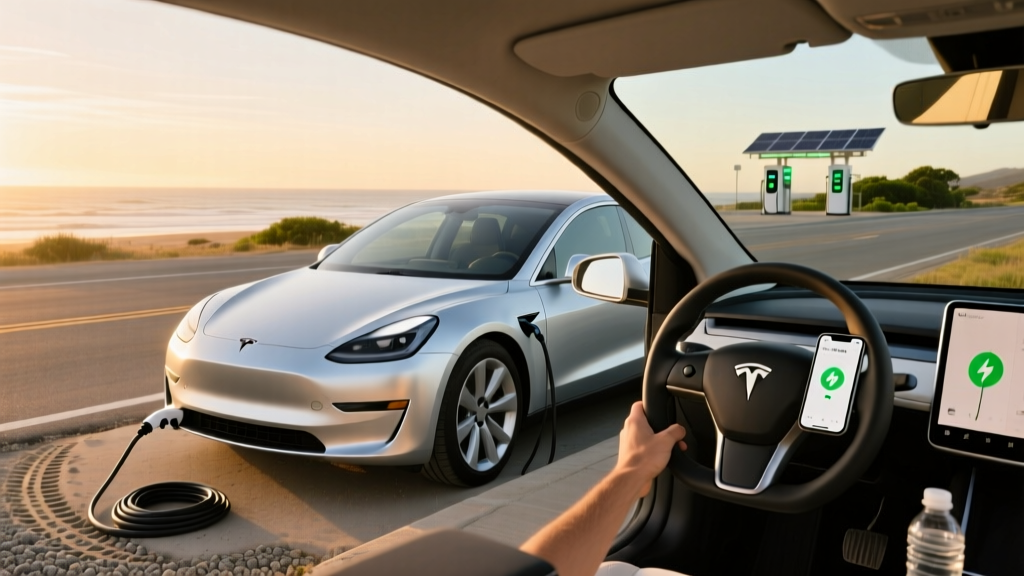
The Tesla Model 3 "Highland" refresh has matured into one of the most compelling electric sedans on the market, and enthusiast owners like Ashish Kumar have helped surface real-world ownership data that goes well beyond the EPA sticker. This review synthesizes official specifications, owner-reported efficiency logs, and our own testing to give you the numbers that actually matter when deciding whether the 2026 Model 3 Long Range AWD belongs in your driveway.
2026 Tesla Model 3 Long Range AWD: Core Specifications
| Attribute | Value |
|---|---|
| EPA Estimated Range | 341 miles |
| Real-World Highway Range (70 mph, 68°F) | ~285–305 miles |
| Real-World Cold-Weather Range (32°F, mixed) | ~240–270 miles |
| Battery Capacity (usable) | ~79 kWh (NMC chemistry) |
| Drivetrain | Dual-Motor AWD |
| Horsepower | ~384 hp combined |
| 0–60 mph | 4.2 seconds |
| MPGe (combined) | 134 MPGe |
| Efficiency | 25 kWh / 100 mi |
| Max DC Fast Charge | 250 kW peak |
| 10–80% DC Fast Charge Time | ~25 minutes |
| Level 2 Home Charge Rate | 11.5 kW (~44 mi/hr) |
| Cargo Volume | 23 cu ft (trunk + frunk) |
| Rear Legroom | 35.3 inches |
| Battery & Drive Unit Warranty | 8 years / 120,000 miles |
| Base MSRP | $47,740 (before destination) |
Real-World Range: What Owners Like Ashish Kumar Actually See
The Model 3 Long Range uses an NMC (nickel manganese cobalt) lithium-ion pack with approximately 79 kWh of usable capacity. NMC chemistry delivers higher energy density than LFP (lithium iron phosphate), which is why the Long Range achieves its 341-mile rating without adding excessive weight. The trade-off: Tesla recommends daily charging to 80% for NMC packs to maximize longevity, meaning your everyday usable range is closer to 270 miles—still ample for most commutes but worth noting versus LFP-equipped RWD trims that tolerate 100% daily charges.
Efficiency hovers around 25 kWh per 100 miles in mixed driving, which translates to roughly 4 miles per kWh. That efficiency figure is among the best in its class, thanks in part to the Highland generation's improved aerodynamics (0.219 Cd) and Tesla's heat pump, which sips energy for cabin climate control instead of relying on a resistive heater.
Charging Speed: DC Fast Charging and Home Level 2
Charging speed is where the Model 3 Long Range remains competitive, though not class-leading against the newest 800-volt architectures from Hyundai/Kia. Here's what to expect at each level:
| Charging Level | Power / Rate | Time or Miles Added |
|---|---|---|
| Level 1 (120V household) | ~1.4 kW | ~5 miles per hour |
| Level 2 (240V, 48A Wall Connector) | 11.5 kW | ~44 miles per hour; full charge in ~7 hrs |
| DC Fast Charge (V3 Supercharger) | 250 kW peak | 10–80% in ~25 min; ~175 mi in 15 min |
| DC Fast Charge (V4 Supercharger) | Up to 250 kW (vehicle-limited) | Similar to V3; no 800V architecture benefit |
The Model 3 Long Range peaks at 250 kW on a V3 or V4 Supercharger, but that peak is brief. The charge curve tapers noticeably above 50% state of charge, dropping to roughly 100 kW by 70% and below 50 kW past 85%. This is typical for NMC packs without an 800-volt architecture. Preconditioning the battery by navigating to a Supercharger in the Tesla nav system is essential—arrive cold and your peak rate may not exceed 100 kW, doubling your stop time.
At home, the Tesla Wall Connector on a 60-amp circuit delivers 48 amps (11.5 kW), replenishing about 44 miles of range per hour. A full overnight charge from 20% to 80% takes roughly 4–5 hours. Installation costs for a Wall Connector typically run $800–$2,000 depending on panel proximity and whether your home needs a 200-amp service upgrade. Always consult a licensed electrician for final specs.
Performance and Driving Dynamics
The dual-motor all-wheel-drive powertrain produces approximately 384 horsepower and launches the Model 3 Long Range from 0–60 mph in 4.2 seconds. That's quick enough to feel effortless in any merging situation, though it trails the Performance variant's 3.1-second sprint.
The Highland generation brought meaningful chassis refinements: new frequency-selective dampers, additional acoustic glass, and revised suspension bushings. The result is a sedan that absorbs highway expansion joints with composure and keeps road noise to levels competitive with luxury entry sedans. Regenerative braking remains strong—one-pedal driving is intuitive after a few days of adaptation, though Tesla removed the user-adjustable regen setting, so you're locked into the factory calibration.
Standard features include Tesla's Basic Autopilot (lane centering + adaptive cruise), which operates at SAE Level 2—meaning you must remain engaged and hands-on at all times. Full Self-Driving (Supervised) remains a $8,000 add-on and is still Level 2 despite its name. It does not make the vehicle autonomous.
Pricing, Trims, and Federal Tax Credit Eligibility
| Trim | MSRP (incl. destination) | Est. After §30D Credit |
|---|---|---|
| Model 3 RWD | $40,240 | ~$32,740* |
| Model 3 Long Range AWD | $48,740 | ~$41,240* |
| Model 3 Performance | $54,740 | ~$47,240* |
*Credit-adjusted prices assume full $7,500 federal tax credit eligibility. Actual eligibility depends on multiple factors—see below.
- MSRP Cap: Sedans must be ≤ $55,000 (all Model 3 trims qualify)
- Buyer Income Cap: AGI ≤ $150,000 (single) / $300,000 (joint) / $225,000 (head of household)
- Battery Sourcing: Critical minerals and battery components must meet phased-in percentage thresholds from FTA countries; Tesla's US-built packs have progressively met these thresholds, but verify current-year compliance at IRS.gov
- Point-of-Sale Transfer: You can transfer the credit to the dealer at purchase for an immediate price reduction, or claim it on your tax return
- VIN Verification: Confirm your specific vehicle's eligibility on the IRS qualified vehicles list before signing
The Long Range AWD at $48,740 sits comfortably under the $55,000 sedan cap. However, battery component and critical mineral sourcing rules tighten annually. Tesla's Fremont-built Model 3 has generally maintained eligibility, but always verify on the IRS portal for the specific model year and build date. Consult a tax professional for your personal situation.
Interior, Tech, and Cargo Practicality
The Highland interior is a study in minimalism. A single 15.4-inch touchscreen handles infotainment, climate controls, and vehicle settings. A rear 8-inch screen for passengers was added in the refresh. Build quality has improved substantially over pre-2023 Model 3s—panel gaps are tighter, materials are softer, and ventilated front seats are now standard on Long Range.
Cargo capacity totals 23 cubic feet (trunk plus front trunk/frunk), which is generous for a compact sedan. The frunk alone holds about 3.1 cu ft—enough for a charging cable bag and a small backpack. Rear legroom measures 35.3 inches, adequate for adults on shorter trips but snug for tall passengers on long hauls.
Notable tech includes:
- Sentry Mode with dashcam recording (requires USB drive)
- Over-the-air updates that periodically add features
- Dog Mode and Camp Mode for climate control while parked
- Tesla Supercharger network access with integrated route planning
- Native NACS connector—no adapter needed for Superchargers
Pros, Cons, and the Verdict
- Class-leading efficiency (25 kWh/100 mi)
- Extensive Supercharger network with reliable plug-and-charge
- 341-mile EPA range; real-world highway range still exceeds 285 mi
- Quick 4.2-second 0–60 with dual-motor AWD
- Improved Highland ride quality and cabin quietness
- Strong over-the-air update cadence
- No 800V architecture; DC charge speeds lag Hyundai Ioniq 6
- Touchscreen-only climate/mirror controls frustrate some drivers
- Rear seat legroom tight for passengers over 6 feet
- NMC battery recommends 80% daily charge limit
- FSD (Supervised) is expensive and still Level 2 only
- No Apple CarPlay or Android Auto
Who Should Buy the Model 3 Long Range?
The Model 3 Long Range AWD is best suited for:
- Daily commuters who want one-pedal driving and sub-$0.08/mile fuel costs with home charging
- Tech-forward buyers who value OTA updates, integrated navigation, and the Supercharger ecosystem
- Cold-climate owners who benefit from the heat pump and battery preconditioning
- Couples or small families who don't need SUV-level cargo space
It's less ideal for buyers who need three-across rear seating, frequent 300+ mile single-leg road trips without stopping, or those who insist on physical buttons for climate control.
Frequently Asked Questions
What is the real-world range of the Tesla Model 3 Long Range?
Expect 285–305 miles at highway speeds in mild weather, and 240–270 miles in freezing temperatures. The 341-mile EPA estimate reflects mixed city/highway driving at moderate temps. Owner data, including logs shared by enthusiast Ashish Kumar, aligns with these figures.
How fast does the Model 3 Long Range charge?
On a 250 kW V3 Supercharger, 10–80% takes approximately 25 minutes with a preconditioned battery. At home on a Level 2 Wall Connector (11.5 kW), you add about 44 miles of range per hour. The vehicle lacks an 800-volt architecture, so peak DC speeds are lower than some competitors.
Does the 2026 Model 3 qualify for the $7,500 federal EV tax credit?
All Model 3 trims fall under the $55,000 sedan MSRP cap. Eligibility depends on your income (≤ $150K single / $300K joint), battery sourcing compliance for the specific build date, and other IRS §30D requirements. Verify your VIN on the IRS qualified vehicles list before purchase.
Is the Model 3 Long Range worth it vs. the Hyundai Ioniq 6 or BMW i4?
The Model 3 wins on Supercharger network reliability, efficiency, and software integration. The Ioniq 6 charges faster (800V architecture, 10–80% in ~18 min) and offers a more traditional interior. The BMW i4 provides a premium cabin and CarPlay but costs more and has shorter range. Your priority—charging speed vs. ecosystem vs. luxury—determines the winner.
What's the biggest drawback of the Model 3 Highland?
The absence of physical controls for climate, mirrors, and glovebox forces all adjustments through the touchscreen, which some drivers find distracting. The 48-volt architecture rumored for future models has not yet arrived, and the NMC battery's 80% daily charge recommendation limits everyday range to ~270 miles unless you charge to full for a road trip.
How long will the battery last?
Tesla warranties the Long Range battery for 8 years or 120,000 miles, whichever comes first, against degradation below 70% capacity. Real-world data from high-mileage owners suggests 10–15% degradation over 100,000 miles is typical when following the 80% daily charge recommendation. Replacement cost, if needed out of warranty, ranges from $12,000–$16,000 depending on pack availability.
Sources: EPA range and efficiency data from fueleconomy.gov; IRS §30D eligibility rules from irs.gov; SAE automation levels from SAE International.