Quick Answer: Should You Care About Army Electric Vehicles?
The U.S. military is actively electrifying its non-tactical fleet and testing tactical electric prototypes, but army electric vehicles are not available for civilian purchase in 2026. What matters for you: military EV research is accelerating battery durability, extreme-temperature performance, and mobile charging — technologies filtering into civilian EVs within 2–4 years. If you're an active-duty service member or veteran, you can access EV incentives and base charging infrastructure that offset the higher upfront cost of civilian electric vehicles. For the typical buyer, the practical takeaway is that military-grade battery validation is making commercial EVs more robust, not that you can buy a JLTV-EV at a dealership.
What the Army's Electric Vehicle Program Actually Looks Like in 2026
The Department of Defense operates two parallel electrification tracks. The first is the non-tactical vehicle (NTV) fleet — sedans, SUVs, and light trucks used on bases for administrative transport, motor pool duties, and personnel movement. The second is tactical vehicle prototyping, where the Army evaluates electric powertrains for combat and logistics roles.
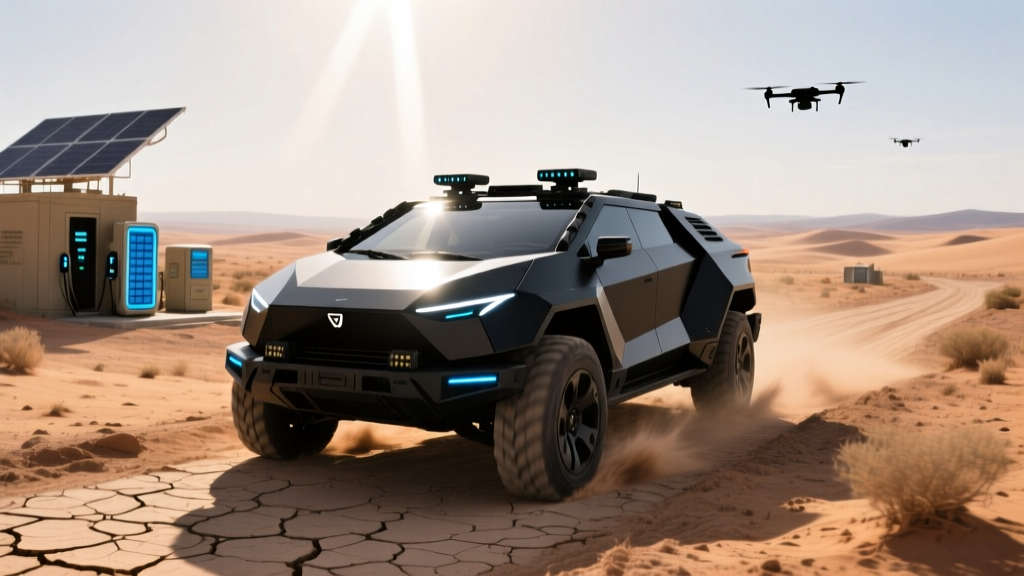
As of early 2026, the DoD has committed to electrifying its entire NTV fleet by 2035 per Executive Order 14057, with interim targets requiring 100% zero-emission light-duty acquisitions by 2027. On the tactical side, prototypes like the GM Defense eJLTV (electric Joint Light Tactical Vehicle) and hybrid-electric variants of logistics trucks remain in testing phases — none are in active combat deployment.
For civilian buyers, the NTV program matters because it creates massive procurement volume for vehicles you can buy: the Ford F-150 Lightning, Chevrolet Silverado EV, and Tesla Model Y are all active in military fleet contracts. This volume pressures manufacturers to improve durability and simplify maintenance — benefits that carry over to retail models.
Civilian EVs With Military Connections: What You Can Actually Buy
Several civilian-market EVs share direct lineage with military programs or benefit from defense-funded R&D:
| Vehicle | Military Connection | EPA Range | Battery (kWh) | Peak DC Charge | 10–80% Time | Base MSRP |
|---|---|---|---|---|---|---|
| Ford F-150 Lightning | DoD NTV fleet contract; GM Defense competitor | 230–320 mi | 98–131 kWh (NMC) | 150 kW | ~41 min | $54,995 |
| Chevrolet Silverado EV | Army logistics fleet evaluation | 380–440 mi | 200 kWh (NMC) | 350 kW | ~20 min | $57,900 |
| GM Defense eJLTV (prototype) | Tactical EV — not civilian-available | ~300 mi (est.) | ~120 kWh (est.) | Undisclosed | N/A | Not for sale |
| Canoo LV (fleet variant) | NASA/DoD base shuttle testing | ~250 mi | 80 kWh (NMC) | ~100 kW | ~45 min | Fleet only |
Real-World Range Reality: The F-150 Lightning Extended Range carries a 320-mile EPA sticker, but expect ~240–270 miles at sustained 70 mph highway speeds, and as low as ~190–210 miles in sub-30°F winter conditions. The Silverado EV 4WT's 440-mile EPA figure similarly drops to ~340–370 miles in real-world mixed driving. Cold weather and highway speeds reduce range 15–35% across all EVs — military testing confirms this, which is why tactical EVs remain hybrid-electric rather than battery-only.
Cost Comparison: EV vs Gas for Military-Adjacent Buyers
Service members and veterans considering an EV face the same economics as civilians, with a few advantages: many installations now offer Level 2 charging at no cost or reduced rates, and the federal §30D tax credit applies equally.
| Cost Category | F-150 Lightning (EV) | F-150 3.5L EcoBoost (Gas) |
|---|---|---|
| Purchase Price (MSRP) | $54,995 | $48,500 |
| Federal Tax Credit (§30D) | –$3,750 to $7,500* | $0 |
| Fuel/Energy (5 years, 75k miles) | $3,400 (home L2 avg) | $10,875 ($3.25/gal, 18 MPG) |
| Maintenance (5 years) | $1,200 | $3,800 |
| Insurance (5 years) | $8,500 | $6,900 |
| Total 5-Year Cost | ~$56,845–$64,395 | ~$70,075 |
*§30D credit eligibility depends on battery sourcing, MSRP caps ($80,000 for trucks), buyer income limits ($300k MFJ / $150k single), and VIN-specific critical-mineral compliance. Check current rules at IRS.gov §30D. The F-150 Lightning qualifies for partial or full credit depending on build date and battery pack sourcing — always verify before purchase.
Charging Infrastructure: On-Base Access and Home Setup
One advantage military-connected buyers have is growing on-base charging. The DoD has installed thousands of Level 2 chargers across installations, and many offer free or subsidized electricity for NTV and personal-vehicle use. However, access varies wildly — a large stateside base may have dozens of chargers, while a small installation may have none.
Home Charging Costs for Service Members
If you live in base housing or privatized military housing, installing a Level 2 (240V) home charger requires property-manager approval. Here's what to budget:
| Item | Typical Cost |
|---|---|
| Level 2 charger hardware (40A–48A) | $350–$700 |
| Electrician: 240V circuit run (50 ft avg) | $800–$2,000 |
| Panel upgrade (if needed, 100A→200A) | $1,500–$3,500 |
| Permit and inspection | $100–$400 |
| Total (no panel upgrade) | $1,250–$3,100 |
| Total (with panel upgrade) | $2,750–$6,600 |
Charging speed at home on a 48A Level 2 circuit delivers roughly 11.5 kW, adding about 30–35 miles of range per hour for a full-size electric truck. An overnight charge (8 hours) restores 240–280 miles — enough for most daily driving. The key distinction: kW measures charging power (how fast energy flows), while kWh measures battery capacity (how much energy is stored). A 131 kWh battery charged at 11.5 kW takes roughly 11.4 hours from 0–100%.
Common Misconceptions About Army Electric Vehicles
| Myth | Fact |
|---|---|
| "You can buy a surplus military electric Humvee" | Military EV prototypes are not entering surplus channels. The eJLTV and electric MRAPs remain classified or in testing. Surplus HMMWVs are diesel-powered. |
| "Military EVs prove EVs work in combat" | Tactical EV testing is ongoing, but the Army has not deployed battery-electric vehicles in combat roles. Logistics, silent-watch capability, and electromagnetic signature are being evaluated — not combat readiness. |
| "If the Army uses them, EV batteries must last 20 years" | Military battery specs prioritize different metrics (thermal resilience, shock tolerance). Civilian NMC batteries degrade ~2–3% per year under normal use; fueleconomy.gov data shows most retain 85–90% capacity at 8 years/100,000 miles. |
| "EVs can't handle extreme heat or cold" | DoD testing in Alaska and desert environments confirms range loss (20–35% in extreme cold), but modern thermal management systems — heat pumps, liquid cooling — keep batteries functional from –40°F to 130°F. Range drops; operability doesn't. |
| "I need a special license to drive a military-style EV" | No civilian-legal military EV exists. Civilian trucks like the F-150 Lightning or Hummer EV (the civilian GMC, not the military HMMWV) require only a standard driver's license. |
Decision Framework: Is an EV Right for Your Situation?
Choose an EV If:
- You have home or on-base Level 2 charging access — this eliminates 90% of ownership friction and cuts fuel costs by 60–70% versus gas.
- Your daily driving is under 200 miles — even in cold weather, a 300-mile EPA vehicle covers this easily with overnight charging.
- You qualify for §30D tax credits — the $3,750–$7,500 credit narrows the upfront gap with gas vehicles significantly. Verify eligibility at IRS.gov before committing.
- You want lower maintenance costs — no oil changes, no transmission fluid, brake pads last 100,000+ miles with regenerative braking.
- You value V2L (vehicle-to-load) capability — the F-150 Lightning's Pro Power Onboard can run tools, appliances, or field equipment at up to 9.6 kW, a feature with direct military-adjacent utility.
Stick With Gas or Hybrid If:
- You deploy or PCS frequently to areas with limited charging — rural installations and overseas postings may lack reliable DC fast-charging networks.
- You regularly tow over 7,000 lbs long-distance — towing cuts EV range by 40–50%. An F-150 Lightning towing 8,000 lbs drops from 320 to ~160 miles between charges.
- You cannot install home charging — relying solely on public DC fast charging costs $0.30–$0.50/kWh, erasing most fuel savings and adding time.
- You need guaranteed range in extreme cold without preconditioning — a PHEV like the Jeep Wrangler 4xe (21 miles electric, then gas) offers flexibility without range anxiety.
Battery Longevity and Warranty: What Military Testing Reveals
DoD battery research focuses on abuse tolerance and cycle life — metrics that directly benefit civilian buyers. Army-funded research into LFP (lithium iron phosphate) chemistry has validated its superior cycle life (3,000–5,000+ cycles vs. 1,500–2,500 for NMC) and thermal stability, accelerating its adoption in civilian vehicles like the Tesla Model 3 Standard Range and Ford Mustang Mach-E Select.
For civilian EVs, battery warranties are standardized:
- Federal minimum: 8 years / 100,000 miles (mandated for emissions-related components, applied to batteries)
- Typical coverage: Capacity must remain above 60–70% of original during the warranty period
- Real-world degradation: Most NMC packs lose 10–15% capacity over 8 years; LFP packs lose 5–10%
- Replacement cost (out of warranty): $8,000–$22,000 depending on pack size — a 131 kWh F-150 Lightning pack replacement runs $18,000–$22,000 at current 2026 pricing
Frequently Asked Questions
Can civilians buy army electric vehicles like the eJLTV?
No. The GM Defense eJLTV and other tactical electric prototypes are not available for civilian purchase. They remain in military testing programs with no announced surplus or commercial-release timeline. The closest civilian equivalent is the GMC Hummer EV, which shares GM's Ultium platform but is a fundamentally different vehicle.
Do military bases have EV charging for personal vehicles?
Many do, but availability varies by installation. Larger continental U.S. bases have added Level 2 chargers in parking areas and motor pools. Check with your base's energy manager or DPW (Directorate of Public Works) for specific charger locations and whether they're available for personal vehicles or restricted to fleet use.
Is the GMC Hummer EV a military vehicle?
No. The GMC Hummer EV is a civilian luxury truck/SUV. It shares the Hummer name with the military HMMWV (Humvee), but AM General — the HMMWV manufacturer — is a separate company. The Hummer EV has no military role, though its size and V2L capability attract interest from defense evaluators.
Are EVs practical for service members who PCS frequently?
It depends on your next duty station. Stateside assignments near urban areas work well with EV ownership. Overseas postings (especially to bases with limited charging infrastructure) or remote installations make EV ownership challenging. A PHEV offers more flexibility if your assignments are unpredictable. Factor in shipping restrictions — POV (privately owned vehicle) shipping to OCONUS locations may not support EV charging at your destination.
Does the military offer any EV purchase incentives beyond the federal tax credit?
Not as a direct purchase incentive, but some installations offer free or reduced-cost Level 2 charging, which offsets ownership costs. The federal §30D tax credit applies equally to military and civilian buyers — verify current-year eligibility rules including income caps ($150k single / $300k married filing jointly), MSRP caps ($55k sedans, $80k trucks/SUVs/vans), and battery sourcing requirements at IRS.gov.
What EV range do I actually need for daily military base commuting?
Most base commutes are under 30 miles round-trip. Any modern EV with 200+ miles of EPA range handles this easily, even in cold weather with a 30% range reduction. A Chevrolet Equinox EV (319 mi EPA, ~$33,600 base) or Tesla Model 3 (341 mi EPA, ~$38,990 base) provides substantial buffer for errands and longer weekend drives without overspending on range you won't use.