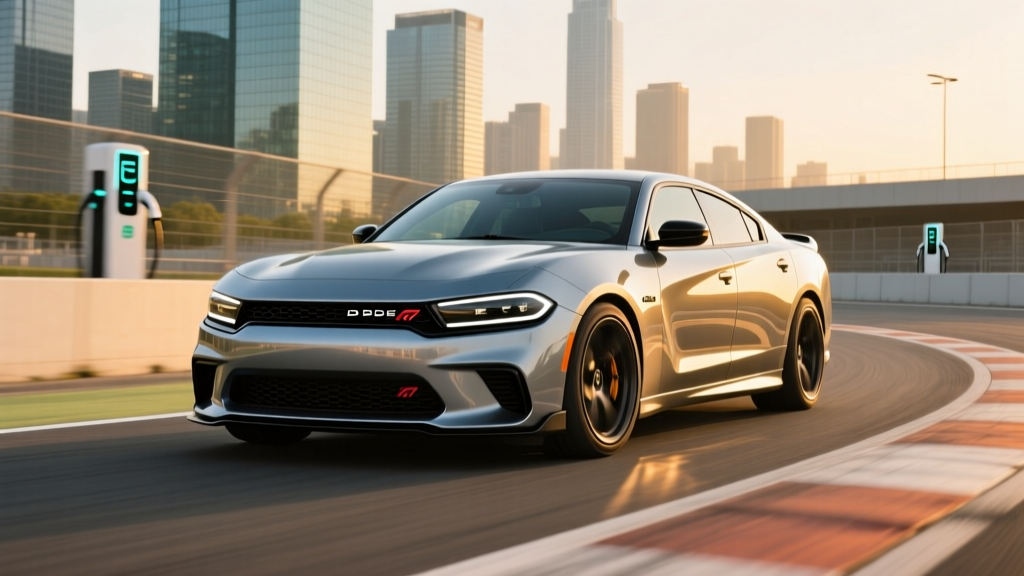
If you're searching for Aripark Dodge EVs, you're likely looking at Dodge's electric future through the lens of a dealership partner or researching the brand's first all-electric muscle car: the 2026 Dodge Charger Daytona EV. Here's the direct answer: the Charger Daytona is Dodge's first battery-electric vehicle, built on the STLA Large platform, starting at $51,990 for the R/T trim and reaching $71,990 for the Scat Pack. It delivers up to 317 miles of EPA-estimated range (R/T), 670 horsepower, and DC fast charging up to 270 kW. However, real-world highway range drops to roughly 250–270 miles, and the Scat Pack's heavier performance tuning cuts range to approximately 260 miles EPA. This is not a budget commuter EV — it's a muscle car that happens to be electric, and understanding the ownership math is critical before you buy.
Quick Answer: Aripark Dodge EV Lineup (2026)
Dodge currently offers one battery-electric model: the 2026 Charger Daytona, available in two-door coupe and four-door sedan body styles. The R/T trim produces 496 HP with 317 miles of range; the Scat Pack produces 670 HP with approximately 260 miles of range. Both use a 100.5 kWh (usable) NMC battery pack on an 800-volt architecture. A plug-in hybrid variant (the Charger Daytona with the Hurricane inline-six) is also available but is a separate powertrain — not a BEV.
2026 Dodge Charger Daytona EV: Full Spec Breakdown
| Specification | R/T Trim | Scat Pack Trim |
|---|---|---|
| Base MSRP | $51,990 | $71,990 |
| EPA Range | 317 miles | ~260 miles |
| Battery (usable) | 100.5 kWh, NMC | 100.5 kWh, NMC |
| Horsepower | 496 HP | 670 HP |
| 0–60 mph | 4.7 seconds | 3.3 seconds |
| Peak DC Fast Charge | 270 kW | 270 kW |
| 10–80% DC Charge | ~24 minutes | ~24 minutes |
| Level 2 Charge Rate | 11.5 kW | 11.5 kW |
| Drivetrain | AWD (dual motor) | AWD (dual motor) |
| MPGe (combined) | ~92 MPGe | ~82 MPGe |
| Battery/Powertrain Warranty | 8 yr / 100,000 mi | 8 yr / 100,000 mi |
Charging the Charger Daytona: What Aripark Buyers Need to Know
The Charger Daytona's 800-volt architecture is its biggest charging advantage. At a compatible 350 kW DC fast charger (like Electrify America or EVgo's latest stations), the car can peak at 270 kW, adding roughly 180 miles of range in about 15 minutes. However, charging follows a curve — peak speed is only sustained between roughly 10% and 40% State of Charge (SoC). Above 80%, the rate tapers significantly to protect the battery, so a 10–80% session takes approximately 24 minutes, but 80–100% can add another 25–30 minutes. Plan to charge to 80% on road trips and move on.
| Charging Level | Power (kW) | Miles Added Per Hour | Best Use Case |
|---|---|---|---|
| Level 1 (120V household) | ~1.4 kW | ~4–5 miles/hr | Emergency/overnight trickle |
| Level 2 (240V home) | 11.5 kW | ~35–38 miles/hr | Daily home charging |
| DC Fast Charge | Up to 270 kW | ~650+ miles/hr (peak) | Road trips, quick top-ups |
For home charging, a full Level 2 installation (48-amp hardwired charger on a 60-amp circuit) typically costs between $800 and $2,500 depending on your electrical panel's proximity to the garage. If your home has a 100-amp panel and needs an upgrade to 200 amps, add $1,500–$3,500. At 11.5 kW, a depleted 100.5 kWh battery recharges fully in about 9 hours — easily overnight.
Charger Daytona EV vs. Gas V8 Charger: The Real Cost Comparison
The most common question from Aripark Dodge shoppers is whether the electric Charger saves money compared to the last-generation 5.7L HEMI V8 Charger. Here's a five-year ownership breakdown based on 15,000 miles per year, national average electricity at $0.16/kWh, and gas at $3.40/gallon:
| Cost Category (5 Years) | Charger Daytona R/T EV | 2023 Charger R/T 5.7L V8 |
|---|---|---|
| Purchase Price (MSRP) | $51,990 | ~$44,000 (used/discontinued) |
| Fuel / Electricity | $4,875 | $10,625 |
| Maintenance | $1,200 | $3,500 |
| Insurance (est. avg) | $12,500 | $9,800 |
| Federal Tax Credit (§30D) | Up to $7,500* | $0 |
| Estimated 5-Year Total | ~$63,065 | ~$67,925 |
*Federal §30D tax credit eligibility depends on buyer income caps ($150K single / $300K joint), vehicle MSRP caps ($55K sedans), battery sourcing requirements, and point-of-sale transfer rules. The Charger Daytona R/T at $51,990 may qualify; the Scat Pack at $71,990 exceeds the sedan MSRP cap. Consult IRS.gov §30D guidelines and a tax professional for your specific situation. Rules are current for 2026 and subject to legislative change.
The EV wins on fuel and maintenance savings — roughly $8,050 over five years — but loses ground on higher insurance premiums and a higher starting MSRP. The tax credit can bridge the gap, but only if you qualify. The real value proposition isn't pure economics; it's instant torque (496 lb-ft from 0 RPM), a lower center of gravity, and zero tailpipe emissions during daily driving.
Federal Tax Credit: Does the Charger Daytona Qualify?
Under the IRS §30D Clean Vehicle Credit, the 2026 Charger Daytona's eligibility is nuanced:
- MSRP Cap: Sedans are capped at $55,000. The R/T at $51,990 clears this; the Scat Pack at $71,990 does not.
- Buyer Income Cap: Modified AGI must not exceed $150,000 (single), $225,000 (head of household), or $300,000 (joint filing).
- Battery Sourcing: At least 60% of critical minerals and 50% of battery components must be sourced from the US or free-trade-agreement countries (2026 thresholds). Dodge has not published full supply-chain disclosure for the Charger Daytona's NMC cells — verify with the dealer at point of sale.
- Point-of-Sale Transfer: You can transfer the credit to the dealer at purchase, reducing your out-of-pocket cost immediately, rather than waiting for a tax refund.
The Scat Pack's price disqualifies it from the federal credit under current sedan MSRP rules. Some buyers have used the commercial clean vehicle credit (§45W) through business registration, but this requires a legitimate business use case and professional tax guidance.
Common EV Misconceptions — Fact-Checked for Dodge Buyers
| Myth | Fact |
|---|---|
| "EV batteries need replacing every few years" | The Charger Daytona's battery is warrantied for 8 years / 100,000 miles against degradation below 70% capacity. Industry data from fueleconomy.gov shows most NMC packs retain 85–90% capacity at 100K miles. |
| "You can't road-trip an EV" | With 270 kW DC fast charging, you can add ~180 miles in 15 minutes. The Electrify America and EVgo networks cover major US highway corridors. Apps like PlugShare and A Better Routeplanner make trip planning straightforward. |
| "EVs are worse in cold weather" | Range drops 15–25% in sub-30°F weather — real, but manageable. The Charger Daytona includes a heat pump and battery preconditioning, which recovers some efficiency. Precondition while plugged in to minimize loss. |
| "Home charging requires a full electrical rewrite" | Most homes with a 200-amp panel and a garage-outlet run can support a 48-amp Level 2 charger for $800–$1,500. Only older homes with 100-amp service typically need a panel upgrade. |
| "EVs cost more to insure" | Partially true. EV insurance premiums run 15–25% higher on average due to higher repair costs and battery replacement risk. Shop quotes from multiple carriers — some now offer EV-specific discounts. |
Who Should Buy the Charger Daytona EV — And Who Shouldn't
Decision Framework
Buy the Charger Daytona R/T EV if:
- You want a 4-door sedan with muscle-car styling and instant electric torque
- You have access to Level 2 home charging (garage or driveway with 240V outlet)
- Your daily commute is under 120 miles round-trip
- You qualify for the §30D tax credit (income under cap, R/T under MSRP cap)
- You value zero tailpipe emissions and lower running costs over raw V8 sound
Skip it (or consider a hybrid/gas alternative) if:
- You live in an apartment with no charging access and rely entirely on public infrastructure
- You regularly drive 300+ miles between stops in rural areas with sparse DC fast chargers
- You want the Scat Pack but need the federal tax credit (MSRP exceeds the cap)
- You frequently tow — the Charger Daytona EV is not rated for heavy towing
- You prioritize lowest possible purchase price over performance and technology
Real-World Ownership: What First-Time EV Buyers Must Know
Transitioning from a gas Charger or any ICE vehicle to the Charger Daytona EV involves adjustments that spec sheets don't capture:
Charging becomes routine, not an event. If you install a Level 2 charger at home, you'll plug in when you get home and wake up to a full battery every morning — similar to charging a phone. You'll visit gas stations roughly 4–6 times per year for road trips instead of 40–50 times.
Regenerative braking changes how you drive. The Charger Daytona offers adjustable regen, including a one-pedal driving mode that slows the car significantly when you lift off the accelerator. Most EV owners adapt within a week and prefer it, but expect a learning curve.
The Fratzonic exhaust system is synthetic. Dodge's "exhaust" sound generator simulates V8-style noise through external speakers. It's polarizing — some owners love the theater, others disable it immediately. It adds no performance value.
Tire costs are higher. The Charger Daytona's weight (over 5,800 lbs for the Scat Pack) and instant torque wear tires faster than a gas Charger. Budget for replacement rubber every 25,000–35,000 miles, and expect to pay $250–$400 per tire for the performance-rated sizes.
Preconditioning matters for fast charging. Navigate to a DC fast charger using the car's built-in navigation, and the battery will automatically precondition (warm up) to accept peak charge rates. If you drive to a charger without preconditioning — especially in cold weather — your charge speed may be cut in half for the first several minutes.
Frequently Asked Questions
Is the Dodge Charger Daytona EV available at Aripark Dodge dealerships?
Availability varies by dealer allocation. The Charger Daytona EV began deliveries in late 2025, and production is ramping through 2026. Contact your local Aripark Dodge location directly for current inventory and wait times. Some trims and color combinations may have 2–4 month lead times.
Does the Charger Daytona EV qualify for the $7,500 federal tax credit?
The R/T trim at $51,990 MSRP falls under the $55,000 sedan cap and may qualify, pending buyer income eligibility and battery sourcing compliance. The Scat Pack at $71,990 exceeds the MSRP cap and does not qualify under current §30D rules for sedans. Always verify with IRS guidelines and your tax advisor before purchasing.
How does the Charger Daytona EV compare to a Tesla Model S?
The Model S Long Range offers approximately 402 miles of EPA range and starts around $74,990 — more range but at a higher price. The Charger Daytona Scat Pack matches or beats the Model S Plaid on 0–60 (3.3 seconds vs 3.1 seconds) but trails significantly on range and Supercharger network access. The Charger is the better pick for muscle-car identity; the Model S wins on efficiency and charging infrastructure.
What happens if the battery degrades past the warranty period?
Based on industry data from comparable NMC packs (Hyundai Ioniq 5, Ford Mustang Mach-E), expect 85–90% capacity retention at 100,000 miles. A full battery replacement outside warranty would cost approximately $15,000–$22,000 based on current NMC cell pricing and labor. However, most EV batteries outlast the vehicles they're installed in — catastrophic failure is rare, and gradual degradation is the norm.
Can I charge the Charger Daytona at Tesla Superchargers?
As of 2026, the Charger Daytona uses the CCS1 connector as standard. Dodge has not announced a native NACS (Tesla-style) port for the Charger. You can use a CCS-to-NACS adapter at Tesla Superchargers that have Magic Dock or where Tesla has opened access to non-Tesla vehicles, but adapter compatibility should be confirmed with Dodge before relying on it for road trips.