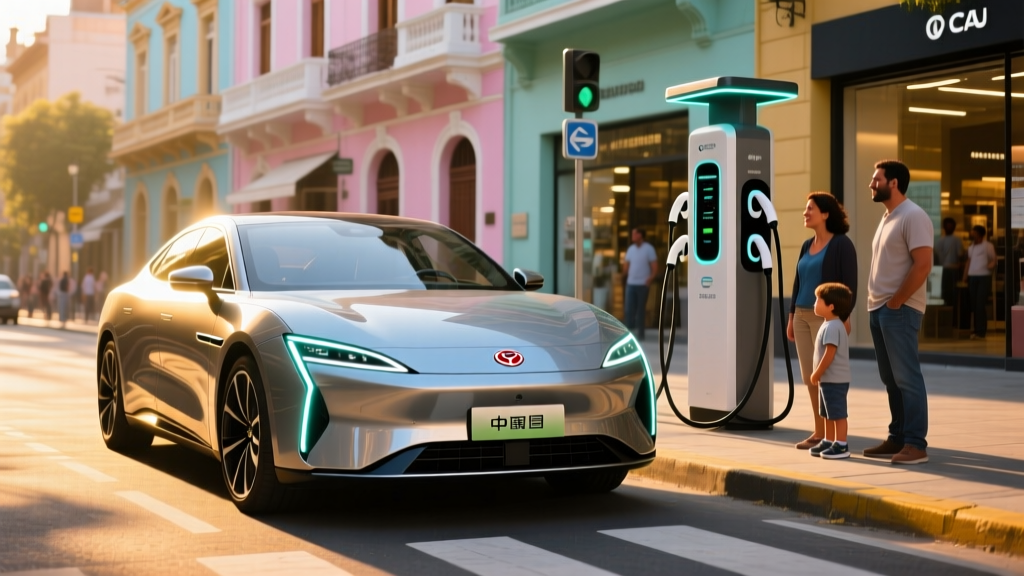
Quick Answer: Argentina's 2025–2026 tariff reductions now allow Chinese EV brands—including BYD, Chery, and Geely—to enter the South American market at competitive prices, with models like the BYD Dolphin (starting around $28,000 USD equivalent) and Chery Omoda E5 gaining traction. However, for US-based buyers, these vehicles remain largely unavailable due to ongoing 100% US tariffs on Chinese-manufactured EVs, §30D tax credit sourcing restrictions, and NHTSA/EPA homologation requirements. The models Argentina is embracing can inform your global EV market awareness, but your 2026 US purchase decisions should focus on domestically available alternatives with comparable specs.
Why Argentina's Chinese EV Shift Matters to Global Buyers
Argentina's decision to reduce import tariffs on electric vehicles—dropping them from 35% to as low as 0–5% for specific EV categories under Mercosur trade adjustments—has opened a floodgate for Chinese automakers who have spent the last half-decade building global-scale manufacturing capacity. BYD, which surpassed Tesla in global BEV sales volume in late 2023, now exports to over 70 countries. Argentina represents a strategic entry point into Latin America's second-largest auto market.
For US readers tracking the EV landscape, this matters for three reasons:
- Global pricing pressure: Chinese EVs are forcing legacy automakers to accelerate cost reductions, which benefits US buyers indirectly through more competitive pricing on models like the Chevrolet Equinox EV and Hyundai Ioniq 5.
- Battery supply chain shifts: Chinese LFP (lithium iron phosphate) battery dominance is reshaping what chemistries appear in US-market vehicles, including Tesla's own LFP-equipped Model 3 RWD.
- Future availability signals: Brands like BYD have publicly stated ambitions to enter the US market once trade barriers ease. Understanding their current lineup tells you what could arrive by 2028–2030.
Chinese EV Models Argentina Is Embracing: Spec Breakdown
Let's look at the actual vehicles Argentine buyers are now purchasing, with hard numbers. These specs reflect manufacturer data and Latin American market configurations as of early 2026.
| Model | Battery (kWh) | Chemistry | Range (WLTP) | Peak DC Charge (kW) | 10–80% Time | 0–100 km/h | Approx. Price (USD) |
|---|---|---|---|---|---|---|---|
| BYD Dolphin | 60.4 | LFP | 427 km (~265 mi) | 88 kW | ~29 min | 7.0 sec | $28,000–$32,000 |
| BYD Yuan Plus (Atto 3) | 60.5 | LFP | 420 km (~261 mi) | 88 kW | ~29 min | 7.3 sec | $33,000–$38,000 |
| Chery Omoda E5 | 61.0 | LFP | 430 km (~267 mi) | 90 kW | ~28 min | 7.6 sec | $30,000–$35,000 |
| Geely Geometry C | 70.0 | NMC | 460 km (~286 mi) | 100 kW | ~32 min | 6.9 sec | $35,000–$40,000 |
| GWM Ora 03 (Good Cat) | 63.1 | LFP | 400 km (~249 mi) | 67 kW | ~35 min | 8.3 sec | $27,000–$31,000 |
Key context: WLTP range figures (the European/Asian testing standard) typically run 10–15% higher than US EPA estimates. A BYD Dolphin rated at 265 miles WLTP would likely earn an EPA sticker closer to 225–240 miles if sold in the US. These are competent but not class-leading ranges compared to the US-market Hyundai Ioniq 5 (EPA 303 mi, 77.4 kWh NMC battery, peak 350 kW DC charging) or Chevrolet Equinox EV (EPA 319 mi, 85 kWh NMC, peak 150 kW).
How Chinese EVs Compare to US-Market Alternatives
Argentine buyers are getting solid value, but US buyers have access to vehicles with superior charging infrastructure compatibility, longer EPA-validated range, and federal tax credit eligibility. Here's a direct comparison using models available in the US as of 2026.
| Attribute | BYD Dolphin (Argentina) | Chevy Equinox EV 2LT (US) | Hyundai Ioniq 5 SE (US) |
|---|---|---|---|
| EPA / Est. Range | ~230 mi (est. EPA) | 319 mi (EPA) | 303 mi (EPA) |
| Battery | 60.4 kWh LFP | 85 kWh NMC | 77.4 kWh NMC |
| Peak DC Charging | 88 kW | 150 kW | 350 kW (800V) |
| 10–80% Charge Time | ~29 min | ~24 min | ~18 min |
| Connector (US) | N/A (not sold in US) | NACS (Supercharger access) | NACS (Supercharger access) |
| MSRP (before credits) | $28,000–$32,000 | $33,000 | $42,400 |
| §30D Tax Credit Eligible | No | Up to $7,500 (income/MSRP rules apply) | Up to $7,500 (income/MSRP rules apply) |
| Battery Warranty | 8 yr / 150,000 km | 8 yr / 100,000 mi | 10 yr / 100,000 mi |
The Ioniq 5's 800-volt architecture enabling 350 kW peak charging is the standout differentiator—adding roughly 200 miles of range in 15 minutes at a compatible DC fast charger. The BYD Dolphin's 88 kW peak means you'd wait nearly twice as long for a comparable charge session, a meaningful gap on road trips.
Real Costs and Savings: EV vs Gas in 2026
Whether you're in Buenos Aires or Austin, the economic case for an EV hinges on your local electricity rates, driving patterns, and fuel costs. Here's a concrete breakdown assuming 15,000 miles driven annually.
| Cost Category | Chinese EV (BYD Dolphin class) | US EV (Equinox EV class) | Gas Car (Toyota RAV4 AWD) |
|---|---|---|---|
| Purchase Price | $30,000 | $33,000 (before credit) | $32,000 |
| Federal Tax Credit | $0 | Up to $7,500 | $0 |
| Effective Purchase | $30,000 | $25,500 | $32,000 |
| Annual Fuel/Energy (15k mi) | $480 (home charging, $0.13/kWh) | $510 (home charging, $0.13/kWh) | $1,875 (28 MPG, $3.50/gal) |
| 5-Year Fuel/Energy Total | $2,400 | $2,550 | $9,375 |
| Annual Maintenance | $300 | $350 | $650 |
| 5-Year Maintenance | $1,500 | $1,750 | $3,250 |
| 5-Year Total Cost | $33,900 | $29,800 | $44,625 |
The US-market EV with a §30D credit actually costs less over five years than the cheaper Chinese EV without one, primarily because the credit offsets the higher MSRP and US models benefit from competitive insurance rates and established dealer networks. Gas vehicles lose badly on fuel and maintenance—no surprise there.
Important caveat on the §30D credit: Eligibility depends on buyer income caps ($150K single / $300K joint MAGI), vehicle MSRP caps ($55K sedans / $80K SUVs/trucks), and stringent battery critical-mineral and component sourcing requirements that shift annually. Always verify current eligibility at IRS.gov before relying on the credit in your purchase math. Point-of-sale transfer is available at participating dealers, reducing your upfront cost directly.
Real-World Ownership: What First-Time EV Buyers Must Know
If Argentina's Chinese EV wave has you reconsidering your next vehicle, here are the ownership realities that spec sheets don't capture.
Home Charging Is the Make-or-Break Factor
Roughly 80% of EV charging happens at home. If you have access to a garage or driveway where a Level 2 (240V) charger can be installed, an EV is transformative—wake up to a full battery daily, rarely visit a public charger. A typical Level 2 home installation runs $500–$2,500 depending on panel capacity and run length, adding 25–44 miles of range per hour of charging (7–11.5 kW).
If you live in an apartment, rely on street parking, or lack electrical panel capacity for a 40-amp circuit, your experience will be fundamentally different. Public DC fast charging costs 2–4× more per kWh than home charging and repeated fast-charging can accelerate battery degradation slightly. Factor this into your decision honestly.
Cold Weather Reduces Range 20–35%
Chinese EVs sold in Argentina operate primarily in temperate-to-warm climates. The BYD Dolphin's LFP battery is particularly sensitive to cold temperatures—LFP chemistry experiences higher internal resistance in freezing conditions than NMC. If you live in the US Midwest or Northeast, expect a 427 km WLTP Dolphin to deliver closer to 160–180 EPA-equivalent miles in January. US-market EVs with heat pumps (standard on Ioniq 5, available on Equinox EV) mitigate this loss to roughly 20%.
Charging Speed Matters More Than Range for Road Trips
A 300-mile range with 350 kW charging (Ioniq 5) beats a 350-mile range with 88 kW charging on any trip over 200 miles. Peak charge rate, sustained charge curve, and connector ecosystem access (NACS/Tesla Supercharger vs. CCS vs. CHAdeMO) determine real road-trip usability far more than the EPA sticker.
Common Misconceptions About Chinese EVs
| Myth | Fact |
|---|---|
| "Chinese EVs are low quality" | BYD's Blade LFP battery passed nail-penetration tests without thermal runaway. Euro NCAP awarded the BYD Atto 3 a 5-star safety rating. Build quality on 2025–2026 models rivals Korean competitors, though infotainment software remains less polished. |
| "They'll flood the US market soon" | The US maintains 100% tariffs on Chinese-manufactured EVs (25% Section 301 + additional duties). No Chinese-brand EV is currently sold in the US, and none are announced for 2026–2027 US launch. BYD has stated it is "studying" the US market but has no timeline. |
| "LFP batteries are inferior" | LFP offers lower energy density than NMC (meaning heavier packs for the same range), but provides superior cycle life (3,000+ full cycles vs. ~1,500 for NMC), better thermal stability, and zero cobalt. Tesla uses LFP in the Model 3 RWD. For daily commuting, LFP is arguably the better chemistry. |
| "If Argentina accepts them, they must meet US standards" | Argentina follows Mercosur/ECE regulations, which differ significantly from US FMVSS (Federal Motor Vehicle Safety Standards) and EPA certification. A vehicle legal in Buenos Aires requires extensive re-engineering and re-testing for US sale—a process taking 2–4 years per model. |
Decision Framework: What Should You Actually Buy?
If you need an EV today in the US:
- Best value under $35K: Chevrolet Equinox EV ($33K MSRP, 319 mi EPA, §30D eligible) — practical range, NACS Supercharger access, competitive charging speed.
- Best charging speed: Hyundai Ioniq 5 ($42,400 MSRP, 303 mi EPA, 350 kW peak) — 18-minute 10–80% charges transform road trips.
- Best budget LFP option: Tesla Model 3 RWD ($38,990 MSRP, 272 mi EPA, LFP battery, Supercharger native) — proven network, strong resale.
If you're tracking Chinese EVs for future consideration:
- Monitor BYD's Mexico factory plans (announced 2024, potential production by 2027) — vehicles built in Mexico could theoretically qualify for USMCA trade terms, though battery sourcing rules remain a hurdle.
- Watch whether any Chinese automaker partners with an established US dealer network for badge-engineered models (similar to how Volvo/Polestar use Geely platforms).
- Do not delay a purchase waiting for Chinese EVs to arrive in the US. The regulatory and tariff barriers make 2028 the earliest realistic entry date, and likely later.
If you're considering a PHEV instead:
- If you lack reliable home charging or frequently drive 400+ mile routes through charging deserts (rural I-70, I-10 West Texas), a plug-in hybrid like the Toyota RAV4 Prime (42 mi electric-only, 38 MPG combined after depletion) eliminates range risk while still reducing fuel consumption by 60–70% on typical commutes.
Frequently Asked Questions
Can I import a Chinese EV from Argentina to the US?
No. Even if purchased in Argentina, a Chinese-manufactured EV would face the same 100%+ US import tariffs, and it would not meet FMVSS safety standards or EPA emissions certification. The cost of compliance modifications would exceed the vehicle's value. Importing a non-conforming vehicle for personal use requires a 25-year age exemption or a show-and-display waiver—neither applies to new Chinese EVs.
Why are Chinese EVs so much cheaper than US-market EVs?
Three factors: (1) China's vertically integrated battery supply chain (BYD makes its own cells, reducing cost 20–30%), (2) lower labor and manufacturing costs, and (3) aggressive government subsidies that have built massive production capacity exceeding domestic demand. A BYD Dolphin at $28,000 in Argentina would likely cost $38,000–$42,000 in the US after tariffs, compliance, and dealer margin—eliminating the price advantage.
Will Chinese EV competition lower US EV prices?
Indirectly, yes. The existence of $28,000 Chinese EVs pressures global automakers to reduce costs. GM's Ultium platform cost reductions, Tesla's price cuts, and Hyundai's competitive Ioniq 5 pricing all reflect competitive pressure from Chinese manufacturers—even if those manufacturers can't sell directly in the US. Expect US EV prices to continue declining 3–5% annually through 2028.
Is LFP battery chemistry safe for cold climates?
LFP is safe but less efficient in cold weather. Below freezing, LFP cells experience higher internal resistance, reducing available capacity by 25–40% compared to 15–25% for NMC. Vehicles with active battery thermal management (preconditioning) mitigate this significantly. If you live where temperatures regularly drop below 20°F, an NMC-equipped EV or one with a heat pump and robust thermal system is preferable.
What's the cheapest EV I can actually buy in the US in 2026?
The Nissan LEAF S starts at $28,140 MSRP with a 40 kWh battery and 149 miles EPA range—functional for city commuting but limited for highway use. The Chevrolet Equinox EV LT at $33,000 (potentially $25,500 after §30D credit) offers 319 miles EPA and is the best value proposition for most buyers. Verify credit eligibility at IRS.gov before committing.
Sources: Manufacturer specifications (BYD Global, Chevrolet, Hyundai); fueleconomy.gov (EPA range and efficiency data); IRS.gov (§30D clean vehicle credit rules, accessed 2026).