Safety is often the deciding factor for EV buyers transitioning from gas vehicles, and Tesla has leaned heavily into its crash-test dominance as a core selling point. But marketing claims and five-star stickers only tell part of the story. In this deep-dive review, we examine whether Teslas are safe in a crash by looking at NHTSA and IIHS data, structural engineering realities, and real-world incident context — while also delivering the full spec rundown buyers need: EPA range, charging speeds, battery chemistry, pricing, and federal tax credit eligibility for the 2026 model year.
Tesla Crash Safety: What the Data Actually Shows
Tesla's current lineup — the Model 3, Model Y, Model S, and Model X — has consistently earned top marks from both major U.S. safety testing bodies. Here is what the authoritative data says:
NHTSA (National Highway Traffic Safety Administration): The Model 3 and Model Y both earned 5-Star Overall Safety Ratings from NHTSA, achieving 5 stars across all subcategories: frontal crash, side crash, and rollover resistance. The Model S and Model X carry identical 5-star ratings. Tesla frequently cites that Model 3 and Model Y achieved the lowest probability of injury of any vehicle NHTSA has tested — a claim rooted in the agency's own risk-weighting methodology.
IIHS (Insurance Institute for Highway Safety): The Model 3 (refreshed "Highland" variant) earned the IIHS Top Safety Pick+ designation for the 2024–2025 model years, with "Good" ratings across every crashworthiness test, including the updated moderate overlap front test that has tripped up many competitors. The Model Y has similarly earned Top Safety Pick status. The Model 3 scored "Acceptable" on the original pedestrian front crash prevention test but "Superior" on vehicle-to-vehicle and vehicle-to-pedestrian front crash prevention.
Real-World Safety Context: Beyond the Stars
Crash-test ratings measure controlled laboratory performance. Real-world safety also depends on active crash-avoidance technology, occupant protection consistency, and post-crash risks. Here is where nuance matters:
Active safety (crash avoidance): Tesla's standard Autopilot suite includes automatic emergency braking (AEB), forward collision warning, lane departure warning, and lane-keeping assist. These systems have scored well in IIHS evaluations. However, it is critical to understand that Autopilot — and even the optional Full Self-Driving (Supervised) package — is a SAE Level 2 driver-assistance system. The driver must remain fully attentive with hands on the wheel at all times. Tesla's FSD is not autonomous driving; it is an advanced cruise-and-steer assist that still requires human judgment and intervention.
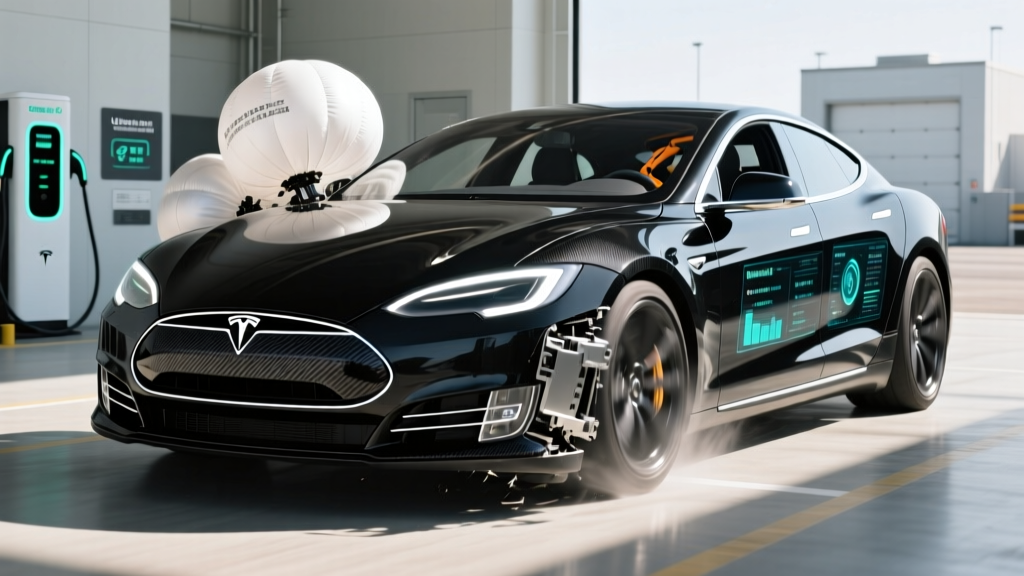
Fire risk after collision: Lithium-ion battery packs can experience thermal runaway if severely damaged in a crash. NHTSA data indicates that EV battery fires remain statistically rare compared to gasoline vehicle fires per 100,000 vehicles, but when they do occur, battery fires burn hotter and are more difficult for first responders to extinguish. Tesla's battery pack is shielded by a titanium and aluminum underbody plate, and the vehicle's high-voltage system is designed to disconnect automatically upon airbag deployment.
Weight as a double-edged factor: Teslas are heavy vehicles. A Model Y Long Range tips the scales at approximately 4,363 lbs. In a collision with a lighter vehicle, the Tesla's occupants benefit from the mass advantage (physics favors the heavier vehicle). However, that same mass increases stopping distances and can cause more damage to other vehicles and pedestrians.
2026 Tesla Model 3: Full Specs and Safety-Adjacent Data
To give this safety discussion practical buying context, here is the complete spec breakdown for the 2026 Tesla Model 3 — Tesla's most affordable and highest-volume sedan, and the model most buyers cross-shop against the Hyundai Ioniq 6, BMW i4, and Polestar 2.
| Specification | Model 3 RWD | Model 3 Long Range AWD | Model 3 Performance |
|---|---|---|---|
| EPA Range | 272 mi | 363 mi | 315 mi |
| Battery (usable) | ~57.5 kWh (LFP) | ~75 kWh (NMC) | ~75 kWh (NMC) |
| Drivetrain | RWD, single motor | AWD, dual motor | AWD, dual motor |
| Horsepower | 271 hp | 346 hp | 510 hp |
| 0-60 mph | 5.8 sec | 4.2 sec | 2.9 sec |
| MPGe (combined) | 132 MPGe | 130 MPGe | 113 MPGe |
| Efficiency | 25 kWh/100 mi | 26 kWh/100 mi | 30 kWh/100 mi |
| Max DC Fast Charge | 170 kW | 250 kW | 250 kW |
| 10-80% DCFC Time | ~30 min | ~25 min | ~25 min |
| Level 2 Home Charging | 11.5 kW (~44 mi/hr) | 11.5 kW (~44 mi/hr) | 11.5 kW (~44 mi/hr) |
| Cargo Volume | 23 cu ft (trunk + frunk combined) | ||
| Rear Legroom | 35.3 in | ||
| Base MSRP | $38,990 | $45,990 | $52,990 |
| Battery Warranty | 8 yr / 100,000 mi | 8 yr / 120,000 mi | 8 yr / 120,000 mi |
Charging Speed and Infrastructure: What Owners Need to Know
Charging speed is where Tesla still holds a meaningful advantage over most competitors — not just in raw kW numbers, but in the reliability and density of the Tesla Supercharger network, which now exceeds 6,000 stations and 65,000+ individual chargers across North America.
| Charging Level | Power (kW) | Miles Added per Hour | Typical Use Case |
|---|---|---|---|
| Level 1 (120V outlet) | ~1.4 kW | ~3-5 mi/hr | Emergency/trickle only |
| Level 2 (240V home) | 11.5 kW | ~44 mi/hr | Daily home charging |
| DC Fast (V3 Supercharger) | Up to 250 kW | ~1,000+ mi/hr (peak) | Road trips, 10-80% in ~25 min |
Charging curve reality: The 250 kW peak rate on Long Range and Performance trims is not sustained for the entire session. Tesla's charge curve is aggressive up to roughly 50% State of Charge (SoC), then tapers progressively. You will see 250 kW for perhaps the first 5–10 minutes of a 10-80% session on a preconditioned battery, then the rate drops to 150 kW, then 100 kW, then 50 kW as you approach 80%. The LFP RWD model peaks at 170 kW, making its 10-80% time closer to 30 minutes. Always precondition your battery via the Tesla navigation system before arriving at a Supercharger — skipping this step can add 10+ minutes to your session in cold weather.
Connector note: All 2026 Teslas use the NACS (North American Charging Standard) connector natively. Tesla opened its Supercharger network to non-Tesla EVs (Ford, GM, Rivian, etc.) via NACS adapters, but Tesla owners never need an adapter on their own network.
Pricing, Trims, and Federal Tax Credit Eligibility
Tesla pricing fluctuates more frequently than legacy automakers, so the figures below reflect early 2026 MSRP data. Destination charges add approximately $1,390.
| Trim | Base MSRP | Est. After §30D Credit | §30D Eligible? |
|---|---|---|---|
| Model 3 RWD | $38,990 | ~$31,490* | Likely (up to $7,500) |
| Model 3 Long Range AWD | $45,990 | ~$38,490* | Likely (up to $7,500) |
| Model 3 Performance | $52,990 | ~$45,490* | Likely (up to $7,500) |
| Model Y Long Range | $44,990 | ~$37,490* | Likely (up to $7,500) |
*Estimated effective price assumes full $7,500 credit and buyer eligibility. Actual credit amount varies.
- MSRP cap: Sedans (Model 3) must be under $55,000; SUVs/trucks/vans (Model Y) under $80,000. All current Model 3 and Model Y trims fall within these caps.
- Buyer income cap: Modified Adjusted Gross Income (MAGI) must not exceed $150,000 (single), $225,000 (head of household), or $300,000 (joint filers) per IRS §30D rules.
- Battery sourcing requirements: The $7,500 credit is split into two $3,750 halves — one for critical minerals sourcing and one for battery component manufacturing. Tesla's U.S.-built vehicles with increasingly North American-sourced battery materials have generally qualified for the full $7,500, but sourcing rules tighten annually. Always verify current eligibility at fueleconomy.gov before purchasing.
- Point-of-sale transfer: As of 2024+, buyers can transfer the credit to the dealer at purchase, reducing the upfront price rather than waiting for a tax refund. This applies to Tesla direct sales as well.
Tech, Interior, and Daily Ownership Experience
The refreshed Model 3 ("Highland") brought meaningful improvements to cabin quality, ride comfort, and noise isolation over the pre-2024 version. The minimalist interior remains polarizing — no physical stalks (turn signals are now steering-wheel buttons), no instrument cluster, and virtually all controls live on the 15.4-inch central touchscreen.
Standout tech features:
- Autopilot standard: Adaptive cruise control, lane centering, AEB, blind-spot monitoring, and 360-degree cameras
- FSD (Supervised) optional (~$8,000 or $99/mo): Adds automatic lane changes, traffic light/stop sign recognition, and city-street navigation-assisted driving. Remains SAE Level 2 — not self-driving
- Over-the-air updates: Tesla continuously pushes software improvements, including efficiency tweaks, UI updates, and new features post-purchase
- Sentry Mode and Dashcam: Built-in camera recording for security and incident documentation
- Heat pump: Standard on all trims — significantly improves cold-weather efficiency and range retention compared to resistive heating
Notable drawbacks:
- No physical turn signal stalks — steering-wheel buttons take weeks to build muscle memory
- Rear visibility is limited; reliance on cameras and mirrors is heavy
- Rear seat legroom (35.3 in) is tighter than the Hyundai Ioniq 6 or BMW i4
- No Apple CarPlay or Android Auto — Tesla's proprietary infotainment is the only option
- Panel gaps and paint quality have improved but still lag premium competitors at this price point
Pros
- Top-tier crash safety (5-star NHTSA, IIHS TSP+)
- Best-in-class Supercharger network access
- Excellent efficiency (25 kWh/100 mi on RWD)
- Strong range on Long Range trim (363 mi EPA)
- Over-the-air updates keep the car current
- Heat pump standard for cold-weather performance
Cons
- No turn signal stalks — steep adjustment curve
- Tighter rear seat than key rivals
- No Apple CarPlay/Android Auto
- FSD is expensive and still Level 2 only
- LFP battery limits RWD fast-charge speed to 170 kW
- Insurance costs above segment average
Who Should Buy a Tesla in 2026?
Best for: Tech-forward commuters and small families who prioritize safety data, have reliable home charging access (Level 2), and want the lowest-friction road-trip experience via the Supercharger network. The Model 3 Long Range AWD is the sweet spot — 363 miles EPA, dual-motor traction, and ~$38,490 after the federal credit.
Consider alternatives if: You regularly carry rear-seat adults (the Model Y offers more space, or look at the Hyundai Ioniq 5), you want Apple CarPlay integration, you lack home charging and your area has limited public infrastructure, or you prefer traditional dealer service relationships over Tesla's mobile-ranger-and-service-center model.
Key competitors to cross-shop:
- Hyundai Ioniq 6: 361 mi range, 800V charging (10-80% in 18 min), more rear room, but smaller charging network
- BMW i4 eDrive40: 307 mi range, premium interior, Apple CarPlay, but higher starting price and no federal credit
- Polestar 2: 320 mi (dual motor), physical controls, Google-based infotainment, but lower range and slower DC charging
Frequently Asked Questions
Are Teslas safe in a crash compared to gas cars?
Yes. Tesla's Model 3 and Model Y have earned 5-star NHTSA ratings across all subcategories and IIHS Top Safety Pick+ designations. The rigid battery pack and low center of gravity provide structural advantages in side-impact and rollover scenarios that most gas-powered sedans cannot match. However, post-crash battery fire risk, while statistically rare, requires specialized first-responder protocols.
What is the real-world range of a Tesla Model 3?
The EPA rates the Model 3 Long Range AWD at 363 miles. Expect 290–320 miles in real-world highway driving and 250–280 miles in freezing conditions. The RWD model (272 mi EPA) delivers roughly 220–240 real-world highway miles, dropping to ~200 in cold weather.
How fast does a Tesla charge at home and on the road?
At home on a 240V Level 2 charger (11.5 kW), a Model 3 gains approximately 44 miles of range per hour — a full overnight charge adds 350+ miles. On a V3 Supercharger, the Long Range and Performance trims peak at 250 kW and charge from 10-80% in roughly 25 minutes. The RWD (LFP battery) peaks at 170 kW, taking about 30 minutes for the same session.
Does the Tesla Model 3 qualify for the $7,500 federal EV tax credit?
All current Model 3 trims fall under the $55,000 MSRP cap for sedans, and Tesla's U.S. manufacturing with North American battery sourcing has generally satisfied IRS §30D requirements for the full $7,500. However, buyer income caps apply ($150K single / $300K joint), and sourcing rules tighten each year. Verify current eligibility at fueleconomy.gov before purchasing.
Is Tesla's Autopilot or FSD actually self-driving?
No. Both Autopilot and Full Self-Driving (Supervised) are SAE Level 2 driver-assistance systems. The driver must remain fully attentive, keep hands on the steering wheel, and be prepared to take over at any moment. True self-driving (Level 4) is currently only available via robotaxi services like Waymo in limited metro areas.
How long does a Tesla battery last and what does replacement cost?
Tesla warranties its Long Range/Performance batteries for 8 years or 120,000 miles (whichever comes first), with a minimum 70% capacity retention guarantee. The RWD's LFP battery is warranted for 8 years / 100,000 miles. Real-world data from Tesla's fleet suggests most batteries retain 85-90% capacity at 150,000 miles. Out-of-warranty replacement costs range from approximately $12,000 to $16,000 depending on the pack, though most owners will never need one.