Quick Verdict: Tesla Safety by the Numbers
If you're shopping for an electric vehicle and asking "are Teslas safe?" — the short answer is yes, by most objective crash-test and active-safety metrics. Tesla's current lineup (Model 3, Model Y, Model S, Model X) consistently earns top marks from both the National Highway Traffic Safety Administration (NHTSA) and the Insurance Institute for Highway Safety (IIHS). But safety is more than a 5-star crash rating. It includes battery fire risk, driver-assist system behavior, structural engineering, and real-world ownership patterns. This guide walks through the data so you can make an informed decision.
Crash-Test Ratings Across the Tesla Lineup
Tesla's unibody architecture — with a rigid battery pack mounted low in the chassis — gives its vehicles an inherently low center of gravity and massive front crumple zone (no engine block to intrude into the cabin). Here's how current models perform:
| Model | NHTSA Overall | IIHS Rating | Key Notes |
|---|---|---|---|
| Model 3 (2025+ Highland) | 5 Stars | Top Safety Pick+ | Highest individual scores in every NHTSA subcategory |
| Model Y (2025 Juniper) | 5 Stars | Top Safety Pick+ | Excellent small-overlap and side-impact performance |
| Model S (2024+) | 5 Stars | Good (most categories) | Strong crashworthiness; older headlight design penalized in past IIHS tests |
| Model X (2024+) | 5 Stars | Good (most categories) | Falcon-wing doors tested for emergency egress |
According to NHTSA, the Model 3 has achieved the lowest probability of injury of any vehicle ever tested by the agency. The IIHS has awarded both the Model 3 and Model Y its highest honor — Top Safety Pick+ — when equipped with acceptable headlights. These aren't marketing claims; they're independently verified crash-test results.
Battery Fire Risk: What the Data Actually Shows
Battery thermal events are the most emotionally charged safety topic in the EV world. Let's look at the numbers rather than viral videos:
- Tesla's own safety report (2024 data) states approximately one vehicle fire per 130 million miles driven across all Tesla models, including fires from collisions, non-battery causes, and structural damage.
- NFPA data on internal-combustion vehicles shows roughly one fire per 19 million miles driven for gas-powered cars — making ICE vehicles statistically more likely to experience a fire event.
- Battery chemistry matters: Tesla's Standard Range Model 3 and Model Y use LFP (lithium iron phosphate) battery packs supplied by CATL. LFP chemistry is inherently more thermally stable than NMC (nickel manganese cobalt), with a higher thermal runaway threshold (~270°C vs ~210°C for NMC). Long Range and Performance trims use NMC chemistry from Panasonic/LG for higher energy density.
Active Safety and Driver-Assist Systems
Every new Tesla ships with a suite of active-safety features as standard equipment — no subscription required for the basics:
- Automatic Emergency Braking (AEB): Forward and rear collision mitigation, consistently rated among the most responsive in IIHS testing.
- Lane Departure Avoidance: Active steering correction with lane-keeping assist.
- Blind Spot Monitoring: Camera-based (no radar on current Tesla vehicles — the company removed ultrasonic sensors and radar in favor of its "Tesla Vision" camera-only system starting in 2022).
- Side Collision Warning: Visual and audible alerts for cross-traffic and merging vehicles.
- Emergency Lane Departure Avoidance: Steers the car back if you drift toward an oncoming lane or road edge.
Autopilot (standard) adds adaptive cruise control and lane-centering on highways. Full Self-Driving (Supervised) — a $8,000 add-on or $99/month subscription — extends lane-centering to city streets, adds traffic-light and stop-sign recognition, and enables automatic lane changes. However, FSD Supervised remains a Level 2 system requiring full driver attention. NHTSA has investigated multiple incidents involving Autopilot and FSD, particularly regarding stationary emergency vehicles and low-visibility conditions. Tesla has issued over-the-air updates to tighten driver-monitoring requirements in response.
Real-World Safety Ownership: Model Y Deep Dive
To ground the safety discussion in a real purchase decision, here's a spec profile of the best-selling Tesla — the 2025 Model Y Long Range AWD — with the data points buyers actually need:
| Spec | Value |
|---|---|
| EPA Range | 320 miles (Long Range AWD) |
| Real-World Range | ~270-290 mi highway; ~220-250 mi in cold weather (below 32°F) |
| Battery Capacity / Chemistry | ~78 kWh usable / NMC (Panasonic 4680 or LG) |
| Efficiency | 122 MPGe combined / 28 kWh/100mi |
| Max DC Fast Charge | 250 kW peak; 10-80% in ~27 minutes |
| Home Level 2 Charging | 11.5 kW (48A) / ~44 miles per hour of charging |
| 0-60 mph | 4.8 seconds (Long Range AWD, dual-motor) |
| Horsepower | 384 hp (combined dual-motor) |
| Drivetrain | Dual-motor AWD |
| Cargo Volume | 34.3 cu ft (rear seats up) / 76.2 cu ft (rear seats folded) + 4.1 cu ft frunk |
| Rear Legroom | 40.5 inches |
| Base MSRP | $44,990 (Long Range AWD) |
| Federal Tax Credit (§30D) | Eligible for up to $7,500 (point-of-sale transfer available) — subject to buyer income caps and battery-sourcing requirements |
| Battery Warranty | 8 years / 120,000 miles (Long Range) with ≥70% capacity retention |
On fueleconomy.gov, the Model Y Long Range AWD posts 122 MPGe combined — among the most efficient electric SUVs on the market. That efficiency translates directly to lower charging costs and, importantly, less heat generation in the battery pack during sustained driving.
Charging Speed and Safety Infrastructure
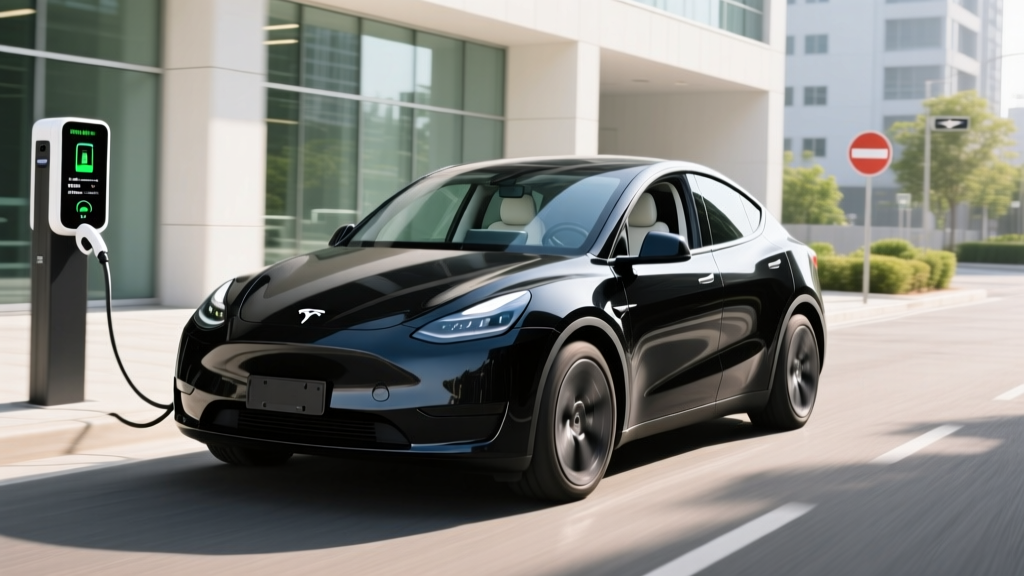
Charging speed matters for road-trip safety as much as convenience — fewer long stops at unfamiliar locations means less exposure. Tesla's Supercharger network is widely regarded as the most reliable DC fast-charging network in the U.S., with over 25,000 stalls nationwide.
| Charging Level | Power | Speed | Use Case |
|---|---|---|---|
| Level 1 (120V outlet) | ~1.4 kW | ~4 mi/hr | Emergency / overnight trickle |
| Level 2 (240V home Wall Connector) | 11.5 kW (48A) | ~44 mi/hr | Daily home charging (full charge in ~7 hours) |
| DC Fast (V3 Supercharger) | 250 kW peak | ~170 mi in 15 min | Road trips, 10-80% in ~27 min |
| DC Fast (V4 Supercharger) | Up to 350 kW* | Faster taper curve | Newer stations; vehicle must support higher C-rate |
*V4 Supercharger stalls can deliver up to 350 kW, but current Tesla vehicles may not accept the full rate due to onboard charge-controller limits. Actual charge speed depends on battery temperature, state of charge, and pack chemistry.
Charging-curve reality: The Model Y peaks near 250 kW only between roughly 10-30% state of charge. By 50% SoC, power drops to ~150 kW, and above 80% it tapers sharply to protect battery longevity. This is why Tesla's navigation system preconditions the battery when you route to a Supercharger — warming the pack to optimal temperature for faster acceptance.
Pricing, Tax Credits, and Value
Safety shouldn't require a luxury budget. Here's how Tesla's lineup prices out for 2025-2026 model years:
| Model / Trim | Base MSRP | Est. After §30D Credit | Credit Eligible? |
|---|---|---|---|
| Model 3 RWD | $38,990 | ~$31,490 | Yes (up to $7,500) |
| Model 3 Long Range AWD | $42,490 | ~$34,990 | Yes (up to $7,500) |
| Model Y Long Range AWD | $44,990 | ~$37,490 | Yes (up to $7,500) |
| Model Y Performance | $48,990 | ~$41,490 | Yes (up to $7,500) |
| Model S LR / Plaid | $74,990 / $89,990 | No credit | No (exceeds $55K sedan MSRP cap) |
| Model X LR / Plaid | $79,990 / $94,990 | No credit | No (exceeds $80K SUV MSRP cap) |
- Buyer income caps: AGI ≤ $150,000 (single), ≤ $225,000 (head of household), ≤ $300,000 (joint)
- MSRP caps: ≤ $55,000 for sedans (Model 3); ≤ $80,000 for SUVs/trucks (Model Y)
- Battery sourcing: Critical minerals and battery components must meet phased-in domestic/free-trade sourcing thresholds (rules tighten annually through 2032)
- Point-of-sale transfer: Eligible buyers can apply the credit as an immediate price reduction at the dealership rather than waiting for tax filing
- Verify current eligibility at irs.gov before purchasing — sourcing rules change frequently
Pros and Cons: Tesla Safety at a Glance
✅ Safety Pros
- 5-star NHTSA ratings across all current models
- IIHS Top Safety Pick+ for Model 3 and Model Y
- Low center of gravity (rollover risk among lowest in class)
- Standard AEB, lane-keeping, blind-spot monitoring on every trim
- LFP battery option (Standard Range) for superior thermal stability
- Over-the-air safety updates improve systems post-purchase
- Supercharger network reliability reduces roadside exposure
⚠️ Safety Cons & Concerns
- Camera-only "Tesla Vision" can struggle in heavy rain, fog, or direct sun glare
- Removal of ultrasonic sensors means parking proximity relies on camera estimation
- Autopilot/FSD misuse risk — drivers over-trusting Level 2 system
- NHTSA investigations into Autopilot behavior near stationary emergency vehicles
- Phantom braking events reported by owners on highways
- Battery fires, while rare, are more difficult to extinguish than ICE fires
- Minimalist interior means climate controls require touchscreen interaction while driving
Who Is a Tesla Best For (Safety-Wise)?
Choose a Tesla if:
- Commuters and daily drivers who prioritize top crash-test ratings and want standard active-safety tech without paying for a premium package.
- Families needing a 5-star-rated crossover (Model Y) with ample cargo space (76+ cu ft) and a low rollover risk profile.
- Tech-savvy owners who value over-the-air updates that continuously improve safety features — Tesla has added and refined AEB, emergency lane departure, and dashcam features long after purchase.
- Road-trippers who benefit from the Supercharger network's reliability, reducing the safety risk of being stranded with a dead battery at poorly lit or remote third-party chargers.
Look elsewhere if:
- You want physical buttons for climate and mirror controls (Hyundai Ioniq 5, BMW i4 offer more tactile interfaces).
- You need proven Level 2+ hands-free driving on mapped highways (GM's Super Cruise and Ford's BlueCruise offer true hands-off on approved roads with stricter driver monitoring).
- You live in an area with frequent heavy fog, snow, or rain and want radar-backed sensor redundancy (many competitors retain radar alongside cameras).
Frequently Asked Questions
Are Teslas safer than gas-powered cars in a crash?
By crash-test metrics, yes. Tesla's Model 3 and Model Y have achieved 5-star NHTSA ratings in every subcategory and IIHS Top Safety Pick+ awards. The absence of a heavy engine block in the front allows a larger crumple zone, and the low-mounted battery pack dramatically reduces rollover risk compared to comparable ICE SUVs.
Do Tesla batteries catch fire easily?
No. Tesla reports approximately one fire per 130 million miles driven (all causes included). Gas vehicles experience fires at roughly one per 19 million miles per NFPA data. LFP-equipped Tesla models (Standard Range trims) have even higher thermal stability. However, lithium-ion battery fires do burn hotter and require specialized firefighting techniques.
Is Tesla Autopilot safe to use?
Autopilot is a Level 2 driver-assist system that can reduce fatigue on long highway drives when used correctly — meaning you remain fully attentive with hands on the wheel. Tesla's own data suggests Autopilot-engaged driving has fewer accidents per mile than manual driving, but NHTSA investigations have highlighted risks near stationary emergency vehicles and in low-visibility conditions. It is not a self-driving system.
Does the Tesla Model Y qualify for the $7,500 federal tax credit?
As of current IRS §30D rules, the Model Y qualifies for up to $7,500 in federal tax credit (available as a point-of-sale price reduction) because its MSRP is under the $80,000 SUV cap. However, buyer income limits apply ($150K single / $300K joint), and battery-sourcing requirements must be met. Always verify current eligibility on irs.gov before purchasing, as sourcing rules change annually.
What is the real-world range of the Tesla Model Y Long Range?
The EPA rates the Model Y Long Range AWD at 320 miles. In real-world highway driving at 70-75 mph, expect roughly 270-290 miles. In cold weather (below 32°F), range drops to approximately 220-250 miles due to battery heating demands and cabin HVAC load. Tesla's heat pump (standard on all current models) mitigates some cold-weather loss compared to older resistive-heating EVs.
How does Tesla Vision compare to camera + radar systems?
Tesla removed radar and ultrasonic sensors starting in 2022, relying solely on cameras and neural-network processing ("Tesla Vision"). In clear conditions, the system performs excellently. In heavy rain, fog, or direct low-angle sun, camera-only systems can experience reduced detection range. Competitors like BMW, Hyundai, and Mercedes retain radar as a redundant sensor layer, which provides better performance in adverse weather.
Are Teslas safe for families with children?
Yes. The Model Y offers 5-star NHTSA ratings, standard rear-door child locks, LATCH anchors for car seats (two outboard positions in the second row), and a cabin air filtration system with HEPA-grade "Bioweapon Defense Mode" that filters particulates, pollen, and smoke. The 40.5 inches of rear legroom accommodates rear-facing car seats without excessive front-seat compromise.