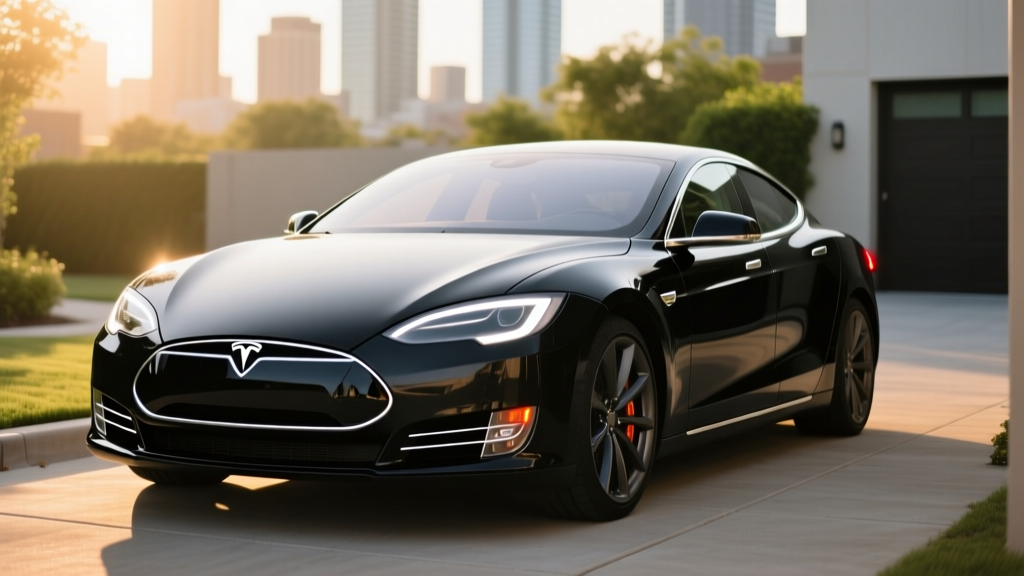
Tesla sells more electric vehicles than any other automaker in the United States, and with that volume comes an outsized share of headlines — many of them questioning whether these software-defined, semi-autonomous machines are actually safe. The question "are Tesla's safe cars?" doesn't have a single yes-or-no answer. It depends on whether you're asking about crashworthiness, active safety technology, battery fire risk, or the real-world behavior of drivers using Autopilot and Full Self-Driving (FSD) Supervised.
This guide cuts through the noise with hard data from NHTSA, IIHS, Tesla's own safety reports, and real-world ownership experience. We'll also cover the specs that matter to buyers — range, charging, pricing, and tax credits — because safety is just one part of the purchase equation.
Crash Test Ratings: What NHTSA and IIHS Actually Say
Tesla's core lineup — the Model 3, Model Y, Model S, and Model X — has consistently earned top marks in government and independent crash testing. Here's the breakdown by model:
| Model | NHTSA Overall Rating | IIHS Rating (Latest) | Key Notes |
|---|---|---|---|
| Model 3 (2024-2026 Highlandland refresh) | 5 Stars | Top Safety Pick+ (when equipped with acceptable headlights) | Top scores in frontal, side, and rollover |
| Model Y (2024-2026) | 5 Stars | Top Safety Pick+ | Excellent side-impact and roof strength |
| Model S (2024-2026) | 5 Stars | Not recently tested by IIHS | Lowest probability of injury in any vehicle NHTSA tested (at launch) |
| Model X (2024-2026) | 5 Stars | Not recently tested by IIHS | Lowest rollover risk of any SUV tested by NHTSA |
| Cybertruck (2024-2026) | Not yet rated | Not yet rated | Stainless steel exoskeleton; no official crash scores published |
The common thread: Tesla's vehicles benefit from a low center of gravity (battery pack mounted in the floor), a massive front crumple zone (no engine block), and rigid passenger cages. According to NHTSA's database, the Model Y achieved 5 stars in every crash category. Source: nhtsa.gov
Active Safety and Driver-Assist Technology
Beyond passive crash protection, Tesla equips every vehicle with its Active Safety suite and optional Autopilot / FSD (Supervised) systems. It's critical to understand what these systems are — and aren't.
Standard Active Safety features (included on all Teslas):
- Automatic Emergency Braking (AEB) — forward and rear
- Forward Collision Warning
- Side Collision Warning
- Blind Spot Monitoring
- Lane Departure Avoidance
- Emergency Lane Departure Avoidance
- Obstacle-Aware Acceleration
Autopilot (included or $2,000 add-on depending on trim/year):
- Traffic-Aware Cruise Control
- Autosteer (lane centering on marked highways)
FSD (Supervised) — $8,000 one-time or $99/month:
- All Autopilot features, plus:
- Navigate on Autopilot (highway on/off-ramp navigation)
- Auto Lane Change
- Autopark
- Smart Summon
- Traffic Light and Stop Sign Control
Tesla's Safety Data vs. Industry Averages
Tesla publishes a quarterly Vehicle Safety Report claiming that drivers using Autopilot technology experience roughly one crash per 4-6 million miles driven, compared to the U.S. average of approximately one crash per 670,000 miles (per NHTSA data). Source: nhtsa.gov
However, these figures require context:
- Selection bias: Autopilot is primarily used on divided highways — the safest driving environment. Comparing highway Autopilot miles to all U.S. driving (including intersections, parking lots, and urban streets) is not apples-to-apples.
- Reporting methodology: Tesla's data includes all airbag deployments and some events that may not meet standard crash-reporting thresholds.
- NHTSA investigations: The National Highway Traffic Safety Administration has opened multiple investigations into Tesla's Autopilot/FSD systems, particularly regarding crashes with emergency vehicles and the adequacy of driver-monitoring systems.
The bottom line: Tesla's active safety hardware is excellent, and the standard AEB system is among the best in the industry. But Autopilot/FSD should be treated as a convenience feature that reduces fatigue — not a replacement for an attentive driver.
Specs That Matter: Range, Charging, and Performance
Safety matters, but buyers also need to know whether a Tesla fits their daily driving needs. Here's a spec comparison across the current 2025-2026 lineup:
| Spec | Model 3 Long Range AWD | Model Y Long Range AWD | Model S Long Range | Model X Long Range |
|---|---|---|---|---|
| EPA Range | 341 mi | 320 mi | 402 mi | 335 mi |
| Battery (usable kWh) | ~79 kWh (NMC) | ~78 kWh (NMC) | ~95 kWh (NMC) | ~95 kWh (NMC) |
| MPGe (combined) | 134 MPGe | 122 MPGe | 124 MPGe | 109 MPGe |
| Efficiency (kWh/100mi) | 25 | 28 | 28 | 32 |
| 0-60 mph | 4.2 sec | 4.8 sec | 3.1 sec | 3.8 sec |
| Horsepower | ~346 hp | ~384 hp | ~670 hp | ~670 hp |
| Drivetrain | Dual-Motor AWD | Dual-Motor AWD | Dual-Motor AWD | Dual-Motor AWD |
| Max DC Fast Charge | 250 kW | 250 kW | 250 kW | 250 kW |
| 10-80% DC Charge Time | ~25 min | ~27 min | ~30 min | ~31 min |
| Level 2 Home Charge (mi/hr) | ~44 mi/hr (11.5 kW) | ~44 mi/hr (11.5 kW) | ~41 mi/hr (11.5 kW) | ~38 mi/hr (11.5 kW) |
| Cargo Volume | 23 cu ft (rear) + 3.1 cu ft (frunk) | 30 cu ft (rear) + 4.1 cu ft (frunk) | 28 cu ft (rear) + 3.1 cu ft (frunk) | 88 cu ft (rear seats folded) + 3.1 cu ft (frunk) |
| Rear Legroom | 35.3 in | 41.6 in | 40.9 in | 40.9 in |
Charging: Supercharger Network Advantage
One of Tesla's strongest safety-adjacent arguments is its Supercharger network — over 6,500 stations and 70,000+ individual chargers in North America as of early 2026. The network's uptime rate consistently exceeds 99%, which matters for road-trip confidence.
| Charging Level | Power (kW) | Miles Added per Hour | Typical Use Case |
|---|---|---|---|
| Level 1 (120V household) | ~1.4 kW | ~3-5 mi/hr | Emergency / overnight trickle |
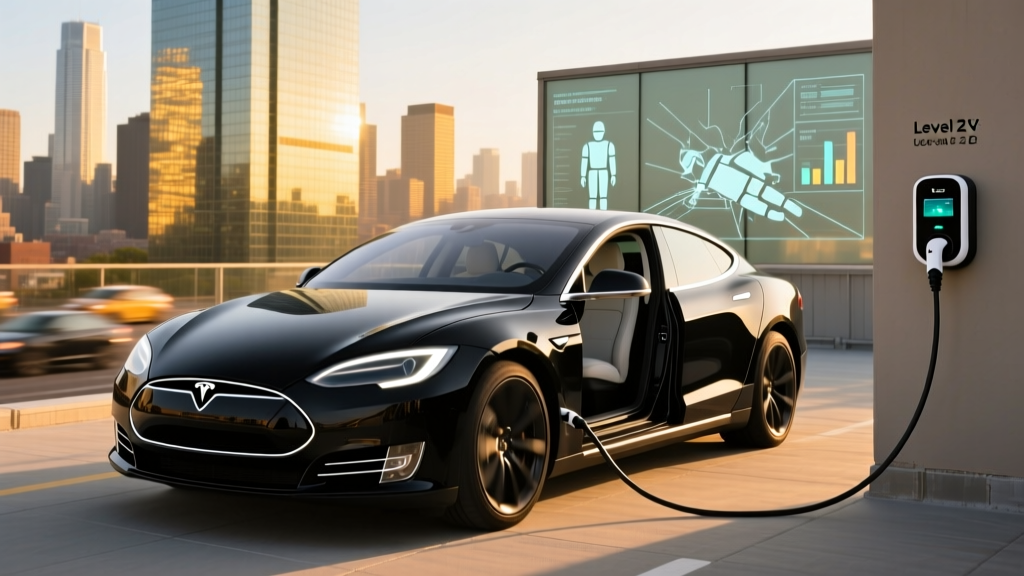
| Level 2 (240V home Wall Connector) | 11.5 kW | ~38-44 mi/hr | Daily home charging |
| DC Fast (V3 Supercharger) | Up to 250 kW | ~1,000+ mi/hr (peak) | Road trips; 10-80% in ~25-30 min |
| DC Fast (V4 Supercharger) | Up to 350 kW (cable-dependent) | Varies by vehicle acceptance | Newer installations; current Teslas still peak at ~250 kW |
Charging curve reality: Tesla vehicles peak at 250 kW only at low state-of-charge (roughly 10-30% SoC). The rate tapers progressively — expect ~150 kW around 50% SoC and ~50-70 kW above 80%. This is why Tesla (and all EV experts) recommend charging to 80% on road trips for the fastest overall travel time.
Connector note: Tesla uses the NACS (North American Charging Standard) connector natively. As of 2025-2026, Ford, GM, Rivian, Hyundai/Kia, and most major automakers have adopted NACS, meaning Tesla Superchargers are increasingly the de facto standard. Tesla vehicles can also use CCS chargers via adapter.
Pricing, Trims, and Federal Tax Credit Eligibility
| Model / Trim | Base MSRP (2025-2026) | §30D Federal Tax Credit | Effective Price (Est.) |
|---|---|---|---|
| Model 3 RWD | $38,990 | Up to $7,500 (if eligible) | ~$31,490 |
| Model 3 Long Range AWD | $45,240 | Up to $7,500 (if eligible) | ~$37,740 |
| Model Y Long Range AWD | $46,630 | Up to $7,500 (if eligible) | ~$39,130 |
| Model S Long Range | $79,990 | $0 (exceeds MSRP cap) | $79,990 |
| Model X Long Range | $84,990 | $0 (exceeds MSRP cap) | $84,990 |
| Cybertruck AWD | $79,990 | $0 (exceeds MSRP cap for trucks) | $79,990 |
- MSRP Cap: Sedans/wagons ≤ $55,000; SUVs/trucks/vans ≤ $80,000 (Model S, X, and Cybertruck exceed caps)
- Buyer Income Cap: AGI ≤ $150,000 (single), $225,000 (head of household), $300,000 (joint)
- Battery Component Sourcing: Percentage of battery components manufactured or assembled in North America must meet annual thresholds (escalating yearly through 2029)
- Critical Minerals Sourcing: Percentage of critical minerals sourced from the U.S. or FTA partners must meet annual thresholds
- Point-of-Sale Transfer: Eligible buyers can transfer the credit to the dealer at purchase for an immediate price reduction (effective Jan 1, 2024)
- Final Assembly: Vehicle must undergo final assembly in North America (all U.S.-sold Teslas are assembled in Fremont, CA or Austin, TX)
Eligibility rules change frequently. Always verify current-year requirements at irs.gov and consult a tax professional before relying on the credit.
Battery Fire Risk: Context for the Headlines
EV battery fires generate disproportionate media coverage relative to their frequency. According to data compiled by the National Fire Protection Association and various insurance analyses, electric vehicles experience fires at a significantly lower rate per 100,000 vehicles than internal-combustion vehicles. However, EV battery fires are harder to extinguish (requiring large volumes of water and extended cooling time) and can reignite hours or days after the initial event.
Tesla reports that from 2012-2025, there was approximately one Tesla vehicle fire for every 210 million miles driven — compared to one fire per 19 million miles for all U.S. vehicles (NFPA/NHTSA data). Most Tesla fires have followed high-speed impacts or severe underbody damage. The battery pack's armored shield and cell-level thermal management are designed to contain and slow thermal propagation.
Warranty and Long-Term Reliability
| Coverage | Model 3 / Model Y | Model S / Model X |
|---|---|---|
| Basic Vehicle | 4 years / 50,000 miles | 4 years / 50,000 miles |
| Battery & Drive Unit | 8 years / 120,000 miles (LR AWD) | 8 years / 150,000 miles |
| Capacity Retention Guarantee | ≥70% over warranty period | ≥70% over warranty period |
Tesla's battery warranty guarantees that the pack will retain at least 70% of its original capacity during the warranty period. Real-world data from fleet operators and high-mileage owners suggests that Tesla's NMC packs typically lose 5-10% capacity in the first 50,000 miles, then degrade very slowly — often retaining 85-90% at 150,000 miles.
Pros, Cons, and Who Should Buy a Tesla
- Top 5-star NHTSA ratings across the lineup
- Industry-leading Supercharger network (70,000+ stalls)
- Over-the-air updates continuously improve safety features
- Class-leading efficiency (MPGe) and real-world range
- Standard active safety suite is comprehensive
- Strong resale value relative to most EVs
- Excellent acceleration and handling for the class
- FSD (Supervised) is expensive and still requires full driver attention
- NHTSA investigations into Autopilot/FSD create uncertainty
- Build quality inconsistency (panel gaps, paint — improving but still noted)
- Service center wait times can be long in some markets
- Model S/X exceed tax credit MSRP caps
- Touchscreen-dependent controls (no physical buttons for HVAC, wipers)
- Cybertruck has no crash-test ratings yet
- Choose a Model 3 or Model Y if: You want a daily commuter with top safety ratings, access to the best charging network, and qualify for the §30D credit. Ideal for suburban families, tech-forward professionals, and road-trippers who value route-planning integration.
- Choose a Model S if: You need 400+ miles of range, executive-level performance, and don't need the tax credit. Best for high-mileage drivers who prioritize range and luxury.
- Choose a Model X if: You need three-row seating (up to 7 passengers), falcon-wing doors for tight parking, and family hauling. Best for larger families who want an electric SUV with genuine third-row usability.
- Look at competitors (Hyundai Ioniq 5, BMW iX, Rivian R1S) if: You prefer traditional controls, need faster CCS charging, want independent dealer service, or need verified IIHS ratings on a newer model.
Frequently Asked Questions
Are Tesla's safe cars in a crash?
Yes. The Model 3, Model Y, Model S, and Model X have all earned 5-star overall NHTSA ratings and top IIHS scores where tested. The low-mounted battery pack provides a low center of gravity (reducing rollover risk) and the front trunk area serves as an exceptionally large crumple zone.
Is Autopilot safe to use?
Autopilot is a Level 2 driver-assist system that reduces highway fatigue when used correctly. Tesla's data suggests lower crash rates with Autopilot engaged, but this data has selection bias (highway use). The driver must remain fully attentive at all times. NHTSA has investigated several Autopilot-related crashes, and the system is not infallible.
Do Tesla batteries catch fire easily?
No. Tesla reports approximately one vehicle fire per 210 million miles driven, far below the fleet average for combustion vehicles. However, when battery fires do occur, they are more difficult to extinguish and can reignite. The armored battery shield and cell-level thermal management are designed to minimize propagation.
Which Tesla qualifies for the $7,500 federal tax credit?
As of 2025-2026, the Model 3 RWD ($38,990), Model 3 Long Range ($45,240), and Model Y Long Range ($46,630) fall under the §30D MSRP caps. The Model S, Model X, and Cybertruck exceed the caps. Buyer income limits and battery-sourcing requirements also apply — verify at irs.gov.
How does Tesla's safety compare to Volvo or Mercedes?
Tesla matches or exceeds Volvo and Mercedes in crash-test scores. Where Volvo and Mercedes may differ is in offering more conservative driver-assist tuning (less aggressive Autosteer behavior) and more physical controls, which some drivers find less distracting. All three brands offer excellent active safety suites.
Is the Cybertruck safe?
As of early 2026, the Cybertruck has not been crash-tested by NHTSA or IIHS, so there is no independent safety data. Its stainless steel exoskeleton is extremely rigid, but rigidity alone doesn't guarantee occupant protection — controlled crumple zones are equally important. We recommend waiting for official test results before making safety-based purchase decisions on the Cybertruck.