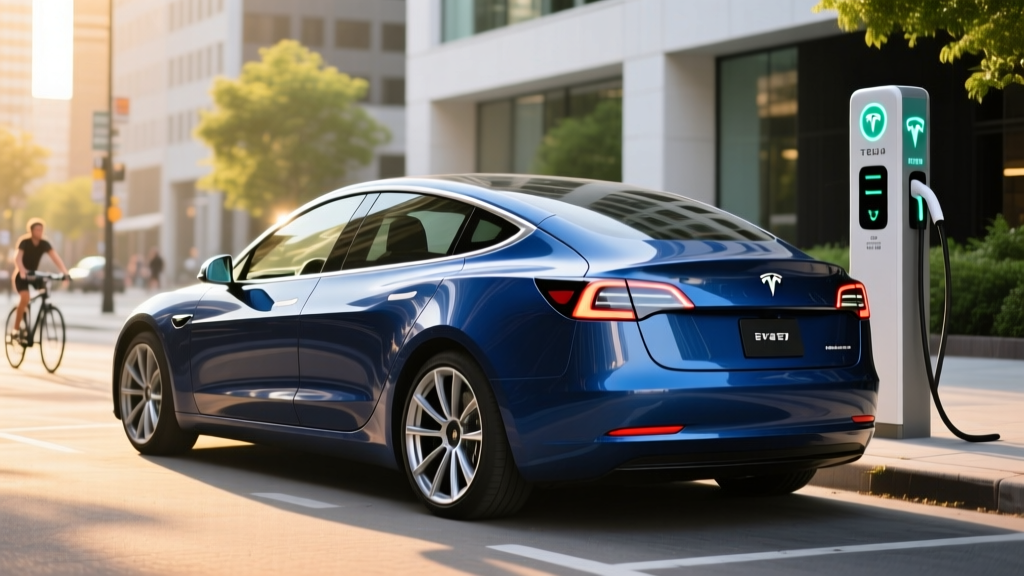
If you've been shopping for a Tesla Model 3 and noticed conflicting information online, you've likely asked: are Teslas made in China? The answer depends on which market you're buying in and which trim you choose. For U.S. buyers, the short answer is no — the Tesla Model 3 sold in North America is built at the Fremont, California factory, not at Giga Shanghai. But the longer answer involves battery chemistry sourcing, global supply chains, and how manufacturing origin impacts your federal tax credit eligibility under IRS §30D rules.
This review breaks down exactly where the 2026 Tesla Model 3 is made, what battery chemistry powers each trim, and whether it still earns the full federal EV tax credit. We'll also cover the real numbers that matter for ownership: EPA range, DC fast-charge speeds, home charging rates, efficiency, cargo space, and total cost.
Where Is the Tesla Model 3 Actually Built?
Tesla operates five vehicle assembly plants worldwide, and production allocation is market-specific:
- Fremont, California (USA): Produces Model 3, Model Y, Model S, and Model X for North America and select export markets.
- Giga Shanghai (China): Produces Model 3 and Model Y primarily for the Asia-Pacific market, Europe, and Canada. This is the source of the "Teslas made in China" narrative.
- Giga Berlin (Germany): Produces Model Y for European markets.
- Giga Texas (USA): Produces Model Y and Cybertruck for North America.
- Giga Mexico (announced): Next-generation platform vehicles; not yet in production as of 2026.
For U.S. retail buyers, every 2026 Model 3 delivered stateside rolls out of Fremont. However, some Canadian and European Model 3 sedans are sourced from Giga Shanghai, which is where confusion arises. Giga Shanghai vehicles use CATL-sourced LFP (lithium iron phosphate) batteries in base trims, while Fremont vehicles have historically used a mix of NMC (nickel manganese cobalt) from Panasonic and LFP from CATL depending on trim and model year.
2026 Tesla Model 3: Full Spec Breakdown
| Spec | Model 3 RWD (Base) | Model 3 Long Range AWD | Model 3 Performance |
|---|---|---|---|
| EPA Range | 341 miles | 363 miles | 315 miles |
| Battery Capacity (usable) | ~60 kWh (LFP) | ~79 kWh (NMC) | ~79 kWh (NMC) |
| Drivetrain | Rear-Wheel Drive | Dual-Motor AWD | Dual-Motor AWD |
| Horsepower | 271 hp | 346 hp | 510 hp |
| 0–60 mph | 5.8 sec | 4.2 sec | 2.9 sec |
| MPGe (combined) | 132 MPGe | 130 MPGe | 115 MPGe |
| Efficiency | 25 kWh/100 mi | 26 kWh/100 mi | 29 kWh/100 mi |
| Max DC Fast Charge | 170 kW | 250 kW | 250 kW |
| 10–80% DCFC Time | ~30 min | ~25 min | ~25 min |
| Level 2 Home Charge Rate | 11.5 kW (~44 mi/hr) | 11.5 kW (~44 mi/hr) | 11.5 kW (~44 mi/hr) |
| Base MSRP | $38,990 | $44,990 | $52,990 |
| Cargo Volume | 23 cu ft (trunk + frunk combined) | ||
| Rear Legroom | 35.2 inches | ||
Source: EPA / fueleconomy.gov and Tesla.com. Specs reflect 2026 model year. Efficiency figures may vary slightly by wheel option.
Real-World Range vs. EPA Estimates
EPA Sticker: 341 miles (RWD) / 363 miles (Long Range AWD)
Real-World Highway (70–75 mph): Expect ~275–295 miles (RWD) and ~295–315 miles (Long Range)
Cold Weather (below 32°F): Reduce EPA figures by 20–30%. An LFP Model 3 RWD may deliver ~240–270 miles in freezing conditions.
Mixed Commute: Most owners report achieving 90–100% of EPA range in temperate city/suburban driving thanks to strong regenerative braking.
The Model 3's efficiency is among the best in its class. The RWD trim achieves 25 kWh per 100 miles on the EPA cycle — meaning it uses less electricity per mile than nearly any competing EV sedan. The LFP battery in the base model has an advantage in longevity and can be charged to 100% daily without degradation concerns, which partly offsets its smaller capacity. However, LFP cells are heavier and lose more range in cold weather than NMC, so northern-climate buyers should weigh the Long Range AWD trim for its NMC chemistry and dual-motor traction.
Charging Speed: DC Fast, Level 2, and Level 1
| Charge Level | Power (kW) | Miles Added per Hour | Notes |
|---|---|---|---|
| Level 1 (120V outlet) | ~1.4 kW | ~5 mi/hr | Emergency/trickle only |
| Level 2 (240V home) | 11.5 kW | ~44 mi/hr | Full charge overnight (~8–10 hrs) |
| DC Fast (V3 Supercharger) | Up to 250 kW (LR/Perf) Up to 170 kW (RWD) |
Up to ~1,000 mi/hr peak | 10–80% in ~25–30 min |
| DC Fast (NACS at non-Tesla) | Up to 250 kW | Varies by station | Compatible via native NACS port |
Tesla's charge curve is aggressive in the mid-range SoC but tapers sharply above 80%. On a V3 Supercharger, the Long Range Model 3 peaks at 250 kW from roughly 10–30% SoC, then progressively steps down. You'll see ~175 kW through 50%, ~100 kW through 70%, and roughly 40–50 kW above 85%. This is why Tesla (and all EV analysts) quote 10–80% times rather than 0–100%: the final 20% can take as long as the first 70%.
The Model 3 uses the NACS (North American Charging Standard) connector natively. As of 2026, the Model 3 can charge at Electrify America, EVgo, and other networks that have deployed NACS cables, expanding road-trip flexibility beyond the Supercharger network.
Federal Tax Credit: Does the Model 3 Qualify?
- ✅ Vehicle MSRP cap: Sedans must be ≤ $55,000. Model 3 RWD ($38,990) and Long Range ($44,990) qualify. Performance ($52,990) qualifies. Adding premium paint or FSD can push as-tested price near the cap — check your configuration.
- ⚠️ Buyer income cap: AGI must not exceed $150,000 (single), $225,000 (head of household), or $300,000 (joint). Check IRS Form 8936 instructions.
- ⚠️ Battery sourcing: At least 60% of critical minerals and 60% of battery components must be sourced from the U.S. or FTA-partner countries (2026 thresholds). Tesla has diversified supply chains, but eligibility can shift by production batch.
- ✅ Point-of-sale transfer: You can transfer the credit to the dealer at purchase for an immediate price reduction (if eligible).
- ⚠️ Credit amount: Up to $7,500, split into $3,750 for critical minerals + $3,750 for battery components. Partial credit ($3,750) is possible if only one requirement is met.
Source: IRS.gov — Clean Vehicle Credits. Verify eligibility at purchase; rules and sourcing compliance are subject to change.
| Trim | Base MSRP | Est. Federal Credit | Effective Price |
|---|---|---|---|
| Model 3 RWD | $38,990 | Up to $7,500* | ~$31,490* |
| Model 3 Long Range AWD | $44,990 | Up to $7,500* | ~$37,490* |
| Model 3 Performance | $52,990 | Up to $7,500* | ~$45,490* |
*Assumes full §30D eligibility (income, sourcing, MSRP). Actual credit may be $3,750 or $0 depending on battery component compliance at time of delivery. Destination fee ($1,390) not included.
Battery Chemistry: LFP vs. NMC in the Model 3
This is where the "made in China" question intersects with real ownership impact. The base Model 3 RWD uses an LFP (lithium iron phosphate) battery, while the Long Range and Performance trims use NMC (nickel manganese cobalt).
| Factor | LFP (Base RWD) | NMC (Long Range / Performance) |
|---|---|---|
| Energy Density | Lower (heavier pack for same kWh) | Higher (lighter, more range) |
| Cycle Life | ~3,000+ cycles | ~1,500–2,000 cycles |
| Daily Charge Recommendation | 100% OK daily | 80% recommended for daily use |
| Cold-Weather Performance | Greater range loss (~25–30%) | Moderate range loss (~15–20%) |
| Cobalt Content | Zero cobalt | Contains cobalt |
| Primary Cell Supplier | CATL (China) | Panasonic (Japan/US) |
Even though the U.S.-built Model 3 RWD is assembled in Fremont, its LFP cells are sourced from CATL, a Chinese manufacturer. This is standard across the global auto industry — battery cell supply chains are deeply international. The NMC cells in the Long Range and Performance trims come primarily from Panasonic's Nevada Gigafactory operation, which supports stronger domestic sourcing for tax credit purposes.
Interior, Tech, and Driver Assistance
The refreshed Model 3 (introduced for the 2024 model year and continuing into 2026) features a significantly improved cabin over earlier iterations: ventilated front seats, acoustic glass, ambient lighting, an 8-inch rear touchscreen, and a 15.4-inch front touchscreen. Build quality from Fremont has improved measurably, though panel-gap consistency still trails legacy luxury automakers.
Notable tech features:
- Tesla's native NACS charging port — no adapter needed at Superchargers or growing NACS-equipped public stations
- Over-the-air updates that have added range improvements, UI refinements, and new features post-purchase
- Heat pump standard on all trims (reduces cold-weather energy penalty)
- Sentry Mode dashcam recording and remote climate preconditioning via app
- Ventilated front seats and power-folding side mirrors (Highland refresh)
Notable drawbacks:
- No physical instrument cluster — all info is on the center screen
- Turn signals are on the steering wheel (no stalk), which some drivers find unintuitive
- No Apple CarPlay or Android Auto integration
- Rear-seat headroom is tight for passengers over 6'2" due to the sloping roofline
Tesla Autopilot and Full Self-Driving (Supervised) are SAE Level 2 driver-assistance systems. The driver must remain fully engaged, monitor the road, and keep hands on the wheel at all times. These systems do NOT make the Model 3 a self-driving vehicle. Only SAE Level 4 services (like Waymo robotaxis in limited metro areas) operate without a human driver.
Warranty Coverage
- Basic Vehicle: 4 years / 50,000 miles
- Battery & Drive Unit (RWD): 8 years / 100,000 miles (whichever comes first), with at least 70% capacity retention
- Battery & Drive Unit (Long Range / Performance): 8 years / 120,000 miles, with at least 70% capacity retention
Tesla's battery warranty threshold of 70% retention is standard for the industry. Real-world degradation data from fleet operators suggests NMC Model 3 batteries retain roughly 90% capacity after 100,000 miles, while LFP packs show even slower degradation thanks to their superior cycle life. Battery replacement out of warranty is estimated at $12,000–$16,000 depending on pack size, though full replacements remain rare.
Pros and Cons at a Glance
- Best-in-class efficiency (25 kWh/100 mi)
- Access to Supercharger network + NACS compatibility
- Strong resale value and low depreciation
- LFP option offers exceptional cycle life and 100% daily charging
- OTA updates continuously improve the vehicle
- Lowest cost-per-mile in the EV sedan segment
- Stalkless steering wheel takes adjustment
- No CarPlay/Android Auto
- LFP range drops significantly in cold weather
- Rear seat headroom is limited
- Insurance premiums run 15–25% above segment average
- FSD (Supervised) adds $8,000 and remains Level 2
Who Is the Model 3 Best For?
- Commuters: Ideal. The RWD trim covers nearly any round-trip commute on a single charge, and home Level 2 charging refills overnight at ~$0.04–0.06/mile (depending on local electricity rates).
- Road trippers: Excellent with the Supercharger network. The Long Range AWD delivers 295+ real-world highway miles and 25-minute 10–80% charge stops.
- Small families: Workable but tight. Rear legroom (35.2") and trunk space (23 cu ft) are adequate for two children and gear but less generous than a Model Y or Hyundai Ioniq 5.
- Cold-climate buyers: Choose the Long Range AWD for its NMC battery (better cold performance) and dual-motor traction. The heat pump helps, but LFP range loss in sub-freezing temps is significant.
- Budget-conscious EV buyers: At ~$31,490 after the estimated federal credit, the RWD trim is one of the most affordable long-range EVs available.
Frequently Asked Questions
Are any Teslas made in China?
Yes — Tesla's Giga Shanghai factory in China produces Model 3 and Model Y vehicles, but these are primarily sold in China, Asia-Pacific, Europe, and Canada. The Model 3 sold to U.S. retail customers is manufactured at the Fremont, California factory. However, some battery cells (specifically CATL LFP cells used in the base RWD trim) are sourced from China regardless of where the car is assembled.
What is the real-world range of the Tesla Model 3?
The EPA rates the 2026 Model 3 RWD at 341 miles and the Long Range AWD at 363 miles. In real-world highway driving at 70–75 mph, expect roughly 275–295 miles from the RWD and 295–315 miles from the Long Range. In freezing temperatures, reduce these figures by 20–30%, especially on the LFP-equipped RWD trim.
How fast does the Model 3 charge at home and on the road?
At home on a 240V Level 2 charger (11.5 kW), the Model 3 adds about 44 miles of range per hour, fully recharging overnight in 8–10 hours. On a Tesla V3 Supercharger, the Long Range and Performance trims peak at 250 kW and charge from 10–80% in roughly 25 minutes. The RWD trim peaks at 170 kW, taking about 30 minutes for 10–80%.
How much does the Model 3 cost after tax credits?
The base Model 3 RWD starts at $38,990. If you qualify for the full $7,500 federal §30D credit (subject to income caps, battery-sourcing rules, and MSRP limits), the effective price drops to approximately $31,490. The Long Range AWD starts at $44,990 (~$37,490 after credit) and the Performance at $52,990 (~$45,490 after credit). Always verify eligibility at point of sale, as battery-sourcing compliance can change.
Is the Tesla Model 3 worth buying vs. competitors?
The Model 3 remains the benchmark for efficiency and charging infrastructure access. Against the Hyundai Ioniq 6 (EPA 361 mi, 350 kW max charge), the Model 3 wins on Supercharger reliability and software ecosystem but trails on rear-seat space and CarPlay support. Against the BMW i4 (EPA 301 mi, $52,200 base), the Model 3 offers significantly more range per dollar. For most buyers prioritizing range, efficiency, and road-trip charging, the Model 3 is still the segment leader.
Does the Model 3 qualify for the federal EV tax credit?
All three 2026 Model 3 trims fall under the $55,000 MSRP cap for sedans under §30D. However, eligibility for the full $7,500 depends on the buyer's adjusted gross income (≤$150K single / $300K joint), and whether the battery's critical minerals and components meet 2026 domestic-sourcing thresholds. The credit can be transferred at point of sale for an instant price reduction. Consult IRS.gov or a tax professional to confirm your eligibility.