Tesla's "Made in America" story is more nuanced than a single flag on a window sticker. While the company's roots and headquarters are firmly planted in Texas, its manufacturing footprint now spans four continents. If you've been searching whether Teslas are made in America, the short answer is: most Teslas sold in the US are built in the US — but battery sourcing, component supply chains, and specific model origins tell a deeper story that directly affects your wallet, especially when it comes to the federal EV tax credit.
In this guide, we'll map every Tesla production facility worldwide, explain what "American-made" actually means under IRS §30D tax credit rules, and then put the best-selling American-built Tesla — the 2026 Model Y — under the microscope with exact EPA range, charging, pricing, and ownership data.
Where Are Teslas Built? The Global Factory Map
Tesla operates six major vehicle production facilities as of the 2026 model year. Here's where each model originates:
| Factory | Location | Models Produced | Primary Market |
|---|---|---|---|
| Fremont Factory | Fremont, California | Model S, Model X, Model 3, Model Y | North America, Asia-Pacific |
| Gigafactory Texas | Austin, Texas | Model Y, Cybertruck | North America |
| Gigafactory Shanghai | Shanghai, China | Model 3, Model Y | China, Europe, Asia |
| Gigafactory Berlin | Grünheide, Germany | Model Y | Europe |
| Gigafactory Mexico | Monterrey, Mexico (announced) | Next-gen platform (preliminary) | TBD |
| Gigafactory Nevada | Sparks, Nevada | Powertrain components, Semi | North America |
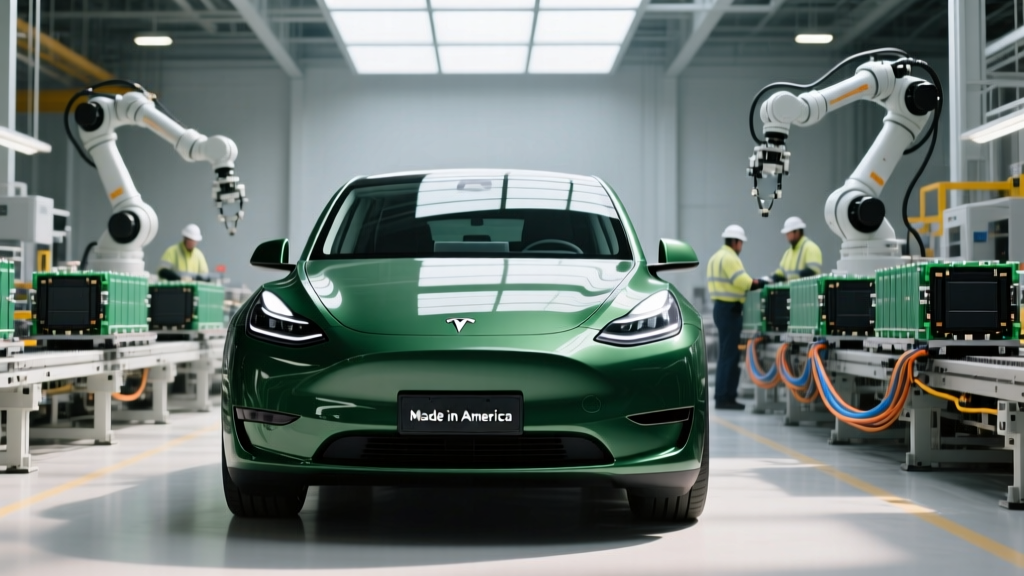
For US buyers: If you purchase a Model Y or Model 3 in the United States, your vehicle was almost certainly assembled at either Fremont or Giga Texas. Tesla does not import Shanghai- or Berlin-built vehicles to the US market. The Cybertruck is exclusively a Giga Texas product.
What "Made in America" Means for the Federal EV Tax Credit
Assembly location is only one piece of the IRS §30D federal tax credit puzzle. Under current 2026 rules, a Tesla must satisfy three separate requirements to unlock the full $7,500 credit:
- Final assembly in North America — All US-market Teslas qualify (Fremont, Giga Texas, Giga Nevada).
- MSRP caps — Vans/SUVs/pickups: ≤$80,000. Sedans: ≤$55,000. (All current Model Y trims qualify; Model S/X do not.)
- Buyer income limits — AGI ≤$150,000 (single), ≤$225,000 (head of household), ≤$300,000 (joint).
- Battery component sourcing — Increasingly strict critical-mineral and battery-component rules tied to US free-trade-agreement partners. Tesla's shift toward LFP batteries from CATL (China) has complicated eligibility for some trims in prior years.
As of the 2026 model year, the Model Y Long Range AWD and Performance trims qualify for the full $7,500 federal credit at point of sale, while the base Rear-Wheel Drive trim's eligibility can depend on the specific battery batch and its mineral sourcing. Always verify current eligibility on IRS.gov's clean vehicle credits page before purchase, as sourcing rules tighten annually.
2026 Tesla Model Y: The American-Built Bestseller Reviewed
The Model Y remains Tesla's volume leader and the best-selling EV in the US. Built at both Fremont and Giga Texas, the 2026 refresh (internally called "Juniper") brought a redesigned interior, improved suspension, and a revised battery pack. Here's the full spec breakdown:
| Specification | Model Y RWD | Model Y Long Range AWD | Model Y Performance |
|---|---|---|---|
| EPA Range | 277 mi | 320 mi | 295 mi |
| Battery (usable) | ~60 kWh (LFP) | ~78 kWh (NMC) | ~78 kWh (NMC) |
| Drivetrain | RWD (single motor) | AWD (dual motor) | AWD (dual motor) |
| Horsepower | 295 hp | 384 hp | 456 hp |
| 0-60 mph | 6.6 sec | 4.8 sec | 3.5 sec |
| Max DC Fast Charge | 170 kW | 250 kW | 250 kW |
| 10-80% DC Charge | ~28 min | ~22 min | ~22 min |
| Level 2 Home Charge | 11.5 kW (~44 mi/hr) | 11.5 kW (~44 mi/hr) | 11.5 kW (~44 mi/hr) |
| Efficiency | 133 MPGe (26 kWh/100mi) | 122 MPGe (28 kWh/100mi) | 115 MPGe (30 kWh/100mi) |
| Base MSRP | $44,990 | $49,990 | $53,990 |
| Price After $7,500 Credit* | $37,490* | $42,490 | $46,490 |
*RWD credit eligibility varies by battery sourcing batch. Verify on IRS.gov before purchase.
Charging Speed: What You'll Actually Experience
Tesla's Supercharger network remains the gold standard for public DC fast charging, and the 2026 Model Y takes full advantage of it. Here's the realistic charging picture:
| Charging Level | Power | Miles Added Per Hour | Typical Use Case |
|---|---|---|---|
| Level 1 (120V outlet) | ~1.4 kW | ~5 mi/hr | Emergency/overnight trickle |
| Level 2 (240V, 48A) | 11.5 kW | ~44 mi/hr | Home daily charging (8-10 hr full charge) |
| DC Fast (Supercharger V3/V4) | Peak 250 kW | ~1,000 mi/hr at peak | Road trips; 10-80% in ~22 min (LR/AWD) |
| DC Fast (CCS adapter, 3rd-party) | Up to 250 kW | Varies by station | Electrify America, EVgo, etc. |
Charging curve reality: The 250 kW peak on Long Range and Performance trims is a peak, not a sustained rate. The battery management system tapers charging speed significantly above 60% State of Charge (SoC). Expect roughly 15 minutes to go from 10-60%, then another 7 minutes to reach 80%. Charging from 80-100% on DC fast charging is painfully slow and should be reserved for Level 2 home sessions. Preconditioning the battery (automatic when you navigate to a Supercharger) is essential for hitting peak charge rates — skip it and you may see only 120-150 kW even at a 250 kW stall.
The RWD model's LFP battery charges at a lower peak rate (170 kW) but has one distinct advantage: Tesla recommends charging LFP batteries to 100% regularly, unlike NMC batteries which are best kept between 20-80% for longevity. This means the RWD's usable daily range is closer to its EPA sticker than the Long Range's.
Interior, Cargo, and Tech: Practical Ownership
The 2026 Juniper refresh addressed many of the prior Model Y's interior complaints. Ambient lighting, ventilated front seats, a rear touchscreen for passengers, and substantially improved sound deadening bring the cabin closer to premium-EV competitors like the Hyundai Ioniq 5 and BMW iX.
| Dimension | Measurement |
|---|---|
| Cargo (rear seats up) | 30.2 cu ft |
| Cargo (rear seats folded) | 72.0 cu ft |
| Front Legroom | 41.8 in |
| Rear Legroom | 37.0 in |
| Frunk (front trunk) | 4.1 cu ft |
Standout tech features:
- 15.4-inch center touchscreen running Tesla's latest software with native streaming, gaming, and trip planner
- Autopilot (Level 2 driver assist) standard — adaptive cruise + lane centering on highways
- Full Self-Driving (Supervised) available as a $8,000 option or $99/month subscription — still Level 2, requires active driver supervision at all times
- Sentry Mode dashcam recording, Dog Mode climate control, and phone-as-key
- Heat pump standard — significantly reduces winter range loss compared to resistive heating
Notable drawbacks:
- No physical buttons or stalks — turn signals are on the steering wheel, gear selection is via screen (a learning curve and safety debate)
- Ride quality on Performance trim is firm; 21-inch wheels amplify road imperfections
- Panel gap consistency has improved but still trails legacy luxury automakers
- No Apple CarPlay or Android Auto — Tesla's native OS only
- Insurance premiums remain 15-30% higher than comparable non-Tesla EVs in most states
Who Should Buy the 2026 Model Y?
- You regularly drive 200+ miles between charges (road trips, rural commutes)
- You live in a region with cold winters and need AWD traction
- You want the best balance of range, performance, and Supercharger access
- Your daily commute is under 80 miles round-trip with reliable home charging
- You want the lowest entry price and prefer LFP battery longevity
- You live in a mild climate and don't need AWD
- You want Apple CarPlay, physical controls, or a more traditional cabin layout
- You need more than 72 cu ft of cargo volume for large family gear
- You prefer a dealership service network over Tesla's mobile-ranger/service-center model
Warranty and Long-Term Ownership
| Coverage | Terms |
|---|---|
| Basic Vehicle | 4 years / 50,000 miles |
| Battery & Drive Unit (RWD, LFP) | 8 years / 100,000 miles (min 70% retention) |
| Battery & Drive Unit (LR/Perf, NMC) | 8 years / 120,000 miles (min 70% retention) |
Tesla's battery warranty guarantees at least 70% capacity retention during the warranty period. Real-world data from high-mileage Tesla owners suggests NMC packs in the Model Y typically lose 8-12% capacity over the first 100,000 miles, with degradation slowing significantly after the initial break-in period. LFP batteries in the RWD model show even less degradation — often 5-8% over the same distance — and tolerate regular 100% charging without accelerated wear.
For a deeper understanding of LFP versus NMC chemistry trade-offs, see our battery technology explainer referencing DOE data.
Pros and Cons at a Glance
- Best-in-class Supercharger network access (17,000+ stalls in North America)
- Strong EPA efficiency (26-30 kWh/100mi) means lower charging costs
- LFP RWD option offers excellent battery longevity and daily 100% charging
- Over-the-air updates continuously add features post-purchase
- Assembled in the US (Fremont/Texas) — supports §30D tax credit
- Class-leading cargo volume for a crossover (72 cu ft seats-down)
- Steering-wheel turn signals and screen-only gear selection are polarizing
- No Apple CarPlay/Android Auto integration
- Insurance costs are above segment average
- Performance trim ride quality is harsh on rough roads
- FSD (Supervised) remains Level 2 despite its name — $8,000 for advanced cruise
- RWD trim tax credit eligibility can vary by battery batch
Frequently Asked Questions
Are all Teslas sold in the US made in America?
Yes. Every Tesla sold in the United States is assembled at either the Fremont, California factory or Gigafactory Texas in Austin. Tesla's Shanghai and Berlin factories serve their respective regional markets and do not export vehicles to the US.
What is the real-world range of the 2026 Model Y?
The EPA rates the Long Range AWD at 320 miles, but real-world highway driving at 75 mph typically yields 265-280 miles. In cold weather (below 30°F), expect 220-250 miles. The RWD model's 277-mile EPA rating translates to roughly 230-250 real-world miles in mixed conditions, but its LFP battery handles cold and daily 100% charging better than NMC.
How fast does the Model Y charge at home and on road trips?
At home on a 240V Level 2 charger (48A/11.5 kW), the Model Y adds about 44 miles of range per hour — a full overnight charge takes 7-10 hours. On a Tesla Supercharger V3/V4, the Long Range and Performance models peak at 250 kW and charge from 10-80% in approximately 22 minutes. The RWD peaks at 170 kW with a 10-80% time of about 28 minutes.
Does the 2026 Tesla Model Y qualify for the $7,500 federal EV tax credit?
The Model Y Long Range AWD and Performance trims currently qualify for the full $7,500 federal tax credit (applied at point of sale), provided the buyer meets IRS income caps (≤$150K single, ≤$300K joint) and the vehicle MSRP is under $80,000 (it is). The RWD trim's eligibility depends on battery component sourcing, which can vary by production batch. Always verify on IRS.gov before purchasing.
Is the Model Y worth buying over competitors like the Ioniq 5 or Mach-E?
The Model Y wins on Supercharger network access, cargo space, and software ecosystem. The Hyundai Ioniq 5 offers faster 800V charging architecture (10-80% in ~18 min), Apple CarPlay, and a more comfortable ride. The Ford Mustang Mach-E provides a more traditional interior with physical controls. If Supercharger reliability and Tesla's software are priorities, the Model Y remains the default choice. If ride comfort, CarPlay, or ultra-fast CCS charging matter more, test-drive the Ioniq 5.
How long will the Model Y battery last?
Tesla warranties the battery for 8 years / 100,000 miles (RWD) or 8 years / 120,000 miles (Long Range/Performance) with a minimum 70% capacity retention guarantee. Real-world data from high-mileage owners shows typical degradation of 8-12% over 100,000 miles for NMC packs and 5-8% for LFP packs. Many Model Y batteries are projected to retain 80%+ capacity at 200,000 miles with proper charging habits (avoiding prolonged 100% storage on NMC, minimizing DC fast charging to 100%).
Are Tesla's battery materials sourced in America?
Partially. Tesla sources lithium and other critical minerals from multiple countries including Australia, Chile, and China. Some LFP battery cells used in the RWD Model Y are manufactured by CATL in China, which has periodically affected §30D tax credit eligibility as US battery-sourcing rules tighten. Tesla's Nevada Gigafactory produces drive units and some battery components domestically, and the company is ramping up domestic lithium refining partnerships. For the latest critical-mineral sourcing requirements, consult the IRS clean vehicle credit guidance.