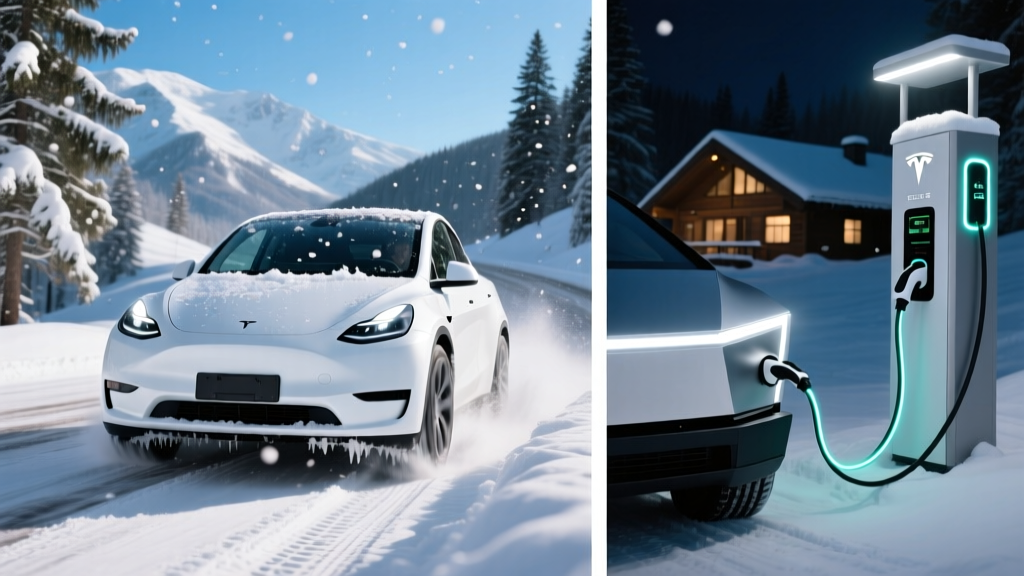
If you live above the 38th parallel or commute through lake-effect snow belts, the question isn't whether an EV can survive winter — it's whether it can thrive. Tesla's dual-motor all-wheel-drive system, standard heat pump, and battery preconditioning give it structural advantages over many competitors, but cold weather still exacts a toll on range, charging speed, and efficiency. Here's what 2026 Tesla ownership actually looks like when the temperature drops below freezing.
Which Tesla Models Handle Snow Best?
Tesla sells four consumer vehicles in the U.S. for the 2026 model year, and not all of them are equally suited to winter driving. The critical variable is drivetrain: dual-motor AWD provides independent torque vectoring to front and rear axles, which translates to better traction on snow-packed roads and ice than any single-motor RWD configuration.
| Model | AWD Available | Ground Clearance | EPA Range (AWD) | Starting MSRP |
|---|---|---|---|---|
| Model 3 Long Range AWD | Yes | 5.5 in | 363 mi | $47,740 |
| Model Y Long Range AWD | Yes | 6.6 in | 320 mi | $46,630 |
| Model X Dual Motor AWD | Yes (standard) | 8.1 in (adaptive) | 327 mi | $79,990 |
| Cybertruck AWD | Yes (standard) | 16.1 in (max) | 340 mi | $79,990 |
For most snow-belt buyers, the Model Y Long Range AWD strikes the best balance of traction, cargo practicality, and price. The Model X offers more ground clearance and an adaptive air suspension that can raise the body for deep snow, but its $80k starting price puts it in a different buying category. The Model 3's lower ride height (5.5 inches) can be a liability in unplowed driveways or after heavy accumulations.
Real-World Winter Range: What the EPA Sticker Doesn't Tell You
The EPA range estimate assumes moderate temperatures (roughly 68°F), mixed city/highway driving, and no climate-control load. Winter introduces three compounding range penalties: battery chemistry slows in cold (increasing internal resistance), cabin heating draws significant energy, and denser cold air increases aerodynamic drag.
EPA rated: 320 miles (75 kWh usable, NMC chemistry)
Real-world summer mixed driving: ~290–310 miles
Real-world winter (20°F, highway 70 mph, cabin heat on): ~220–250 miles
Extreme cold (0°F, short trips, frequent cabin reheating): ~180–210 miles
Source: Owner-reported data aggregated by fueleconomy.gov and independent winter testing.
Tesla's heat pump — standard on all current models — is a significant advantage here. Unlike older resistive heaters that convert electricity directly to heat at a 1:1 ratio, the heat pump scavenges ambient thermal energy and can deliver 3–4 units of heat per unit of electricity consumed. In practical terms, this means roughly 30% less energy spent on cabin heating compared to EVs still using PTC resistive heaters, which translates to 15–25 extra miles of range on a cold day.
Battery preconditioning is another critical Tesla feature. When you navigate to a Supercharger in the Tesla app or in-car navigation, the car begins warming the battery pack 15–30 minutes before arrival. A warm battery charges faster and operates more efficiently. In winter, preconditioning before departure (while the car is still plugged in at home) means you leave with a warm battery and full cabin, using grid electricity instead of range-robbing battery power.
Charging in Cold Weather: Speed, Strategy, and the Curve
Cold batteries charge slowly — this is basic electrochemistry. Lithium-ion cells resist accepting charge when cold, and Tesla's battery management system (BMS) will deliberately limit charge rates to protect the cells from lithium plating, a degradation mechanism where metallic lithium deposits on the anode instead of intercalating properly.
| Charging Level | Max Power | Speed / Time | Winter Note |
|---|---|---|---|
| Level 1 (120V) | 1.4 kW | ~3–4 mi/hr | Negligible; not viable for daily use |
| Level 2 (240V home) | 11.5 kW (48A) | ~36 mi/hr; full charge ~9 hrs | Preconditioning draws from grid, not battery |
| DC Fast (V3 Supercharger) | 250 kW peak | 10–80% in ~25 min (warm) | Add 10–15 min if battery is cold and not preconditioned |
| DC Fast (V4 Supercharger) | 250+ kW | 10–80% in ~22 min (warm) | Longer cable, CCS-adapter friendly |
The charge curve matters as much as the peak number. The Model Y Long Range peaks at 250 kW only between roughly 10–30% State of Charge (SoC), then tapers progressively: ~175 kW at 50%, ~100 kW at 70%, and ~40 kW above 85%. In winter, the entire curve shifts rightward — meaning you spend more time at lower charge rates unless you precondition.
Winter charging strategy: Always navigate to a Supercharger using the in-car nav (triggers preconditioning). Charge from 10–80% rather than topping off to 100% — the last 20% takes nearly as long as the first 60%. For daily driving, set your charge limit to 80% and plug in every night at a Level 2 home charger; the battery stays within its ideal SoC window, and you wake up with a warm, full-charge-every-morning routine that eliminates range anxiety.
Snow Traction, Handling, and the AWD Advantage
Tesla's dual-motor AWD system uses two independent electric motors — one on each axle — with no mechanical linkage between them. Torque distribution is managed electronically, with adjustments happening in milliseconds. This is fundamentally faster than any mechanical AWD system that relies on viscous couplings or clutch packs to redirect torque.
In practical winter driving, this means:
- Launch traction: Instant torque to all four wheels with no drivetrain lag. On snow-covered intersections, Teslas accelerate cleanly while RWD and some FWD vehicles spin wheels.
- Stability control: Regenerative braking can be modulated per-wheel, effectively acting as a traction control system that recaptures energy while maintaining grip.
- Low center of gravity: The battery pack sits beneath the floor, giving Teslas a lower center of gravity than comparable ICE crossovers. This reduces body roll and improves stability on icy curves.
AWD improves acceleration and traction — it does not improve braking distance. On ice and packed snow, a Tesla's ~4,400 lb curb weight (Model Y) means longer stopping distances than lighter vehicles. Winter tires are the single most impactful upgrade for cold-climate Tesla owners. Tesla sells approved winter tire packages, and brands like Nokian Hakkapeliitta and Michelin X-Ice are popular among owners in Minnesota, Wisconsin, and New England.
Tesla's traction control settings include a "Slip Start" mode that allows a small amount of wheel spin to dig through loose snow to find pavement grip — useful when stuck in a snowbank. The Stability Control system is always active and cannot be fully disabled, which is a safety-positive for most drivers but can feel intrusive on unplowed roads where some controlled slip is desirable.
Tech Features That Matter in Winter
Beyond the powertrain, several Tesla-specific features make winter ownership more manageable:
- Scheduled Departure / Preconditioning: Set a departure time in the Tesla app, and the car warms the battery, cabin, and even defrosts windows while still on grid power. You step into a 70°F car with maximum range — no scraping ice, no idling to warm up.
- Heated everything: All 2026 Teslas include heated front and rear seats, a heated steering wheel, and heated side mirrors. Seat heaters use far less energy (~50W per seat) than cabin air heating (~2–4 kW), so using them on mild cold days preserves range.
- Over-the-air (OTA) updates: Tesla regularly ships software updates that improve thermal management algorithms, heat pump efficiency, and traction control logic — improvements that competing EVs typically can't match without a dealer visit.
- Sentry Mode / Dog Mode / Camp Mode: Useful in winter for keeping the cabin warm for pets or maintaining battery temperature during extended stops.
On the driver-assist front, Tesla's Autopilot and FSD (Supervised) are SAE Level 2 systems — they require active driver supervision at all times. In winter conditions with obscured lane markings, heavy snow, or icy road surfaces, these systems will frequently disengage and alert the driver to take over. This is by design and is the correct behavior; however, it means you cannot rely on Autopilot to reduce workload in the worst winter conditions.
Tesla Autopilot and FSD (Supervised) provide steering, acceleration, and braking assistance, but the driver must remain fully engaged, hands on or near the wheel, and eyes on the road. These are not self-driving systems. Level 4 driverless capability (no human required) currently exists only in geofenced robotaxi services like Waymo — not in any consumer vehicle.
Pricing, Tax Credits, and Total Winter Cost
The 2026 Tesla Model Y Long Range AWD starts at $46,630 (including destination). The Model 3 Long Range AWD starts at $47,740. Both fall under the $80,000 MSRP cap for SUVs/trucks (Model Y) and the $55,000 cap for sedans (Model 3) under the IRS §30D federal tax credit.
| Requirement | Model Y LR AWD | Model 3 LR AWD |
|---|---|---|
| MSRP cap | $80,000 (SUV) ✓ | $55,000 (sedan) ✓ |
| Buyer income cap (AGI) | $150k single / $300k joint | $150k single / $300k joint |
| Battery sourcing (critical minerals) | Varies by build week — check VIN at purchase | Varies by build week — check VIN at purchase |
| North American final assembly | Fremont, CA ✓ | Fremont, CA ✓ |
| Max credit amount | Up to $7,500 | Up to $7,500 |
| Point-of-sale transfer | Yes — reduces purchase price at delivery | Yes — reduces purchase price at delivery |
Critical caveat: The §30D credit has battery component and critical mineral sourcing requirements that change annually. A vehicle that qualifies in January may not qualify in June if Tesla's supply chain shifts. Always verify eligibility for your specific VIN at fueleconomy.gov before purchasing, and consult a tax professional for your personal situation. The point-of-sale transfer option (effective 2024) lets you apply the credit as a down-payment reduction at delivery rather than waiting to claim it on your tax return.
| Item | Cost |
|---|---|
| Base MSRP (Long Range AWD) | $46,630 |
| Full Self-Driving (Supervised) | +$8,000 |
| 19" Gemini Wheels (better winter range) | Included |
| Pearl White Multi-Coat Paint | +$1,500 |
| Destination Fee | Included |
| As-Tested Total | $56,130 |
| Estimated §30D Credit (if eligible) | −$7,500 |
| Effective Price After Credit | ~$48,630 |
Who Should Buy a Tesla for Snow Driving?
- You have access to home Level 2 charging (the single most important factor for winter EV ownership)
- Your daily winter commute is under 100 miles round-trip
- You value instant cabin preconditioning and never scraping ice off a cold car
- You want the lowest per-mile energy cost — Tesla's efficiency (27–28 kWh/100mi for Model Y) is among the best in the segment
- Supercharger network access matters for your road-trip patterns
- You need more than 6.6 inches of ground clearance for unplowed roads (look at Rivian R1S or Model X)
- You want physical buttons, Apple CarPlay, or a more traditional dealership service experience
- You frequently tow in winter (towing in cold reduces range by an additional 30–40%)
- Your budget is under $40k (consider a used Model 3 or wait for the next-generation Tesla platform)
Biggest Pros and Cons for Winter Ownership
- Dual-motor AWD with millisecond torque vectoring — excellent snow traction
- Heat pump standard on all models — best-in-class winter efficiency
- Scheduled preconditioning — warm car, full battery, no ice scraping
- Supercharger network — most reliable public DC charging in North America
- OTA updates continuously improve thermal management
- Low center of gravity — stable handling on icy roads
- Heated seats, steering wheel, and mirrors standard
- 25–35% range loss in sub-freezing temperatures is real and unavoidable
- Ground clearance (5.5–6.6 in) insufficient for deep unplowed snow
- Cold DC charging is slower without proper preconditioning discipline
- No physical buttons — touchscreen-only climate controls can be distracting with gloves
- Autopilot/FSD frequently disengages in snow/ice (correct but frustrating)
- Winter tires are a necessary additional expense (~$800–$1,200 for a set)
- Panel gaps and door handles can freeze shut in ice storms (known owner complaint)
Warranty and Long-Term Battery Health in Cold Climates
Tesla's battery and drive unit warranty covers 8 years or 120,000 miles (whichever comes first) for the Model 3 and Model Y Long Range, with a guaranteed minimum 70% capacity retention over that period. The Model X and Cybertruck carry an 8-year/150,000-mile battery warranty.
Cold weather itself does not significantly accelerate battery degradation — Tesla's BMS actively prevents the battery from operating in damaging temperature ranges. What does cause long-term degradation is consistently charging to 100% and storing the battery at high SoC in extreme heat. For NMC chemistry (used in the Long Range models), Tesla recommends a daily charge limit of 80% and only charging to 100% before long trips. The Standard Range / RWD models use LFP (lithium iron phosphate) chemistry, which tolerates 100% daily charging without degradation concerns — but those models are RWD-only and less ideal for snow.
Battery replacement costs, should you need one outside warranty, currently range from $12,000–$16,000 for a Model Y pack at a Tesla service center, though most packs are lasting well beyond 150,000 miles with less than 15% degradation based on fleet data.
Frequently Asked Questions
Do Teslas lose range in the snow?
Yes. Expect 25–35% range reduction in sustained sub-freezing temperatures compared to the EPA estimate. A Model Y Long Range rated at 320 miles will realistically deliver 220–250 miles in typical winter highway driving at 20°F. The heat pump, preconditioning, and seat heaters help minimize this loss.
Are Teslas good in the snow compared to gas AWD vehicles?
For acceleration and traction, yes — Tesla's dual-motor AWD provides instant, independently controlled torque that outperforms most mechanical AWD systems. For ground clearance and deep-snow capability, traditional SUVs with 8+ inches of clearance still have an edge unless you opt for the Model X air suspension or Cybertruck.
Do I need winter tires on a Tesla?
Strongly recommended if you regularly drive below 40°F or on snow/ice. Tesla's stock all-season tires (typically Michelin Pilot Sport All-Season or Hankook Ventus S1) are adequate for light snow but compromise braking and cornering grip in sustained winter conditions. A dedicated winter tire reduces braking distances on ice by 25–40%.
Can I charge my Tesla at home in freezing weather?
Yes, and you should. Level 2 home charging (11.5 kW / 48A) works in any temperature. Keeping your Tesla plugged in overnight allows preconditioning to draw from the grid instead of the battery, meaning you leave every morning with a warm battery and cabin at full range.
Does Autopilot work in snow?
Autopilot and FSD (Supervised) are SAE Level 2 systems that rely on camera vision. Heavy snow, obscured lane markings, and icy road surfaces will cause frequent disengagements. Tesla explicitly warns drivers to maintain full control in adverse conditions. Treat Autopilot as unavailable in active snowfall.
How much does it cost to charge a Tesla in winter?
Home Level 2 charging at the U.S. average electricity rate of $0.17/kWh costs roughly $12.75 for a full 75 kWh charge (Model Y). Winter efficiency drops to roughly 32–35 kWh/100mi (from 27–28 kWh/100mi in summer), so per-mile cost rises from ~$0.046 to ~$0.058. That's still roughly 60% cheaper per mile than a comparable gas AWD SUV at $3.20/gallon.
Which Tesla model is best for snow?
The Model Y Long Range AWD offers the best combination of price ($46,630), ground clearance (6.6 in), range (320 mi EPA), and cargo space (76 cu ft with seats folded). For deep-snow areas, the Model X with adaptive air suspension (up to 8.1 in clearance) is superior but costs nearly twice as much.
Sources: fueleconomy.gov (EPA range/efficiency data), IRS §30D clean vehicle credit guidelines, Tesla.com official specifications (2026 model year).