The Short Answer: Tesla Repair Costs in 2026
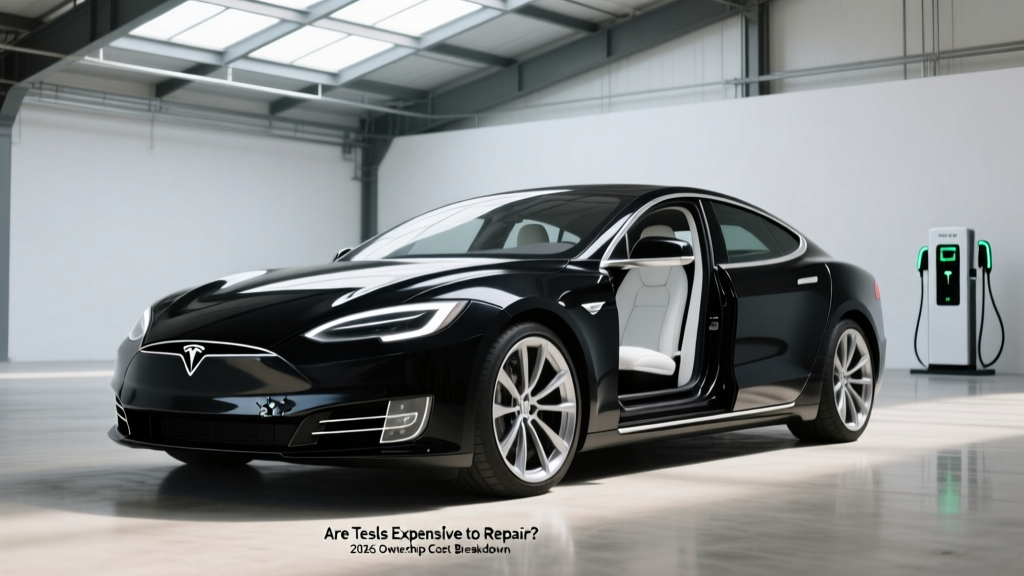
The question "are Teslas expensive to repair?" doesn't have a single yes-or-no answer — it depends entirely on what breaks. Routine maintenance on a Tesla is dramatically cheaper than any gas car. But when something goes wrong outside of warranty — a battery module, a drive unit, a structural casting, or a sensor suite — the bills can be eye-watering. Here's the reality across the 2026 Tesla lineup, backed by warranty terms, real-world owner data, and service economics.
To ground this analysis, we'll use the highest-volume Tesla most buyers consider: the 2026 Tesla Model Y Long Range AWD, while pulling in comparative data from the Model 3, Model S, and Model X where repair costs diverge significantly.
2026 Tesla Model Y Long Range: The Spec Sheet
| Spec | 2026 Model Y Long Range AWD |
|---|---|
| EPA Range | 320 miles |
| Battery Capacity | 78.1 kWh usable (NMC chemistry) |
| Drivetrain | Dual Motor AWD |
| Horsepower | 384 hp (combined) |
| 0–60 mph | 4.8 seconds |
| Peak DC Fast Charge | 250 kW (V3 Supercharger) |
| 10–80% DC Time | ~25 minutes |
| Level 2 Home Charging | 11.5 kW (~44 miles/hr) |
| Efficiency | 122 MPGe combined / 28 kWh/100mi |
| Cargo Volume | 76.2 cu ft (rear seats folded) |
| Rear Legroom | 41.6 inches |
| Base MSRP | $44,990 (before destination) |
| Battery Warranty | 8 years / 120,000 miles (≥70% retention) |
| Basic Vehicle Warranty | 4 years / 50,000 miles |
Where Teslas Save You Money: Routine Maintenance
Electric vehicles eliminate the entire internal-combustion maintenance schedule. No oil changes, no spark plugs, no timing belts, no transmission fluid flushes, no exhaust system repairs. Tesla's recommended service intervals are minimal:
- Cabin air filter: Every 2–3 years (~$50–$80 DIY, ~$120–$150 at service)
- HEPA filter (if equipped): Every 3 years (~$100–$150)
- Tire rotation: Every 6,250 miles (~$35–$60)
- Brake fluid check: Every 2 years (test for contamination; replacement ~$150–$200 if needed)
- AC desiccant bag: Every 3–6 years depending on model (~$150–$300)
- Windshield washer fluid: Owner-filled
Tesla estimates annual maintenance costs at roughly $200–$400 per year — compared to $1,200–$1,800/year for a comparable gas-powered SUV according to fueleconomy.gov total cost data. Regenerative braking also extends brake pad life enormously; many Tesla owners report original brake pads at 80,000+ miles because the motor handles most deceleration.
Information gain: The biggest routine cost surprise for new Tesla owners is tires. EVs are heavier (the Model Y Long Range weighs ~4,400 lbs) and deliver instant torque, which accelerates tire wear. Expect to replace tires every 25,000–35,000 miles rather than the 40,000–50,000 miles typical on gas crossovers. A set of four Michelin Pilot Sport All-Season 4s or equivalent EV-rated tires runs $900–$1,400 installed.
Where Teslas Cost Serious Money: Out-of-Warranty Repairs
Here's where the "are Teslas expensive to repair" question gets a resounding yes — for specific, high-cost components. Once the basic 4-year/50,000-mile warranty expires, these are the repair categories that generate five-figure invoices:
Battery Pack Replacement
This is the fear every prospective EV buyer carries. Tesla's battery warranty covers 8 years/120,000 miles (Long Range/Performance) or 8 years/100,000 miles (RWD with LFP) with a minimum 70% capacity retention threshold. If your battery degrades below that threshold within the warranty period, Tesla replaces or refurbishes it at no cost.
Out of warranty? A full battery pack replacement runs:
- Model 3/Y: $12,000–$16,000 (parts + labor)
- Model S/X: $18,000–$25,000+ (larger packs, more complex integration)
However, complete pack failure is rare. Data aggregated from owner reports and Recurrent Auto shows that Tesla NMC batteries typically retain 85–90% capacity at 100,000 miles, with LFP batteries (Model 3 RWD) showing even slower degradation curves. Catastrophic failure rates are well under 1% in the first 8 years.
Drive Unit (Motor) Replacement
Tesla's drive units are covered under the same 8-year/120,000-mile powertrain warranty. Out of warranty, replacement costs $5,000–$9,000 per unit. Dual-motor vehicles have two, though it's uncommon for both to fail simultaneously. Drive unit failures are infrequent but not unheard of, particularly on early-production vehicles.
Touchscreen / Infotainment (MCU)
The central 15.4-inch touchscreen is essentially the car's entire control interface — HVAC, navigation, media, vehicle settings, and even the speedometer all live here. MCU failures outside warranty typically cost $1,500–$2,500 for parts and labor. Earlier Model S/X vehicles had well-documented MCU1 failures (yellowing, delamination), which led to a recall. The current MCU4 hardware in 2026 models is significantly more robust.
Sensor Suite and Autopilot Hardware
The 2026 Tesla vision-only architecture (Tesla removed ultrasonic sensors and radar beginning in 2022–2023) relies on cameras for Autopilot and FSD (Supervised). Camera replacements run $300–$600 each. Windshield replacements — which require camera recalibration — cost $800–$1,500 depending on glass availability. The camera-based system is actually cheaper to repair than the lidar/radar suites on some competitors.
Body and Collision Repair
This is where Tesla repair costs consistently shock owners. Tesla uses large single-piece "gigacastings" for the Model Y's front and rear underbody structures. These reduce manufacturing cost and weight but create a binary outcome in collisions: if a gigacasting is damaged, the vehicle is often declared a total loss because the casting cannot be section-repaired like traditional stamped steel.
Even minor collision repairs carry premium costs:
- Bumper cover replacement + paint: $1,500–$3,000
- Fender/quarter panel: $2,000–$5,000
- Headlight assembly (single): $1,200–$2,000
- Windshield: $800–$1,500
Tesla's direct-to-consumer model means no third-party parts ecosystem comparable to legacy automakers. You're largely locked into Tesla-approved body shops with Tesla-sourced parts, which keeps prices elevated. Insurance premiums reflect this — Tesla insurance costs 20–40% more than comparable gas vehicles according to industry analyses.
Tesla Repair Costs vs. Key Competitors
| Repair Category | Tesla Model Y | Ford Mustang Mach-E | Hyundai Ioniq 5 |
|---|---|---|---|
| Battery (out of warranty) | $12,000–$16,000 | $15,000–$22,000 | $12,000–$18,000 |
| Drive unit replacement | $5,000–$9,000 | $6,000–$10,000 | $5,000–$8,000 |
| Annual routine maintenance | $200–$400 | $250–$500 | $200–$400 |
| Brake job (pads + rotors) | $400–$700 (rarely needed) | $500–$800 | $400–$700 |
| Tire set (EV-rated) | $900–$1,400 | $800–$1,300 | $800–$1,200 |
| Battery warranty | 8 yr / 120,000 mi | 8 yr / 100,000 mi | 10 yr / 100,000 mi |
| Basic warranty | 4 yr / 50,000 mi | 3 yr / 36,000 mi | 5 yr / 60,000 mi |
| Collision parts access | Tesla-only network | Dealer + aftermarket | Dealer + aftermarket |
The key takeaway: Tesla's battery and drivetrain reliability are competitive with or better than rivals, but its collision repair ecosystem is more expensive due to proprietary parts, gigacasting design, and a limited body-shop network. Hyundai's 10-year battery warranty is the strongest in the segment, while Ford's broader dealer network makes body repairs more accessible.
Tesla Warranty Coverage: What's Protected and What Isn't
Understanding the warranty is essential to answering whether Teslas are expensive to repair, because most catastrophic costs fall within the coverage window for typical ownership periods.
- Basic Vehicle Limited Warranty: 4 years / 50,000 miles — covers virtually everything except wear items (tires, wiper blades, brake pads, 12V battery)
- Battery & Drive Unit Warranty (Long Range/Performance): 8 years / 120,000 miles, minimum 70% capacity retention
- Battery & Drive Unit Warranty (RWD/LFP): 8 years / 100,000 miles, minimum 70% capacity retention
- Restraint System: 5 years / 60,000 miles
- Corrosion: 12 years with no mileage limit (perforation only, not surface rust)
What's NOT covered: Cosmetic issues, damage from misuse, modifications, aftermarket parts, environmental damage (hail, floods), and normal wear items. The 12V lithium auxiliary battery has been a point of contention — failures in earlier Model S/X vehicles occurred within the basic warranty window, but replacement out of warranty costs $400–$800.
Practical advice: If you plan to keep a Tesla beyond 4 years/50,000 miles, an extended service agreement (offered directly by Tesla at purchase or within the warranty period) can cover the gap. Pricing varies but typically runs $3,000–$5,000 for an additional 2–4 years of coverage.
Federal Tax Credit and Total Cost Context
Repair cost concerns should be weighed against the total ownership picture, including purchase incentives. The 2026 Tesla Model Y Long Range AWD is priced at $44,990 (before the $1,390 destination fee), which falls under the IRS §30D MSRP cap of $80,000 for SUVs/pickups/vans and $55,000 for sedans (Model 3 qualifies under the sedan cap).
However, eligibility for the full $7,500 federal tax credit is not guaranteed. Per current IRS §30D rules, the credit depends on:
- Buyer income caps: $150,000 single / $225,000 head of household / $300,000 joint (modified AGI)
- Battery sourcing requirements: Critical minerals and battery components must meet escalating domestic-content thresholds that increase each year
- Point-of-sale transfer: Since 2024, buyers can transfer the credit to the dealer for an instant price reduction at purchase
- MSRP verification: Confirm the vehicle's classification (sedan vs. SUV) on the IRS eligible vehicle list
As of early 2026, certain Tesla configurations qualify for the full $7,500 credit while others qualify for $3,750 or $0 depending on battery-sourcing compliance for that production batch. Always verify current eligibility on the IRS website before purchasing — sourcing rules change as supply chains shift.
If you qualify for the full credit and transfer it at point of sale, the Model Y Long Range's effective price drops to approximately $38,880 (including destination). That context matters when weighing potential repair costs against total cost of ownership.
Who Should (and Shouldn't) Worry About Tesla Repair Costs
- You plan to own the vehicle within the 8-year/120,000-mile battery & drivetrain warranty window
- You carry comprehensive insurance with a reasonable deductible
- You prioritize low routine maintenance costs ($200–$400/yr vs. $1,200+/yr for gas)
- You charge at home and avoid public charging markups
- You live near a Tesla Service Center or mobile-service area
- You plan to keep the vehicle 10+ years or beyond 120,000 miles
- You live in a collision-prone area (high hail, dense urban traffic, deer corridors)
- You lack access to Tesla-certified body shops in your region
- You prefer the competitive aftermarket parts ecosystem of legacy brands
- You self-insure or carry liability-only coverage on older vehicles
Frequently Asked Questions
What is the most expensive repair on a Tesla?
A full battery pack replacement out of warranty is the single most expensive repair: $12,000–$16,000 for Model 3/Y and up to $25,000 for Model S/X. However, catastrophic battery failure is statistically rare (well under 1%), and the 8-year/120,000-mile warranty covers degradation below 70% capacity retention.
Do Teslas break down more or less than gas cars?
Less often, for mechanical systems. EVs have far fewer moving parts — no engine, transmission, exhaust, or fuel system. Consumer Reports and J.D. Power data consistently show Tesla powertrain reliability is strong. The issues that arise tend to be body/trim-related (panel gaps, paint quality) or electronic (touchscreen, sensors) rather than mechanical breakdowns.
How much does Tesla insurance cost compared to other cars?
Tesla insurance premiums run 20–40% higher than comparable gas vehicles, primarily due to elevated collision-repair costs and proprietary parts. Tesla offers its own insurance product in many states that uses real-time driving data and can be competitive — sometimes 10–20% cheaper than third-party quotes. Always compare both.
Can I take my Tesla to any mechanic for repairs?
For routine maintenance (tire rotation, cabin filter, brake fluid), yes — any competent shop can handle it. For high-voltage system diagnostics, software-related issues, battery service, and drive unit replacement, you must use a Tesla Service Center or Tesla Mobile Service. Body repairs require Tesla-certified shops with access to Tesla's parts portal, which has limited availability in some regions.
Are Tesla parts hard to get?
It depends. Consumables (filters, wiper blades, 12V batteries) are readily available. Collision parts (body panels, gigacastings, headlight assemblies) can have lead times of 2–8 weeks depending on availability and your proximity to a parts depot. This is a persistent complaint among Tesla owners after accidents and is a direct result of Tesla's vertically integrated supply chain.
Is the Tesla extended warranty worth it?
If you plan to own beyond the basic 4-year/50,000-mile window and want predictable costs, the Tesla Extended Service Agreement can provide peace of mind. At $3,000–$5,000, it's a hedge against a single $10,000+ repair. For owners who trade vehicles every 3–4 years, the basic warranty is sufficient.
Do Teslas hold their value considering repair cost concerns?
Tesla depreciation has been steeper than some legacy EV competitors in 2024–2026, driven partly by aggressive new-vehicle price cuts and partly by used-market buyers' awareness of out-of-warranty repair risk. A 3-year-old Model Y typically retains 55–65% of its original MSRP, depending on mileage and condition. Vehicles still under battery warranty command a premium on the used market.
Bottom Line: Are Teslas Expensive to Repair?
Teslas are cheap to maintain and potentially expensive to repair. If you own within the warranty period, carry good insurance, and drive in low-collision-risk environments, your total annual vehicle cost will likely be significantly lower than a gas equivalent — $0.04–$0.06 per mile for electricity vs. $0.12–$0.18 for gas, plus $800–$1,400/year less in maintenance.
The risk concentrates in three areas: out-of-warranty battery replacement (rare but costly), collision repair (more expensive than rivals due to gigacastings and proprietary parts), and the relative lack of a competitive aftermarket for body and electronic components. If those three risks don't apply to your ownership plan — or if you mitigate them with extended warranty and comprehensive insurance — a Tesla's repair-cost profile is a net advantage, not a liability.