If you've searched "are Teslas 4-wheel drive," you're not alone. The short answer is that Tesla doesn't use a traditional 4-wheel-drive (4WD) system with a transfer case and low-range gearing like a body-on-frame truck. Instead, Tesla offers All-Wheel Drive (AWD) through dual-motor and tri-motor powertrains that independently power the front and rear axles. Every current Tesla model is available with AWD, and some are exclusively AWD.
This guide breaks down exactly how Tesla's AWD systems work across the 2026 lineup, what you gain (and give up) versus rear-wheel drive, and how drivetrain choice affects range, price, and federal tax credit eligibility.
How Tesla's Dual-Motor AWD Actually Works
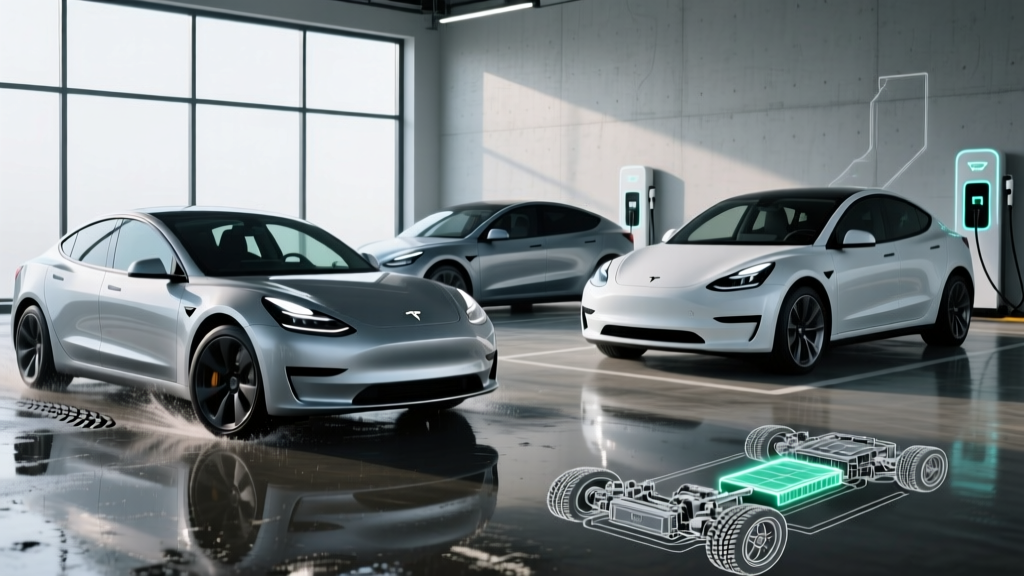
Traditional 4WD systems use a mechanical linkage — a driveshaft and transfer case — to send engine power to all four wheels. Tesla's approach is entirely different. Dual-motor Teslas use one electric motor on the front axle and one on the rear axle, with no mechanical connection between them. A digital control system manages torque distribution hundreds of times per second.
This setup provides several advantages over mechanical 4WD:
- Instant torque vectoring: The system can shift power between axles in milliseconds, faster than any mechanical system.
- No drivetrain loss: Eliminating the driveshaft and transfer case reduces parasitic energy loss, preserving range.
- Lower maintenance: No transfer-case fluid, no U-joints, no front differential in the traditional sense — each motor drives its axle directly through a single-speed reduction gear.
For the Performance and Plaid variants, Tesla adds a third motor (tri-motor) or tunes the dual-motor setup for maximum power delivery. The Cyberbeast uses three motors for 845 horsepower.
2026 Tesla Lineup: Which Models Offer AWD?
Here's the current Tesla lineup with drivetrain availability, key specs, and pricing for the 2026 model year.
| Model | Drivetrain Options | EPA Range (mi) | Battery (kWh) | 0-60 mph | HP | Base MSRP |
|---|---|---|---|---|---|---|
| Model 3 RWD | Rear-Wheel Drive | 272 | ~60 (LFP) | 5.8s | 283 | $38,990 |
| Model 3 Long Range AWD | Dual-Motor AWD | 341 | ~79 (NMC) | 4.2s | 346 | $45,490 |
| Model Y RWD | Rear-Wheel Drive | 274 | ~60 (LFP) | 6.6s | 295 | $39,990 |
| Model Y Long Range AWD | Dual-Motor AWD | 320 | ~79 (NMC) | 4.8s | 384 | $46,630 |
| Model S Long Range AWD | Dual-Motor AWD | 402 | ~100 (NMC) | 3.1s | 670 | $79,990 |
| Model S Plaid | Tri-Motor AWD | 359 | ~100 (NMC) | 1.99s | 1,020 | $89,990 |
| Model X Long Range AWD | Dual-Motor AWD | 335 | ~100 (NMC) | 3.8s | 670 | $84,990 |
| Cybertruck AWD | Dual-Motor AWD | 340 | ~123 (NMC) | 4.1s | 600 | $79,990 |
| Cybertruck Cyberbeast | Tri-Motor AWD | 320 | ~123 (NMC) | 2.6s | 845 | $99,990 |
Sources: fueleconomy.gov, Tesla.com. Specs reflect 2026 model year at time of publication.
Real-World Range: AWD vs RWD — What You'll Actually See
EPA range figures assume a mix of city and highway driving at moderate temperatures. In real-world use:
- Highway driving (70-80 mph): Expect 10-15% less than the EPA sticker. A Model Y Long Range AWD rated at 320 miles will deliver roughly 270-290 miles at sustained highway speeds.
- Cold weather (below 32°F): Range can drop 20-30%. That same Model Y may deliver 220-250 miles in freezing conditions, even with Tesla's heat pump.
- City driving with regen: You may match or slightly exceed EPA estimates thanks to regenerative braking recapturing energy.
The AWD penalty on range is smaller than you might expect. The Model 3 Long Range AWD actually achieves more EPA range (341 miles) than the RWD version (272 miles) — but that's because the Long Range AWD carries a much larger 79 kWh NMC battery versus the RWD's 60 kWh LFP pack. Comparing apples to apples, AWD variants typically lose 10-20 miles of range versus an equivalent RWD configuration due to the added weight and front-motor drag.
Charging Speed: Does AWD Change How Fast You Charge?
Drivetrain doesn't significantly affect charging speed — battery chemistry and pack size do. Here's what to expect across the 2026 lineup:
| Model | Max DC Fast Charge | 10-80% Time | Level 2 Home Rate | Miles/Hour (L2) |
|---|---|---|---|---|
| Model 3 (LFP RWD) | 170 kW | ~30 min | 11.5 kW | ~37 mi/hr |
| Model 3 LR AWD (NMC) | 250 kW | ~25 min | 11.5 kW | ~44 mi/hr |
| Model Y LR AWD (NMC) | 250 kW | ~27 min | 11.5 kW | ~40 mi/hr |
| Model S / X (NMC) | 250 kW | ~30 min | 11.5 kW | ~48 mi/hr |
| Cybertruck (NMC) | 250 kW | ~35 min | 11.5 kW (17.2 kW capable) | ~37-52 mi/hr |
Charging curve reality: Peak kW is not sustained kW. A Model 3 Long Range may peak at 250 kW around 15-20% state of charge (SoC), but by 50% SoC it drops to roughly 150 kW, and above 80% it tapers sharply to protect the battery. This is why Tesla (and the EPA) quote 10-80% times rather than 0-100% — charging the final 20% can take as long as the first 70%.
For home Level 2 charging, Tesla's Wall Connector delivers up to 11.5 kW on a 60-amp circuit (48-amp continuous draw). Most owners charge overnight and wake up to a full battery regardless of drivetrain. The Cybertruck supports up to 17.2 kW on Level 2 if your electrical panel can handle an 80-amp circuit — a worthwhile upgrade for its larger 123 kWh pack.
Efficiency and MPGe: The AWD Cost in Energy
AWD models consume slightly more energy per mile than their RWD counterparts. Here's the efficiency breakdown:
- Model 3 RWD: 132 MPGe combined / 25 kWh per 100 miles
- Model 3 Long Range AWD: 130 MPGe combined / 26 kWh per 100 miles
- Model Y RWD: 123 MPGe combined / 27 kWh per 100 miles
- Model Y Long Range AWD: 117 MPGe combined / 29 kWh per 100 miles
- Model S Long Range AWD: 120 MPGe combined / 28 kWh per 100 miles
The efficiency gap between RWD and AWD is modest — typically 1-3 kWh per 100 miles. At the national average electricity rate of ~$0.17/kWh, that translates to roughly $15-$25 more per year in electricity costs for an AWD model driven 12,000 miles annually. The traction and performance benefits far outweigh this marginal cost for most buyers.
Pricing, Trims, and Federal Tax Credit Eligibility
Federal tax credit eligibility under IRS §30D depends on three factors: vehicle MSRP caps, buyer income limits, and battery component/mineral sourcing requirements. Here's where the 2026 Tesla lineup stands:
| Model | MSRP | Under $55K Sedan / $80K SUV Cap? | Estimated §30D Credit | After-Credit Price |
|---|---|---|---|---|
| Model 3 RWD | $38,990 | Yes | $3,750–$7,500* | $31,490–$35,240 |
| Model 3 LR AWD | $45,490 | Yes | $3,750–$7,500* | $37,990–$41,740 |
| Model Y RWD | $39,990 | Yes (SUV) | $3,750–$7,500* | $32,490–$36,240 |
| Model Y LR AWD | $46,630 | Yes (SUV) | $3,750–$7,500* | $39,130–$42,880 |
| Model S LR AWD | $79,990 | Yes (SUV cap, but sedan) | Not eligible (sedan cap $55K) | $79,990 |
| Model X LR AWD | $84,990 | No (exceeds $80K SUV cap) | Not eligible | $84,990 |
| Cybertruck AWD | $79,990 | Yes (truck cap $80K) | $3,750–$7,500* | $72,490–$76,240 |
*Credit amount depends on battery sourcing compliance. The §30D credit is split into two halves: $3,750 for critical-minerals sourcing and $3,750 for battery-component manufacturing. Tesla's sourcing has shifted over time — verify current eligibility at IRS.gov before purchasing.
Income caps for §30D: Modified adjusted gross income (MAGI) must not exceed $300,000 (joint filers), $225,000 (head of household), or $150,000 (single). The credit is non-refundable but can be transferred to the dealer as a point-of-sale discount starting in 2024.
AWD vs RWD: Which Tesla Should You Buy?
Choose RWD if:
- You live in a mild climate with infrequent snow or ice
- Lower purchase price is a priority (RWD saves $4,000-$6,500)
- Your daily commute is under 50 miles and range isn't a concern
- You want the lowest cost per mile for ride-share or fleet use
Choose AWD if:
- You regularly drive in rain, snow, or on unpaved roads
- You want the additional range of the Long Range battery pack (AWD models carry larger batteries)
- You need faster acceleration for highway merging or mountain driving
- Resale value matters — AWD Teslas historically hold value better in northern states
Pros and Cons of Tesla's AWD System
- Digital torque vectoring reacts faster than any mechanical 4WD system
- No transfer case or driveshaft means less maintenance and more interior/frunk space
- AWD paired with a larger Long Range battery gives the best range in the lineup
- Excellent traction in rain and snow — Tesla's traction control is among the best in the industry
- Flat floor and low center of gravity from the battery pack enhance stability
- AWD adds $4,000-$6,500 to the purchase price versus RWD
- Not true 4WD — no low-range gearing for rock crawling or deep mud
- Ground clearance remains car-like (5.3-6.4 inches) except Cybertruck (up to 16 inches with air suspension)
- Slightly higher energy consumption (1-3 kWh/100mi more than RWD)
- Tire replacement costs more — AWD models often require staggered or matched tire sets
Cargo, Passenger Space, and Practicality
AWD doesn't significantly impact interior space because Tesla's motors are compact and there's no transmission tunnel. Here's how the key models compare:
- Model 3: 23 cu ft cargo (trunk + frunk), 42.3 inches front legroom, 35.3 inches rear legroom. The frunk is slightly smaller on AWD models due to the front motor, losing roughly 1 cu ft.
- Model Y: 76 cu ft cargo (seats folded, including frunk), 41.8 inches front legroom, 41.6 inches rear legroom. The class-leading cargo volume makes it the top family choice.
- Model S: 28 cu ft cargo, 42.4 inches front legroom, 35.4 inches rear legroom.
- Model X: 88 cu ft cargo (seats folded), 41.2 inches front legroom, 37.1 inches rear legroom (5-seat config). Available with a third row for 7-passenger seating.
- Cybertruck: ~120 cu ft total (bed + frunk + sail pillars), 41.5 inches front legroom, 41.2 inches rear legroom. The 6-foot bed and 2,500-lb payload make it the utility leader.
Warranty and Battery Longevity
All 2026 Teslas come with the same warranty coverage regardless of drivetrain:
- Basic vehicle: 4 years / 50,000 miles
- Battery and drive unit: 8 years / 100,000 miles (Model 3/Y) or 8 years / 150,000 miles (Model S/X/Cybertruck)
- Capacity retention guarantee: Tesla warrants that the battery will retain at least 70% of its original capacity during the warranty period.
Real-world data from Tesla's annual impact reports and third-party fleet studies show NMC batteries (used in Long Range and Performance models) typically degrade 10-12% over the first 100,000 miles, then the curve flattens. LFP batteries (used in RWD Model 3 and Y) show even slower degradation — often under 8% at 100,000 miles — and can be charged to 100% daily without the longevity concerns of NMC. For AWD buyers, the NMC chemistry is standard because the larger energy capacity is needed to offset the AWD weight and power consumption.
Standout Tech and Notable Drawbacks
Tech highlights:
- Autopilot (standard): SAE Level 2 driver assistance with adaptive cruise, lane centering, and automatic emergency braking. The driver must remain engaged at all times — this is not self-driving.
- Full Self-Driving Supervised (optional, ~$8,000): Adds automatic lane changes, navigate-on-autopilot, traffic light/stop sign recognition, and parking features. Still SAE Level 2 — hands on the wheel, eyes on the road.
- Over-the-air updates: Tesla regularly pushes software updates that add features, improve efficiency, and enhance performance post-purchase.
- Supercharger network: Access to 60,000+ Superchargers globally, widely regarded as the most reliable DC fast-charging network.
- 15.4-inch center touchscreen: Controls virtually all vehicle functions — no physical buttons for climate, media, or glovebox.
Notable drawbacks:
- No physical stalks on the refreshed Model 3/Y — turn signals and gear selection are on the touchscreen or steering wheel buttons, which many drivers find unintuitive.
- Rear visibility is limited in the Model 3 and Cybertruck (the truck relies entirely on cameras).
- Panel gaps and paint quality remain inconsistent, though improving year over year.
- Insurance costs run 15-30% higher than comparable gas vehicles — get a quote before committing.
- Service center wait times can stretch to several weeks in some metro areas.
Who Is a Tesla AWD Best For?
Daily commuters in northern climates: The Model 3 or Model Y Long Range AWD is the sweet spot. You get 320-341 miles of EPA range, confident all-weather traction, and a $3,750-$7,500 federal credit (if you meet income and sourcing requirements). Home Level 2 charging means you start every morning with a full "tank."
Families needing space: The Model Y Long Range AWD offers 76 cu ft of cargo room, available 7-seat configuration, and easy Supercharger access for road trips. It's the best-selling EV in the U.S. for good reason.
Performance enthusiasts: The Model S Plaid's tri-motor AWD delivers 1,020 horsepower and a 1.99-second 0-60 time. No production sedan — gas or electric — touches it on straight-line acceleration.
Truck buyers wanting electric: The Cybertruck AWD provides genuine utility with a 6-foot bed, 11,000-lb towing capacity, and 340 miles of range. The Cyberbeast tri-motor adds absurd performance to a truck form factor.
Frequently Asked Questions
Are any Teslas true 4-wheel drive?
No. Tesla does not make a traditional 4WD vehicle with a transfer case and low-range gearing. All Teslas with power to all four wheels use a dual-motor or tri-motor AWD system. For snow, rain, and light off-road use, Tesla's AWD is highly effective. For rock crawling or deep mud, a body-on-frame 4WD truck (like a Rivian R1T or a Ford F-150 with 4WD) is better suited.
Does AWD reduce Tesla range significantly?
The AWD system itself adds a modest efficiency penalty — roughly 1-3 kWh per 100 miles. However, AWD models typically come with larger battery packs (79-100 kWh vs 60 kWh on RWD), so the net EPA range is often higher on AWD variants. The Model 3 Long Range AWD (341 miles) has more range than the RWD (272 miles) because of its larger battery, not despite its AWD.
How does Tesla AWD perform in snow?
Very well. Tesla's dual-motor system can independently control torque to each axle in milliseconds, providing excellent traction on snow and ice. Pair AWD with winter tires (Tesla sells approved winter tire packages) and the car performs confidently in winter conditions that would strand most RWD vehicles. Ground clearance remains the limiting factor — 5.3 to 6.4 inches on cars, which is less than a typical crossover.
Do I need AWD if I live in a warm climate?
If you never encounter snow or heavy rain, RWD saves $4,000-$6,500 and is slightly more efficient. However, AWD models come with larger Long Range batteries, giving you more range and faster acceleration. Many warm-climate buyers still choose AWD for the range and performance benefits rather than the traction.
Can I add AWD to a Tesla after purchase?
No. AWD is determined at the factory by the physical presence of a front motor and associated power electronics. There is no aftermarket conversion available, and attempting one would void the warranty and likely be impossible due to the integrated vehicle architecture.
Does Tesla AWD qualify for the federal tax credit?
It depends on the model. The Model 3 and Model Y AWD variants fall under the $55,000 sedan / $80,000 SUV MSRP caps and may qualify for $3,750 to $7,500 under §30D, subject to battery sourcing rules and buyer income limits. The Model S sedan exceeds the $55,000 sedan cap and does not qualify. The Model X exceeds the $80,000 SUV cap and does not qualify. The Cybertruck AWD at $79,990 falls under the $80,000 truck cap and may qualify. Always verify current rules at IRS.gov.