When Elon Musk famously hurled a steel ball at the Cybertruck's window during its 2019 unveiling — and the glass shattered — the internet had a field day. But the question persists years later: are Tesla trucks bulletproof? The short answer is nuanced. The Cybertruck's stainless-steel exoskeleton and armored glass offer legitimate ballistic resistance to certain threats, but "bulletproof" is a spectrum, not a binary. Let's break down what the Cybertruck actually protects against, then dig into the specs that matter just as much for daily ownership: real-world range, charging speed, tax-credit eligibility, and whether this polarizing electric truck is worth its premium price in 2026.
What "Bulletproof" Actually Means for the Cybertruck
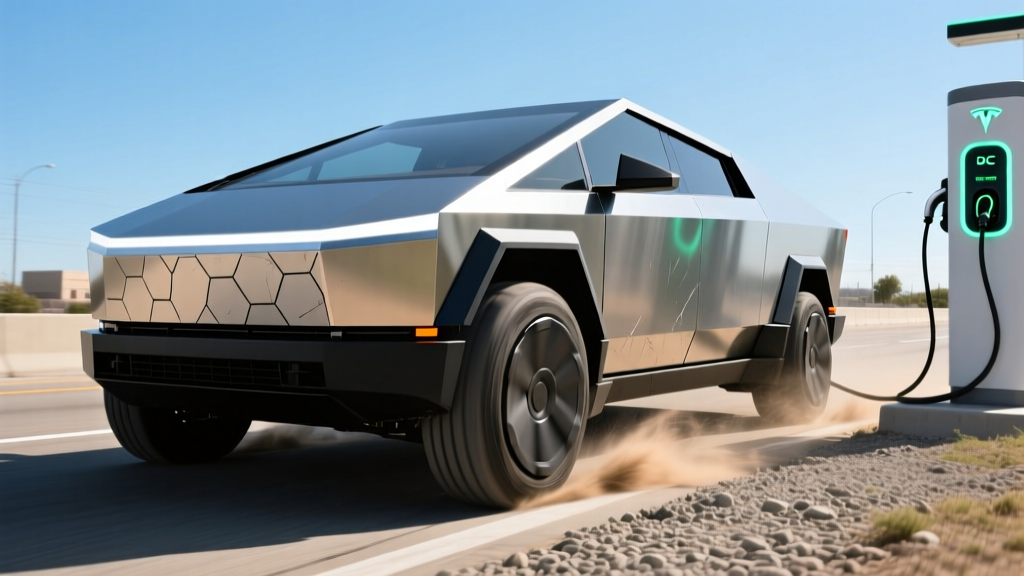
Tesla markets the Cybertruck's body as an "exoskeleton" built from ultra-hard 30X cold-rolled stainless steel. The company has demonstrated the truck stopping 9mm handgun rounds fired at the body panels, and the armored glass (a polymer-glass laminate) is rated to resist similar handgun impacts. However, Tesla does not claim the Cybertruck meets any formal NIJ (National Institute of Justice) ballistic certification for the complete vehicle.
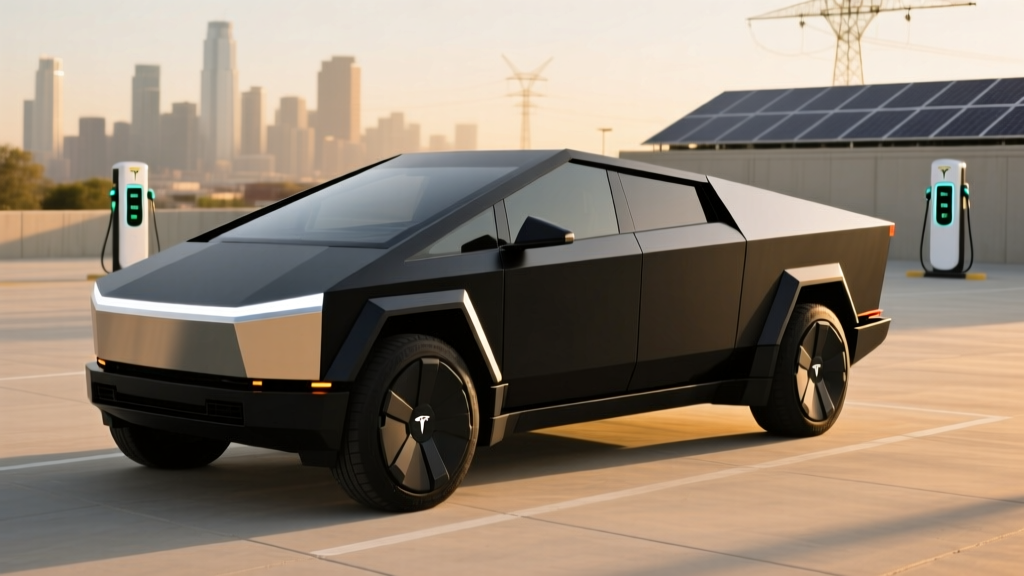
Where the Cybertruck genuinely excels versus conventional pickups is dent and scratch resistance. The 30X steel is so hard it cannot be stamped by conventional factory dies (hence the angular, origami-like design), and it laughs off parking-lot dings, shopping carts, and trail pinstriping that would mar an aluminum F-150 or steel Ram. That everyday durability — more than the ballistic headlines — is where the exoskeleton delivers practical value.
Cybertruck Specs at a Glance: Range, Battery, Power, and Price
| Specification | AWD (Dual-Motor) | Cyberbeast (Tri-Motor) |
|---|---|---|
| EPA Range | 340 miles | 320 miles |
| Battery Capacity (usable) | ~123 kWh, NMC | ~123 kWh, NMC |
| Horsepower | 600 hp | 845 hp |
| 0-60 mph | 3.9 seconds | 2.6 seconds |
| Drivetrain | Dual-motor AWD | Tri-motor AWD |
| Max DC Fast Charge | 250 kW | 250 kW |
| 10-80% DC Charge Time | ~30 minutes | ~30 minutes |
| Level 2 Home Charge | 11.5 kW (~37 mi/hr) | 11.5 kW (~37 mi/hr) |
| MPGe (combined) | 72 MPGe | 69 MPGe |
| Efficiency | 47 kWh/100 mi | 49 kWh/100 mi |
| Towing Capacity | 11,000 lbs | 11,000 lbs |
| Payload | 2,500 lbs | 2,500 lbs |
| Cargo Bed Length | 6 ft (72 in) | 6 ft (72 in) |
| Frunk Volume | 7 cu ft | 7 cu ft |
| Vault (bed) Volume | ~67 cu ft (bed) + under-bed | ~67 cu ft (bed) + under-bed |
| Base MSRP (2026) | $81,835 | $101,835 |
| Battery/Powertrain Warranty | 8 yr / 120,000 mi | 8 yr / 120,000 mi |
Sources: Tesla Cybertruck specs, fueleconomy.gov
Real-World Range: What the EPA Sticker Doesn't Tell You
Real-World Expectation: ~270-300 miles highway at 70 mph; ~230-260 miles in freezing temperatures or while towing.
The Cybertruck's angular, flat-panel design is an aerodynamic challenge. Despite Tesla's efforts (active aero, tonneau-integrated bed cover), the truck's brick-like profile exacts a toll at sustained highway speeds. In independent testing by outlets like Edmunds and Car and Driver, the Cybertruck AWD typically delivers between 270 and 300 miles at 70 mph on a warm day — roughly 10-15% below the 340-mile EPA sticker.
Cold weather compounds the loss. Lithium-ion batteries lose efficiency in freezing temperatures, and the cabin heater draws significant energy (the Cybertruck uses a heat pump, which helps, but doesn't eliminate the penalty). Expect range to drop to roughly 230-260 miles in sub-30°F conditions at highway speeds.
Towing is the biggest range killer. With a 7,000-8,000 lb trailer, real-world range can fall to 150-180 miles. This is consistent with every electric truck on the market — the Rivian R1T and Ford F-150 Lightning show similar towing-range reductions. If you tow frequently, route planning around DC fast chargers becomes essential.
Charging Speed: 250 kW Peak, but Watch the Curve
The Cybertruck supports up to 250 kW DC fast charging on Tesla's V3 and V4 Superchargers. On a properly preconditioned battery (the truck automatically warms the pack when you navigate to a Supercharger), you'll see peak rates near 250 kW in the 10-30% state-of-charge window. However, the charging curve tapers significantly above 60% SoC, and especially above 80%.
| Charging Method | Power | Speed / Time |
|---|---|---|
| DC Fast Charge (Supercharger V3/V4) | Up to 250 kW peak | ~180 miles in 15 min; 10-80% in ~30 min |
| Level 2 (Tesla Wall Connector, 48A) | 11.5 kW | ~37 miles per hour; full charge in ~10-11 hours |
| Level 2 (Mobile Connector, 240V/32A) | 7.7 kW | ~25 miles per hour |
| Level 1 (120V standard outlet) | ~1.4 kW | ~4 miles per hour (emergency use only) |
For home charging, a Tesla Wall Connector on a 60-amp circuit delivers 11.5 kW (48 amps), adding roughly 37 miles of range per hour. An overnight charge (10 hours) replenishes the full battery. Installation typically costs $500-$2,000 depending on panel proximity and whether your electrical panel needs an upgrade to 200 amps — a common requirement for homes with existing high-draw appliances.
The Cybertruck uses Tesla's NACS (North American Charging Standard) connector natively. With the broader industry adopting NACS through 2025-2026, the Cybertruck now accesses not only Tesla's 60,000+ Supercharger network but also an expanding number of third-party networks (Electrify America, EVgo) that have added NACS cables. This is a genuine ownership advantage over CCS-equipped competitors still transitioning.
Performance: Supercar Acceleration in a 6,800-lb Truck
The Cybertruck AWD's 600 horsepower and 3.9-second 0-60 time are quick by any measure. But the Cyberbeast — with its tri-motor, 845-horsepower setup — is genuinely absurd: 2.6 seconds to 60 mph in a vehicle with a 6-foot bed and 11,000-lb towing capacity. That puts it in the territory of a Porsche 911 Turbo S, while carrying more payload than most half-ton pickups.
The dual-motor and tri-motor configurations provide true torque-vectoring AWD, with independent front and rear motor control. Off-road, the Cybertruck offers up to 16 inches of ground clearance in Extract Mode (adaptive air suspension), a 35-degree approach angle, and a stainless-steel underbody armor plate. It's more capable on trails than its low-slung looks suggest, though the 6,800+ lb curb weight limits it in deep mud or sand compared to lighter off-road rigs.
Pricing, Tax Credits, and What You'll Actually Pay
As of 2026, the Cybertruck lineup has stabilized after the initial Founder's Series pricing:
- AWD (Dual-Motor): $81,835 MSRP
- Cyberbeast (Tri-Motor): $101,835 MSRP
Options are minimal — Tesla keeps the configurator simple. Paint colors (beyond the raw stainless steel), the Full Self-Driving (Supervised) package, and a few accessories are the main add-ons.
Does the Cybertruck Qualify for the Federal EV Tax Credit?
- MSRP Cap: Trucks/vans/SUVs must be under $80,000. The AWD at $81,835 exceeds this by $1,835 — it does not qualify. The Cyberbeast at $101,835 also does not qualify.
- Buyer Income Cap: AGI must not exceed $150,000 (single), $225,000 (head of household), or $300,000 (joint).
- Battery Sourcing: Critical minerals and battery components must meet escalating domestic-content thresholds (2026: 80% critical minerals from US/FTA partners, 100% battery components manufactured/assembled in North America).
- Point-of-Sale Transfer: Eligible credits can be transferred to the dealer at purchase for an immediate price reduction.
Source: IRS §30D Clean Vehicle Credit
The Cybertruck's pricing places it above the §30D MSRP cap for trucks ($80,000). This means no federal tax credit for new Cybertruck purchases in 2026. State-level incentives (California's CVRP, Colorado's innovative motor vehicle credit, and others) may still apply — check your state's energy office for current programs. Used Cybertruck purchases (once they enter the secondary market) could potentially qualify for the separate used-EV credit (up to $4,000, with lower income caps and a $25,000 MSRP ceiling for used vehicles).
Interior, Tech, and Daily Livability
The Cybertruck's interior is minimalist even by Tesla standards. A single 18.5-inch touchscreen dominates the dash, handling navigation, climate, media, and vehicle settings. There are no physical buttons — even the glovebox opens via the screen. A rear 9.4-inch touchscreen serves second-row passengers.
Seating fits five adults, though the rear bench is flatter and less contoured than the F-150 Lightning or Rivian R1T. Rear legroom measures approximately 38 inches — adequate but not generous for a truck at this price. The panoramic glass roof (tinted, no shade) floods the cabin with light but can feel hot in direct summer sun.
The 6-foot bed (which Tesla calls "the Vault") features a motorized tonneau cover that's strong enough to support 300 lbs of distributed weight — useful as a platform or work surface. Under the bed floor, a large lockable storage compartment adds security. The 7-cu-ft frunk is small compared to the F-150 Lightning's massive 14-cu-ft front trunk but still fits a couple of carry-on bags or charging cables.
Driver Assistance: The Cybertruck ships with Tesla's Autopilot (adaptive cruise + lane centering). The optional Full Self-Driving (Supervised) package adds automated lane changes, traffic-light recognition, and city-street navigation. FSD is an SAE Level 2 system — the driver must remain fully attentive and keep hands on the yoke at all times. It is not autonomous driving.
Pros, Cons, and the Verdict
- Stainless-steel exoskeleton resists dents, scratches, and handgun rounds (9mm)
- 2.6-second 0-60 (Cyberbeast) is supercar territory in a truck
- 250 kW Supercharger access + NACS compatibility across growing network
- 11,000-lb towing capacity with integrated trailer brake controller
- Adaptive air suspension with Extract Mode for serious ground clearance
- Over-the-air updates continuously add features
- Real-world highway range ~270-300 mi (10-15% below EPA) due to aero
- No federal tax credit — MSRP exceeds $80,000 §30D cap
- Polarizing design; love-it-or-hate-it factor affects resale predictability
- Rear visibility is poor; relies heavily on cameras
- Panel gap and build-quality inconsistency reported by early owners
- $81,835+ starting price undercuts value proposition vs. F-150 Lightning, R1T
Who the Cybertruck Suits Best
The Cybertruck fits a specific buyer: someone who wants an electric truck that stands apart, values the stainless-steel durability for work or trail use, and primarily charges at home or on the Tesla Supercharger network. It's a strong choice for tech-forward commuters who want supercar acceleration with truck utility, and for those who tow moderately (under 8,000 lbs) on routes with reliable Supercharger coverage.
It's a weaker choice for buyers who need maximum real-world range, frequent heavy towing (range drops severely), budget-conscious shoppers who want to leverage the $7,500 federal credit, or families who prioritize rear-seat comfort and traditional pickup ergonomics. The F-150 Lightning and Rivian R1T remain more practical, more conventional alternatives.
How the Cybertruck Stacks Up Against Key Competitors
| Spec | Tesla Cybertruck AWD | Ford F-150 Lightning (Ext. Range) | Rivian R1T (Dual-Motor Max) |
|---|---|---|---|
| EPA Range | 340 mi | 320 mi | 352 mi |
| Starting MSRP | $81,835 | $62,995 | $79,900 |
| Federal Tax Credit | No (over MSRP cap) | Yes (qualifying trims) | Yes (qualifying trims) |
| Max DC Charge | 250 kW | 150 kW | 200+ kW |
| 0-60 mph | 3.9 sec | ~5.0 sec | ~3.5 sec |
| Towing | 11,000 lbs | 10,000 lbs | 11,000 lbs |
| Frunk | 7 cu ft | 14 cu ft | 11 cu ft |
| Connector | NACS | CCS → NACS adapter | NACS (2025+) |
The F-150 Lightning wins on price, tax-credit eligibility, and frunk space. The R1T wins on range and off-road refinement. The Cybertruck wins on acceleration, Supercharger-native access, and exoskeleton durability. The "best" truck depends entirely on your priorities.
Frequently Asked Questions
Are Tesla trucks bulletproof against all firearms?
No. The Cybertruck's stainless-steel body panels and armored glass can resist 9mm handgun rounds, but the truck is not rated against rifle calibers (5.56mm, 7.62mm), armor-piercing ammunition, or concentrated fire to the same point. It is not a certified armored vehicle. The primary practical benefit is extreme dent and scratch resistance in everyday use.
What is the real-world range of the Cybertruck on the highway?
Expect approximately 270-300 miles at 70 mph in moderate temperatures for the AWD model (EPA-rated at 340 miles). In freezing weather, plan for 230-260 miles. Towing a trailer reduces range further to roughly 150-180 miles depending on weight and terrain.
How fast does the Cybertruck charge at home and on the road?
On a Tesla V3/V4 Supercharger, the Cybertruck peaks at 250 kW and charges from 10-80% in approximately 30 minutes. At home with a Tesla Wall Connector (11.5 kW / 48A), it adds about 37 miles of range per hour, fully recharging overnight in 10-11 hours.
Does the Cybertruck qualify for the $7,500 federal EV tax credit?
No. Under IRS §30D rules, trucks must have an MSRP under $80,000 to qualify. The Cybertruck AWD starts at $81,835 and the Cyberbeast at $101,835 — both exceed the cap. State incentives may still apply. Consult a tax professional for your specific situation.
Is the Cybertruck worth buying over the F-150 Lightning or Rivian R1T?
It depends on your priorities. Choose the Cybertruck if you want maximum acceleration, native Supercharger access, and the stainless-steel exoskeleton's durability. Choose the F-150 Lightning for a lower price, federal tax credit eligibility, and a massive frunk. Choose the Rivian R1T for the best real-world range and off-road refinement. All three are excellent electric trucks; none is universally "best."
What is the Cybertruck's battery chemistry and warranty?
The Cybertruck uses an NMC (nickel-manganese-cobalt) lithium-ion battery pack with approximately 123 kWh of usable capacity. Tesla covers the battery and drive units with an 8-year / 120,000-mile warranty, guaranteeing at least 70% capacity retention during that period. NMC chemistry offers higher energy density than LFP, which is critical for a heavy truck, but requires more careful charge management (Tesla recommends daily charging to 80-90% rather than 100% for longevity).
Final Word
So, are Tesla trucks bulletproof? Against 9mm handgun rounds on the body panels — largely, yes. Against everything — no, and no production consumer vehicle is. What the Cybertruck undeniably delivers is a uniquely durable exoskeleton, blistering acceleration, and access to the best fast-charging network in North America. Whether those traits justify the $81,835+ price (with no federal tax credit) and real-world range compromises depends entirely on what you need from an electric truck. Test-drive all three — Cybertruck, Lightning, R1T — and let your daily driving pattern, not the headlines, make the decision.