If you've ever gotten a flat on a highway and wished for a run-flat tire, you're not alone. Many new Tesla owners ask the same question: are Tesla tires run flats? The short answer is no. Tesla does not equip its vehicles with run-flat tires from the factory, nor does it recommend them as replacements. Instead, Tesla uses standard pneumatic tires with acoustic foam liners and supplies a tire-repair kit (or roadside assistance) rather than a spare.
That decision has real implications for your range, ride quality, repair costs, and long-term ownership experience. Below, we break down exactly what tires Tesla uses, why they made that choice, and how it affects you as an owner — along with a full profile of the current Tesla Model Y (the brand's best-selling vehicle) so you can see the complete ownership picture.
Why Tesla Doesn't Use Run-Flat Tires
Run-flat tires have reinforced sidewalls that let you drive up to ~50 miles at reduced speed after a puncture. They sound ideal for EVs, which are heavier and lack spare tires. But Tesla avoids them for several engineering reasons:
- Range penalty. Run-flats are typically 10–15% heavier than standard tires and have stiffer sidewalls that increase rolling resistance. In an EV where every watt-hour matters, that translates to 5–15 fewer miles of EPA-estimated range depending on the model.
- Ride quality. The stiff sidewalls transmit more road noise and harshness into the cabin — exactly the opposite of what you want in a quiet, heavy EV.
- Replacement cost and availability. Run-flats cost 25–50% more than equivalent standard tires and are harder to find at independent tire shops. Many run-flats cannot be repaired after being driven on while deflated and must be replaced outright.
- Tesla's roadside assistance. Tesla includes 4 years/50,000 miles of roadside assistance with towing to the nearest service center, which covers the most common flat-tire scenarios without needing run-flat capability.
What Tires Does Tesla Actually Use?
Tesla fits its vehicles with OEM-specific tires from Michelin, Pirelli, Hankook, and Continental, depending on model and trim. These tires carry a "T0" or "T1" designation on the sidewall, indicating Tesla-specific engineering. Key features include:
- Acoustic foam liner. A polyurethane foam ring bonded inside the tire cavity that reduces road noise by 3–9 dB. This matters in EVs because there's no engine noise to mask tire roar.
- Low rolling-resistance compound. Optimized for EV efficiency, helping maximize EPA range figures.
- High load index. EVs are heavy (the Model Y Long Range weighs ~4,400 lbs), so Tesla-spec tires carry higher load ratings than equivalent ICE-vehicle tires.
- No spare tire. Like most EVs, Tesla provides a tire-repair kit (sealant can + 12V compressor) in the rear cargo area rather than a spare wheel.
Tesla Model Y 2026: Full EV Profile
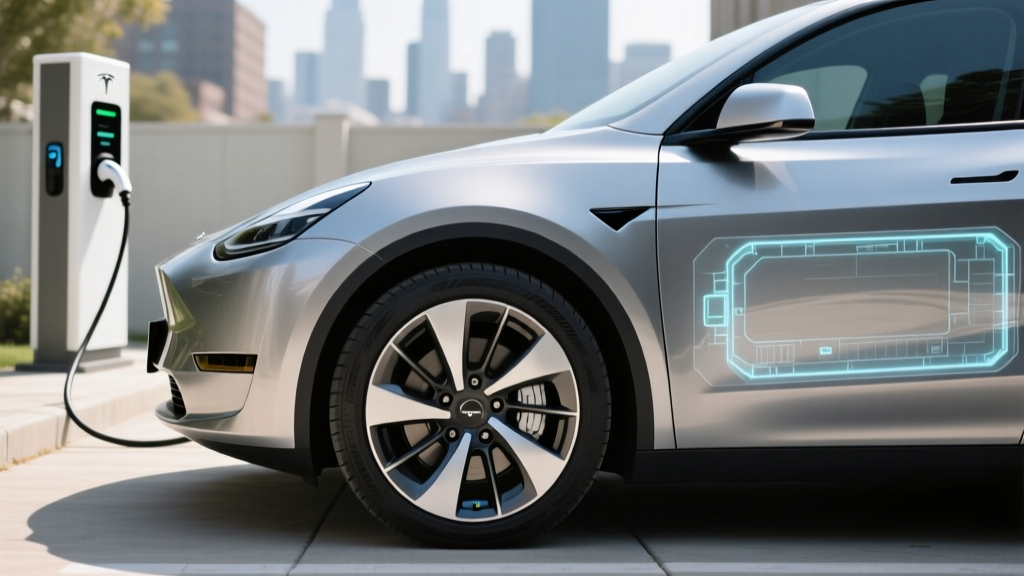
To ground the tire discussion in real ownership context, here's a complete profile of the 2026 Tesla Model Y Long Range AWD — the highest-volume Tesla and the most likely model where tire questions arise.
| Specification | 2026 Tesla Model Y Long Range AWD |
|---|---|
| EPA Range | 320 miles (Juniper refresh) |
| Battery Capacity | ~78 kWh usable (NMC chemistry) |
| Drivetrain | Dual-motor AWD |
| Horsepower | 384 hp (combined) |
| 0–60 mph | 4.8 seconds |
| Top Speed | 125 mph (electronically limited) |
| Max DC Fast Charge | 250 kW (V3 Supercharger) |
| 10–80% DC Charge Time | ~27 minutes |
| Level 2 Home Charge Rate | 11.5 kW (~44 mi/hr) |
| Efficiency | 122 MPGe combined / 27 kWh/100 mi |
| Cargo Volume | 30.2 cu ft (rear seats up) / 72.1 cu ft (folded) |
| Front Trunk (Frunk) | 4.1 cu ft |
| Legroom (front / rear) | 41.8 in / 37.5 in |
| Curb Weight | ~4,398 lbs |
| OEM Tire Size | 255/45R19 (Gemini) or 255/40R20 (Induction) |
| Battery Warranty | 8 years / 120,000 miles (min 70% retention) |
| Basic Vehicle Warranty | 4 years / 50,000 miles |
Source: fueleconomy.gov, Tesla.com
Real-World Range: What to Actually Expect
The EPA's 320-mile estimate for the Model Y Long Range is measured under controlled conditions. In real-world driving, expect variation:
- City / moderate-speed driving (30–50 mph): 310–340 miles. Regen braking and low speeds play to the EV's strengths.
- Highway cruising (70–75 mph): 260–290 miles. Aerodynamic drag dominates at speed.
- Cold weather (below 32°F / 0°C): 220–270 miles. Battery chemistry slows, cabin heating draws energy, and the heat pump helps but can't eliminate the loss. Expect 15–30% range reduction depending on severity.
- Towing (if equipped): 150–200 miles with a light trailer. The Model Y is rated for 3,500 lbs towing, but range drops dramatically under load.
Preconditioning the battery (via the Tesla app or navigation to a Supercharger) before fast charging is critical — a cold battery may accept only 50–80 kW initially, stretching your 10–80% charge to 40+ minutes instead of 27.
Charging Speed and Network Access
The Model Y charges on Tesla's proprietary NACS (North American Charging Standard) connector, which is now being adopted by Ford, GM, Rivian, and others. Here's what charging looks like across levels:
| Charging Level | Power (kW) | Miles Added per Hour | Typical Use Case |
|---|---|---|---|
| Level 1 (120V outlet) | 1.4 kW | ~5 mi/hr | Emergency / overnight trickle |
| Level 2 (240V, 48A Wall Connector) | 11.5 kW | ~44 mi/hr | Home daily charging |
| DC Fast (V3 Supercharger) | Up to 250 kW | ~1,000 mi/hr (peak) | Road trips; 10–80% in ~27 min |
| DC Fast (V4 Supercharger) | Up to 350 kW* | ~1,200 mi/hr (peak) | Newer stations; Model Y caps at ~250 kW |
*V4 Superchargers can deliver higher power, but the current Model Y architecture caps intake at approximately 250 kW. Future hardware revisions may increase this.
Charging curves matter: the Model Y holds near peak 250 kW from roughly 10–35% SoC, then tapers to ~150 kW through 60%, and drops further to ~70 kW by 80%. Charging from 80–100% at a DC fast charger is painfully slow — plan to leave at 80% unless you absolutely need the full battery.
Pricing, Trims, and Federal Tax Credit Eligibility
Here's how the 2026 Model Y lineup is priced before and after potential incentives:
| Trim | Base MSRP | Est. After §30D Credit | Notes |
|---|---|---|---|
| Long Range AWD | $44,990 | ~$37,490 | Eligible for up to $7,500 if buyer meets income caps and battery-sourcing requirements |
| Performance AWD | $48,990 | ~$41,490 | Same credit eligibility; 0–60 in 3.5s |
Federal tax credit rules (§30D) for 2026:
- Income caps: Modified AGI ≤ $150,000 (single), $225,000 (head of household), $300,000 (joint).
- MSRP cap: SUVs/vans/pickups ≤ $80,000; sedans ≤ $55,000. The Model Y qualifies as an SUV.
- Battery sourcing: A percentage of critical minerals and battery components must be sourced from the U.S. or FTA partners. These thresholds increase annually. Tesla's U.S. battery production generally satisfies current requirements, but always verify on the IRS eligible-vehicle list before purchasing.
- Point-of-sale transfer: You can transfer the credit to the dealer at purchase to reduce the sale price directly, rather than waiting to claim it on your tax return.
Source: IRS.gov §30D Clean Vehicle Credit
Tire Replacement Costs and Ownership Impact
Since Tesla doesn't use run-flats, what does tire ownership actually cost?
- OEM replacement tires (Tesla-spec with foam liner): $250–$400 per tire, depending on size and brand. A full set: $1,000–$1,600 plus mounting and alignment.
- Aftermarket non-Tesla-spec tires: $180–$300 per tire. You sacrifice the acoustic foam liner (more road noise) and possibly some range efficiency, but save 20–30%.
- Tire lifespan: EV tires wear 20–30% faster than tires on comparable ICE vehicles due to higher weight and instant torque. Expect 25,000–40,000 miles from a set, depending on driving style and rotation discipline.
- Run-flat aftermarket option: You can fit run-flat tires on a Tesla, but you'll sacrifice 5–15 miles of range, increase road noise, and pay a 25–50% premium. Most tire shops and Tesla service centers advise against it.
Pros
- Best-in-class Supercharger network (19,000+ stalls in North America)
- Class-leading efficiency (122 MPGe combined)
- Spacious cargo area (72.1 cu ft with seats folded)
- OTA software updates continuously add features
- Strong resale value relative to most EVs
- Standard Autopilot included; FSD Supervised available
Cons
- No spare tire — repair kit only handles minor punctures
- OEM Tesla-spec tires are expensive ($250–$400 each)
- EV tire wear is accelerated (25K–40K mile lifespan)
- Service-center availability can be limited in rural areas
- Panel gaps and interior build quality inconsistent vs. legacy luxury brands
- FSD Supervised is SAE Level 2 — driver must remain fully engaged
Who Should Buy the Model Y (and Who Shouldn't)
Choose the Model Y if:
- You want access to the most reliable DC fast-charging network in North America
- You commute 30–80 miles daily and can charge at home overnight
- You need a practical family SUV with strong cargo space and good efficiency
- You value over-the-air updates and a minimalist tech-forward interior
Look elsewhere if:
- You frequently drive in areas with no Tesla Supercharger or reliable DC fast-charging access
- You want a traditional luxury interior with physical controls (consider the BMW iX or Genesis Electrified GV70)
- You need a true spare tire for remote-area driving (consider the Rivian R1S or keep a full-size spare on a hitch carrier)
- You tow heavy loads regularly — range under tow drops to ~150–200 miles
Frequently Asked Questions
Are Tesla tires run flats?
No. Tesla does not equip any of its production vehicles with run-flat tires. All Tesla models use standard pneumatic tires with an acoustic foam liner for noise reduction. Tesla provides a tire-repair kit (sealant and compressor) and includes 4 years / 50,000 miles of roadside assistance for flats that can't be repaired with the kit.
Can I put run-flat tires on my Tesla?
Technically yes, if you find run-flats in the correct size and load rating. However, doing so will increase road noise, reduce range by an estimated 5–15 miles, cost 25–50% more per tire, and provide a harsher ride. Most tire professionals and Tesla owners advise against it.
Does Tesla include a spare tire?
No Tesla model comes with a spare tire. Instead, each vehicle includes a tire mobility kit (sealant can + 12V air compressor) stored in the rear cargo sub-trunk. For punctures larger than ~6mm, sidewall damage, or blowouts, you'll need to call Tesla roadside assistance or a third-party tow service.
How long do Tesla tires last?
Expect 25,000–40,000 miles from a set of OEM Tesla-spec tires. EVs wear tires faster than gas cars due to heavier curb weight (the Model Y is ~4,400 lbs) and instant torque at the wheels. Regular rotation every 6,250 miles and proper alignment are essential to maximize tire life.
Does the 2026 Model Y qualify for the $7,500 federal tax credit?
The Model Y Long Range and Performance (MSRP under the $80,000 SUV cap) are generally eligible for the full $7,500 §30D credit, provided the buyer meets income limits ($150K single / $300K joint) and the vehicle's battery satisfies critical-mineral and component-sourcing thresholds. Tesla manufactures batteries in the U.S., which typically satisfies current requirements, but always check the IRS eligible vehicle list before purchasing. The credit can be transferred at point of sale to reduce your purchase price directly.
What is the real-world range of the 2026 Model Y?
The EPA rates the 2026 Model Y Long Range AWD at 320 miles. In real-world use, expect approximately 260–290 miles at highway speeds (70–75 mph), 310–340 miles in city driving, and 220–270 miles in freezing temperatures. Preconditioning the battery and using seat heaters instead of cabin heat can help recover some cold-weather range.
Is the Model Y worth buying vs. competitors?
Against the Hyundai Ioniq 5, Ford Mustang Mach-E, and BMW iX, the Model Y's key advantages are Supercharger network access, efficiency (122 MPGe combined), and cargo space (72.1 cu ft). Its weaknesses include minimal physical controls, inconsistent panel-gap quality, and expensive OEM tire replacements. If charging infrastructure and efficiency are your top priorities, the Model Y remains the segment benchmark. If interior luxury or dealer service access matters more, the Ioniq 5 or Mach-E are strong alternatives.