Quick Verdict: The Reliability Picture for Rivian in 2026
The question "are Rivians reliable" has evolved significantly since the R1T pickup and R1S SUV launched in 2022. Early production models suffered from well-documented build-quality inconsistencies — panel gaps, software glitches, and suspension component replacements were common complaints among 2022-2023 owners. Fast-forward to 2026, and Rivian's Normal, Illinois factory has matured considerably. The second-generation R1 (introduced for the 2025 model year) brought a redesigned electrical architecture, fewer moving parts in the drive system, and a substantially refined assembly process.
That said, reliability is multi-dimensional. It encompasses build quality, powertrain durability, battery longevity, software stability, and the company's ability to service vehicles through a still-growing network. Here's what the data and ownership experience actually tell us about Rivian's R1T and R1S in 2026 — with exact numbers, not marketing spin.
Rivian R1T & R1S: Core Specifications at a Glance
| Spec | R1T (Dual-Motor, Standard Battery) | R1S (Dual-Motor, Large Battery) | R1T (Tri-Motor, Max Battery) |
|---|---|---|---|
| EPA Range | 270 miles | 352 miles | 420 miles |
| Battery Capacity (usable) | 92 kWh (LFP) | 109 kWh (NMC) | 141 kWh (NMC) |
| Horsepower | 533 hp | 533 hp | 850 hp |
| 0-60 mph | 4.5 sec | 4.6 sec | 2.9 sec |
| Drivetrain | AWD (Dual-Motor) | AWD (Dual-Motor) | AWD (Tri-Motor) |
| Max DC Fast Charge | 200 kW | 220 kW | 220 kW |
| 10-80% DC Time | ~28 min | ~25 min | ~36 min |
| Level 2 Home Charge Rate | 11.5 kW (~25 mi/hr) | 11.5 kW (~25 mi/hr) | 11.5 kW (~25 mi/hr) |
| MPGe (combined) | 73 MPGe | 76 MPGe | 69 MPGe |
| Towing Capacity | 11,000 lbs | 7,700 lbs | 11,000 lbs |
| Base MSRP (2026) | $69,900 | $74,900 | $99,900 |
Source: fueleconomy.gov and Rivian official specifications. Tri-Motor R1S specs are analogous to R1T with minor range/weight adjustments.
Real-World Range: What the EPA Sticker Doesn't Tell You
Rivian's LFP (lithium iron phosphate) Standard Battery pack, introduced with the second-generation R1, offers lower energy density than the NMC (nickel manganese cobalt) Large and Max packs, which is why the Standard pack delivers 270 miles from 92 kWh. The trade-off is meaningful: LFP chemistry tolerates regular 100% charging without accelerated degradation, making it better suited for daily commuters who can charge at home every night. NMC packs benefit from staying between 20-80% for daily use and reserving 100% charges for road trips.
The Tri-Motor Max Battery R1T achieves its 420-mile EPA figure thanks to 141 kWh of usable NMC capacity, but the physics penalty is real: this configuration adds over 400 lbs to the curb weight, and efficiency drops to 69 MPGe. You're trading efficiency for range and the 850-horsepower performance envelope.
Charging Speed: DC Fast Charging and Home Setup
Charging speed remains a critical concern for any EV buyer, and Rivian's second-generation architecture delivers competitive — though not class-leading — performance. All 2026 R1 vehicles use the NACS (North American Charging Standard) connector natively, granting seamless access to Tesla's Supercharger network without an adapter, in addition to Electrify America, EVgo, and other CCS-based networks (via NACS-to-CCS adapter, which Rivian includes).
| Charging Level | Power | Speed (approx.) | Notes |
|---|---|---|---|
| Level 1 (120V household) | 1.4 kW | ~3 mi/hr | Emergency/trickle only; impractical for daily use on 109+ kWh packs |
| Level 2 (240V home, 48A) | 11.5 kW | ~25 mi/hr | Full charge overnight (~10 hrs for Large Battery); requires NEMA 14-50 or hardwired install |
| DC Fast Charge (peak) | 200-220 kW | 10-80% in 25-36 min | Peak rate sustained to ~55% SoC, then tapers; preconditioning via navigation routing is essential for best speeds |
Charging-curve reality check: Rivian's advertised 220 kW peak on Large and Max Battery models holds only between roughly 15-55% state of charge. Beyond 65%, the curve tapers significantly — you'll see 120 kW declining to under 50 kW above 85%. This is normal for NMC chemistry and large packs, but it means the last 20% of a charge session can add 15-20 minutes. Plan road-trip stops around 10-80% for time efficiency.
For home charging, a Level 2 installation on a 60-amp circuit (48 amps continuous) is the practical minimum for R1 ownership. Expect to pay $800-$2,500 for a quality Level 2 EVSE (Rivian's Wall Charger or a ChargePoint Home Flex) plus $500-$2,000+ for electrician labor, depending on panel proximity and whether your home's 200-amp electrical service needs an upgrade. Homes with older 100-amp panels may face a $2,000-$4,000 panel upgrade — a cost many buyers overlook.
Build Quality and Reliability: What the Data Shows
Assessing whether Rivians are reliable requires separating early-production growing pains from systemic issues. Here's what we know heading into 2026:
Improvements in the Second Generation (2025+)
Rivian's Gen 2 R1 vehicles consolidated the electrical system from multiple ECUs to a unified zonal architecture, reducing wiring harness complexity by approximately 40%. The dual-motor drive unit was redesigned with fewer components. The thermal management system was upgraded for better cold-weather efficiency, including a standard heat pump across all trims. These are the kinds of engineering changes that directly address the failure points identified in 2022-2024 models.
Historical Trouble Spots
Among 2022-2024 owners, the most frequently reported issues included:
- Suspension components: Early air suspension struts and control arm bushings required replacement under warranty on some vehicles, particularly those used for off-road or heavy-towing duty.
- Software glitches: Infotainment freezes, phantom key-fob disconnections, and navigation routing errors were common in the first two years, though most have been resolved via OTA (over-the-air) updates.
- Panel fit and finish: Inconsistent panel gaps and tailgate alignment issues appeared on early Normal-factory builds. Rivian has acknowledged and addressed these through production-line improvements.
- 12V battery issues: Like many modern EVs, the 12V auxiliary battery (which powers electronics when the main pack is off) was a failure point on early models. Rivian transitioned to a lithium 12V battery in Gen 2 to improve longevity.
Third-Party Reliability Data
Consumer Reports' most recent reliability surveys placed Rivian in the middle of the pack among EV manufacturers — an improvement from its bottom-tier ranking in 2023. J.D. Power's Initial Quality Study (IQS) showed similar upward movement, though Rivian still trails established luxury brands like Porsche and BMW in problem-free-per-100-vehicles metrics. It's worth noting that Rivian's direct-to-consumer service model means many issues are resolved via mobile service or OTA updates, which may not fully register in traditional survey methodologies.
Battery Longevity, Warranty, and What Protection You Actually Get
Rivian's warranty package is competitive with the EV market standard:
- Battery & Drive System: 8 years / 175,000 miles (whichever comes first), with a capacity retention threshold of 70% — meaning Rivian will repair or replace the pack if it degrades below 70% of original capacity within the warranty period.
- Limited Vehicle Warranty: 5 years / 60,000 miles bumper-to-bumper.
- Corrosion Perforation: 12 years, unlimited miles.
- Roadside Assistance: 5 years / 60,000 miles.
The 175,000-mile battery warranty is notably generous compared to the industry-standard 100,000 miles offered by most competitors (Tesla, Ford, Hyundai). This signals confidence in pack longevity, particularly for the LFP Standard Battery, which is chemically rated for 3,000+ full charge cycles before reaching 80% capacity — equivalent to over 800,000 miles of theoretical use.
For the NMC Large and Max packs, real-world degradation data from high-mileage 2022-2023 owners suggests approximately 5-8% capacity loss after 60,000-80,000 miles, which is consistent with industry norms for liquid-cooled NMC packs. Rivian's thermal management system actively conditions the battery during charging and driving, which is a key factor in long-term health.
Pricing, Trim Levels, and Federal Tax Credit Eligibility
Rivian's pricing positions the R1T and R1S firmly in the premium segment, but the federal tax credit equation is complicated for these vehicles.
| Trim / Config | Base MSRP | As-Tested (typical) | §30D Federal Credit Eligible? |
|---|---|---|---|
| R1T Dual-Motor Standard | $69,900 | $74,000-$78,000 | Partial — subject to sourcing rules |
| R1T Dual-Motor Large | $75,900 | $80,000-$86,000 | Partial — subject to sourcing rules |
| R1T Tri-Motor Max | $99,900 | $105,000-$112,000 | No — exceeds $80,000 truck MSRP cap |
| R1S Dual-Motor Standard | $74,900 | $79,000-$84,000 | Partial — subject to sourcing rules |
| R1S Dual-Motor Large | $79,900 | $85,000-$92,000 | No — exceeds $80,000 SUV MSRP cap |
Critical tax credit context: Under IRS §30D rules, the federal clean vehicle credit offers up to $7,500, split into two $3,750 halves based on battery component manufacturing and critical mineral sourcing requirements. The R1T (classified as a truck) has an $80,000 MSRP cap, while the R1S (classified as an SUV) also has an $80,000 cap. This means most R1S configurations and all Tri-Motor R1Ts are ineligible due to MSRP alone.
Additionally, buyer income caps apply: modified adjusted gross income (MAGI) cannot exceed $150,000 (single), $225,000 (head of household), or $300,000 (joint). Battery sourcing requirements continue to tighten annually, and Rivian's supply chain has been progressively qualifying more configurations — but you should verify current eligibility on the IRS qualified vehicles list at the time of purchase. The credit can be transferred to the dealer as a point-of-sale discount if all requirements are met.
Cargo, Passenger Space, and Daily Practicality
R1T (Pickup)
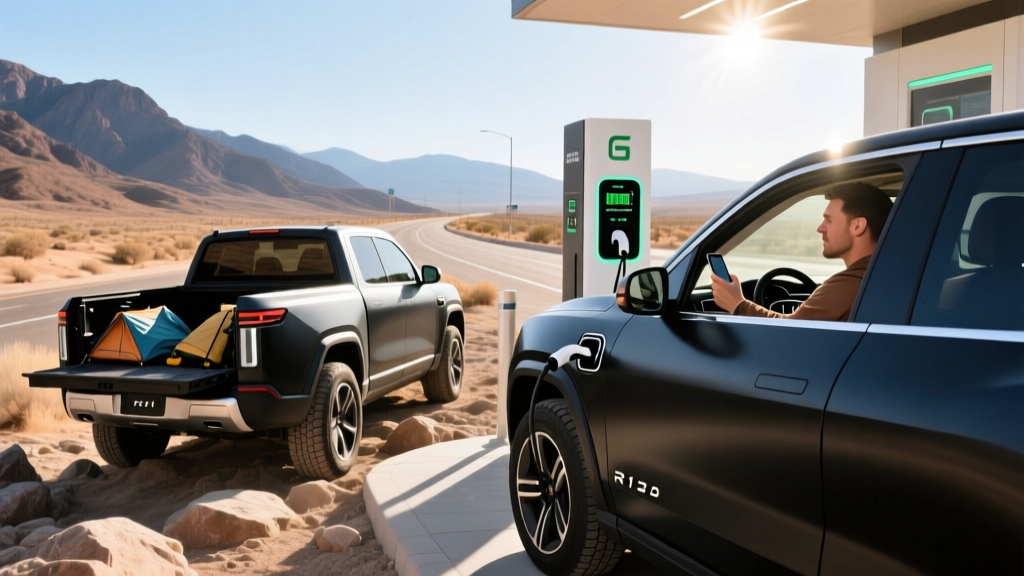
- Bed length: 4.5 feet (54 inches) — shorter than a traditional midsize truck bed, but supplemented by the Gear Tunnel (a lockable, pass-through storage compartment spanning the vehicle width behind the rear seats, offering ~11 cu ft).
- Frunk (front trunk): 11 cu ft, drainable, usable as a cooler.
- Rear-seat legroom: 37.3 inches — adequate for adults on longer trips.
- Total payload: ~1,760 lbs.
R1S (Three-Row SUV)
- Cargo behind third row: 10.4 cu ft (tight for a three-row; competitors like the Kia EV9 offer more).
- Cargo behind second row (third row folded): 46.7 cu ft.
- Cargo behind first row (all rear rows folded): 91.6 cu ft.
- Third-row legroom: 30.4 inches — best suited for children or short trips.
- Second-row legroom: 38.6 inches.
The R1T's Gear Tunnel is a genuinely innovative storage solution that partially compensates for the short bed, and it's a feature no competitor currently matches. The R1S's third row is the vehicle's most obvious compromise — it works in a pinch but can't match the passenger comfort of a Rivian-adjacent competitor like the Tesla Model X or Kia EV9.
Tech, Driver Assistance, and Standout Features
Rivian's software stack is one of its strongest differentiators. The infotainment system runs on a custom operating system with a responsive 15.6-inch center display, and OTA updates have added meaningful features consistently since launch — including enhanced route planning, camp mode improvements, and driver-assist refinements.
Driver+ (Rivian's ADAS)
Notable Tech Highlights
- Adventure Network: Rivian's proprietary destination charger network at trailheads, parks, and adventure destinations — Level 2 chargers in locations other networks ignore.
- Vehicle-to-Load (V2L): Built-in 120V/240V outlets in the bed and Gear Tunnel allow the R1T to power tools, camp equipment, or tailgate setups directly from the traction battery.
- Camp Mode: Maintains cabin climate, plays ambient sounds, and keeps the vehicle powered for overnight camping without idling.
- Quad-Motor availability (R1T only): The 1,025-hp Quad-Motor trim remains available for 2026, offering independent torque vectoring at each wheel for extreme off-road capability, though at a $120,000+ price point.
Drawbacks to Acknowledge
- No Apple CarPlay or Android Auto — Rivian insists on its native software. For some buyers, this is a dealbreaker.
- Service center availability remains limited outside major metro areas. Mobile service covers many routine needs, but body repair and major mechanical work may require shipping or driving to a Rivian Service Center.
- The R1S third row is cramped compared to dedicated three-row competitors.
- Insurance costs trend 15-25% higher than comparable ICE trucks/SUVs, consistent with the broader EV market but worth budgeting for.
Pros
- Class-leading adventure capability: genuine off-road chops, 11,000-lb towing (R1T), Gear Tunnel innovation
- 175,000-mile battery warranty exceeds most competitors
- Gen 2 architecture meaningfully improved build quality and efficiency
- Native NACS connector for seamless Supercharger access
- Strong OTA update cadence adds features post-purchase
- LFP Standard Battery option allows daily 100% charging without degradation concern
Cons
- Most configurations exceed $80,000 MSRP cap — federal tax credit eligibility is limited
- Service network still sparse in rural and mid-size markets
- No wireless CarPlay/Android Auto
- R1S third row is tight for adults
- DC fast charging peaks at 220 kW — competitive but behind Hyundai Ioniq 5 (350 kW) and Lucid (300+ kW)
- Insurance premiums run higher than ICE equivalents
Who Should Buy a Rivian — And Who Should Look Elsewhere?
Frequently Asked Questions
Are Rivians reliable compared to Tesla?
As of 2026, Rivian's Gen 2 vehicles have closed much of the reliability gap with Tesla. Tesla still benefits from a larger service network and longer production history, but Rivian's build quality, software stability, and warranty coverage (particularly the 175,000-mile battery warranty vs. Tesla's 120,000-mile) are competitive. The key differentiator remains service accessibility — Tesla has far more service centers nationwide.
What is the real-world range of the Rivian R1T?
The R1T Dual-Motor Standard Battery (EPA 270 miles) delivers approximately 230-250 miles in real-world mixed driving, dropping to 190-210 miles in cold weather or when towing. The Tri-Motor Max Battery (EPA 420 miles) realistically provides 350-380 miles unloaded in moderate conditions. Towing at highway speeds can cut range by 40-50%, regardless of battery size.
How fast does the Rivian R1 charge at home and on the road?
At home on Level 2 (11.5 kW / 48A), you'll add approximately 25 miles of range per hour — a full overnight session replenishes even the Max Battery pack. On DC fast chargers, the Large and Max Battery R1s peak at 220 kW and charge from 10-80% in approximately 25-36 minutes. Preconditioning the battery by routing through the built-in navigation to a charger is essential for achieving peak speeds.
Does the Rivian R1T or R1S qualify for the $7,500 federal EV tax credit?
Eligibility is limited and configuration-dependent. The R1T Dual-Motor Standard at $69,900 falls under the $80,000 truck MSRP cap and may qualify for partial or full credit depending on battery sourcing requirements at time of purchase. Most R1S configurations and all Tri-Motor models exceed the $80,000 MSRP cap and are ineligible. Buyer income limits also apply ($150K single / $300K joint). Always verify on the IRS qualified vehicles list before purchasing. Consult a tax professional for personal eligibility.
Is a Rivian worth buying over a Ford F-150 Lightning or Tesla Cybertruck?
The R1T commands a premium over the F-150 Lightning (which starts around $55,000) but delivers superior off-road capability, a more refined interior, and the innovative Gear Tunnel. Compared to the Cybertruck, the R1T offers a more conventional (and for many, more practical) truck bed and interior layout, though the Cybertruck's 48V electrical architecture and stainless-steel exoskeleton appeal to different priorities. If budget is the primary concern, the Lightning wins on value. If adventure capability and build refinement matter most, the R1T justifies its premium.
How expensive is it to maintain a Rivian?
EV maintenance costs are structurally lower than ICE vehicles — no oil changes, no transmission fluid, no spark plugs, and regenerative braking extends pad life significantly. Rivian's direct-service model includes mobile technicians for many routine needs. Budget for tire replacement (EVs wear tires faster due to weight and instant torque — expect $1,200-$1,800 for a set of all-terrains every 30,000-40,000 miles), cabin air filter replacement, and washer fluid. Insurance is the larger cost delta — expect premiums 15-25% above comparable ICE trucks.