The Short Answer
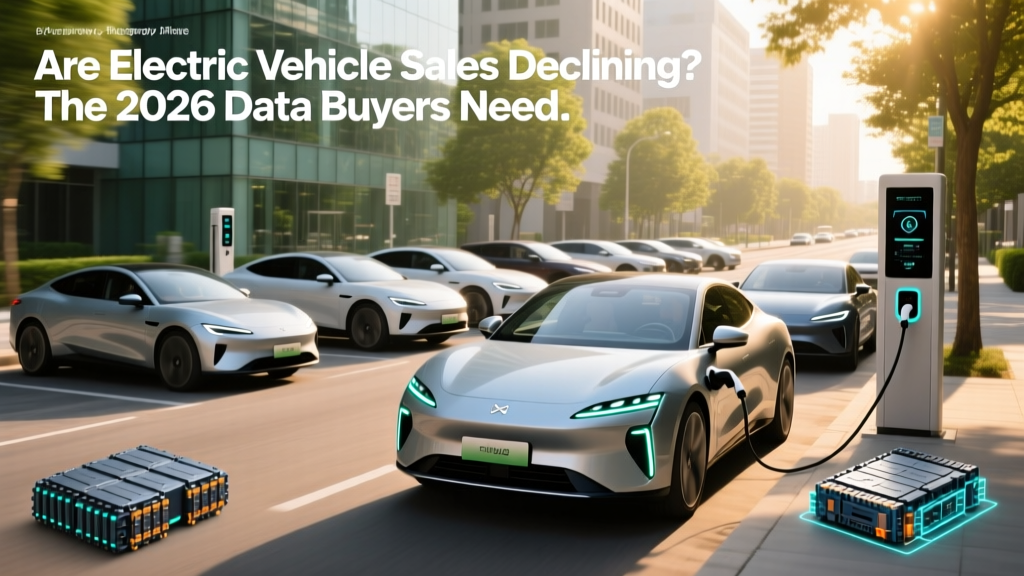
No — electric vehicle sales are not declining in absolute terms. U.S. BEV (battery electric vehicle) sales continued to grow through 2025 and into 2026, but the rate of growth has slowed compared to the 2021–2023 boom years. Headlines conflating "slower growth" with "decline" have created confusion. Meanwhile, hybrid and PHEV sales have surged, capturing buyers who want electrification without full BEV commitment. For shoppers, this market normalization means better pricing, more model choices, and stronger incentives than during the peak-demand years.
What the Sales Numbers Actually Show
The narrative that EV sales are crashing doesn't survive contact with the data. According to Kelley Blue Book estimates, U.S. new BEV sales reached approximately 1.3 million units in 2024 — up from roughly 1.2 million in 2023. The 2025 calendar year pushed past 1.4 million BEVs sold, with early 2026 quarterly figures showing continued single-digit year-over-year growth.
What has changed is the growth trajectory. BEV sales grew roughly 70% from 2021 to 2022, then about 50% from 2022 to 2023. By 2024–2025, growth settled into the 8–15% range. That's still growth — just not the hockey-stick curve early adopters expected. This is typical of any technology adoption S-curve: early explosive growth flattens as the market moves from enthusiasts to the more cautious mainstream.
BEV market share of total U.S. new car sales hovered around 7.5–8.5% through 2024 and into 2025, up from roughly 5.5% in 2022. The U.S. lags behind Europe (~20% BEV share) and China (~30%+ BEV share), partly due to geography, lower fuel prices, and uneven charging infrastructure.
The Hybrid Surge: What's Really Eating Into BEV Share
The real story isn't that EVs are losing — it's that hybrids and PHEVs are winning buyers who might otherwise have waited on a BEV. Toyota's hybrid lineup, the Hyundai Tucson PHEV, and the Ford Maverick Hybrid have pulled in shoppers who want fuel savings without range or charging concerns.
| Powertrain | Approx. Market Share | YoY Trend |
|---|---|---|
| Gasoline-only (ICE) | ~72% | Declining |
| Hybrid (HEV) | ~10% | Growing rapidly |
| Plug-in Hybrid (PHEV) | ~3% | Growing |
| Battery Electric (BEV) | ~8.5% | Growing slowly |
| Other (diesel, FCEV) | ~6.5% | Flat/declining |
A buyer cross-shopping a 2026 Hyundai Ioniq 5 (EPA 318 miles, $42,600 base) might also consider a Toyota RAV4 Hybrid (EPA 39 MPG combined, ~$33,000) or a Toyota RAV4 Prime PHEV (42 miles electric-only, 94 MPGe, ~$44,500). The hybrid and PHEV options require no charging infrastructure change and eliminate range anxiety — a compelling pitch for apartment dwellers or those in cold climates where BEV range drops 20–30% in winter.
Why Headlines Say "Declining" When the Data Says Otherwise
| Headline Claim | What the Data Shows |
|---|---|
| "EV sales are crashing" | BEV sales grew ~8–15% YoY in 2024–2025; growth slowed, not reversed |
| "Nobody wants EVs anymore" | 1.4M+ BEVs sold in the U.S. in 2025 — a record, not a collapse |
| "EVs are losing to gas cars" | ICE market share continues to decline; BEVs + hybrids together gained share |
| "EV prices are too high" | Average BEV transaction price dropped from ~$61,000 (2022) to ~$53,000 (2025); multiple models under $35,000 |
| "Charging is impossible" | U.S. public DC fast charger count surpassed 50,000 ports in 2025; Tesla Supercharger network opened to NACS-equipped non-Tesla EVs |
Several factors feed the "decline" narrative. Automakers like Ford and GM publicly scaled back BEV production targets in late 2024, shifting some investment toward hybrids. Media outlets framed these strategic pivots as evidence of collapsing demand, when they more accurately reflect a recalibration from over-optimistic forecasts. Inventory also built up on dealer lots in 2024–2025 as production caught up with demand, leading to price cuts and lease deals — a sign of market normalization, not failure.
The Real Cost Picture: BEV vs. Hybrid vs. Gas in 2026
For buyers, the sales trend matters less than the ownership math. Here's a five-year cost comparison for three popular models, assuming 12,000 miles/year and national average energy prices:
| Category | 2026 Tesla Model 3 RWD (BEV) | 2026 Toyota Camry Hybrid (HEV) | 2026 Honda Accord 1.5T (Gas) |
|---|---|---|---|
| Base MSRP | $38,990 | $29,495 | $29,290 |
| Federal Tax Credit (§30D) | Up to $7,500* | $0 | $0 |
| Effective Purchase Price | ~$31,490 | $29,495 | $29,290 |
| Fuel/Energy (5 yr) | ~$3,200 (home L2) | ~$5,900 | ~$7,800 |
| Maintenance (5 yr) | ~$1,800 | ~$3,200 | ~$3,800 |
| Insurance (5 yr avg) | ~$11,500 | ~$8,200 | ~$8,500 |
| Estimated Depreciation | ~$14,000 | ~$9,500 | ~$10,200 |
| 5-Year Total | ~$61,990 | ~$56,295 | ~$59,590 |
*§30D federal tax credit eligibility depends on buyer income (≤$150K single / $300K joint), vehicle MSRP caps ($55K cars / $80K SUVs/trucks), and battery critical-mineral and component sourcing rules. Always verify on IRS.gov and consult a tax professional. Point-of-sale transfer available at participating dealers.
The BEV wins on energy and maintenance costs but gives back ground on insurance premiums (typically 20–40% higher for EVs) and steeper depreciation. The hybrid offers a strong middle ground: no charging dependency, proven reliability, lower insurance, and meaningful fuel savings over gas. For buyers without reliable home charging, the hybrid math almost always wins.
What First-Time EV Buyers Should Know Right Now
The slowing sales growth has actually created a buyer-friendly environment. Here's what matters if you're considering your first EV in 2026:
Home Charging Is the Make-or-Break Factor
Level 2 home charging (240V, typically 7.7–11.5 kW) adds roughly 25–44 miles of range per hour of charging. A full overnight charge handles virtually all daily driving. Installation costs range from $500–$1,500 if your electrical panel has capacity, to $2,500–$5,000+ if you need a panel upgrade to 200A. If you can't charge at home — apartment, street parking, no garage — a BEV becomes significantly less convenient, and a hybrid or PHEV is likely the smarter choice.
Cold Weather Cuts Range 20–30%
Battery chemistry and cabin heating demands reduce real-world range in freezing temperatures. A BEV with an EPA rating of 300 miles may deliver 210–240 miles in sustained 20°F driving. Models with heat pumps (standard on most 2026 Hyundai/Kia EVs, Tesla Model 3/Y) mitigate this by 5–10 percentage points, but the loss is unavoidable. If you live in the upper Midwest or Northeast, budget for this.
Charging Speed: Peak kW vs. Sustained Reality
A vehicle advertising "250 kW DC fast charging" does not sustain that rate for the full session. Charging curves taper significantly above 80% state of charge. A realistic metric is the 10–80% charge time. For example, the 2026 Hyundai Ioniq 5 (84 kWh battery, NMC) peaks at ~240 kW and reaches 10–80% in approximately 18 minutes at an optimal charger. The 2026 Tesla Model 3 Long Range peaks at ~250 kW with a similar 10–80% time. Expect real-world sessions at non-preconditioned or older chargers to take 25–35 minutes.
The §30D Tax Credit Is Not Guaranteed
Federal credit eligibility depends on where battery components and critical minerals are sourced — requirements that tightened in 2024 and 2025. Several popular models lost partial or full credit eligibility as sourcing rules changed. Before committing to a purchase, check the current eligible vehicle list on fueleconomy.gov and confirm with your dealer. The point-of-sale transfer option lets you apply the credit as a down payment reduction rather than waiting for a tax refund.
Decision Framework: Should You Buy a BEV, Hybrid, or Gas Car?
If X, Then Y
- If you have home charging access AND drive under 250 miles/day AND live in a moderate climate → a BEV likely saves you the most over 5 years. Consider the Tesla Model 3, Hyundai Ioniq 5, or Chevrolet Equinox EV.
- If you have home charging BUT regularly drive 300+ miles in cold weather OR tow frequently → a PHEV (like the RAV4 Prime or Jeep Wrangler 4xe) gives you electric commuting with gas flexibility for long trips.
- If you cannot charge at home (apartment, street parking, no garage) → a hybrid (HEV) is your best electrification play. You'll get 40–55 MPG without any charging dependency.
- If you drive under 10,000 miles/year → the fuel savings from a BEV shrink significantly. A hybrid or even a fuel-efficient gas car may have a lower total cost of ownership.
- If you want the lowest possible upfront cost → a conventional hybrid starts around $28,000–$33,000, while the most affordable new BEVs (Chevrolet Equinox EV, Nissan Leaf) start around $33,000–$37,000 before credits.
What the Market Means for Your Purchase Timing
The current market environment — slowing BEV growth, rising hybrid demand, growing inventory — is the most favorable for buyers since 2020. Automakers are offering aggressive lease deals, price cuts, and loyalty incentives to move metal. Tesla has cut Model 3 and Model Y prices multiple times since late 2024. Hyundai, Kia, and Ford have stacked dealer incentives on top of federal credits. If you've been waiting for the right moment to buy an EV, the combination of lower transaction prices, expanded model availability, and maturing charging infrastructure makes 2026 a pragmatic entry point.
At the same time, don't let the "decline" headlines spook you into thinking EVs are a bad bet. The vehicles themselves have never been more capable: 300+ mile ranges are standard on many models, DC fast charging has matured, and the NACS connector standardization (adopted by Ford, GM, Hyundai, Rivian, and others) means broader access to the Tesla Supercharger network. The data shows that EV adoption is proceeding at a pace typical of major automotive transitions — not overnight, but steadily and with real benefits for those whose driving patterns align with the technology.
Frequently Asked Questions
Are EV sales actually declining in 2026?
No. U.S. BEV sales are still growing, but at a slower pace (~8–15% YoY) compared to the 50–70% growth rates of 2021–2023. Total BEV volume continues to set annual records. The slowdown reflects market maturation, not collapsing demand.
Are hybrids outselling electric vehicles?
In 2025–2026, conventional hybrids (HEVs) surpassed BEVs in U.S. unit sales for the first time in several years, driven by strong demand for models like the Toyota RAV4 Hybrid, Honda CR-V Hybrid, and Ford Maverick Hybrid. However, BEVs and hybrids are complementary rather than directly competitive — both are gaining share from gasoline-only vehicles.
Will EV prices drop further?
Average BEV transaction prices have fallen from ~$61,000 in 2022 to ~$53,000 in 2025. Multiple models now start under $35,000 (Chevrolet Equinox EV, Nissan Leaf). Further price compression is likely as battery costs continue to decline and competition intensifies, but the steepest drops may be behind us.
Is now a good time to buy an EV?
For buyers with home charging access and daily driving under 250 miles, 2026 offers strong incentives, expanded model choices, and a maturing charging network. Slower sales growth means dealers are more willing to negotiate. If you lack home charging or drive in extreme cold regularly, a hybrid or PHEV may be the more practical choice.
Do EVs still qualify for the $7,500 federal tax credit?
Some do, but eligibility has tightened significantly. The IRS §30D credit requires the buyer to meet income caps ($150K single / $300K joint AGI), the vehicle to fall under MSRP limits ($55K for cars, $80K for SUVs/trucks/vans), and the battery to meet critical-mineral and component sourcing requirements that change annually. Always verify eligibility on fueleconomy.gov before purchasing.