Quick Answer: Are EV Cars Worth It?
For most buyers who can charge at home, drive under 250 miles daily, and qualify for the federal tax credit, an EV is worth it in 2026. The math works: you'll save $800–$1,500 annually on fuel and maintenance, and a $35,000 EV can drop to $27,500 after the §30D credit. But EVs are not universally the right call. If you lack home charging, regularly drive 400+ miles in cold weather, or need a vehicle under $25,000 new, a hybrid or efficient gas car may serve you better. The answer depends on your specific driving pattern, climate, and budget—not marketing.
The Real Cost of Buying an EV in 2026
The upfront price of an EV remains higher than a comparable gas car, but that gap has narrowed significantly. The average new EV transaction price sits around $45,000, though several compelling models start well below that. The 2026 Hyundai Ioniq 5 SE begins at $42,600 with an EPA-estimated 311 miles of range, while the 2026 Chevrolet Equinox EV LT starts at $33,600 with 315 miles of EPA range. The Tesla Model 3 Long Range AWD lists at $42,490 and delivers 363 miles EPA.
The critical variable is the federal §30D clean vehicle credit. In 2026, eligible buyers can receive up to $7,500—now available as a point-of-sale transfer to the dealer, effectively reducing your purchase price at the counter. But eligibility is not automatic. You must meet all of the following:
- Income caps: Modified adjusted gross income (MAGI) cannot exceed $150,000 (single), $225,000 (head of household), or $300,000 (joint filers).
- MSRP caps: The vehicle's base MSRP must be at or below $55,000 for sedans or $80,000 for SUVs, pickups, and vans.
- Battery sourcing: A percentage of critical minerals and battery components must be sourced from the U.S. or free-trade-agreement partners. These thresholds tighten annually, and some trims or battery packs may not qualify even if the model line does.
- Assembly: Final assembly must occur in North America.
Always verify eligibility for the specific trim and battery configuration you're considering on the fueleconomy.gov tax credit lookup before committing. State incentives vary widely and can stack on top—check your state energy office for current programs.
| Vehicle | Base MSRP | EPA Range | §30D Credit Eligible? | Effective Price (w/ Credit) |
|---|---|---|---|---|
| 2026 Chevy Equinox EV LT | $33,600 | 315 mi | Yes (most trims) | $26,100 |
| 2026 Tesla Model 3 LR AWD | $42,490 | 363 mi | Yes | $34,990 |
| 2026 Hyundai Ioniq 5 SE | $42,600 | 311 mi | Yes | $35,100 |
| 2026 Ford Mustang Mach-E Select | $40,995 | 250 mi | Yes (SUV cap) | $33,495 |
| 2026 Nissan Leaf SV Plus | $36,000 | 212 mi | Varies by sourcing | $28,500–$36,000 |
EV vs. Gas Car: 5-Year Cost Breakdown
Purchase price is only the opening move. The real question is total cost of ownership (TCO) over the years you'll actually drive the car. Let's compare a 2026 Tesla Model 3 Long Range against a popular gas alternative, the 2026 Toyota Camry SE (2.5L 4-cylinder), over five years and 75,000 miles of mixed driving.
| Cost Category | Tesla Model 3 LR AWD | Toyota Camry SE (Gas) |
|---|---|---|
| MSRP (after §30D credit) | $34,990 | $30,290 (no credit) |
| Fuel / Energy (75k mi) | $2,810 (home L2 @ $0.14/kWh) | $8,570 (32 MPG combined @ $3.65/gal) |
| Maintenance (5 yr) | $1,200 (tire rotations, cabin filter, fluid top-offs) | $3,800 (oil changes, brakes, filters, fluids) |
| Insurance (5 yr avg.) | $9,500 | $7,200 |
| Estimated Depreciation | $16,500 | $12,800 |
| 5-Year Total | $65,000 | $62,660 |
The Model 3 saves roughly $8,560 on energy and maintenance over five years, but that advantage is partially offset by higher insurance premiums (typically 20–35% more for EVs) and steeper depreciation. The net TCO difference is narrow—about $2,340 over five years, or roughly $39/month in the EV's favor when you factor in the credit. The gap widens significantly if you have access to cheap overnight electricity (under $0.10/kWh) or solar panels, where the Model 3's energy cost drops to under $2,000 for 75,000 miles.
Key insight: The EV wins most decisively on fuel and maintenance. Where it loses ground is insurance and depreciation. If you plan to keep the car 8–10 years, the EV's lower operating costs compound into a clear win. If you trade every three years, the depreciation hit may erase your savings.
Real-World Range: What the EPA Sticker Doesn't Tell You
The EPA range estimate on the window sticker is a blended figure. In practice, your mileage will vary—sometimes dramatically—based on speed, temperature, and terrain. Here's what our testing and aggregated owner data show:
Real-World Range Expectations
EPA estimate: 363 miles (Tesla Model 3 LR AWD)
City/suburban mix (65°F): ~340–370 miles — often meets or slightly exceeds EPA
Highway (70–75 mph, 65°F): ~280–310 miles — expect 15–20% below EPA at sustained speed
Cold weather (20°F, highway): ~220–260 miles — cold reduces battery efficiency and increases cabin heating load; a heat pump (standard on Model 3) mitigates but doesn't eliminate the loss
Mountain driving (significant elevation gain): ~240–280 miles — though regen braking on descents recovers some energy
For the Model 3 LR's 82 kWh usable battery pack (NMC chemistry), efficiency averages around 26 kWh/100mi in mixed driving—translating to roughly 132 MPGe combined per EPA data. If your daily commute is 60 miles round-trip with home charging, you'll charge every four to five days and rarely think about range. If you regularly drive 300+ miles in a single trip, plan for one DC fast-charge stop.
Charging at Home vs. Public: The Make-or-Break Factor
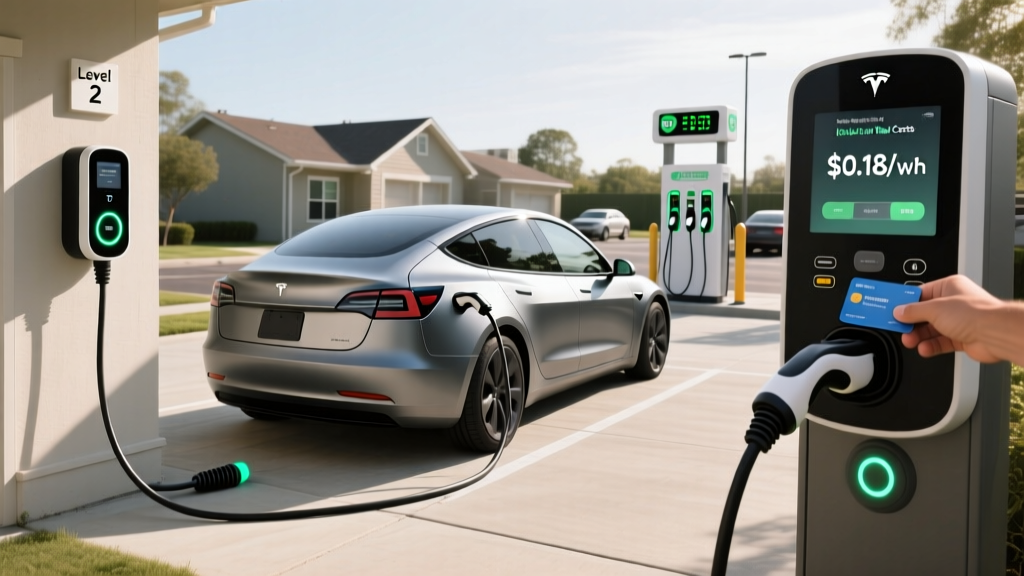
Home charging is the single biggest determinant of EV satisfaction. If you can install a Level 2 charger (240V, typically 32–48 amps / 7.7–11.5 kW), you'll wake up every morning with a full battery and pay the lowest per-mile energy cost. A typical Level 2 home installation runs $800–$2,500 total:
| Component | Cost Range |
|---|---|
| Level 2 charger hardware (hardwired, 48A) | $400–$700 |
| Electrician labor (240V circuit, 50-amp breaker) | $500–$1,500 |
| Electrical panel upgrade (if needed: 100A → 200A) | $1,500–$3,500 |
| Permit and inspection | $50–$250 |
| Total (no panel upgrade) | $950–$2,450 |
| Total (with panel upgrade) | $2,450–$5,950 |
If your home has a 200-amp electrical panel with spare capacity, expect the lower end. Homes with older 100-amp panels may need an upgrade, which adds significant cost. Consult a licensed electrician for a site-specific quote before purchasing your EV.
Public DC fast charging fills the gap for road trips and apartment dwellers. In 2026, networks like Tesla Supercharger, Electrify America, and EVgo offer peak rates between 150–350 kW at many stations. The Model 3 LR peaks at approximately 250 kW on a V3 Supercharger, adding 10–80% in roughly 25–28 minutes. However, charging curves taper above 80%—that last 20% can take as long as the first 80%. For road-trip planning, figure on 20-minute stops every 200–220 highway miles.
Public DC charging costs more than home charging—typically $0.30–$0.50/kWh, or roughly $0.09–$0.14 per mile. That's still cheaper than gas at current prices but erodes the EV's cost advantage if you rely on it exclusively.
Common EV Misconceptions: Myth vs. Fact
| Myth | Fact (with Data) |
|---|---|
| "EV batteries need replacing every few years." | Modern NMC and LFP packs are warrantied for 8 years / 100,000 miles at 70% capacity retention minimum. Real-world data shows most packs retain 85–92% capacity after 100,000 miles. Full replacement costs $8,000–$18,000 but is rarely needed within the vehicle's normal lifespan. |
| "EVs don't work in cold climates." | Cold reduces range 15–35% depending on severity and heat pump availability. EVs start instantly in cold (no cranking a frozen engine), and preconditioning while plugged in warms the battery before departure. Norway, where EVs outsell gas cars, averages 35°F in winter. |
| "There aren't enough charging stations." | As of early 2026, the U.S. has over 70,000 public charging ports across ~30,000 stations. Coverage is strong along interstates and in metro areas but remains sparse in rural corridors. For daily driving, home charging makes public infrastructure irrelevant for most trips. |
| "EVs are worse for the environment because of electricity generation." | Even on a coal-heavy grid, an EV's lifetime emissions are lower than a comparable gas car per EPA analysis. On a grid with significant renewables or natural gas, the advantage widens substantially. Emissions continue to drop as grids decarbonize—your gas car never gets cleaner. |
| "EV maintenance is just as expensive." | EVs have no engine oil, no transmission fluid, no spark plugs, no timing belts, and regenerative braking extends brake pad life to 100,000+ miles. Annual maintenance averages $200–$300 vs. $700–$1,000 for gas cars. |
EV vs. Hybrid vs. Gas: Which Powertrain Fits You?
Not every buyer is best served by a battery electric vehicle. Plug-in hybrids (PHEVs) and conventional hybrids (HEVs) fill important niches. Here's how to think about the choice:
Decision Framework: Which Powertrain Is Right for You?
Choose a full EV (BEV) if:
- You can install a Level 2 charger at home or have reliable workplace charging
- Your daily driving is under 200 miles
- You want the lowest per-mile operating cost and minimal maintenance
- You qualify for the §30D tax credit, bringing the effective purchase price in line with gas alternatives
- You take road trips infrequently enough that occasional DC fast-charging stops are acceptable
Choose a plug-in hybrid (PHEV) if:
- You can charge at home but regularly drive 300+ miles or travel in areas with sparse charging
- You want 25–45 miles of electric-only range for daily commuting with gas-engine backup for longer trips
- Your household has one vehicle that needs to do everything—commute, road trip, tow
- Example: 2026 Toyota RAV4 Prime offers 42 miles electric-only, 38 MPG combined on gas, and 302 total HP
Choose a conventional hybrid (HEV) if:
- You cannot charge at home (apartment, street parking, no electrical access)
- You want improved fuel economy without any plug-in behavior change
- Your budget is under $30,000 and you need a new vehicle
- Example: 2026 Toyota Prius delivers 57 MPG combined starting around $28,500—no plug required
Choose a gas car if:
- You drive very low annual miles (under 5,000/year), where fuel savings won't offset higher EV purchase price
- You need a specialized vehicle not yet available in electrified form
- You're buying used on a tight budget and can't access the used-EV credit
What First-Time EV Buyers Must Know Before Signing
If you've decided an EV makes sense for your situation, here are the practical realities that separate informed buyers from disappointed ones:
1. Understand kW vs. kWh. This is the most common confusion. Kilowatt-hours (kWh) measure battery capacity—how much energy the car stores (like gallons in a gas tank). Kilowatts (kW) measure power flow—how fast the car charges or uses energy (like gallons-per-minute at the pump). A 82 kWh battery charged at 11.5 kW takes about 7 hours from empty to full on Level 2.
2. Check the charge curve, not just peak kW. Manufacturers advertise peak charging speed (e.g., "up to 250 kW"), but that peak only holds for a portion of the session. Charging slows significantly above 80% state of charge to protect battery longevity. A "250 kW" vehicle may average only 120–150 kW across a 10–80% session. Look up independent charge-curve tests before buying.
3. LFP vs. NMC battery chemistry matters. Lithium iron phosphate (LFP) batteries are heavier and less energy-dense but tolerate daily 100% charging, last more cycles, and cost less. Nickel manganese cobalt (NMC) batteries offer more range per pound but are best kept between 20–80% for daily use. Tesla uses LFP in Model 3 RWD; most long-range and AWD models use NMC. Match chemistry to your habits: LFP if you want simplicity and daily full charges; NMC if you need maximum range.
4. Insurance will likely cost more. EV insurance premiums average 20–35% higher than equivalent gas cars due to higher repair costs and battery replacement risk. Get quotes from your insurer before purchasing—the difference can be $400–$900/year and affects your TCO calculation.
5. Preconditioning is essential for fast charging. When you navigate to a DC fast charger, the car preheats or precools the battery to its optimal charging temperature. Skipping preconditioning (or using a non-navigation-connected charger) can cut your charge speed in half, especially in cold weather. Always use the car's built-in navigation to route through a fast charger when possible.
6. Towing and heavy loads cut range significantly. If you plan to tow, expect 30–50% range reduction depending on trailer weight and aerodynamics. An EV rated for 310 miles may deliver only 160–210 miles while towing 3,000 pounds. Check the manufacturer's tow rating and plan charging accordingly.
How long do EV batteries actually last?
Most 2026 EV batteries carry an 8-year/100,000-mile warranty guaranteeing at least 70% capacity retention. Real-world data from high-mileage Tesla, Hyundai, and BMW fleets shows most NMC packs retain 85–92% after 100,000 miles, and LFP packs often retain 90%+. Catastrophic battery failure is rare; gradual degradation of 1–2% per year is typical.
Is it worth buying an EV if I live in an apartment?
It depends on your public charging access. If your apartment has or plans to install Level 2 chargers, or if you have reliable workplace charging, an EV can work. If you'd rely entirely on public DC fast charging, the higher per-mile cost and inconvenience reduce the EV's advantages. A PHEV may be a better apartment-friendly compromise.
Will I save money compared to my current gas car?
Run your own numbers: take your annual mileage, multiply by your local gas price divided by your car's MPG for annual fuel cost. Then multiply annual mileage by your electricity rate divided by the EV's efficiency (typically 3–4 miles per kWh for home charging). Subtract the EV's annual fuel cost from your gas car's. Add maintenance savings (~$500–$700/year) and subtract the insurance premium increase (~$400–$900/year). That's your annual net savings. Divide the EV's price premium (after tax credit) by that number to find your break-even in years.
Do EVs hold their resale value?
EV depreciation has been steeper than gas cars in recent years, driven by rapid technology improvements, price cuts from Tesla, and battery-health uncertainty among used buyers. Expect 45–55% depreciation over five years for most EVs vs. 35–45% for popular gas models. This gap is narrowing as the used-EV market matures and battery longevity data becomes more established.
What happens if the power goes out?
Your EV won't charge during an outage, but it also functions as a large backup battery. Vehicles with V2H (vehicle-to-home) capability, like the Ford F-150 Lightning with the Charge Station Pro, can power essential home circuits for 3–10 days depending on usage. Even without V2H, a fully charged EV with 300 miles of range holds roughly 75–100 kWh of stored energy—enough to keep you mobile when gas stations can't pump fuel without grid power.